


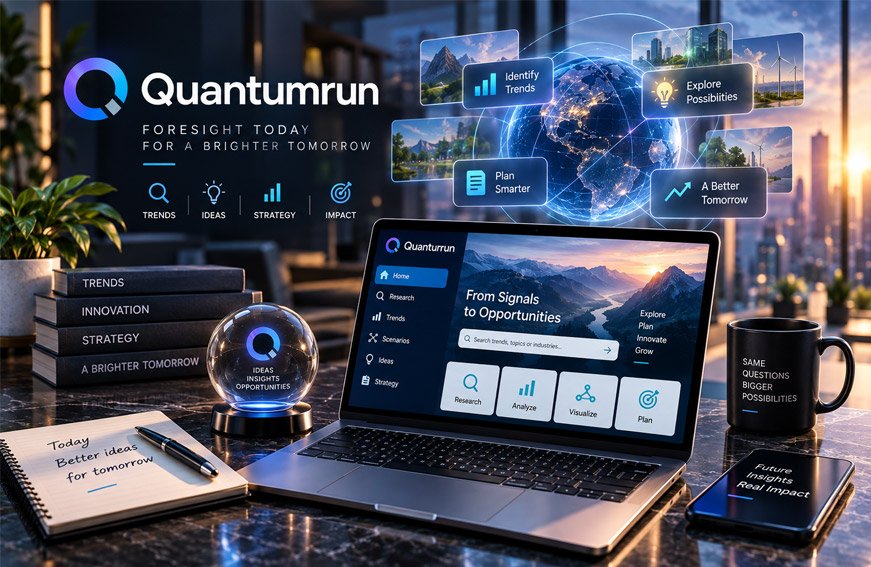
Quantumrun is a strategic foresight company and software platform. It helps organizations study trends, find early signs of change, and use that research for future planning.
People may search for Quantumrun when looking for trend intelligence, innovation research, scenario planning, or tools for long-term business strategy. This guide explains how Quantumrun works, its Foresight Platform, trend research, Tylo AI, and its main planning tools.
What Is Quantumrun?
Quantumrun is a company focused on strategic foresight and trend intelligence. It provides software and consulting services for organizations that need to understand possible future changes.
Strategic foresight is different from trying to predict exactly what will happen. It looks for early signs of change and studies several possible outcomes. Organizations can then use this information when making plans today.
Quantumrun works with private companies and public organizations. Its tools can support strategy, research, innovation, R&D, product development, policy planning, and market intelligence.
For example, a company may want to know how AI could change its industry over the next several years. Another organization may want to understand changes in customer habits, laws, science, or technology. Quantumrun provides a structured way to collect and study this information.
The research can then support new products, services, business models, policies, and long-term plans.
How Does Quantumrun Work?
Quantumrun brings different parts of foresight research into one system. The basic process can be understood as research, curate, and visualize.
Research starts with finding useful information about possible changes. These signals may come from industry developments, technology, patents, academic research, consumer behavior, laws, or other sources.
Users can then select useful findings and organize them. Instead of keeping research across many browser tabs, emails, files, and documents, teams can collect important information in shared lists and projects.
Organizations can also add their own research. This allows teams to work with internal knowledge and outside trend information in the same broader research process.
The next step is analysis. Teams can compare trends, look for connections, and study how important a change might become. Research can also be placed into visual tools that make complex information easier to review.
The findings can then support activities such as strategy planning, product development, innovation, scenario planning, and risk research.
Quantumrun does not decide what will happen in the future. People still need to check sources, question assumptions, and use their own knowledge when making decisions.
Quantumrun Foresight Platform
The Quantumrun Foresight Platform is the company’s main software product. It gives teams one place to find, organize, share, and work with foresight research.
The platform provides access to research feeds and trend information. Users can search for useful material and save important findings for later study.
Research can be categorized and placed into lists. This makes it easier to keep information about different technologies, industries, markets, risks, or opportunities separate.
The platform also supports functions such as searching, importing, exporting, emailing, and sharing trend information. Teams can work together instead of each person keeping a separate collection of reports and links.
This can be especially useful for larger research projects. One team member may follow technology. Another may study customers. Someone else may watch laws, competitors, or scientific developments. Bringing their findings together makes it easier to compare different signals.
It can also make older research easier to find. Useful information may still matter months later, so keeping it in an organized system can reduce repeated work.
The platform goes beyond storing information. Saved research can be used with Quantumrun’s visual tools for strategy, ideation, market analysis, and scenario planning.
Trend Scanning and Research
Trend scanning is an important part of Quantumrun. It means looking for early signs that something may be changing.
These signs can come from many areas. Teams may study new technologies, patents, scientific research, customer behavior, industry news, competitors, government rules, or wider social changes.
For example, an R&D team could follow patents related to a new technology. A product team might watch changes in customer behavior. A strategy team could study new regulations that may affect its market.
Some early developments are known as weak signals. They may appear small today but could become more important later.
A weak signal is not proof that a major change will happen. Some signals disappear or never become important. For this reason, teams should compare different sources and signals before making decisions.
Finding a possible trend early can still be useful. It gives an organization more time to research the issue, test an idea, study a risk, or prepare for a possible market change.
Tylo AI Research Assistant
Quantumrun also offers an AI research assistant called Tylo.
Tylo is designed to help users research a subject more quickly. Users can ask research questions and use the tool to create customized research reports.
According to the collected information, these reports can include citations from sources such as industry material, patents, and academic research. Quantumrun also provides customized research feeds that can support tasks such as technology scouting and industry tracking.
This can reduce some of the manual work involved in early research. Instead of searching many sources separately, a user can use AI to help gather and organize relevant information.
However, AI research should still be checked. A generated report can contain incomplete information, miss important context, or depend on sources that need closer review.
For important business or policy decisions, users should examine the original sources and use their own knowledge. Tylo is best understood as a research aid rather than a replacement for researchers, managers, or industry experts.
Visual Planning and Foresight Tools
Finding information is only the first part of foresight. Teams also need to understand what the information could mean.
Quantumrun includes visual planning tools that help users compare trends and explore relationships between them. Instead of reviewing a long collection of reports, a team can place selected information into a more structured view.
Trends can be considered using factors such as timing, possible impact, likelihood, sector, topic, location, risk, or business value.
This can make research easier to discuss during meetings and workshops. Team members can look at the same information and decide which developments deserve more attention.
Visual tools do not tell users which future will happen. Their purpose is to make complicated research easier to compare and use.
Ideation Engine
The Ideation Engine helps teams explore connections between different trends.
A new business opportunity may not come from one trend alone. It could appear when several changes happen together.
For example, a team might connect a change in customer behavior with a new technology, material, or regulation. Looking at these developments together may reveal an idea for a new product, service, or business model.
The Ideation Engine provides a structured way to explore these connections. It can support brainstorming and innovation work, but it cannot guarantee that an idea will succeed.
Any idea found through the process still needs normal research, testing, and business evaluation.
Scenario Composer
The Scenario Composer supports scenario planning.
Scenario planning does not depend on one prediction. Instead, a team considers several possible futures and studies what each one could mean for the organization.
According to the collected information, Quantumrun can help organize trend research using factors such as time range, likelihood, market impact, sector, topic, and location.
For example, a business could study what might happen if a new technology becomes affordable faster than expected. It could also consider a future where regulation slows the technology’s use or where customers do not adopt it as quickly as expected.
The purpose is not to decide which scenario will definitely happen. It is to understand how different changes could affect existing plans.
Looking at several possible futures can also reveal weaknesses. If a strategy works only under one very specific set of conditions, a company may decide that it needs other options.
Strategy and Risk Planning
Quantumrun can help teams think beyond their current plans. This is useful when a company needs to prepare for changes that may happen several years from now.
Teams can study possible opportunities and threats and decide which ones need more attention. They can also look at when a trend may become important and how large its effect could be.
The platform supports planning approaches connected with methods such as SWOT and VUCA. SWOT looks at strengths, weaknesses, opportunities, and threats. VUCA is used when thinking about situations that are uncertain or difficult to predict.
Teams can also use foresight research when creating longer-term roadmaps. A roadmap can show which trends should be watched, which ideas should be tested, and where future investment may be needed.
This is important because not every trend deserves the same level of attention. A useful foresight process helps teams focus on changes that could have a real effect on their organization.
Quantumrun Consulting Services
Quantumrun is not only a software provider. It also offers strategic foresight and innovation consulting.
These services can help organizations that need more support with research and future planning. Consulting work may include trend research, scenario planning, strategy support, product and service ideas, and cross-industry market intelligence.
Consultants can help a team define the right research questions. They can also study signals, compare possible changes, and help turn research into useful plans.
This type of support may be useful when a business is entering a new market, developing a product, changing an existing service, or studying a risk outside its normal area of knowledge.
Public organizations may also use foresight consulting when studying future policy needs or the possible effects of technology and social change.
What Can Quantumrun Be Used For?
Quantumrun can support several types of research and planning.
Strategy teams can use it to study changes that may affect costs, demand, supply chains, regulations, technology, or customer needs.
Product and innovation teams can study trends to find possible ideas for new products or services. They can also connect changes from different industries to find opportunities that may not be obvious at first.
R&D teams may use trend intelligence for technology scouting. This could include watching patents, scientific research, and technical developments.
Market intelligence teams can follow industries, competitors, consumer behavior, and outside forces that may affect a market.
Quantumrun can also support scenario planning, risk research, opportunity identification, new business models, and longer-term roadmaps.
Public-sector organizations can use strategic foresight to study possible future changes and consider how different developments could affect policies.
Who Is Quantumrun For?
Quantumrun is mainly designed for people and organizations that regularly make decisions about the future.
This can include strategy managers, innovation managers, research teams, R&D managers, product teams, market intelligence professionals, and directors of innovation.
Marketing and consumer research teams may also find it useful when they need to understand changing customer behavior.
Government agencies and other public organizations can use foresight when studying policy options or preparing for long-term social and technological changes.
The platform may be especially useful for organizations working in industries that change quickly. It may also help companies with long investment cycles, where decisions made today can have effects for many years.
Not every organization needs a full foresight platform. A small company with simple research needs may be able to manage its work with basic research and collaboration tools.
The value of Quantumrun depends partly on how much foresight research an organization does and how regularly the team uses that research.
Benefits of Quantumrun
One useful part of Quantumrun is that it brings several foresight tasks into one system.
Teams can discover research, save information, organize findings, share them with colleagues, and use the research in planning tools. This can reduce the need to move between many separate files and systems.
Another benefit is collaboration. Different team members can contribute research to a shared collection. This can make it easier to compare findings and reduce repeated work.
Quantumrun also connects research with practical planning. Information can be used for visual analysis, scenario work, strategy, and idea development instead of simply being stored and forgotten.
Its trend intelligence tools can help organizations notice possible opportunities and risks earlier. This does not mean every early signal will become important, but it can give teams more time to investigate.
The combination of software, AI research support, and consulting is another useful part of the service. Organizations can use the platform for their own research while getting professional support when a project requires it.
Limitations and Things to Consider
Quantumrun cannot tell users exactly what will happen in the future. No foresight platform can do that.
Trends can change direction. A technology that appears important today may develop slowly. Customer behavior can change, regulations can appear, and unexpected events can affect earlier assumptions.
Research quality is also important. A strategy based on weak sources or incorrect assumptions can lead to poor conclusions.
The same care is needed with AI-generated research. Tylo can help with research, but important information should still be checked against its original sources.
Human knowledge remains necessary. People who understand the company, industry, customers, and wider market still need to judge what the research means.
Organizations should also think about how they will use the platform before adopting it. Someone needs to manage research, keep it organized, and make sure useful findings become part of real planning.
Cost is another practical consideration. The collected sources do not provide enough confirmed current pricing information to give exact prices here. Buyers should check Quantumrun’s current offer directly before making a decision.
A team may also want to test the platform with a real research question. This can help show whether its research feeds, search functions, AI tools, and visual features fit the team’s normal workflow.
Quantumrun vs. Traditional Research
Traditional business research often focuses on what is happening now. It may study current customers, competitors, sales, market size, or recent industry changes.
Strategic foresight has a different purpose. It looks further ahead and searches for early signals that may affect an organization in the future.
Traditional research might tell a company what customers currently want. Foresight research may explore how technology, regulation, demographics, science, or social behavior could change those needs later.
There is also a difference in how research is managed. Teams often keep normal research in reports, spreadsheets, presentations, emails, or separate files. Quantumrun is designed to bring foresight information into a shared system and connect it with planning tools.
This does not mean strategic foresight should replace normal market research. The two approaches can work together. Current market information helps organizations understand where they are today, while foresight can help them think about what may change next.
Is Quantumrun Worth Using?
Whether Quantumrun is useful depends on the organization’s needs.
A team that regularly studies emerging technology, market changes, customer behavior, regulations, or long-term risks may find a dedicated foresight system useful.
It may also make sense for organizations that have several people collecting research. A shared platform can make that information easier to organize and use.
Companies making long-term investments may have another reason to use strategic foresight. A decision made today could still matter five or ten years later, so understanding possible changes can be important.
However, organizations should first consider whether they have a clear reason for using the platform. Buying foresight software without a research process will not automatically improve strategy.
Teams need clear questions, reliable information, regular research reviews, and people who know how to use the findings.
For smaller organizations with limited research needs, simpler tools may be enough. Testing Quantumrun with a real project can help a team decide whether its features match the work they actually need to do.
Bottom Line
Quantumrun is a strategic foresight and trend intelligence platform that helps organizations study possible future changes.
Its Foresight Platform brings together trend research, shared research collections, AI support through Tylo, visual planning, ideation, scenario planning, and other foresight tools. Quantumrun also provides consulting for organizations that need more direct support.
The platform is mainly useful for teams working in strategy, research, innovation, R&D, product development, market intelligence, and long-term planning.
Quantumrun should not be treated as a tool that predicts the future. Its main purpose is to help teams notice important signals, explore different possibilities, and make plans with more information.
Frequently Asked Questions
What is Quantumrun?
Quantumrun is a company that helps businesses study future trends. It offers research tools, software, and consulting.
What is the Quantumrun Foresight Platform?
It is a platform for finding, saving, and studying trends. Teams can use the information for research and future planning.
What is Tylo in Quantumrun?
Tylo is Quantumrun’s AI research assistant. It helps users find information and create research reports.
What can Quantumrun be used for?
Quantumrun can be used for trend research, business planning, new ideas, market research, and studying possible future changes.
Does Quantumrun predict the future?
No. It studies trends and possible future changes to help teams prepare and make better plans.
Who can use Quantumrun?
It is mainly useful for research, strategy, product, innovation, and business teams. Public organizations can also use it.
Does Quantumrun offer consulting?
Yes. Quantumrun offers consulting to help organizations with research, innovation, strategy, and future planning.
What are the main limitations of Quantumrun?
Quantumrun cannot know exactly what will happen in the future. Its results also depend on good research and human judgment.
Explore More:


[…] Quantumrun Review: Foresight Platform, Features, and Uses […]