


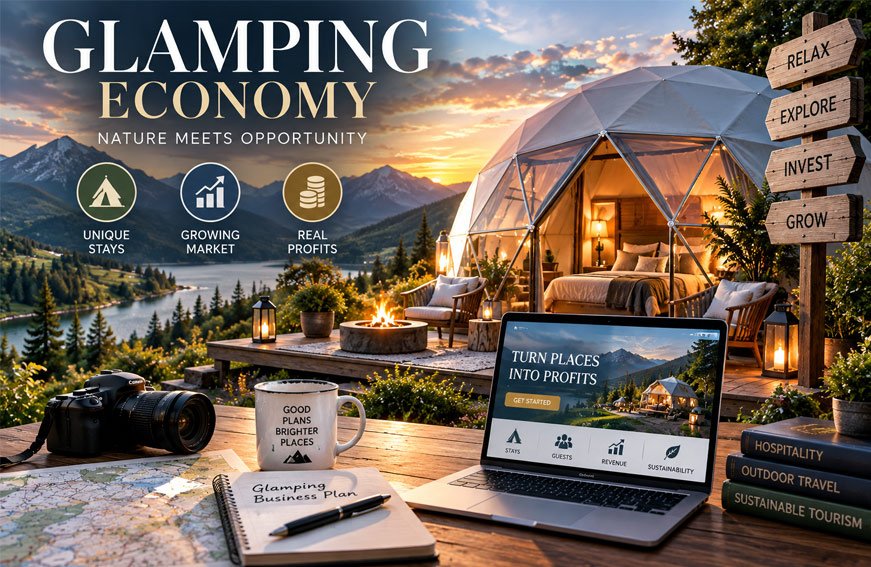
The glamping economy is the business market built around comfortable outdoor stays. Glamping combines parts of camping with comforts normally found in hotels or vacation rentals.
It has become popular with travelers who want to enjoy nature without giving up a proper bed, electricity, heating, bathrooms, or other basic comforts. The market also creates opportunities for landowners, hospitality businesses, and RV owners.
This guide explains what the glamping economy is, how it works, common accommodation types, startup costs, pricing, profits, legal requirements, and the main risks involved.
What Is the Glamping Economy?
Glamping is short for “glamorous camping.” It gives travelers an outdoor experience with more comfort than normal camping.
Instead of sleeping in a basic tent and sleeping bag, a glamping guest may stay in a safari tent, dome, yurt, treehouse, cabin, or converted RV. Many units have real beds, electricity, heating or air conditioning, and private bathrooms. Some also provide kitchens and Wi-Fi.
The glamping economy is larger than the accommodation itself. It includes glamping site owners, landowners, accommodation manufacturers, booking platforms, RV owners, property managers, and other businesses that support these stays.
Glamping normally costs more than traditional camping because guests are paying for both the outdoor setting and a higher level of comfort.
Why Is Glamping Growing?
One reason for glamping’s growth is that many travelers want to spend time outdoors without dealing with the harder parts of traditional camping.
Unique stays also work well on social media. Domes, treehouses, vintage trailers, and attractive tents can become part of the travel experience rather than simply a place to sleep.
Remote work has created another type of customer. Some travelers can stay for several days while continuing to work, especially when a property has reliable Wi-Fi and a comfortable workspace. The supplied sources also point to younger travelers, nature-based tourism, and interest in lower-density accommodation as factors behind demand.
The global market is now worth billions of dollars, although market estimates differ. One supplied source cites Grand View Research and gives a 2025 global market value of about $3.8 billion, with a projection of about $7.9 billion by 2033. These are market estimates rather than guaranteed future results.
How Does the Glamping Economy Work?
The basic business model is similar to other short-term accommodation businesses.
An operator prepares land, installs one or more accommodation units, adds the required utilities and guest facilities, and then rents the units by the night.
Guests may find the property through booking platforms or through the operator’s own website. Rates can change according to the season, day of the week, local demand, holidays, accommodation type, and available amenities.
The nightly stay is usually the main source of income. Operators can also earn from extras such as breakfast baskets, firewood or bonfire packages, guided activities, retreats, small events, and longer stays.
A property’s financial results depend heavily on its nightly rate, occupancy, number of units, operating season, and expenses. A high nightly price does not automatically mean high profit.
Types of Glamping Accommodation
Glamping does not use one standard type of accommodation. Operators choose units according to their land, climate, budget, and target guests.
Safari tents are one of the more traditional choices. They provide more space and comfort than ordinary camping tents and can be cheaper to set up than permanent cabins.
Geodesic domes have a distinctive shape and are often used at scenic or stargazing locations. Yurts provide another recognizable glamping style and can offer better protection from the weather than basic tents.
Treehouses can provide a more unusual and premium experience, but construction can be more complicated and expensive. A-frame cabins sit closer to the cabin side of glamping and can offer stronger weather protection.
RVs and trailers are also part of the market. Vintage Airstreams, travel trailers, campervans, fifth wheels, and some motorhomes can be placed on private land and used as stationary accommodation.
Some sites use several unit types. This allows the business to offer different experiences and prices.
How Much Does It Cost to Start a Glamping Business?
There is no standard amount needed to start. Costs depend on the country, land, accommodation type, number of units, utilities, and level of comfort.
One supplied source gives the following rough estimates for a small operation:
| Expense | Source-Reported Estimate |
|---|---|
| Land purchase or lease setup | $0 if already owned to $50,000+ |
| Tents, domes, or pods | $8,000–$25,000 each |
| Water, electricity and septic | $10,000–$40,000 |
| Furniture and interiors | $2,000–$6,000 per unit |
| Permits and legal fees | $1,000–$5,000 |
| Marketing and booking setup | $500–$2,000 |
The same source estimates that a modest three-unit site may cost around $40,000 to $80,000, while a more luxurious development can exceed $150,000. These are general estimates, not standard industry prices. Actual costs can be much higher or lower.
Operators also need to consider costs that are easy to overlook. These can include drainage, roads or paths, decks, bathrooms, mattresses, bedding, heating and cooling, outdoor furniture, fire-safety equipment, insurance, photography, internet service, and ongoing maintenance.
Starting with one or two units can reduce the initial investment. An owner can then test demand before spending money on a larger development.
RV Glamping and Lower-Cost Entry
An existing RV can provide another way to enter the glamping economy.
Instead of constructing a cabin, dome, or other permanent unit, an owner can place a suitable RV on approved land and prepare it for stationary guests. Vintage trailers and Airstream-style units are especially associated with this type of stay.
Owning the RV already can reduce the accommodation cost, but the site still needs preparation. The supplied RV-focused source estimates $5,000 to $15,000 for work such as leveling, utility connections, and decking, plus possible costs for interior improvements, furniture, and amenities. These figures are estimates and will vary by property.
An RV also offers some flexibility because it may be moved if necessary. However, using an RV does not automatically avoid local rules. Zoning, short-term rental regulations, insurance, utilities, fire safety, and business requirements may still apply.
Some owners place RV units on farms, vineyards, campgrounds, or other tourism properties instead of buying their own land. This can reduce infrastructure needs, although the property owner may charge rent or take part of the booking revenue.
RV glamping can therefore lower some startup costs, especially for someone who already owns a suitable vehicle, but it still needs to be planned and operated as a hospitality business.
Glamping Prices and Nightly Rates
Glamping prices vary widely. The location, type of unit, season, privacy, and available facilities all affect the nightly rate.
The supplied sources report that simpler glamping stays may start around $80 to $150 per night. Mid-range accommodation often falls around $150 to $300, while luxury units may charge $300 to $600 or more. Some high-end resorts can cost much more.
Guests paying higher rates normally expect private bathrooms, comfortable beds, heating and cooling, attractive interiors, outdoor space, and a good location. Hot tubs, kitchens, scenic views, and other private facilities can support higher prices.
Rates may also rise on weekends, holidays, and during peak travel seasons. Many operators lower prices on quieter weekdays or offer discounts for longer stays.
How Do Glamping Businesses Make Money?
Nightly bookings are the main source of income in the glamping economy. A business with several units can earn from multiple bookings on the same night.
Extra services can provide additional revenue. These may include breakfast baskets, firewood, guided activities, outdoor experiences, retreats, small weddings, and photo shoots.
Direct bookings can also help operators keep more of each booking because they may reduce third-party platform fees. However, booking platforms can be useful for reaching new guests.
Is Glamping Profitable?
Glamping can be profitable, but there is no standard amount an owner will earn.
Revenue depends on the nightly rate, occupancy, number of units, and length of the operating season. Profit is what remains after expenses such as cleaning, utilities, insurance, platform fees, maintenance, marketing, staffing, taxes, and property costs.
For example, a unit charging $200 per night for 100 occupied nights would generate $20,000 in gross accommodation revenue before expenses.
The supplied RV-focused source reports profit margins of around 30% to 50% for some operations. It also gives examples of units earning tens of thousands of dollars per year. These figures should be treated as estimates rather than expected results for every glamping business.
A strong location and good occupancy can improve returns. Owning the land or accommodation already may also reduce the time needed to recover the initial investment.
Choosing a Location
Location is one of the most important parts of a glamping business. Guests usually want both privacy and easy access to something worth visiting.
Mountains, forests, lakes, beaches, hiking areas, parks, and other natural attractions can make a site more appealing. Being within a reasonable driving distance of a large population center may also help attract weekend guests.
Operators should also check road access, weather, drainage, electricity, water, septic options, internet access, nearby competition, and the length of the local tourism season.
Cheap land alone does not make a good glamping location. The property still needs enough demand to support bookings.
Permits, Zoning, Insurance, and Legal Requirements
Glamping rules depend on the location. There is no single license or legal system that applies everywhere.
Before spending money, an operator should check local zoning and land-use rules. Some areas treat glamping as a short-term rental, while others may classify a larger operation as a campground or commercial hospitality business.
Building approval, fire safety, drinking water, septic systems, sanitation, business registration, taxes, and insurance may also apply.
An RV does not automatically avoid these requirements. Local authorities may have separate rules for stationary RV accommodation.
It is best to confirm the rules with the relevant local authority before buying units or developing the property.
What Guests Expect From Glamping
Glamping guests generally expect more comfort than traditional campers.
A clean and comfortable bed is one of the basics. Guests may also expect electricity, clean bathrooms, heating or cooling, charging points, outdoor seating, and the facilities shown in the booking listing.
At higher prices, expectations increase. Guests may look for private bathrooms, quality bedding, stylish interiors, kitchens, fire pits, hot tubs, outdoor showers, or other premium features.
Photos and descriptions should accurately show what guests will receive. This helps prevent disappointment and poor reviews.
Technology, Booking, and Marketing
Glamping businesses often use online booking platforms to reach travelers. The supplied sources mention Airbnb, Hipcamp, Glamping Hub, and RV-focused rental platforms.
Operators can also use their own websites for direct bookings. If a property appears on several platforms, channel-management software can help prevent two guests from booking the same unit for the same dates.
Technology can also improve the stay. Keyless entry, mobile check-in, smart heating or lighting, and reliable Wi-Fi can make property management easier.
Good photography is especially important because travelers often choose glamping properties based on the setting and design. Social media, local search visibility, guest reviews, and email marketing can also bring bookings.
Main Benefits of the Glamping Business
Glamping can offer several practical advantages.
- Operators can start with one or two units and expand later.
- Nightly prices can be higher than basic camping.
- Existing land or an RV may reduce startup costs.
- Different accommodation styles can serve different budgets.
- Extra services can create additional income.
- Direct bookings and repeat guests can reduce dependence on booking platforms.
However, these benefits depend on the location, demand, costs, and quality of the operation.
Risks and Drawbacks
Seasonality is a major issue. In colder areas, much of the yearly income may come from only a few busy months.
Outdoor units also face rain, wind, snow, sunlight, insects, and other conditions that increase maintenance. RVs, tents, decks, plumbing, electrical systems, and outdoor furniture need regular attention.
Guest management can require significant time. Cleaning, answering questions, handling repairs, and preparing units between stays make glamping difficult to run as completely passive income.
Competition is another concern. Popular destinations may already have many domes, cabins, RVs, treehouses, and vacation rentals competing for the same guests.
Current Glamping Trends
Modern glamping is moving beyond luxury tents.
Off-grid and lower-impact properties are attracting interest, with some operators using solar power and other systems designed to reduce environmental impact. Vintage trailers and RV conversions are another visible part of the market.
Remote work has also created demand for workcation-friendly glamping with reliable Wi-Fi and suitable working space. Pet-friendly accommodation is another area highlighted by the supplied research.
Operators are also using contactless check-in, smart controls, dynamic pricing, and online booking systems.
Market forecasts continue to suggest growth, although estimates differ considerably between research companies. Any market-size forecast should therefore be read together with its source and publication date.
Tips for Starting a Glamping Business
Before starting, research the local market rather than relying only on national industry growth.
- Check zoning and permits before buying accommodation.
- Study nearby prices and competition.
- Choose units suitable for the local weather.
- Start small if demand is uncertain.
- Invest in good beds, bathrooms, cleanliness, and climate control.
- Plan for drainage, bad weather, repairs, and maintenance.
- Use clear and accurate photos.
- Adjust prices according to demand and season.
- Track expenses as carefully as revenue.
- Keep money available for unexpected repairs.
A successful site needs hospitality management as well as attractive accommodation.
Bottom Line
The glamping economy combines outdoor tourism with comfortable short-term accommodation. It includes everything from safari tents and domes to cabins, treehouses, vintage trailers, and stationary RVs.
Startup costs and profits vary widely. A good location, legal approval, suitable accommodation, sensible pricing, controlled expenses, and a reliable guest experience all affect the result.
Glamping can provide a business opportunity for landowners, hospitality operators, and some RV owners. However, it requires active management and should not be treated as guaranteed or completely passive income.
Frequently Asked Questions
What does glamping economy mean?
The glamping economy is the wider business market around comfortable or luxury outdoor stays. It includes accommodation operators, landowners, manufacturers, booking platforms, RV owners, and related services.
How much does it cost to start a glamping business?
There is no fixed cost. A small operation may require tens of thousands of dollars, while luxury developments can cost much more. Land, units, utilities, bathrooms, furnishings, permits, and site preparation are major expenses.
How much can a glamping business make?
Earnings depend on the nightly rate, number of units, occupancy, season length, and expenses. Revenue figures from successful properties should not be treated as guaranteed income.
Is glamping profitable?
It can be. Profit depends on keeping enough units occupied at rates that cover operating costs and recover the initial investment.
How much land do you need for a glamping site?
There is no universal minimum. The required space depends on the number of units, privacy between guests, access, utilities, septic requirements, and local zoning rules.
Do you need permission to start a glamping business?
Usually some local requirements apply. These can include zoning approval, business licensing, building or planning permission, fire and health requirements, and short-term rental rules. Exact requirements depend on the location.
What is the best type of glamping accommodation to start with?
There is no single best choice. Safari tents can be relatively simple to set up, while an existing RV may reduce accommodation costs. Domes, cabins, and treehouses can offer a more premium experience but may require a larger investment.
Can you use an RV for a glamping business?
Yes. An RV can be used as stationary glamping accommodation where local rules allow it. The site may still need utility connections, insurance, safety measures, permits, and suitable guest facilities.
Explore More:


[…] Glamping Economy: What It Is, Costs, Profits, and How It Works […]