


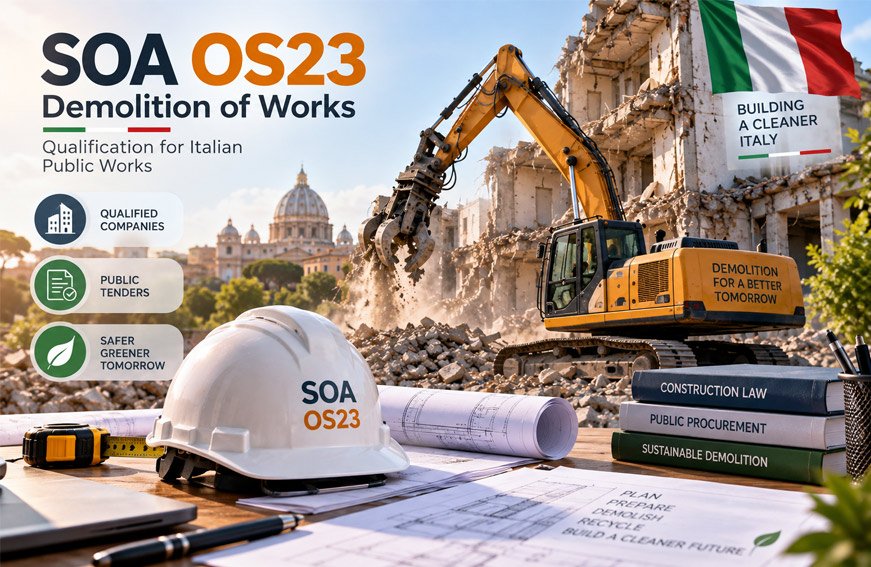
SOA OS23 is an Italian qualification category for companies that carry out the demolition of works (Demolizione di opere). It is mainly relevant to businesses that want to take part in public works contracts involving demolition and dismantling.
People search for SOA OS23 to understand what the category covers, who needs it, what requirements apply, and how the certification process works. This guide explains these points in simple words, including public tenders, company requirements, and the main types of work covered.
What Is SOA OS23?
SOA OS23 is a specialized category connected with the demolition of works in Italy. The category is used within the Italian public works qualification system. It helps show that a company has the technical and organizational ability to carry out the type of work covered by the category.
The term can be confusing because SOA can also mean Service-Oriented Architecture in technology. In this article, SOA OS23 refers to the Italian construction and public procurement system, not software architecture.
OS23 is mainly linked with demolition activities that require suitable equipment, trained workers, planning, and proper handling of the worksite. Depending on the project, the work may involve buildings, structures, industrial plants, reinforced concrete, or other works that need to be partly or fully demolished.
The qualification is especially relevant when a company wants to work on public projects. The exact requirements depend on the tender and the type and value of the contract.
What Work Does OS23 Cover?
OS23 covers different types of demolition and dismantling work. The collected information includes both ordinary and controlled demolition activities.
This can include the demolition of civil structures and buildings, as well as the dismantling of industrial plants. Work may involve removing parts of a structure or bringing down an entire structure.
Some work may require more precise methods. Examples include:
-
Controlled dismantling
-
Mechanical demolition
-
Push-pull demolition
-
Reinforced-concrete demolition
-
Diamond sawing
-
Abrasive cutting
-
Industrial plant dismantling
-
Partial demolition
-
Complete demolition
The source material also mentions demolition using explosives and high-pressure techniques. These methods require careful planning and must follow the safety and legal rules that apply to the specific project.
OS23-related work can also include moving demolished materials away from the worksite or loading them for transportation. Material separation and recycling can be part of modern demolition practices as well.
This means OS23 is not limited to simply bringing down a building. The work can involve several stages of controlled demolition and the handling of the resulting materials.
Who Needs SOA OS23?
SOA OS23 is relevant to companies that want to carry out demolition work covered by the category, especially when they are seeking Italian public works contracts.
Businesses that may work in this area include demolition contractors, construction companies, and firms specializing in industrial dismantling. Companies carrying out controlled demolition or precision cutting may also fall within the scope of the category.
Examples include companies working on:
-
Civil buildings and structures
-
Industrial plants
-
Reinforced-concrete structures
-
Controlled demolition projects
-
Specialized cutting
-
Material separation and recovery
However, a company should not assume that OS23 is required for every demolition project. The requirement depends on the specific contract, tender documents, work category, and applicable Italian procurement rules.
For this reason, a company planning to bid for public work should first check the tender documents. They should confirm whether OS23 is required and which qualification level applies.
SOA Certification and Public Tenders in Italy
SOA certification is part of the qualification system used for Italian public works. The system helps contracting authorities assess whether companies have the technical and financial ability needed for certain works.
The qualification system includes different categories. OG categories cover general types of construction work, while OS categories cover specialized areas. OS23 is part of the specialized category system.
For a public tender, the required category is normally connected to the type of work included in the contract. A demolition project may therefore require an OS23 qualification, while a project with other construction activities may involve additional categories.
The collected material states that SOA qualification is mandatory for contracts above €150,000, while it describes OS23 itself as not automatically compulsory for every project. The exact requirements should be checked against the current procurement rules and the individual tender.
This distinction is important. The €150,000 threshold does not mean that every construction or demolition company must always hold OS23. The type of work and the requirements written in the tender also matter.
SOA qualification can provide evidence that a company meets the required standards for the relevant public work. The collected material also connects the system with checks involving equipment, staff, and compliance.
SOA OS23 Requirements
A company seeking OS23 qualification needs to show that it has the ability to perform the relevant work. The assessment is not based on one single factor.
The collected information identifies several areas that can be considered, including the company’s legal position, technical ability, financial stability, equipment, personnel, and compliance history.
Technical Capability
The company needs suitable experience and technical ability for the work it wants to undertake. Demolition can involve heavy machinery, structural risks, controlled dismantling, and specialized methods, so the company’s technical resources are important.
Equipment
Suitable equipment is another important area. Depending on the work, this may include machinery and tools needed for controlled demolition, cutting, dismantling, loading, and material handling.
A company should keep equipment records and make sure its machinery is suitable for the projects it undertakes.
Staff and Skills
Qualified and properly trained workers are important for demolition work. Companies need people who understand the equipment, work methods, safety procedures, and requirements of the project.
The collected material also recommends regular employee training as part of maintaining compliance.
Financial and Legal Position
SOA certification also considers the company’s financial and legal position. The purpose is to assess whether the business has the resources and standing needed for public works.
The company’s compliance history can also be relevant during the qualification process.
Documentation
Good records are important throughout the process. Companies may need to organize information about their business, staff, equipment, technical experience, and financial position.
Poor or incomplete documentation can make the qualification process harder. Keeping records updated also helps when certification needs to be reviewed or renewed.
How to Obtain SOA OS23 Certification
A company seeking SOA OS23 qualification applies through an authorized SOA (Società Organismo di Attestazione) organization.
The SOA organization reviews the company’s qualifications and supporting information. The assessment can cover the company’s legal status, technical capability, financial stability, and compliance history.
The basic process can be understood in these steps:
-
Check the required category — Confirm that OS23 matches the work the company plans to perform.
-
Prepare company records — Organize the required legal, technical, financial, personnel, and equipment information.
-
Contact an authorized SOA organization — Start the qualification process with the appropriate body.
-
Complete the assessment — The company and its records are reviewed.
-
Receive the qualification — If the requirements are met, the relevant SOA qualification is issued.
-
Maintain compliance — Keep records, staff, equipment, and certification requirements up to date.
The exact documents and current conditions can change under Italian procurement rules. Companies should therefore confirm the current requirements with an authorized SOA organization before starting an application.
SOA OS23 Classification and Validity
SOA qualifications are divided into different classes based on the value of the public works a company can carry out. The correct class matters when a company wants to bid for a public contract.
The exact classification required depends on the value and type of work in the tender. A company should therefore check the tender documents before applying.
It is also important to keep the qualification valid. Companies should track renewal dates and keep their technical, financial, staff, equipment, and company records updated. Letting required documents or certifications expire can create problems when bidding for new work.
Benefits of SOA OS23
SOA OS23 can be useful for companies that work in demolition and want to take part in relevant Italian public works contracts.
One important benefit is that the qualification provides evidence of the company’s technical and organizational ability. It can also help a contracting authority assess whether a company has the resources needed for the work.
For companies working on complex demolition projects, having the appropriate qualification can also support their ability to meet tender requirements.
The practical benefits include:
-
Access to relevant public tender opportunities when the qualification is required.
-
Evidence of technical and organizational capability.
-
Better preparation for public procurement requirements.
-
A structured way to demonstrate company qualifications.
-
Support for work involving specialized demolition activities.
However, SOA OS23 should not be viewed as an automatic requirement for every demolition job. The tender documents and current Italian rules determine what qualification is needed.
Challenges in Obtaining and Maintaining OS23
Obtaining and maintaining an SOA qualification can require regular work from a company.
One challenge is documentation. Companies need to keep important business, technical, financial, equipment, and staff information organized. Missing or outdated records can make the process more difficult.
Another issue is equipment. Demolition companies need suitable equipment for the work they perform. Equipment that no longer meets project or safety needs may need to be replaced or upgraded.
Staff and training are also important. Workers need the right skills for the demolition methods and equipment used on a project. Regular training can help companies keep their teams prepared.
Companies must also follow changes in Italian public procurement rules. Requirements can change, so relying on old information can create problems.
Certification dates should be tracked as well. A company should know when its qualification needs to be reviewed or renewed and prepare the required information in advance.
Sustainability and SOA OS23
Sustainability is becoming an important part of modern demolition work. Demolition does not only involve removing a structure. It can also involve deciding what happens to the materials after they are removed.
Useful practices include separating different materials during demolition and recovering materials that can be reused or recycled. The collected material also mentions recycled aggregates and equipment designed to produce lower emissions.
These practices can support the idea of a circular construction process. Instead of treating all demolition material as waste, companies can identify materials that may have another use.
Environmental requirements can differ between projects. Companies should therefore check the specific environmental and waste rules that apply to each contract.
Digital Technology and SOA OS23
Digital tools are also changing how demolition projects can be planned and managed.
BIM (Building Information Modeling) can help create a detailed digital model of a building or structure before work begins. This can support planning, documentation, and the review of possible demolition methods.
GIS (Geographic Information Systems) can add location-based information. It can help teams understand environmental conditions, site information, and other factors around a project.
Digital systems can also make compliance records easier to organize. Online submissions and digital documents can reduce some manual work.
AI and automation are another developing area. The collected material reports possible uses of AI for predictive maintenance, safety, and operational efficiency.
These technologies can support a demolition company, but they do not replace the formal SOA qualification process or the legal requirements for a project.
How SOA OS23 Supports Modern Demolition Planning
Modern demolition planning can use digital information before physical work begins.
A BIM model, for example, can help teams understand the structure and plan the order of work. GIS can provide additional information about the site and surrounding conditions.
Digital planning can also make it easier to record decisions, inspections, and other project information.
Some sources also describe more advanced uses such as AI-based analysis and blockchain-based tracking of environmental information. These should be understood as possible technology applications, not as mandatory features of SOA OS23.
The main value of digital tools is that they can make planning and information management more organized. The actual legal and technical requirements still need to be met by the company and project team.
SOA OS23 vs Other SOA Categories
Italy has several SOA categories for different types of public works.
OG categories generally relate to broader construction activities, while OS categories cover specialized types of work. OS23 is the specialized category connected with demolition of works.
Other categories can apply to different activities. For example:
-
OG1 — civil and industrial buildings.
-
OG3 — roads, motorways, bridges, and related works.
-
OS21 — special structural works.
-
OS23 — demolition of works.
A single project can involve more than one type of construction activity. In such cases, the tender may specify more than one category or qualification requirement.
Companies should therefore look at the complete scope of a contract instead of assuming that an OS23 qualification covers every part of a construction project.
Is SOA OS23 Recognized Outside Italy?
SOA OS23 is connected to the Italian public procurement and construction qualification system.
It should not be treated as a worldwide demolition certification. The collected material states that the category is governed by Italian regulations and does not have general recognition as a certification standard in other countries.
A company planning to work on public projects outside Italy needs to check the rules of that country. Other countries may use different contractor qualification systems, licenses, or certifications.
For an international project, an Italian SOA qualification may provide useful information about a company’s experience and capability, but its legal value depends on the rules of the country and the specific contract.
Tips for Companies Seeking OS23
Companies preparing for SOA OS23 qualification can take a few practical steps:
-
Check the public tender requirements carefully.
-
Confirm that OS23 is the correct category for the planned work.
-
Check the required classification.
-
Keep legal and company records updated.
-
Organize technical and financial documents.
-
Keep equipment information current.
-
Maintain records of qualified staff and training.
-
Track certification and renewal dates.
-
Follow changes to Italian procurement rules.
-
Keep demolition and environmental records organized.
-
Use digital tools where they genuinely improve planning and documentation.
-
Contact an authorized SOA organization for current qualification requirements.
Good preparation can make it easier to respond when a public tender requires evidence of the company’s qualifications.
Bottom Line
SOA OS23 is the Italian specialized category for demolition of works. It is mainly relevant to companies that want to carry out demolition and dismantling work covered by Italian public contracts.
The qualification process looks at areas such as technical ability, financial position, equipment, staff, legal status, and compliance. The exact requirements depend on the current rules and the individual tender.
Modern demolition is also becoming more connected with sustainability and digital tools. Material recycling, BIM, GIS, automation, and AI can support project planning and management. They do not replace the formal qualification requirements.
For any specific project, companies should check the current tender documents and confirm the applicable rules with an authorized SOA organization.
Explore More:
Growth Navigate Review: Services, Benefits, and Possible Limitations

