


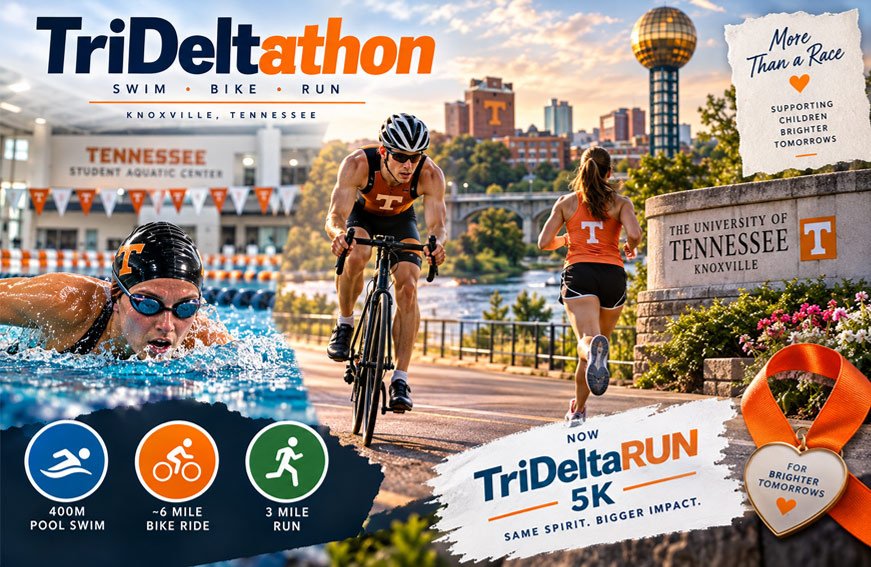
TriDeltathon was a short-distance triathlon held in Knoxville, Tennessee. It was closely connected with the University of Tennessee and Delta Delta Delta, also known as Tri Delta. The race became known for its indoor pool swim, short bike ride, campus run, and charity purpose.
People may still find old TriDeltathon race pages and results online. However, the original swim-bike-run event is no longer the active format. A related event called TriDeltaRUN now continues the local running and charity tradition.
This guide explains the history of TriDeltathon, how the race worked, its course, its connection with Tri Delta, and what happened to the event.
What Is TriDeltathon?
TriDeltathon was a pool-based triathlon in Knoxville. It followed the normal triathlon order of swimming, cycling, and running.
The best-known later version started with a 400-meter indoor pool swim. Athletes then completed a bike ride of about six miles and finished with a three-mile run. Much of the event took place on or around the University of Tennessee campus.
The indoor swim was an important part of the race. Many triathlons start in a lake, river, or other open water. TriDeltathon instead used the University of Tennessee Student Aquatic Center.
This gave swimmers a more controlled setting. They did not have to deal with waves, currents, poor visibility, or a large open-water start.
TriDeltathon was also a charity event. Delta Delta Delta members were involved with the race, and proceeds supported children’s causes in East Tennessee.
The race included individual and relay divisions. Individual athletes completed all three parts themselves. Relay teams could divide the different parts among team members.
By 2020, organizers described the planned race as the 36th year of TriDeltathon. They also promoted it as the country’s oldest running pool triathlon. This was an organizer description rather than an independently verified national record.
TriDeltathon History
TriDeltathon had a long history in Knoxville. One collected source reports that the event began in 1984. However, a strong primary historical source confirming the exact first year has not been found, so 1984 is best treated as a reported starting date.
The race developed strong ties with the University of Tennessee. University facilities were used for the event, and the bike and run sections passed through the campus and surrounding area.
Students were also part of the event. Tri Delta members supported its charity work and helped create a connection between the university and the wider Knoxville racing community.
The short distances made the event different from longer triathlons. Athletes still had to prepare for three sports, but they did not need to cover the much longer distances found in Olympic-distance or endurance triathlons.
The pool swim was another important part of its identity. It allowed people to experience a triathlon without starting in open water. This could be useful for athletes who were more comfortable swimming in a pool.
Over the years, TriDeltathon attracted students, local athletes, relay teams, volunteers, and people supporting its charity work. By the planned 2020 edition, the event had been running for several decades.
The Traditional TriDeltathon Race Format
The traditional TriDeltathon used three stages: swimming, cycling, and running.
In the later documented format, athletes completed a 400-meter swim, followed by an approximately six-mile bike ride, and then a three-mile run.
The distances were short compared with many other triathlons, but competitors still had to move from one sport to another without a long break.
There were also two transitions. The first transition, often called T1, took place between the swim and bike. Athletes left the pool, prepared their cycling equipment, and started the bike section.
The second transition, or T2, happened between cycling and running. Athletes returned from the bike course, left their bikes in the transition area, and started the run.
Transitions could matter in a short race because even a small delay could add noticeable time to the final result. Beginners mainly needed to stay organized and move safely, while competitive athletes could try to complete their transitions more quickly.
Historical course information should be read carefully. The later race information gives a bike distance of about six miles, but an older source mentions a five-mile bike course. This suggests that the route or distance may have changed during the event’s long history.
How the 400-Meter Pool Swim Worked
The pool swim was one of the most unusual parts of TriDeltathon. It took place inside the University of Tennessee Student Aquatic Center.
Athletes had to complete 400 meters before moving to the bike section.
The documented format used eight 50-meter lanes. Instead of everyone starting together, swimmers entered the water individually at short intervals. Historical race information reports starts of about seven seconds apart.
Swimmers moved through the lanes as they completed the distance. At the end of a length, they moved into the next lane by going under the lane rope.
The starting order was based on each athlete’s expected 400-meter swim time. Faster swimmers were placed earlier, while slower swimmers started later. This helped reduce crowding and allowed athletes with similar swimming speeds to move through the pool more smoothly.
This system was very different from an open-water triathlon. There was no large group entering a lake or river at the same time. Athletes also did not need to follow buoys or deal with currents and waves.
The pool still required preparation. Racers needed to pace themselves because cycling and running came immediately afterward. Using too much energy in the first part could make the rest of the race harder.
The Bike Ride Around the UT Campus
After finishing the swim, competitors moved into the bike section.
Later TriDeltathon information lists the cycling distance as about six miles. The course used roads around the University of Tennessee campus and the Neyland Drive area.
Although six miles is a relatively short cycling distance, athletes had already completed the swim. They needed to change quickly from swimming to cycling and find a comfortable pace.
Bike handling was also important. Competitors had to follow the course safely while managing their effort for the run that followed.
The exact cycling course was not necessarily the same throughout TriDeltathon’s history. At least one older account mentions a five-mile bike ride instead of six miles. For this reason, the six-mile distance is best understood as the documented distance for later editions rather than a fixed distance used every year.
The Three-Mile Campus Run
The run was the final part of the traditional TriDeltathon. Competitors completed about three miles after finishing the bike section.
The route went through the University of Tennessee area. Historical descriptions mention well-known campus landmarks, including Neyland Stadium and the arena long known as Thompson-Boling Arena.
Running immediately after cycling can feel different from starting a normal road race. The legs may feel heavy during the first part of the run because the muscles have just been used for cycling.
Athletes therefore needed to control their pace when leaving the bike section. Once they adjusted to running, they could settle into a steadier rhythm for the rest of the course.
The campus route was also an important part of TriDeltathon’s identity. Instead of using a course far from the university, the race remained closely connected with familiar Knoxville and University of Tennessee locations.
Individual and Relay Divisions
TriDeltathon was not limited to athletes who wanted to complete all three sports alone.
Individual competitors completed the full race themselves. They swam 400 meters, completed the bike course, and then ran three miles.
The relay division allowed team members to share the event. For example, one person could complete the swim while another handled the bike or run. This gave people a way to participate even if they did not train in all three sports.
For the planned 2020 edition, the individual division was listed for participants from ages 10 to 99. Relay participation was listed for ages 7 to 99. These were rules for that edition and should not be assumed to apply to every year of the race.
The event also included recognition for different competitors, including overall, age-group, and relay awards. This allowed both individual athletes and teams to compete within their respective divisions.
Delta Delta Delta and the University of Tennessee
Delta Delta Delta, commonly called Tri Delta, was closely connected with TriDeltathon. Sorority members supported the event and its fundraising purpose.
The University of Tennessee was equally important to the race. The Student Aquatic Center provided the pool for the opening stage, while the cycling and running sections used the campus and nearby Knoxville roads.
Students could be involved as competitors and volunteers. An event of this type also needed people to help with registration, course directions, athlete support, setup, and other race-day work.
The university setting gave TriDeltathon a clear local identity. Athletes were not simply completing three distances. They were swimming, cycling, and running through an area closely connected with the University of Tennessee and Knoxville.
Tri Delta’s involvement also linked the sporting event with community service. This became especially important through the race’s fundraising work, which is the next part of the TriDeltathon story.
TriDeltathon’s Charity Purpose
Charity was an important part of TriDeltathon. The race was not only about swimming, cycling, and running. It also raised money for children’s causes in East Tennessee.
The historic event supported East Tennessee Children’s Hospital. Tri Delta members, athletes, volunteers, and other supporters helped connect the race with this fundraising purpose.
The charity connection was clear when the planned 2020 race was canceled. Registered athletes were reportedly given different choices for their entry fees. They could request a refund, transfer their entry, or leave the money as a donation to support East Tennessee Children’s Hospital.
This showed that fundraising remained part of the event even when the race itself could not take place.
Camp Eagle’s Nest and the Current Charity Connection
The newer TriDeltaRUN continues the connection with children’s causes. Current race information links its fundraising with East Tennessee Children’s Hospital and Camp Eagle’s Nest.
Camp Eagle’s Nest is a summer camp for children with cancer and certain serious blood disorders. It gives children a chance to enjoy camp activities in a setting designed around their needs.
This connection is important when looking at the history of TriDeltathon. The race format has changed, but support for local children remains part of the modern event.
The available information does not show that Camp Eagle’s Nest was the named beneficiary of every historic TriDeltathon. It is better understood as part of the current charity connection unless records from a specific older year say otherwise.
What Happened to TriDeltathon in 2020?
The 2020 TriDeltathon was planned for April 19, 2020. It did not take place.
The race was canceled during the COVID-19 disruption after the University of Tennessee moved classes online. Organizers reportedly looked for another possible date but were unable to hold the planned event.
This was an important point in the history of TriDeltathon. The traditional pool triathlon did not later return in the same established form.
Older race pages can still be found online. These may describe the 400-meter pool swim, bike course, three-mile run, registration details, and other information from past editions. Readers should not assume these old pages describe a current race.
There is also not enough reliable evidence to say that COVID-19 directly caused the permanent change in format. What is confirmed is that the 2020 race was canceled and that the current related event uses a different format.
From TriDeltathon to TriDeltaRUN
In later years, the Tri Delta race tradition continued through TriDeltaRUN.
The biggest change is the type of race. TriDeltathon required swimming, cycling, and running. TriDeltaRUN is a running-only 5K.
Delta Delta Delta and Race Day Events are connected with the newer event. It also remains close to the University of Tennessee area and continues its charity focus.
A 5K requires less equipment than a triathlon. Participants do not need a bicycle or swimming equipment, and they do not need to train for three different sports. This makes preparation simpler.
However, there is no clear official source in the collected information that gives an exact date or reason for permanently changing the old triathlon into the newer 5K. For this reason, it is safer to describe TriDeltaRUN as the modern event that continues the tradition rather than claim a confirmed direct replacement process.
What Is TriDeltaRUN?
TriDeltaRUN is a 5K running event in Knoxville connected with Delta Delta Delta and the history of TriDeltathon.
A 5K covers five kilometers, which is about 3.1 miles. Unlike the historic event, there is no swimming or cycling.
Recent editions have been based around UT Gardens and the University of Tennessee Agriculture Campus. Much of the route uses the Third Creek Greenway.
The 2026 TriDeltaRUN took place on April 19, 2026. Official race information described it as the fifth year of the 5K.
For that edition, the race started at 10:00 a.m., while race-day registration opened at 9:00 a.m.
These times apply to the 2026 event. Future dates, start times, prices, and other details can change, so runners should check the latest official event information before registering.
TriDeltaRUN Course and Race-Day Features
UT Gardens serves as an important location for the modern race. Much of the course follows Third Creek Greenway near the University of Tennessee Agriculture Campus.
Information for the 2025 event described the route as rolling but without major hills. This description should not automatically be applied to every future course because race routes can change.
The modern event also includes common community-race features. Recent information mentions a soft cotton race-logo shirt, overall awards, age-group awards, post-race refreshments, and snacks.
Student discounts have also been offered. This helps maintain the event’s connection with the university community.
Exact entry fees, shirt details, awards, and other benefits may change each year.
TriDeltathon vs. TriDeltaRUN
The historic TriDeltathon and modern TriDeltaRUN share some connections, but they are different types of races.
| Detail | TriDeltathon | TriDeltaRUN |
|---|---|---|
| Type | Triathlon | 5K run |
| Swim | 400-meter pool swim | None |
| Bike | About 6 miles in later editions | None |
| Run | 3 miles | 5 km / 3.1 miles |
| Main setting | UT campus and Student Aquatic Center | UT Gardens and Third Creek Greenway |
| Individual participation | Yes | Yes |
| Relay option | Available in historic race | Not established in collected current information |
| Tri Delta connection | Yes | Yes |
| Charity focus | Yes | Yes |
| Main equipment | Swim, bike, and running gear | Running gear |
The main difference is simple. TriDeltathon was a three-sport race. TriDeltaRUN focuses only on running.
Several parts of the tradition remain. Tri Delta is still involved, the event remains connected with the University of Tennessee area, and fundraising for children’s causes continues.
How Athletes Prepared for TriDeltathon
Training for the old TriDeltathon required preparation in swimming, cycling, and running.
For the pool section, athletes could practice steady 400-meter swims. The goal was not only to finish the distance but also to save enough energy for the bike and run.
Cycling practice helped competitors become comfortable on the bike and improve their handling. Running training prepared them for the final three-mile section.
Transitions were another useful part of training. Athletes could practice moving from swimming to cycling and from cycling to running.
A common triathlon exercise is a brick workout. This usually involves cycling and then running soon afterward. It helps an athlete become familiar with the feeling of starting a run after using the legs for cycling.
Because TriDeltathon was a short event, athletes did not need the same training volume required for a long-distance triathlon. They still needed enough practice to complete all three stages safely and comfortably.
How to Prepare for TriDeltaRUN
Training for the modern 5K is more direct because there is only one sport.
A beginner can start with short walk-run sessions several times a week. As fitness improves, the running parts can slowly become longer and the walking breaks shorter.
It can also help to build toward completing about three miles during training. Runners do not need to race this distance every time. The aim is to become comfortable staying active for roughly the length of a 5K.
Practice on gentle hills or rolling paths may also help. Recent course information describes some rolling terrain rather than a completely flat route.
Runners should use shoes and clothing they already know are comfortable. Race day is usually not the best time to try new shoes, clothing, or food.
Arriving early also gives runners time to find the start area, complete any required check-in, and warm up. Beginners can start at a controlled pace instead of running too fast in the first mile.
Why TriDeltathon Is Still Remembered
TriDeltathon remains part of Knoxville’s local multisport history because of its unusual format and long connection with the University of Tennessee.
The indoor pool swim made it different from many triathlons that begin in open water. Its short bike and run sections also created a compact event that could attract students, local athletes, relay teams, and people new to multisport racing.
The University of Tennessee setting was another important part of the race. The Student Aquatic Center, campus roads, Neyland Drive, and other university areas gave the event a clear local identity.
Tri Delta’s involvement added a charity and student-service connection. Athletes were taking part in a sporting event while also supporting fundraising for children’s causes.
People searching for TriDeltathon today may still find old registration pages, results, and race descriptions. These pages are useful for understanding its history, but they should not be confused with current registration information.
The active related tradition now appears through TriDeltaRUN. Although it uses a different format, it keeps several important connections with the older event.
Bottom Line
TriDeltathon was a long-running Knoxville triathlon closely connected with the University of Tennessee and Delta Delta Delta. Its best-known later format included a 400-meter indoor pool swim, an approximately six-mile bike ride, and a three-mile run.
The event also had a strong charity purpose. It supported East Tennessee Children’s Hospital and brought together students, athletes, volunteers, and community members.
The planned 2020 TriDeltathon was canceled, and the historic swim-bike-run format is no longer the active race shown in current event information.
Today, the related tradition continues through TriDeltaRUN, a 5K held near the University of Tennessee area. It keeps the Tri Delta and charity connections while offering a simpler running-only format.
Anyone looking for a current race should check the latest TriDeltaRUN information rather than relying on old TriDeltathon registration pages.
Frequently Asked Questions
What is TriDeltathon?
TriDeltathon was a charity triathlon in Knoxville, Tennessee. It included swimming, cycling, and running.
When did TriDeltathon begin?
TriDeltathon reportedly began in 1984. However, the exact starting year is not fully confirmed.
What were the TriDeltathon distances?
The race included a 400-meter swim, about a 6-mile bike ride, and a 3-mile run. Some older editions may have used different distances.
Why did TriDeltathon use a pool?
The swim took place in the University of Tennessee Student Aquatic Center. This meant swimmers did not have to use open water.
What charity did TriDeltathon support?
The historic race supported East Tennessee Children’s Hospital. The newer TriDeltaRUN also supports Camp Eagle’s Nest.
What happened to TriDeltathon?
The 2020 race was canceled during the COVID-19 period. The original swim-bike-run format did not later return in the same form.
Is TriDeltathon still a triathlon?
No. The historic triathlon is no longer the active event. The related modern event is TriDeltaRUN, a 5K race.
What is the difference between TriDeltathon and TriDeltaRUN?
TriDeltathon included swimming, cycling, and running. TriDeltaRUN is a 5K running-only event.
Explore More:

