


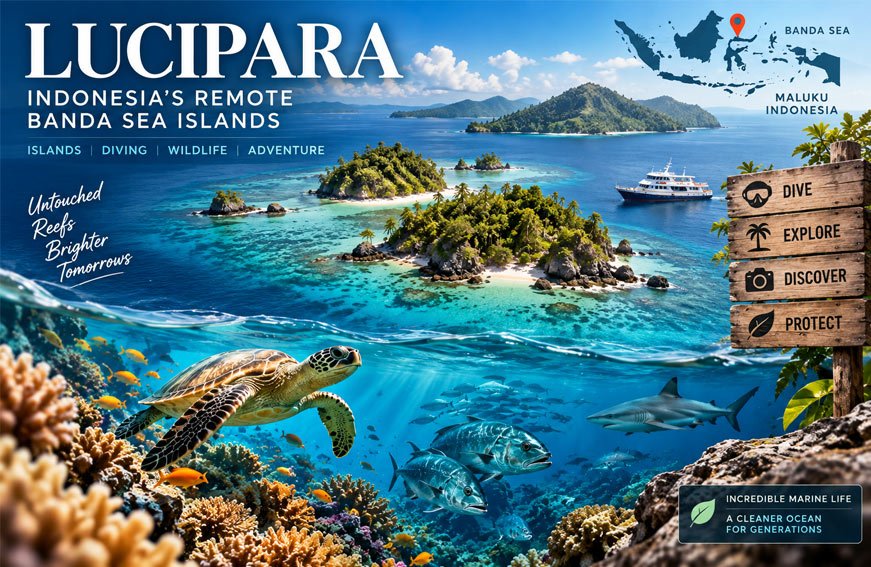
Lucipara is a remote group of small coral islands and reefs in Indonesia’s Banda Sea. The islands are in the Maluku region. They are mainly known for coral reefs, marine life, diving, fishing, and conservation.
People search for Lucipara to learn where it is, how to get there, what animals live there, and whether tourists can visit. This guide explains the location, wildlife, diving, fishing, conservation, safety, and travel information about the Lucipara Islands.
What Is Lucipara?
Lucipara usually means the Lucipara Islands, a remote island group in eastern Indonesia. It is not one large island. The area includes several small coral islands, reefs, and a large marine environment.
Sources do not always give the same number of islands. This may be because small coral islands, reefs, and the nearby Penyu group can be counted in different ways.
The Lucipara Islands are low and surrounded by coral reefs. They are different from the high volcanic islands found in other parts of the Banda region.
Much of Lucipara’s natural value is below the water. Its reefs, deep water, currents, and underwater features provide habitats for many marine animals.
Tourism development is very limited. There are no large resorts, shopping areas, or normal tourist centers on the islands. Visitors usually need a suitable boat and an experienced crew.
Lucipara is sometimes described as “untouched.” However, this does not mean every reef is in perfect condition. Reports mention both healthy reefs and areas affected by coral damage, disease, marine waste, waves, and harmful fishing.
Where Are the Lucipara Islands?
The Lucipara Islands are in the Banda Sea in Indonesia’s Maluku region. Maluku was historically known as the Moluccas.
The islands are far from Indonesia’s main tourist areas. They cannot normally be reached by a short ferry ride or road trip.
Ambon is commonly used as a starting point for trips into this part of the Banda Sea. Travelers may first reach Ambon and then join a liveaboard, charter boat, or organized expedition.
Lucipara is also within the wider Coral Triangle. This large marine region is known for very high marine biodiversity.
The islands’ remote location has helped limit large-scale development. However, the distance also makes tourism, research, conservation work, and emergency help more difficult.
Geography and Underwater Landscape
Lucipara has small areas of land, but its underwater environment is much larger.
The group includes low coral islands surrounded by reef systems. Below the water are coral gardens, reef edges, steep walls, underwater ridges, submerged reefs, and deep drop-offs.
Some shallow reefs are close to very deep water. This allows both reef animals and open-ocean species to use the same general area.
The wider region also contains deep underwater features such as seamounts, submarine canyons, trenches, and submerged reef structures.
Currents are important to this ecosystem. They carry nutrients and small organisms through the water. Small fish gather in these areas, and larger predators often follow them.
However, strong currents and waves can also make boating and diving more difficult.
Marine Life Around Lucipara
Lucipara supports many types of marine life. Its coral reefs, deep water, currents, and open sea create different habitats.
Commonly reported reef fish include snapper, fusiliers, surgeonfish, butterflyfish, and triggerfish.
Larger reported species include giant trevally, barracuda, tuna, Napoleon wrasse, bumphead parrotfish, reef sharks, and sea turtles.
Blacktip and gray reef sharks may be found near reef edges and deeper walls. Sharks are important predators and help keep the marine food chain balanced.
Giant trevally and tuna also hunt around reefs and areas with strong currents.
Wildlife sightings are never guaranteed. What visitors see depends on the season, location, currents, weather, and natural animal movement.
Sea Turtles and Nesting Beaches
Sea turtles are an important part of Lucipara’s ecosystem.
Green turtles are connected with feeding and nesting areas in the region. Hawksbill turtles are also linked with the wider Lucipara and Banda Sea environment.
Some small beaches may provide nesting places for turtles. Female turtles come onto land to lay eggs in the sand. Later, the young turtles move toward the sea.
These nesting areas are sensitive. Bright lights, loud noise, people walking near nests, and rubbish can cause problems.
Plastic waste and old fishing equipment are also dangerous. Nets, ropes, bags, and other waste can trap turtles or block their path.
Visitors should keep a safe distance from turtles and never touch them. Nesting areas and local conservation rules should also be respected.
Blue Whales and Other Cetaceans
The wider Banda Sea is important for whales and other cetaceans.
Deep ocean areas and channels provide routes that large marine animals can use while moving through Indonesian waters.
Blue whales have been documented in or near the wider region. This makes the area important for marine conservation.
However, seeing a blue whale during a Lucipara trip is not guaranteed. Whales travel across very large areas, and their location changes naturally.
If whales are seen, boats should keep a safe distance. They should not chase, surround, block, or touch the animals.
Seabirds and Coastal Wildlife
Lucipara’s small islands also provide useful habitats for seabirds.
Reports mention nesting and resting areas used by seabirds, including tern species. Small and isolated islands can give birds safer places to rest, breed, and raise their young.
The surrounding sea provides food for these birds. They can rest on the islands and then fly over nearby reefs and open water to feed.
Visitors should stay away from nests and breeding areas. Loud noise and getting too close can disturb the birds.
Diving in Lucipara
Scuba diving is one of the main reasons people visit Lucipara.
Because the islands are very remote, diving is normally part of a multi-day liveaboard trip rather than a normal day trip.
Dive sites may include coral gardens, reef walls, underwater ridges, pinnacles, and deep drop-offs.
When conditions are good, visibility can be very clear. Divers may see large areas of coral and schools of fish.
Possible sightings include reef sharks, turtles, giant trevally, barracuda, tuna, Napoleon wrasse, bumphead parrotfish, triggerfish, and many smaller reef fish.
Currents can bring food into the area and attract marine life. However, they can also make diving more difficult.
Lucipara has very little nearby tourism infrastructure. Divers depend heavily on their liveaboard, crew, equipment, and planning.
Is Lucipara Suitable for Beginner Divers?
Lucipara is generally not the best place for a first diving trip.
Some dive sites have strong currents, open-ocean waves, deep drop-offs, and changing conditions. Medical help, ports, and dive shops can also be far away.
Divers should have good buoyancy control and feel comfortable in moving water. Experience with drift diving can be useful.
Divers should also know how to use important safety equipment, including a surface marker buoy.
Not every site is difficult. Beginners may be able to dive at calmer sites with close professional guidance. More difficult sites are better for experienced divers.
A good liveaboard should have communication and navigation equipment, first-aid supplies, emergency oxygen, and suitable backup dive equipment.
Divers should always stay within their training and experience level.
Fishing and Saltwater Fly Fishing
Lucipara is also known among saltwater anglers.
The area has shallow flats, reef edges, channels, and deeper water. These different environments support several types of fishing.
One of the main sport fish is the giant trevally, also called GT. It is a large and powerful fish that often hunts near reefs and moving water.
Other reported fish include dogtooth tuna, barracuda, triggerfish, bluefin trevally, coral trout, snapper, and grouper.
Saltwater fly fishing may also be possible around shallow flats and reef areas. Anglers may look for giant trevally and triggerfish in clear, shallow water.
Fishing can be difficult because strong fish may quickly move toward coral or deep water. Sharp coral can also break fishing line.
Strong fishing gear, good leaders, durable reels, and suitable footwear are useful. Experienced guides can also help anglers understand tides, channels, and reef areas.
Responsible Fishing
Fishing around Lucipara should be done carefully because the marine environment is sensitive.
Where catch-and-release fishing is allowed, fish should be handled gently. They should spend as little time outside the water as possible.
Fish should be supported properly and should not be lifted by the gills. Barbless hooks may also make releasing fish easier.
Anglers must follow current Indonesian and local fishing rules.
Fishing may not be allowed in every area. Protected zones, turtle habitats, nursery areas, and other sensitive places may have special rules.
Lucipara’s Coral Reefs
Coral reefs are an important part of Lucipara.
They provide food, shelter, breeding areas, and nursery grounds for many marine animals. Small reef fish depend on coral, while larger animals often visit reef edges to hunt.
Not every reef is in the same condition. Reports describe both healthy reefs and damaged sections.
Coral disease, strong waves, marine waste, destructive fishing, and warmer water can all affect reef health.
Protecting healthy coral areas is important because these reefs support many other parts of the marine ecosystem.
Marine Conservation and Protected-Area Efforts
Lucipara has received attention from marine conservation groups because of its reefs, turtles, seabirds, deep-water habitats, and other wildlife.
The collected information describes conservation work involving Maluku authorities, conservation groups, researchers, local communities, and other stakeholders.
This work has included ecological surveys, social and economic research, and discussions about how the marine area should be managed.
One possible management method is zoning. Different areas can have different rules. Some may allow controlled tourism or fishing, while more sensitive areas may receive stronger protection.
Sources do not describe Lucipara’s current protected status in exactly the same way. One source reports a protected framework of more than 380,000 hectares, while another describes continuing work on marine protection and management.
For this reason, visitors should check the latest official Indonesian rules before fishing, diving, anchoring, or carrying out other activities.
Environmental Threats
Being remote does not protect Lucipara from every environmental problem.
Illegal and destructive fishing can reduce fish populations and damage reefs. Old fishing gear can also trap turtles and other marine animals.
Plastic pollution is another problem. Ocean currents can carry bottles, bags, nets, and other rubbish from distant places.
Climate change can also affect Lucipara. Warmer ocean temperatures can cause coral bleaching. Strong storms and waves can damage shallow reefs and nesting beaches.
Poorly managed tourism could create more pressure. Anchors can damage coral, waste can enter the sea, and visitors can disturb wildlife.
Local Communities and Human Activity
The Lucipara Islands are generally described as uninhabited or having very little permanent human presence.
However, the wider area still has connections with people.
Nearby communities have used the region for activities such as fishing and occasional resource gathering.
This is important when conservation plans are made. Local people may depend on marine resources and may have useful knowledge about fishing areas, weather, wildlife, and sea conditions.
Good conservation should therefore consider local communities as well as scientific and environmental needs.
How to Reach Lucipara
There are no normal tourist flights directly to Lucipara.
Most visitors reach the islands by liveaboard, charter boat, or organized expedition. Ambon is a common starting point.
Some trips combine Lucipara with other Banda Sea destinations, including the Banda Islands.
Travel can take several days as part of a wider route. Boats need enough fuel, food, drinking water, medical supplies, and safety equipment.
An experienced crew is important because the area has reefs, currents, open water, and changing weather.
Best Time to Visit Lucipara
The best time to visit depends mainly on weather and sea conditions.
The Banda Sea is affected by seasonal monsoon winds. These can change waves, currents, visibility, and travel conditions.
Some liveaboard trips operate during calmer periods around spring and autumn. However, weather conditions can still change.
Bad weather may cause an operator to delay a crossing, change a dive site, or use another route.
Travelers should check current conditions and trip schedules with an experienced Banda Sea operator before booking.
Where to Stay
There are no normal large hotels or resorts on the Lucipara Islands.
Most visitors stay on a liveaboard or expedition boat. The boat provides accommodation, meals, transport, and diving support.
Travelers should arrange accommodation before leaving the main port.
Visitors should not expect to arrive at Lucipara and find hotels, restaurants, shops, or other normal tourist services.
What to Pack
Visitors should pack carefully because it may be difficult to buy missing items after leaving Ambon or another main port.
Useful items include:
- Personal diving or fishing equipment
- Spare equipment when needed
- Reef-safe sunscreen
- Sun hat
- Polarized sunglasses
- Lightweight rain jacket
- Reusable water bottle
- Dry bag
- Waterproof camera
- Strong reef shoes
- Motion-sickness medicine
- Personal first-aid supplies
- Insect protection
- Travel and activity insurance documents
Divers should also bring any personal safety equipment recommended by their operator.
Safety and Trip Planning
A trip to Lucipara should be treated as a remote sea expedition rather than a normal beach holiday.
Strong currents, waves, reefs, changing weather, and the long distance from medical help can make travel more difficult.
Choose an experienced operator with suitable navigation and communication equipment.
Dive boats should also have emergency oxygen, first-aid supplies, and backup equipment.
Travelers should consider insurance that covers their planned activities and remote travel. Divers should make sure their insurance covers the type and depth of diving they plan to do.
Always follow the crew’s safety instructions. Divers should stay within their training and experience level.
Travel plans should also be flexible. Routes may need to change when sea conditions become unsafe.
Responsible Tourism
Visitors can help protect Lucipara by following simple rules.
Divers should avoid touching, kicking, or standing on coral. Boats should use safe moorings where possible instead of dropping anchors onto reefs.
Visitors should take their rubbish with them. Plastic, fishing line, packaging, and other waste should never be left on beaches or thrown into the sea.
Wildlife should be watched from a safe distance. Visitors should not chase, feed, touch, or surround turtles, sharks, whales, seabirds, or other animals.
Turtle nesting beaches and bird breeding areas should receive extra care.
Visitors should also follow all local rules and protected-area restrictions.
Lucipara vs Other Indonesian Dive Destinations
Lucipara is very different from Indonesia’s better-known diving destinations.
Bali is much easier to reach. It has many hotels, restaurants, dive centers, shops, and transport options.
Raja Ampat is more remote than Bali and is widely known for its marine biodiversity. It also has a much larger international diving industry than Lucipara.
The Banda Islands offer diving as well as settlements, cultural sites, and history connected with the spice trade.
Lucipara has much less tourism development. Most access is by liveaboard or expedition boat.
This makes Lucipara more suitable for travelers who are comfortable with remote, boat-based trips rather than a normal resort holiday.
Why Lucipara Matters
Lucipara contains several important marine habitats in one area.
Coral reefs support fish and other sea life. Small beaches provide nesting areas for turtles. Isolated islands support seabirds, while deep water is important for larger marine animals.
The area can also be useful for scientific research.
Researchers can study coral health, fish populations, biodiversity, and environmental changes. Less-developed reefs can also be compared with reefs that face greater human pressure.
Long-term research may help scientists understand how warmer oceans and other environmental changes affect coral ecosystems.
Lucipara’s remote location also creates problems. Monitoring such a large marine area can be difficult and expensive. Illegal fishing or environmental damage may not always be noticed quickly.
Long-term protection therefore needs clear rules, scientific research, local community involvement, funding, and practical enforcement.
Bottom Line
Lucipara is a remote group of coral islands and reefs in Indonesia’s Banda Sea. It is known for coral reefs, sea turtles, seabirds, sharks, large fish, diving, fishing, and other marine wildlife.
Getting there requires more planning than a normal island holiday. Most visitors need a liveaboard or expedition boat, suitable equipment, and an experienced crew.
The islands have little large-scale development, but their environment still faces risks from fishing, plastic waste, coral damage, climate change, and future tourism.
Visitors should prepare carefully, follow current local rules, respect wildlife, and avoid damaging the reefs and beaches.
Frequently Asked Questions
Where are the Lucipara Islands?
The Lucipara Islands are in the Banda Sea in Maluku, Indonesia. They are in a remote part of eastern Indonesia.
Are the Lucipara Islands inhabited?
The islands have little or no permanent population. People from nearby areas may visit for fishing.
How do you get to Lucipara?
Most visitors travel by liveaboard, charter boat, or organized trip. Many trips start from Ambon.
Can you stay on the Lucipara Islands?
There are no large hotels or resorts on the islands. Most visitors stay and sleep on a liveaboard boat.
Is Lucipara good for scuba diving?
Yes. Lucipara has coral reefs, deep walls, and rich marine life. Some sites have strong currents and are better for experienced divers.
What animals can you see around Lucipara?
You may see sea turtles, reef sharks, tuna, giant trevally, reef fish, and seabirds. Whales may also be seen in the wider Banda Sea.
What is the best time to visit Lucipara?
The best time depends on weather and sea conditions. Check current conditions with a Banda Sea tour operator before traveling.
Is Lucipara a marine protected area?
Lucipara is part of ongoing marine conservation efforts. Check current Indonesian rules for its latest protected status and restrictions.
Explore More:

