


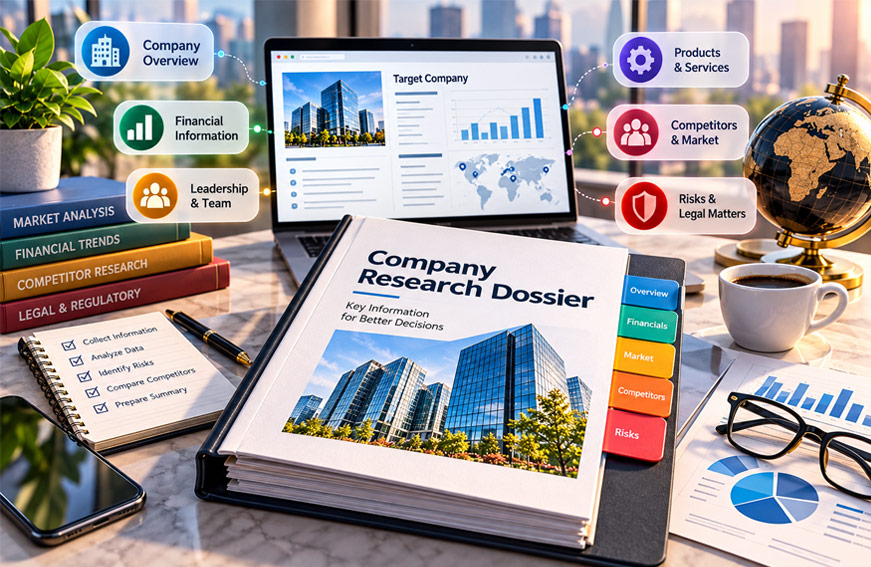
A research dossier for target company is a document that collects important information about a business in one place. It may include the company’s owners, products, customers, finances, competitors, and possible risks.
People create these reports for many reasons. They may want to contact a company, start a partnership, choose a supplier, study a competitor, make an investment, or buy a business.
This guide explains what a company research dossier is, what information to collect, where to find it, and how to check if the information is reliable.
What Is a Research Dossier for a Target Company?
A research dossier for a target company is a detailed report about one business. It collects useful information from different sources and puts it into one clear document.
Here, “target company” simply means the company you are researching. It does not always mean Target Corporation.
The dossier may include the company’s history, owners, leaders, products, customers, business model, finances, competitors, reputation, technology, legal matters, and possible risks.
A good dossier does more than collect facts. It also explains where the information came from and whether the source is reliable.
It should also mention important information that could not be confirmed.
The information you collect depends on your goal. A sales team may focus on customers, products, and decision-makers. An investor may care more about finances, ownership, growth, and risks. Someone checking a supplier may focus on financial health, production, and delivery.
Research Dossier vs. Company Profile vs. Due Diligence
A company profile gives basic details about a business. It may include the company’s location, industry, products, history, and leaders.
A research dossier gives more detail. It uses different sources to build a wider picture of the company. It may also include risks, missing information, and facts that do not match across sources.
Due diligence is usually a much deeper review. It may include private financial records, contracts, tax records, legal documents, customer information, and other private business records.
A public research dossier can be useful for an early review. However, it cannot confirm private information that the researcher cannot access.
Why Create a Target Company Research Dossier?
Information about a company may be spread across many websites, reports, and databases. A research dossier puts the most useful information in one place.
It can help you understand what the company sells, how it makes money, who owns it, who manages it, and who its customers are.
It can also help you find competitors, recent company changes, business opportunities, and possible risks.
Sales teams can use a dossier before contacting a company. It can help them understand the business and find the right person to contact.
A business may use a dossier before choosing a supplier or starting a partnership.
Investors and buyers may use deeper research to understand a company’s finances, ownership, customers, competitors, and risks.
A dossier can also be updated later. New information can be added when the company launches a product, changes leaders, buys another business, or releases new financial results.
Define the Research Goal Before You Start
Start with one simple question: Why are you researching this company?
Your answer will help you decide what information matters most.
For example, if you are checking a possible supplier, you may want to know about its financial health, production ability, delivery history, and important suppliers.
If you are looking at buying a company, you may need information about its owners, finances, contracts, debt, taxes, and legal issues.
For sales research, you may focus on products, customers, decision-makers, and reasons to contact the company.
You should also decide which legal company you are researching and which countries or markets you want to study.
Add a research cutoff date. This tells readers when the information was last checked.
You do not need to collect every fact about the company. Focus on information that helps answer your main question.
Start With Company Identity and Ownership
First, make sure you have the correct company.
Find its official legal name, brand names, website, registration details, headquarters, industry, and type of business.
If reliable information is available, also check the founders, owners, parent company, subsidiaries, and related brands.
This step is important because two companies may have similar names. One brand may also be connected to several legal companies.
Official registration numbers can help you find the correct business.
Check whether the company is private or publicly traded. Also find out if it is part of a larger business group.
Look at where the company operates. Its main office may be in one country, while its products, offices, or customers may be in many countries.
Government company records, official filings, regulatory databases, and company websites can help confirm this information.
Research the Company’s History
A company’s history can help explain how it reached its current position.
Start with when the company was created and who founded it.
Then look at important events. These may include new products, funding, acquisitions, mergers, partnerships, rebranding, restructuring, and expansion into new markets.
Major leadership changes may also be useful.
Legal or regulatory events can be included if they had an important effect on the company.
You do not need to include every small event. Focus on changes that help readers understand the business today.
A simple timeline can make the history easier to follow. Add dates and reliable sources when possible.
Always check newer information too. An old report may say a company planned to enter a market, while a newer report may show that the plan changed.
Understand Products, Services, and Customers
A company dossier should clearly explain what the business sells.
Find its main products and services. Explain what they do, what problems they solve, and who uses them.
Check prices when they are publicly available. Some companies show fixed prices. Others provide prices only after a customer asks for a quote.
Also look at similar products from competitors and other ways customers can solve the same problem.
Check whether the company depends heavily on one product. Only make this claim when reliable information supports it.
You should also understand the company’s customers.
Find out whether it serves normal consumers, small businesses, large companies, government groups, developers, agencies, or certain industries.
For a business-to-business company, you may also check the industries it serves, customer size, locations, and publicly known clients.
Customer concentration may also matter. If a few customers provide most of the company’s revenue, losing one could cause problems.
However, do not make this claim without reliable evidence.
Customer reviews and case studies can also provide useful information. Remember that one review does not show the experience of every customer.
Analyze the Business Model
A business model explains how a company makes money.
A company may make money from product sales, subscriptions, memberships, advertising, licenses, commissions, consulting, marketplace fees, or business contracts.
Some companies use more than one method.
For example, a software company may offer a free plan, paid monthly plans, and special plans for large businesses.
Pricing pages, company reports, official filings, and investor information can help you understand how the company earns money.
Also check how the company sells its products. It may use its own website, physical stores, marketplaces, distributors, sales teams, or business partners.
Important suppliers and partnerships may also help explain how the business works.
Be careful with private companies. If exact revenue information is not available, do not guess how much money each product makes.
Research Leadership, Employees, and Governance
Find out who owns and manages the company.
Important people may include the founders, major owners, CEO, CFO, CTO, COO, board members, and other senior leaders.
Check their current jobs and duties. Official company pages, company announcements, regulatory filings, and trusted professional profiles can help.
Always check the dates because people may leave or change roles.
Their work history can also be useful. You can look at their previous jobs, experience, and how long they have worked in their current position.
Important leadership changes should be included.
However, a new CEO or senior leader does not automatically mean the company has changed its plans.
For larger companies, you may also study the board, future leadership plans, business relationships, and whether the company depends heavily on one founder or leader.
Employee numbers should also be checked carefully.
Use official numbers when possible. If another website only gives an estimate, clearly call it an estimate.
Examine Financial Information
Financial information can help you understand how a company is performing.
Public companies often publish financial statements, annual reports, and official filings. Private companies may publish much less information.
Useful financial details may include revenue, profit or loss, costs, cash, debt, assets, liabilities, cash flow, and funding.
Do not look at revenue alone.
A company may increase its sales but still have financial problems. Its costs may rise, profits may fall, or debt may increase.
Compare several years or reporting periods when possible. This makes changes easier to see.
For seasonal businesses, compare similar periods. Comparing a busy season with a quiet season may give the wrong picture.
Every financial number should have a date or reporting period and currency.
You should also explain where the number came from. It may come from audited accounts, an official filing, company management, or an outside estimate.
Funding announcements also need care.
If a company raised $20 million, it does not mean the company still has $20 million available. Some of that money may already have been spent.
Outside estimates can sometimes help when researching private companies. However, website traffic, employee numbers, hiring, and past funding do not prove how much revenue or profit a company makes.
Analyze Competitors and Market Position
You should also study the company’s competitors.
Start with direct competitors. These are businesses that sell similar products or services to similar customers.
Then look at indirect competitors. These companies may solve the same problem in a different way.
Customers may also choose to solve the problem themselves or not buy a product at all.
Compare important areas such as products, prices, customers, locations, technology, distribution, and service coverage.
You do not need to list every company in the industry. Focus on competitors that can really affect the target company.
Be careful with claims about competitive advantages.
For example, if a company says its technology is unique, check whether competitors offer something similar.
Market share also needs context. A company may be large in one small market but much smaller in the wider industry.
Add Industry Context
You should also understand the industry in which the company operates.
Look at customer demand, economic conditions, new technology, regulations, supply chains, competitors, and new ways of doing business.
The important areas depend on the company.
A software company may be affected by AI, cloud services, cybersecurity, and changes in software development.
A manufacturing company may be more affected by material prices, transport costs, workers, and supply-chain problems.
Industry research can help you understand whether a problem affects only one company or many companies.
For example, if many companies face higher costs, the issue may affect the whole industry.
Industry figures should include a date, location, and clear market definition. Different reports may measure different markets.
Review Operations and Technology
Look at how the company provides its products or services.
For a manufacturer, this may include suppliers, factories, materials, shipping, and distribution.
For an online business, important areas may include software, hosting, payment systems, and outside platforms.
Also look at what may happen if an important supplier or system stops working.
Public information may not give a complete answer. If the information is not available, do not guess.
Technology research may include the company’s website, apps, payment tools, customer support systems, public APIs, developer information, and integrations.
For technology companies, patents, trademarks, software ownership, and outside technology may also matter.
Cybersecurity information should come from reliable sources. Security policies, certifications, official reports, and public incident reports may provide useful information.
Do not guess how private security systems work.
Check Recent Company Developments
Company information changes over time.
Look for recent product launches, updates, partnerships, acquisitions, funding, contracts, leadership changes, layoffs, restructuring, and business expansion.
New offices, large investments, lawsuits, and regulatory actions may also be important.
Always check dates.
For example, an old article may say a company plans to enter a new country. A newer report may show that the plan happened, was delayed, or was cancelled.
A research cutoff date helps readers know when the information was last checked.
Older information may still be useful for understanding company history. Newer information is usually more useful for understanding the company today.
Research Reputation and Online Presence
Start with the company’s official website.
Check pages such as About, Products, Services, Newsroom, Blog, Careers, Contact, and Investor Relations when available.
Official social media pages may show company news, job openings, product updates, and leadership changes.
Do not use follower numbers as proof that a business is successful. A company can have many followers and still have financial problems.
Customer reviews can show common praise and complaints. Look for repeated patterns instead of using one review.
Employee reviews can also provide clues. However, one anonymous review should not be used to make a claim about the whole company.
Job listings can also provide useful signs. Many engineering jobs, for example, may suggest that the company is hiring more technical workers.
However, this does not prove the company’s full business plan.
Trusted news and industry publications can provide more information about the company’s reputation.
Check Legal and Regulatory Information
Legal research may be important, especially for companies in industries with many rules.
Check official company registrations, licenses, regulatory filings, government databases, court records, trademarks, and public enforcement records when needed.
Use legal terms carefully.
An allegation does not prove that a company did something wrong.
An investigation means that an issue is being checked.
A lawsuit means that a legal claim has been filed.
A settlement may end a dispute without a final court decision.
A final judgment is different from all of these.
Clearly explain what actually happened.
Do not make broad claims such as “the company has no lawsuits.” Instead, say which records were checked and when.
Legal information also differs between countries. Some countries provide detailed public records, while others provide much less information.
Where to Find Reliable Company Information
Good research needs good sources.
Start with information that comes close to the original source.
Government company records can help confirm legal names, registration details, and company officers.
Regulatory filings, annual reports, financial statements, and investor information can be very useful for public companies.
The company’s official website can provide details about products, prices, leaders, locations, and company news.
However, remember that the company website shows the business from its own point of view.
Independent sources can provide another view. These may include trusted news websites, financial publications, industry publications, and professional databases.
Reviews, forums, social media, and professional profiles can provide useful clues. Important claims should usually be checked using stronger sources.
Use the source that best fits the information you want to confirm.
Build an Evidence Register
An evidence register is a simple record of the important information you find.
For every major claim, record the source and the evidence that supports it.
You may include the company name, source, page or document, reporting period, publication date, and the date you checked it.
Also record whether another source agrees or disagrees with the information.
This makes it much easier to check facts later.
Be careful with dates.
If you read a report from 2023 in 2026, the information is still from 2023. The date you read it does not make the information new.
An evidence register also makes future updates easier.
Separate Facts, Estimates, and Analysis
Not all information is equally reliable.
Officially reported information comes from the company or an official organization.
Independently verified information is confirmed by reliable outside sources.
A third-party estimate is an outside estimate that has not been officially confirmed.
Unconfirmed information is information that cannot be checked well enough.
Conflicting information means different reliable sources give different information.
Researcher interpretation is the researcher’s view based on the available facts.
Keeping these groups separate helps readers understand which information is stronger and which information is less certain.
How to Handle Conflicting Information
Do not hide information when sources disagree.
For example, one source may say a company makes $8 million in yearly revenue, while another says $11 million.
First, check the dates. The numbers may be from different years.
Then check the currency and legal company. One number may cover the whole company group, while another covers only one part of the business.
One number may also be official, while the other is only an estimate.
If you find the reason for the difference, explain it.
If you cannot find the reason, show both numbers and say that the information does not match.
Turn Company Data Into Useful Analysis
Collecting numbers is only the first step. You also need to understand what they mean.
Revenue growth can show whether sales are going up. However, higher sales do not always mean the company is financially stronger.
Gross margin can show how much money remains after direct costs.
Cash flow can show whether the company is bringing in cash or spending more cash.
Debt shows how much money the company owes.
Customer concentration can also matter. If one customer provides a large part of the company’s revenue, losing that customer could have a major effect.
Look at why important numbers changed.
Revenue may rise because prices increased, the company gained more customers, bought another business, or had changes in currency values.
Margins may fall because of discounts, higher costs, or changes in the products being sold.
Compare similar time periods. This is especially important for seasonal businesses.
If you calculate the value of a company, clearly explain the numbers and assumptions used.
Analysis should make the information easier to understand. It should not make uncertain information look like a confirmed fact.
Identify Strengths, Opportunities, and Risks
After collecting the information, look at the company’s main strengths, opportunities, and risks.
Possible strengths may include several successful products, operations in many markets, strong distribution, experienced leaders, or long-term customers.
Only call something a strength when there is evidence.
Possible opportunities may include new markets, new products, partnerships, new technology, or growing customer demand.
Possible risks may include strong competition, dependence on one product, dependence on a few customers, new regulations, cybersecurity problems, supply-chain problems, or financial pressure.
Keep current weaknesses separate from possible future risks.
For example, depending heavily on one customer may be a current weakness. A law that may change in the future could be a possible risk.
Explain why each important point matters.
Keep an Unanswered-Questions List
Sometimes important information cannot be found.
Do not guess the answer.
Missing information does not mean something is wrong.
For example, if you cannot find reliable profit figures for a private company, this does not mean the company is losing money. It only means its profit cannot be confirmed.
Write down important questions that still need answers.
Focus first on questions that could change your final view of the company.
If important information cannot be found, clearly mention this in the dossier.
Common Research Mistakes to Avoid
Do not rely only on the company’s website. It mainly shows how the company presents itself.
Do not use old information without checking if it is still correct.
Make sure you are researching the correct business. Companies with similar names can easily be mixed up.
Do not present estimates as official facts.
Do not use one customer or employee review to make a claim about the whole company.
Be careful with legal information. An allegation, investigation, lawsuit, settlement, and final judgment are different things.
Do not collect information just because you can find it. Focus on information that helps answer your research question.
Most importantly, never guess when reliable information is missing.
Best Practices for a Reliable Research Dossier
Start with a clear research question.
Use official and trusted sources whenever possible.
Check important facts with more than one good source when needed.
Always record dates because company information can change.
Keep facts separate from estimates and analysis.
Use simple and neutral words.
Make calculations easy to understand and check.
If you use AI to organize information or create summaries, check important claims against the original sources.
Do not use an AI-generated citation as proof unless you can check the real source.
Be careful with private documents. Only use confidential information when you have permission.
Update the dossier when important company information changes.
How to Organize the Final Research Dossier
Start the final dossier with an executive summary.
Explain why the research was done and give the most important findings.
Then explain what the research covers, its cutoff date, and any important limits.
The main part can cover company identity, history, products, customers, business model, leadership, ownership, finances, competitors, industry, operations, technology, reputation, and legal matters.
After that, explain the main opportunities, risks, and unanswered questions.
Keep sources and calculations organized so another person can check them.
It is usually better to write the executive summary last. At that point, you know which findings are most important.
The length depends on the reason for the research. A simple public company dossier may be short. Investment or acquisition research may need much more detail.
When Should a Company Dossier Be Updated?
A company dossier does not stay current forever.
Update it before using it to make an important new decision.
It may also need an update after new financial results, an acquisition, merger, product launch, leadership change, ownership change, large contract, lawsuit, or regulatory action.
Companies in fast-changing industries may need updates more often.
Always add a research cutoff date. This helps readers understand how recent the information is.
Bottom Line
A research dossier for target company puts useful company information into one clear document.
It can explain the company’s owners, products, customers, business model, leaders, finances, competitors, operations, reputation, and possible risks.
Good research also explains where the information came from and how reliable it is.
Keep confirmed facts, estimates, conflicting information, and analysis separate.
The goal is not to collect every fact about a company. The goal is to understand what is known, what is still unknown, and what information is important for the decision.
Frequently Asked Questions
What is a research dossier for a target company?
It is a document with useful information about a company, such as its owners, products, finances, competitors, and risks.
What information should a company research dossier include?
It can include the company’s history, owners, leaders, products, customers, finances, competitors, legal matters, and risks.
What are the best sources for researching a company?
Use official company records, government databases, financial reports, company websites, and trusted news sources.
Is a research dossier the same as due diligence?
No. A research dossier often uses public information, while due diligence may also check private business, financial, and legal records.
Can you research a private company without financial statements?
Yes. You can research its owners, products, leaders, customers, and competitors, but its profit may be hard to confirm.
How do you verify information about a company?
Check the original source, date, and company details. Compare important facts with other trusted sources.
How long does it take to prepare a company research dossier?
A simple dossier may take a few hours or days. A detailed one may take several weeks.
How often should a company research dossier be updated?
Update it before an important decision or when major company changes happen.
Explore More:
What Is the 785 Area Code? Kansas Cities, Time Zone, and History

