


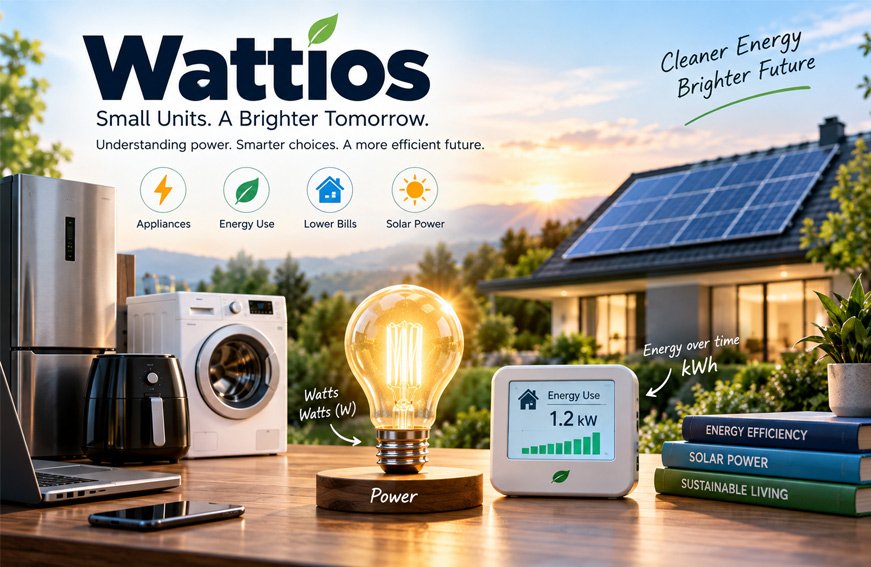
Wattios is a term connected with the watt, the standard unit used to measure power. It can be confusing because “Wattios” is not a separate modern SI unit.
The term is linked to older Spanish forms such as watio and wattio. Today, the standard scientific term is watt (W).
Understanding watts is useful in everyday life. It can help you read appliance labels, estimate electricity use, compare products, and understand solar and backup power systems. This guide explains the meaning of Wattios, watts, kilowatts, energy use, and related electrical terms in simple words.
What Does Wattios Mean?
Wattios is a historical term connected with the watt and older Spanish electrical terminology. Historical Spanish forms included words such as watio, wattio, and wattios. The modern Spanish term is vatio.
In modern electrical science, the recognized unit is the watt, written as W. It measures power, which tells us how quickly energy is transferred or used.
For example, a device rated at 100 watts has a power rating of 100 W. A device rated at 1,000 watts has a power rating of 1,000 W, or 1 kilowatt.
It is important not to describe Wattios as a new type of electricity or a separate modern unit. The available information does not support that meaning.
The word can also appear in business or brand names. In those cases, its meaning depends on the company or product using the name. It should not automatically be treated as a scientific term.
Where Does the Word Wattios Come From?
The history of Wattios is linked to the word watt, which was named after Scottish engineer James Watt.
James Watt made important improvements to steam engines. His surname was later used for the scientific unit of power.
As scientific and electrical terms moved between languages, different forms of the word appeared. Historical Spanish writing used forms such as watio, wattio, and wattios.
Over time, vatio became the established Spanish form. In international scientific writing, watt remains the standard name.
This history explains why someone may find the word “Wattios” when searching for information about watts. It is mainly useful as a historical and language-related term rather than a separate measurement.
Watts, Kilowatts, and Other Power Units
A watt measures power. It tells us the rate at which energy is being transferred or used.
The basic relationship is:
1 watt = 1 joule per second
For larger amounts of power, kilowatts and other units are commonly used.
1 kilowatt (kW) = 1,000 watts (W)
For example, a 2,000-watt heater has a power rating of 2 kW.
Larger electrical systems may use even bigger units:
- 1 megawatt (MW) = 1,000 kilowatts
- 1 gigawatt (GW) = 1,000 megawatts
Household appliances are usually described in watts or kilowatts. Larger equipment, solar farms, power plants, and electricity systems may use megawatts or gigawatts.
The power number alone does not tell you how much electricity a device will use over a whole day or month. Operating time is also important.
Watts, Voltage, and Amps: What Is the Difference?
Watts, volts, and amps describe different parts of an electrical system.
Watts measure power.
Volts (V) measure electrical potential difference.
Amps (A) measure electrical current.
These values are related. For a simple electrical calculation, power can be found with:
Power (W) = Voltage (V) × Current (A)
For example, if a device operates at 10 volts and draws 2 amps:
10 × 2 = 20 watts
So the basic power value is 20 watts.
This formula is useful for understanding simple electrical systems. Real electrical systems can be more complex, especially with AC equipment. Factors such as power factor can affect some calculations.
For normal appliance use, the information printed on the product label is usually the best starting point. Users should not rely on a simple calculation when proper electrical system sizing is required.
Watts vs Watt-Hours and Kilowatt-Hours
One of the most important things to understand is the difference between power and energy.
A watt measures power. It tells you how quickly energy is being used or transferred.
A watt-hour (Wh) measures energy over time.
A kilowatt-hour (kWh) is also a unit of energy. It is commonly used to measure electricity consumption.
For example, a 1,000-watt appliance is equal to 1 kilowatt. If it runs at that power for one hour, it uses about:
1 kW × 1 hour = 1 kWh
If the same appliance runs for three hours, it would use about:
1 kW × 3 hours = 3 kWh
This is why electricity bills normally use kilowatt-hours rather than simply showing the watt rating of each appliance.
A high-wattage appliance does not always use the most electricity. A device with a lower watt rating can use more total energy if it runs for many more hours.
How to Calculate Electricity Use
You can make a basic estimate of electricity use if you know an appliance’s wattage and how long it operates.
The simple formula is:
Energy in kWh = Watts ÷ 1,000 × Hours Used
For example, imagine a device rated at 500 watts that runs for four hours.
First convert watts to kilowatts:
500 ÷ 1,000 = 0.5 kW
Then multiply by the operating time:
0.5 × 4 = 2 kWh
So the device would use about 2 kWh if it operated continuously at its rated power for four hours.
You can also estimate longer-term use. If an appliance uses 2 kWh each day, you can multiply that amount by the number of days it is used.
However, this is only an estimate. Many appliances do not use their full rated power all the time. Refrigerators, air conditioners, computers, and other devices may change their power use during normal operation.
Weather, settings, workload, appliance condition, and usage habits can also affect actual consumption.
How to Estimate Appliance Running Costs
Once you know the estimated energy use in kWh, you can make a basic running-cost estimate.
The formula is:
Estimated Cost = Energy Used in kWh × Electricity Price per kWh
For example, if an appliance uses 3 kWh and your electricity price is based on a particular cost per kWh, you can multiply those two numbers to estimate the energy cost.
The electricity rate used in the calculation should match your own tariff. Prices can differ between countries, providers, usage levels, and billing plans.
The final electricity bill may also include other charges. These can include taxes, fixed fees, different pricing tiers, or time-based rates.
For this reason, a simple wattage calculation should be treated as an estimate. It is still useful for comparing appliances and understanding which devices may use more energy.
Understanding Appliance Power Ratings
An appliance power rating shows how much electrical power the product needs under its rated conditions. It is usually shown in watts or kilowatts.
An appliance label may also show voltage, current, and frequency. These details help users check whether the product is suitable for their electrical supply.
The watt rating is useful, but it does not always show the exact amount of electricity the appliance will use all the time. Some products change their power use while operating.
For example, a refrigerator may turn its compressor on and off. An air conditioner may change its output as the room temperature changes. A computer can also use different amounts of power depending on what it is doing.
This means the rated wattage should often be used as a starting point rather than an exact measure of long-term electricity use.
Common Appliances and Their Electricity Use
Different appliances need different amounts of power because they perform different jobs.
Lights and small electronic devices often have lower power ratings. Heating and cooking equipment can need much more power because producing heat quickly requires a large amount of energy.
Common examples include refrigerators, air conditioners, electric kettles, heaters, ovens, water heaters, washing machines, televisions, fans, and chargers.
An electric kettle may have a high watt rating but run for only a few minutes. A refrigerator may use less power at one moment but operate throughout the day.
Air conditioners are another important example. They can use a significant amount of electricity, especially when they run for many hours in hot weather.
For this reason, it is better to compare appliances by looking at both their power rating and how long they normally operate.
Does Higher Wattage Mean Higher Electricity Costs?
Not always.
A higher watt rating means an appliance can use power at a higher rate while operating at that level. It does not automatically mean it will create the highest monthly electricity cost.
Operating time is also important.
For example, a 2,000-watt kettle may run for only a few minutes. A 100-watt device that stays on for many hours can use a similar or greater amount of energy over time.
This is why kilowatt-hours are more useful for understanding total electricity consumption. Wattage tells you the rate of power use, while operating time helps determine how much energy is actually used.
A useful way to think about it is:
Higher power + short use = may use less energy
Lower power + long use = may use more energy
The actual result depends on the appliance and its real operating pattern.
Does Lower Wattage Mean Better Energy Efficiency?
A lower watt number does not automatically mean an appliance is more energy efficient.
Efficiency is about how well a product performs its intended job while using energy. Two appliances may have different power ratings but also have different sizes, speeds, capacities, or output.
For example, one light may use fewer watts but produce less light. A larger appliance may use more power because it is designed to handle a larger workload.
When comparing similar products, look at:
- Power rating
- Energy consumption
- Operating time
- Capacity
- Useful output
- Performance
- Energy label
This gives a better picture than choosing the product with the lowest watt number.
How to Compare Appliances Before Buying
The purchase price is only one part of the cost of an appliance. Electricity use can also affect how much the product costs over its lifetime.
Start by choosing products that match your actual needs. Consider the room size, household size, required capacity, and how often you expect to use the appliance.
Then check the power rating and energy information.
If yearly energy consumption is available, it can be especially useful when comparing similar products. It gives you a better idea of expected energy use than looking at the watt rating alone.
You should also consider the appliance’s warranty, expected lifespan, repair needs, and features you will actually use.
An appliance with a higher purchase price may have lower running costs. A cheaper appliance may cost more over time if it uses more electricity.
The goal is not always to choose the lowest wattage. The better approach is to choose a product that does the required job well without using unnecessary energy.
Wattios and Energy-Saving at Home
Understanding power ratings can help reduce wasted electricity at home.
Simple changes can make a difference. Turn off lights and equipment when they are not needed. Avoid running heating or cooling equipment in empty rooms.
Air conditioners should be maintained properly. Cleaning filters can help the system work as intended. Doors and windows should also be managed so cooled air does not escape unnecessarily.
Refrigerators also need regular care. Check that the door seal works properly and avoid leaving the door open longer than necessary.
For washing machines, using suitable loads can avoid unnecessary cycles. Where appropriate, cooler water settings can also reduce energy use.
Lighting is another simple area to manage. Replacing older bulbs with more efficient lighting can reduce electricity use while providing the needed light.
The main idea behind Wattios is simple: understand where electricity is being used, then reduce unnecessary power use and running time.
Wattios and Solar Power, Inverters, and Batteries
Wattage is important when planning a solar system or backup power setup.
Solar panels, inverters, batteries, and UPS systems all have different ratings. Understanding appliance power helps estimate how much power the home may need at one time.
For example, if several high-power appliances run together, their combined load can be much larger than the demand of one appliance.
An inverter needs to be suitable for the power required by the connected equipment. Battery capacity is different. Batteries are often described in watt-hours or kilowatt-hours because these units describe stored energy.
This difference is important.
Watts or kilowatts = power
Watt-hours or kilowatt-hours = energy
Some appliances also have a short startup or surge demand. Motors and compressors can require more power when starting than they use during normal operation.
Because of this, simply adding the normal watt ratings may not be enough for proper solar or backup-system sizing.
Appliance ratings are a useful starting point, but complete solar, inverter, and battery planning should consider the total load, operating time, battery capacity, system losses, and startup demand.
Common Mistakes When Understanding Wattios
Several mistakes can make electricity information confusing.
Treating watts and kWh as the same thing:
Watts measure power, while kilowatt-hours measure energy used over time.
Assuming the highest wattage always costs the most:
A high-power appliance may run for only a short time. A lower-power device may run for many hours.
Assuming lower wattage means better efficiency:
Efficiency also depends on useful output, capacity, performance, and operating time.
Assuming rated wattage is constant:
Many appliances change their power use during normal operation.
Ignoring operating time:
Power ratings are much more useful when combined with realistic hours of use.
Ignoring standby use:
Some electronic devices can still use a small amount of electricity while plugged in or in standby mode.
Reading the watt rating together with energy information and normal usage gives a much clearer picture.
Is Wattios a Company, App, or Energy Platform?
The available information does not establish Wattios as one official modern company, app, software platform, or certified energy service.
The word can appear in different contexts. Some online content uses it when discussing appliance power, energy efficiency, and electricity use. Other businesses may use Wattios as part of their names.
For example, Wattios Coffee is a separate business name in Spain. Its use of the word does not change the scientific meaning of the watt.
Therefore, readers should check the context when they see the term Wattios. A reference involving watts, volts, amps, appliances, or electricity is likely discussing electrical power. A company or product using Wattios as a name is a separate matter.
Safety and Practical Considerations
A watt is simply a measurement of power, so Wattios itself is not a product that creates a separate safety risk.
Electrical equipment should still be used according to its voltage, power, and other manufacturer specifications. Using equipment with an unsuitable electrical supply can be unsafe or can damage the product.
Extra care is needed when dealing with high-power appliances, solar systems, batteries, inverters, and other electrical equipment.
Power ratings can help with basic planning, but they should not replace proper electrical calculations. Complex installations should be checked by a qualified professional.
Bottom Line
Wattios is mainly connected with the historical development of the word watt and older Spanish electrical terms. In modern science, the recognized unit is the watt (W).
For everyday electricity use, the most important idea is the difference between power and energy. Watts show the rate of power use, while kilowatt-hours show how much energy is used over time.
When checking an appliance, do not look at wattage alone. Consider its operating time, energy use, capacity, performance, and efficiency. The same information is also useful when comparing appliances or planning solar, inverter, battery, and backup-power systems.
Frequently Asked Questions
What does Wattios mean?
Wattios is an old term linked to the watt, including older Spanish forms like wattio. Today, the standard term is watt (W).
Is Wattios an official SI unit?
No. The official SI unit of power is the watt (W).
Is Wattios the same as watts?
Wattios is linked to the watt in older terms. It is not a separate modern unit.
What does one watt equal?
One watt equals one joule per second. It measures the rate of energy use or transfer.
How many watts are in one kilowatt?
One kilowatt equals 1,000 watts.
What is the difference between watts and kWh?
Watts measure power, while kWh measures energy used over time.
Does higher wattage mean a higher electricity bill?
Not always. The cost also depends on how long the appliance runs.
Can Wattios help with solar power planning?
Yes, understanding watts helps estimate power needs. Solar planning also needs battery, inverter, usage time, and other details.
Explore More:

