


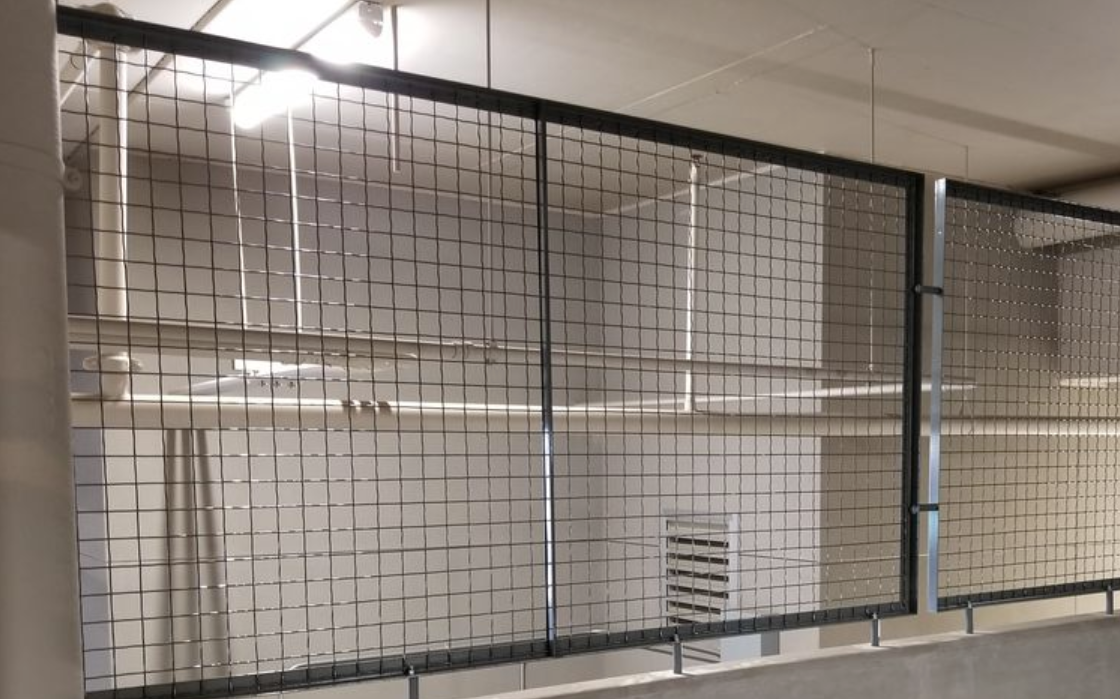
In facilities where visibility, airflow, and structural flexibility all carry operational weight, the choice between a solid barrier and an open-structure partition is rarely straightforward. Facility managers, plant engineers, and procurement teams often default to solid walls or sheet metal enclosures without fully accounting for what that decision costs in ventilation, sightlines, weight load, and long-term maintenance. The reality is that in a wide range of industrial environments, solid barriers create secondary problems even as they solve primary ones. They block air, obstruct supervision, add unnecessary weight to structural supports, and in some cases accelerate corrosion by trapping heat and moisture against surfaces.
This article examines ten specific industrial applications where an open-structure alternative consistently outperforms solid construction — not in theory, but in measurable operational terms. Each application reflects conditions that real facilities manage daily, where the wrong barrier choice creates compounding inefficiencies over time.
Why the Barrier Material Decision Matters More Than Most Teams Realize
The structural choice made at installation often carries operational consequences for years. Many facilities treat partition and enclosure decisions as one-time capital purchases, then absorb the downstream costs without connecting them to the original specification. Industrial mesh panels, when correctly selected for an application, reduce those downstream costs by maintaining airflow, enabling visual monitoring, and distributing structural load more efficiently than their solid counterparts. For facilities managing electrical equipment, machinery, or inventory in environments with temperature variation, humidity, or particulate matter, that difference is tangible. You can review how these mesh panels are structured and applied across different service categories to understand the range of configurations available for varied industrial contexts.
The Cost of Getting This Decision Wrong
When a facility installs solid sheet metal around electrical control panels in a high-heat production area, the enclosure itself becomes a heat trap. Cooling systems work harder, components run hotter, and failure rates increase. The original installation looked like a straightforward compliance decision. The ongoing cost appears in energy bills, technician call-outs, and premature equipment replacement. The barrier material decision is rarely revisited until a failure event makes the root cause obvious.
Machine Guarding in Manufacturing Cells
Machine guarding is one of the most regulated areas of industrial safety, and solid barriers are often assumed to be the more protective option. In practice, the opposite is frequently true for perimeter guarding around automated cells. Open-structure guarding allows operators and safety personnel to visually confirm machine state — whether a robotic arm has completed its cycle, whether a part has been correctly positioned — without opening an access point. This visual confirmation reduces the frequency of unnecessary entry, which is where most guarding-related incidents occur. Solid barriers require workers to open panels to assess machine status, introducing the very exposure the guarding was designed to prevent.
Compliance and Visibility Working Together
Safety standards, including those maintained by bodies such as OSHA’s machine guarding guidelines, recognize that effective guarding is not simply about physical obstruction — it includes maintaining awareness of hazardous areas without requiring entry. Open-structure perimeter barriers satisfy the physical separation requirement while preserving the sightlines that allow supervisors and operators to monitor conditions continuously. In high-throughput environments, that continuous monitoring capability reduces downtime because problems are identified earlier.
Electrical and Control Panel Enclosures
Electrical panels generate heat as a byproduct of normal operation. When enclosed in solid sheet metal without adequate active ventilation, that heat accumulates and shortens the service life of every component inside. Open-structure enclosures allow passive airflow to move heat away from components continuously, without relying on fans or cooling units that introduce their own maintenance requirements. In facilities where power reliability is critical, this passive thermal management represents a meaningful operational advantage over sealed enclosures.
Warehouse Inventory Partitioning
Large distribution and storage facilities regularly need to divide floor space into zones — separating product categories, restricting access to high-value inventory, or creating designated pick areas within a shared floor plan. Solid partition walls make those zones permanent, difficult to reconfigure, and visually opaque in a way that complicates inventory oversight. Open-structure partitioning preserves sightlines across the floor, allowing supervisors to monitor activity across multiple zones simultaneously without physically moving between them. When floor layouts need to change — and in active warehouses, they do — open-structure systems can be reconfigured without significant demolition or construction cost.
Inventory Visibility as an Operational Control
In high-volume picking environments, the ability to see across zone boundaries reduces the time supervisors spend physically walking the floor to verify activity. It also deters internal shrinkage more effectively than solid barriers, which create concealed spaces that are harder to monitor with fixed camera systems. The partition material, in this context, functions as an operational control rather than simply a physical one.
Server Room and Data Center Containment
Data centers operate complex airflow management systems designed to move cool air through equipment and exhaust heat efficiently. Solid barriers placed within data centers to create aisle containment zones often disrupt those airflow patterns unless penetrations are carefully engineered. Open-structure containment allows controlled airflow to pass through the structure itself, reducing the risk of hot spots forming in equipment rows and making it easier to adjust containment arrangements as rack configurations change.
Chemical Storage and Hazardous Materials Zones
Storage areas for chemicals and hazardous materials require both controlled access and adequate ventilation to prevent vapor accumulation. Solid enclosures in these environments create conditions where vapors can concentrate to dangerous levels if ventilation systems are inadequate or temporarily offline. Open-structure barriers maintain passive airflow continuously, reducing vapor buildup as a background condition rather than relying entirely on active ventilation systems to manage it. This redundancy matters in environments where vapor accumulation carries fire, explosion, or health exposure risk.
Regulatory Alignment and Passive Risk Reduction
Facilities storing flammable or toxic materials are subject to ventilation requirements that solid enclosures must actively meet through engineered systems. Open-structure barriers reduce the ventilation burden by design, making compliance easier to sustain across operational conditions, including those where active systems may be temporarily degraded.
Agricultural and Food Processing Environments
Food processing and agricultural handling environments present a specific challenge: they must be regularly cleaned, often with high-pressure water, and they must not trap organic material in ways that create contamination risk. Solid surfaces with seams, overlaps, or concealed cavities accumulate residue in areas that are difficult to access and clean thoroughly. Open-structure barriers expose their full surface area to cleaning processes, leave no concealed spaces for organic material to accumulate, and dry faster after cleaning, which reduces the conditions that support microbial growth.
Perimeter Security Fencing in Industrial Yards
Industrial yards, storage depots, and material handling areas require perimeter security that controls access without creating blind spots that complicate monitoring. Solid perimeter fencing creates visual barriers that work in both directions — they prevent unauthorized observation of the facility, but they also prevent internal security personnel from observing activity near the perimeter from a distance. Open-structure perimeter barriers allow security cameras and personnel to maintain sightlines along the fence line, making unauthorized approach or breach more detectable before it becomes an entry event.
Camera Coverage and Structural Integrity
Open-structure perimeter systems also interact more predictably with wind loads. Solid panels act as sails in high-wind conditions, placing significant lateral stress on posts and foundations. Open-structure systems allow wind to pass through, reducing the structural load substantially and extending the service life of the installation in exposed outdoor environments.
Equipment Staging and Maintenance Bays
Maintenance bays where large equipment is serviced require access from multiple directions, often with overhead cranes, forklifts, or mobile equipment moving through the space. Solid barriers in these environments create fixed boundaries that complicate access for large equipment and require frequent panel removal when work scope changes. Open-structure systems can be reconfigured quickly to accommodate different equipment footprints, keeping maintenance bays productive across a wider range of work orders.
Conveyor Line Separation in Production Facilities
Production facilities running parallel conveyor lines sometimes need to separate product streams — to prevent cross-contamination, to create distinct production zones, or to comply with product segregation requirements. Solid barriers between lines eliminate visual oversight of adjacent lines, requiring supervisors to physically move between zones to monitor production. Open-structure separators maintain zone separation for product and personnel while preserving the visual continuity that allows supervisors to monitor multiple lines from a single position.
HVAC and Mechanical Equipment Enclosures
Rooftop and ground-level mechanical equipment — HVAC units, chillers, compressors — is often enclosed to reduce visual impact, control access, and protect equipment from weather-driven debris. Solid enclosures in these applications restrict the airflow that mechanical equipment requires to operate efficiently. Open-structure enclosures provide the access control and debris management function without restricting the air supply that mechanical equipment depends on. In high-ambient-temperature climates, this distinction has a direct effect on equipment efficiency and service life.
Closing Observations
The common thread across all ten of these applications is that solid barriers solve one problem — physical separation or access control — while creating secondary problems that affect ventilation, visibility, maintenance access, and structural performance. Open-structure alternatives address the primary separation requirement without generating those secondary costs.
This does not mean open-structure solutions are universally appropriate. There are applications where containment of noise, dust, or liquids genuinely requires a solid barrier, and specifying an open-structure system in those contexts would be a clear operational error. The point is that many facilities default to solid construction out of habit rather than specification — and absorb ongoing costs they do not connect to that original decision.
For procurement teams, plant engineers, and facility managers evaluating barrier systems across new construction or retrofit projects, the most productive question is not which barrier type is generally better, but which set of operational requirements — airflow, sightlines, structural load, cleanability, reconfigurability — actually governs each specific application. Answering that question with the same rigor applied to equipment selection tends to produce specifications that perform better over the full operational life of the installation, rather than just at the point of initial commissioning.

