


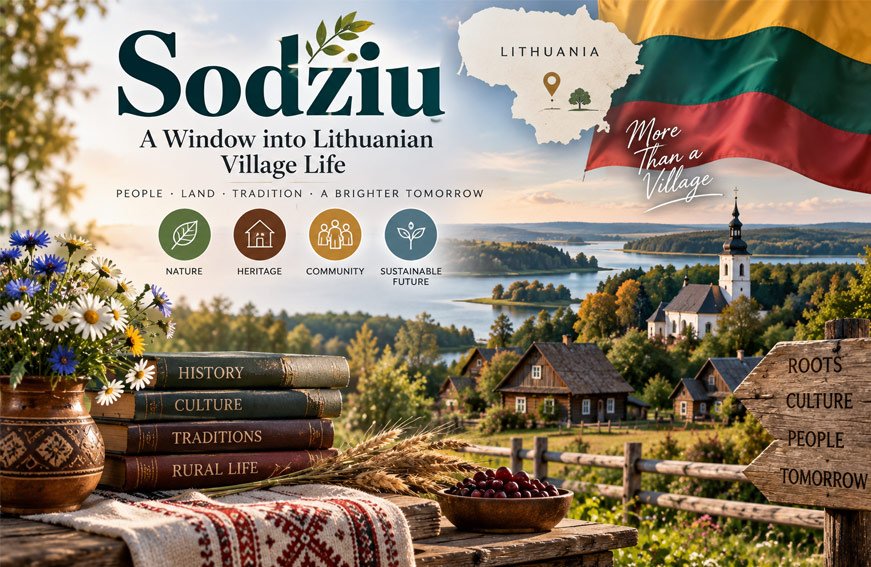
Sodziu is usually linked with the Lithuanian word sodžius, which means a village or rural settlement. The word also has an older historical meaning connected with traditional Lithuanian farming communities.
People often search for Sodziu because different websites give different meanings. Some also confuse sodžius with another Lithuanian word, žodžiu.
This article explains what Sodziu means, where the word comes from, how old Lithuanian villages developed, and what daily rural life was like.
What Does Sodziu Mean?
The most reliable meaning of Sodziu comes from the Lithuanian word sodžius.
It mainly means a village or rural settlement. Some dictionaries also connect it with a farmstead or estate, depending on the context.
Historically, the word had a more specific meaning. A sodžius was a type of Lithuanian rural settlement where farming families lived across agricultural land.
Sodziu is not normally the name of one particular village. It is a common word that can describe a type of settlement.
Where Does the Word Sodziu Come From?
The correct Lithuanian spelling is sodžius.
The letter ž is part of the Lithuanian alphabet. On English-language websites, special letters are sometimes removed, so sodžius may be written as Sodziu.
This simpler spelling can cause confusion because another Lithuanian word, žodžiu, can also look similar when special letters are removed.
When the topic is villages, farms, rural settlements, or Lithuanian countryside history, sodžius is the correct word.
Lithuanian language sources connect sodžius with the idea of a village or peasant settlement.
Sodziu and the History of Lithuanian Villages
Historical sodžiai were part of Lithuania’s rural settlement system.
Sources connect this form of settlement mainly with the period from around the 12th to the 16th centuries.
These settlements developed around farming. Families lived on agricultural land and built homes and other structures as communities grew.
A historical sodžius was not always built according to one fixed plan. Homes could be spread across the land rather than placed along one straight road.
This makes the term useful when learning about how Lithuanian farming communities lived before later changes to land and village organization.
What Did a Traditional Sodžius Look Like?
Early sodžiai were often irregular settlements.
Homes and farm buildings could be spread out instead of standing close together in neat rows. Early homesteads were also quite simple.
Some had only one main building at first. They did not always have the organized courtyards, fences, and groups of buildings that became common later.
The shape of the land also mattered. Fields, forests, water, and other natural features could affect where people built their homes.
As settlements developed, homesteads became more complex. Families added more buildings, fences, and courtyards.
This means there was no single design that every sodžius followed.
How Sodziu Changed During the 16th Century
Lithuanian rural settlements changed greatly during the 16th century.
One important reason was the Valak reform, a major land reform that changed the way agricultural land and villages were organized.
In Aukštaitija, many older sodžiai disappeared as a separate type of settlement during the second half of the 16th century.
Some were reorganized into more regular villages. Houses and farms could be arranged in a clearer street pattern instead of remaining widely scattered.
Homesteads also gained more buildings, fences, and courtyards.
Over time, the word sodžius became less limited to this older settlement type. It later became close in meaning to kaimas, the common Lithuanian word for village.
Farming and Seasonal Life
Farming was an important part of traditional Lithuanian rural life.
Families depended on the land for food and daily needs. They grew crops, cared for animals, repaired tools, and stored food for colder months.
Work changed with the seasons.
Spring was a time for planting and repairs. Summer brought more work in the fields. Autumn was important for harvesting and preparing food for winter.
During winter, outdoor farm work was more limited, but families still cared for animals, repaired tools, and completed work inside the home.
Weather and soil were very important. A good or poor harvest could strongly affect a farming family.
These activities were common parts of Lithuanian village life. They should not be treated as rules of a special system called “Sodziu.”
Family and Community Life
Rural families often depended on one another.
Some types of work were easier when neighbors helped each other. This could include harvesting, building, and other heavy farm jobs.
Community life could also include weddings, funerals, religious events, and local gatherings.
Children learned many skills by watching and helping adults. They might help with animals, gardens, firewood, food preparation, or simple farm work.
Older family members also passed down practical skills, stories, customs, and local knowledge.
This knowledge was often learned through everyday life rather than formal education.
Food and Everyday Rural Life
Traditional country families often used food they could grow, raise, gather, or prepare themselves.
Common foods in Lithuanian rural life included potatoes, bread, dairy products, meat, mushrooms, berries, and vegetables.
Food storage was especially important because winters could be long and cold. Families needed ways to keep food for months when fresh crops were not available.
Preserving, drying, storing, and preparing seasonal food were therefore practical parts of household life.
There is no confirmed special cuisine officially called “Sodziu food.” These foods are better understood as part of traditional Lithuanian countryside life.
Traditional Skills and Crafts
Practical skills were important in rural homes.
People often needed to make, repair, or maintain things themselves. Skills connected with village life could include woodworking, weaving, sewing, basket making, woodcarving, and tool repair.
These were not only hobbies. They helped families manage everyday needs and reduce their dependence on outside goods.
Lithuanian rural culture is also connected with folk songs, storytelling, proverbs, and other oral traditions.
However, these traditions should be understood as part of wider Lithuanian village culture. They were not necessarily unique to every historical sodžius.
Sodziu, Kaimas, and Sodyba
These three Lithuanian words are related to rural places, but they do not always mean the same thing.
Sodžius is an older word linked with a village or rural settlement. Historically, it could also describe a certain type of settlement.
Kaimas is the more common Lithuanian word for a village today.
Sodyba usually refers more closely to a homestead, farmstead, or country property.
The meanings can overlap in some situations, but they should not be treated as exact synonyms in every sentence.
Is Sodziu the Same as Žodžiu?
No. Sodžius and žodžiu are different Lithuanian words.
Sodžius means a village or rural settlement.
Žodžiu comes from the Lithuanian word žodis, which means “word.” It can appear in expressions related to speaking, oral communication, or saying something “in a word.”
This is one reason Sodziu can be confusing online.
When Lithuanian letters are removed, the words can look more similar than they really are.
So meanings such as “in short,” “basically,” or “in a word” should not be given to sodžius.
Sodziu and Lithuanian Rural Culture
Sodziu is closely connected with Lithuania’s countryside and rural history.
Old villages were places where families lived, farmed, raised animals, and shared local customs.
Because of this, the word can also bring up ideas of:
-
family roots
-
farming life
-
village traditions
-
rural heritage
-
local customs
However, Sodziu is not known as one official Lithuanian philosophy or lifestyle.
Its cultural meaning comes mainly from the history of villages and rural communities.
Nature and Rural Life
Nature had a strong effect on traditional village life.
Rain could help or damage crops. Snow could make travel difficult. Forests gave families wood, berries, mushrooms, and other useful resources.
Water also mattered. Wells, rivers, and streams were important for homes, animals, and farming.
People had to pay close attention to the seasons because their work depended on them.
This is why Sodziu is sometimes linked today with simple living and a closer connection to nature.
Is Sodziu a Sustainable Lifestyle?
Some modern websites connect Sodziu with sustainability.
They may mention ideas such as:
-
using local resources
-
wasting less
-
growing food
-
reusing materials
-
living close to nature
These ideas can fit traditional rural life, but Sodziu was not originally the name of a formal environmental movement.
Old farming families often reused materials because resources were limited. They also depended heavily on local food, land, and animals.
It is better to say that modern people may see sustainable lessons in old village life, rather than saying historical sodžiai followed a formal green lifestyle.
Sodziu in Modern Lithuania
The old settlement type changed many centuries ago, but rural life still exists in Lithuania.
Some villages still have farms and family homes. Other country properties are used for holidays, weekends, or visits to relatives.
There is also interest in restoring old houses, growing gardens, and spending more time outside large cities.
The word sodžius also remained in the language, even after the older settlement system changed.
Today, Sodziu is mainly useful as a word linked with village history, rural life, and Lithuanian heritage.
Sodziu and Rural Tourism
Rural tourism can help visitors learn more about life outside Lithuania’s large cities.
People may visit small villages, farms, forests, old wooden houses, and country properties.
Some rural places may offer:
-
local food
-
farm stays
-
saunas
-
outdoor activities
-
craft lessons
-
cultural events
These experiences may reflect traditional countryside life.
However, there is no clear evidence that all of this belongs to one official tourism category called Sodziu tourism.
Sodziu in Branding and Online Use
The word Sodziu or similar forms may appear in the names of businesses, farms, guesthouses, or organizations.
This can make sense because the word has a rural meaning.
A business may use it to suggest:
-
countryside life
-
natural products
-
traditional style
-
farming
-
local heritage
But a company using the word does not change its original meaning.
The same is true for social media. A page or username containing “Sodziu” does not automatically represent the Lithuanian historical term.
Each business, page, or organization must be checked separately.
Why Sodziu Can Be Confusing Online
There are several reasons people may find different meanings for Sodziu online.
One reason is spelling. Lithuanian letters such as ž are often removed on English-language websites.
Another reason is that sodžius and žodžiu are separate words but can look similar without correct spelling.
Some websites also mix cultural ideas with dictionary meanings.
For example, they may describe Sodziu as a full lifestyle based on simplicity, sustainability, and community. These can be modern associations, but they are not the basic dictionary meaning of the word.
The safest meaning is still connected with sodžius, meaning a village or rural settlement.
What Sodziu Does Not Mean
Based on the information available, Sodziu should not automatically be described as:
-
one specific person
-
one famous village
-
an app or software platform
-
a religion
-
a formal lifestyle movement
-
one fixed ceremony
-
one company
Some places or businesses may use similar names, but they are separate from the general Lithuanian word.
Sodziu also does not have personal details such as age, family, career, height, or net worth because it is not a person.
Why Sodziu Still Matters
Sodziu is useful because it helps explain part of Lithuania’s rural history.
The word is connected with older settlement forms, farming communities, and the way villages changed over time.
It also shows how language can keep a link with the past.
Even after the original settlement type changed, the word continued to be connected with village life.
Learning the correct meaning also helps avoid confusion between sodžius and other similar Lithuanian words.
Bottom Line
Sodziu is best understood as a simplified spelling of the Lithuanian word sodžius.
Its main meaning is a village or rural settlement. Historically, it also described an older type of Lithuanian farming settlement.
The word is connected with village life, agriculture, rural communities, and Lithuanian history.
Modern ideas about simple living, sustainability, tourism, and nature can be linked with Sodziu, but they are later interpretations rather than the original meaning.
It is also important not to confuse sodžius with žodžiu, which is a different Lithuanian word.
Frequently Asked Questions
What does Sodziu mean?
Sodziu is usually linked with the Lithuanian word sodžius, meaning a village or rural settlement.
Is Sodziu a Lithuanian word?
The correct Lithuanian form is sodžius. Sodziu is a simplified spelling often used when the letter ž is removed.
How old are traditional sodžiai?
Historical sources connect this settlement type mainly with the period from around the 12th to the 16th centuries.
Is Sodziu the same as žodžiu?
No. Sodžius means village, while žodžiu comes from žodis, meaning “word.”
What is the difference between sodžius and kaimas?
Both can refer to a village, but sodžius has a stronger historical link with an older type of rural settlement. Kaimas is the more common modern word for village.
What is the difference between sodžius and sodyba?
Sodžius refers to a village or settlement. Sodyba usually refers more closely to a homestead, farmstead, or country property.
Is Sodziu a lifestyle or philosophy?
No reliable source shows Sodziu as one official lifestyle or philosophy. It is mainly a word connected with villages and rural history.
Does Sodziu still exist today?
The original historical settlement form changed long ago, but the word still exists and remains connected with Lithuanian village life and rural heritage.
Explore More:

