


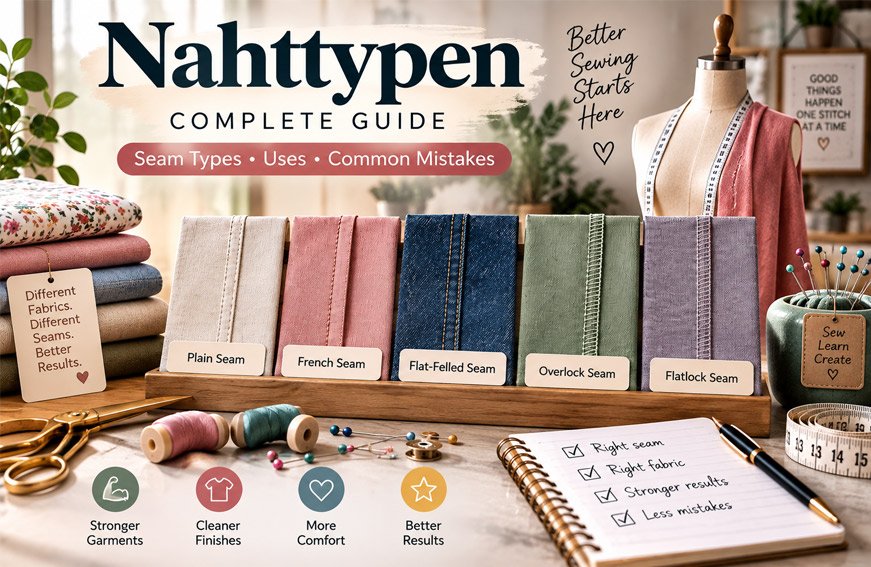
Nahttypen is a German term that usually means seam types in sewing. It describes the different ways pieces of fabric can be joined and finished.
Different seams are used for different jobs. Some give more strength, some hide raw edges, and others work better with stretch fabrics. This guide explains the main Nahttypen, where they are used, and how to choose the right one.
What Does Nahttypen Mean?
Nahttypen is a German plural term. “Naht” means a seam or joining line, while “Typen” means types. In sewing, the simplest English translation is seam types.
A seam is made when two or more pieces of fabric or material are joined. In normal sewing, stitches hold the fabric pieces together. The fabric between the stitching line and the cut edge is called the seam allowance.
A seam type is not exactly the same as a stitch type. A seam describes how pieces of fabric are arranged and joined. A stitch describes how the thread is formed to make that join.
The meaning of Nahttypen also depends on the subject. In sewing, it means seam types. In metalworking, it may refer to weld seams or joint types. In medicine, it can refer to surgical suture types or techniques.
Why Different Seam Types Matter
There is no single seam that works best for every sewing project. Fabric weight, stretch, strength, comfort, and appearance can all affect which Nahttyp should be used.
A seam mainly joins fabric, but it may also protect raw edges from fraying. Some seams add strength in areas that are pulled often. Others allow the material to stretch without the stitches breaking.
Comfort also matters. A thick seam may rub against the skin, especially in sportswear or close-fitting clothes. A flatter seam can make these garments more comfortable.
Appearance is another reason to choose carefully. A French seam can hide raw edges inside a light garment. A flat-felled seam can add visible stitching to denim. Piping can turn the seam itself into a design detail.
The best choice depends on what the finished item needs to do.
Common Nahttypen in Sewing
Most home sewing projects use a small group of common seam types. Each has its own construction and best uses.
Plain Seam
A plain seam is one of the simplest and most common Nahttypen. Two fabric pieces are normally placed with their right sides facing each other. A straight line of stitching joins them near the raw edges.
After sewing, the seam allowances can be pressed open or toward one side. The raw edges remain exposed, so fabric that frays may need another finish. Zigzag stitching or overlocking can help protect the edges.
Plain seams are commonly used for shirts, skirts, dresses, trousers, cushions, and many basic projects. They create little bulk and are also fairly easy to change during fitting.
For beginners, this is usually one of the easiest seam types to learn.
French Seam
A French seam completely hides the raw fabric edges. It uses two lines of stitching instead of one.
The first line is sewn with the wrong sides of the fabric together. The seam is then trimmed, folded, pressed, and sewn again with the right sides together. This traps the raw edges inside the finished seam.
French seams work especially well with light and delicate materials such as chiffon, voile, organza, lightweight cotton, and some silk fabrics. They are often used for blouses, lingerie, and light dresses.
The inside looks neat because there are no exposed raw edges. However, a French seam can become bulky on thick fabric. It is also easier to use on straight or gently curved areas than on very tight curves.
Flat-Felled Seam
A flat-felled seam is made for strength and a clean finish. The raw edges are folded and enclosed, then additional stitching holds the seam flat.
This construction is commonly seen on jeans, denim shirts, workwear, and casual clothing. These items often need seams that can handle regular movement and washing.
The finished seam has no loose raw edges. Its visible stitching can also become part of the garment’s design.
A flat-felled seam takes more work than a plain seam. Accurate trimming, folding, pressing, and stitching are important. Several folded layers can also become bulky on very thick fabric.
Overlock or Serged Seam
An overlock seam is widely used in modern clothing. It is made with an overlocker, also called a serger in some countries.
The machine forms thread around the edge of the fabric. Many overlock machines also trim the raw edge while sewing. This creates a neat edge and helps stop fraying.
Depending on the machine setup, overlocking can join fabric, finish raw edges, or do both. It is common in T-shirts, knitwear, underwear, casual clothing, and mass-produced garments.
Overlocking is fast, but it is not right for every project. Delicate fabrics may look better with an enclosed seam, while areas under heavy stress may need extra reinforcement.
A serger is also not required for good sewing. A regular sewing machine can finish many raw edges with a zigzag stitch.
Flatlock Seam
A flatlock seam is designed to create a flatter joining area. It reduces the thick ridge that some other seams leave inside clothing.
This is useful for clothes that sit close to the body. Flatlock construction is often found in sportswear, activewear, base layers, and underwear. A flatter seam can reduce rubbing against the skin during movement.
Flatlock and overlock are not the same thing. An overlock seam mainly joins or finishes fabric edges. Flatlock construction focuses more on creating a flat, low-bulk seam.
The final result depends on the machine, fabric, thread, and tension settings.
Bound Seam
A bound seam uses another strip of fabric to cover a raw edge. Bias tape or lightweight fabric is often used as the binding.
This gives the inside of a garment a clean finish. Bound seams are often used in tailoring and unlined jackets, where the inside may remain visible.
They can also work with fabrics that would become too bulky if a French seam were used. The binding may be chosen to blend with the garment or become a decorative detail.
Welt Seam
A welt seam starts in a similar way to a plain seam. One seam allowance is trimmed shorter. The longer allowance is then folded over and topstitched in place.
This creates a stronger seam with a visible stitched line. Welt seams can be used in outerwear and structured garments where both strength and appearance matter.
Piped Seam
A piped seam adds a narrow strip of fabric between two fabric pieces. The strip often contains a cord, which creates a raised line along the finished seam.
Piping is commonly used on cushions, upholstery, bags, jackets, and decorative clothing. It can make an edge more visible or add contrast to a design.
Accurate sewing is important because uneven piping is easy to see.
Zigzag and Stretch Seams
Stretchy fabrics need seams that can move with them. A normal straight stitch may break when the material is stretched.
A zigzag stitch moves more easily with the fabric. Many sewing machines also have a special stretch stitch for this purpose.
These stitches are useful for T-shirts, leggings, jersey fabrics, and materials containing elastane or spandex. They are also useful for home sewers who do not have an overlocker.
Lapped Seam
A lapped seam is made by placing one section of material over another instead of joining the edges in the same way as a normal plain seam.
Different forms of lapped construction can be used in clothing, leatherwork, and technical products. The exact construction depends on the material and the purpose of the finished item.
Choosing Nahttypen for Different Fabrics
The fabric should be one of the first things you consider when choosing a seam. Weight, stretch, thickness, and fraying can all change which Nahttyp works best.
Testing the planned seam on a small piece of the same fabric is useful. It can show problems with tension, stretching, puckering, or bulk before you sew the main project.
Woven Fabrics
Woven fabrics usually have less stretch than knitted fabrics. Cotton, linen, denim, and similar materials can work with several seam types.
A plain seam is suitable for many basic woven garments. Flat-felled seams are useful when more strength is needed. Bound seams can provide a cleaner finish where the inside of the garment will be visible.
You should also check how easily the raw edge frays. Fabric that frays quickly needs a suitable edge finish.
Knits and Stretch Fabrics
Knitted and stretch fabrics need seams that can move with the material.
Overlock, flatlock, zigzag, and dedicated stretch stitches are common options. A rigid straight stitch can break when stretchy clothing is pulled during dressing or movement.
The amount of stretch also matters. A slightly stretchy knit and highly elastic sports fabric may need different machine settings.
Delicate and Sheer Fabrics
Thin fabrics such as chiffon, silk, voile, and organza need lightweight seam finishes.
French seams are often a good choice because they hide the raw edges without leaving an exposed overlock finish. Bound seams may also work for some projects.
Heavy seam construction should usually be avoided when it shows through thin fabric or creates unnecessary bulk.
Heavy Fabrics
Heavy fabrics such as denim and canvas need strong stitching, but thickness can become a problem.
Flat-felled seams are often useful for denim because they provide strength and enclose the raw edges. However, several folded layers can become difficult for some sewing machines to handle.
The needle, thread, stitch settings, and machine should all be suitable for the thickness of the material. Testing the seam first can help show whether the machine can sew through all the layers cleanly.
Seam Strength, Comfort, and Appearance
There is no single Nahttyp that is right for every project. The best choice depends on what the seam needs to do.
Strength is important in areas that get pulled or used often. Jeans, work clothes, bags, and similar items usually need stronger seams. A flat-felled seam is often useful for these areas because the edges are enclosed and supported by extra stitching.
Comfort matters when the seam touches the skin. Thick or rough seams can cause rubbing in sportswear and tight clothing. Flatlock seams are useful here because they create less bulk.
Appearance also matters. Some seams are almost hidden, while others become part of the design. French seams give delicate clothes a clean inside finish. Piping and visible topstitching can add a decorative detail.
The right choice should balance strength, stretch, comfort, bulk, and appearance.
Seam Allowance, Thread, Needle, and Machine Settings
Choosing the correct Nahttypen is only part of good sewing. The seam allowance, thread, needle, stitch length, and machine settings also affect the final result.
Seam allowance is the fabric between the stitching line and the raw edge. If it is too narrow, the seam may be difficult to finish or may become weak. Too much seam allowance can create extra bulk.
Stitch length should match the fabric. Very small stitches are not always stronger. On delicate material, the wrong stitch length can cause puckering or even damage the fabric.
The thread and needle should also suit the material. Thin fabrics usually need a finer needle. Heavy fabrics such as denim need a needle that can handle thicker layers.
Machine tension controls how the upper and lower threads work together. Poor tension may cause loose loops, weak stitching, or puckering.
Overlock machines may also have differential feed. This controls how the fabric moves through the machine and can help prevent some knit fabrics from stretching or gathering while being sewn.
Pressing is another important step. Pressing a seam during construction helps it sit flat and gives the finished garment a cleaner shape.
Always test the needle, thread, stitch length, and tension on a scrap of the same fabric before sewing the main project.
Common Nahttypen Mistakes
One common mistake is using the same seam type for every project. A seam that works well on cotton may not work well on jersey, chiffon, or heavy denim.
Using a normal straight stitch on very stretchy material can also cause problems. The thread may break when the fabric stretches.
Raw edges should not be ignored when working with fabric that frays easily. An unfinished edge may continue losing threads during wear and washing.
Seam allowance is another common problem. Too little allowance can make finishing difficult. Too much can add unwanted thickness.
The wrong needle, thread, stitch length, or tension may cause puckering, skipped stitches, broken thread, or weak stitching.
Fabric layers can also move while sewing. This is sometimes called fabric creep. It is more common with smooth or slippery materials.
Poor pressing can make even a correctly sewn seam look bulky or uneven. Pressing during construction helps the fabric sit in the correct position.
How to Fix Common Seam Problems
If a seam is puckering, first check the machine tension, needle, and stitch length. A needle that is too large for a fine fabric can sometimes cause problems. A finer needle may work better.
If stitches are loose or uneven, check the threading and tension. Test any changes on scrap fabric before continuing.
For stretch fabric, use a zigzag stitch, stretch stitch, overlock, or another method that can move with the material.
If one fabric layer moves faster than another, careful pinning or clipping can help. A walking foot can also help feed both layers more evenly, especially with slippery or difficult fabrics.
If the seam is too bulky, check whether the chosen construction is suitable for the fabric. Trimming seam allowances where the method allows can reduce some bulk.
When raw edges fray, use a suitable finish such as overlocking, zigzag stitching, binding, or an enclosed seam.
Testing on scraps is one of the easiest ways to find and fix these problems before working on the actual garment.
Nahttypen in Professional Clothing Production
Nahttypen are also important in professional clothing production. Factories need clear instructions so the same garment can be made in a consistent way many times.
Manufacturers consider more than appearance. Seam strength, sewing speed, available machines, thread use, material cost, production time, and quality requirements can all affect the choice.
A method that works well for one handmade garment may take too much time when thousands of garments need to be produced.
Clear seam specifications also help designers, suppliers, factories, and quality-control teams understand how each part of a garment should be made. This is especially useful when design and production happen in different countries.
ISO 4916 and Seam Classification
Professional textile work can use more detailed seam classifications than home sewing.
ISO 4916 is associated with the classification and terminology of stitched seams. It classifies seams based on their construction and how material pieces are arranged and joined.
This type of standard is useful because common seam names can differ between countries, languages, and companies. A standard system makes technical instructions clearer.
Home sewers do not normally need to memorize the full classification system. Names such as plain seam, French seam, and flat-felled seam are usually enough for normal sewing projects.
German-to-English Nahttypen Terms
German sewing patterns may use terms that are unfamiliar to English-speaking readers. Some useful terms include:
| German term | English meaning |
|---|---|
| Steppnaht | Plain or straight seam |
| Französische Naht | French seam |
| Kappnaht | Flat-felled seam |
| Eingefasste Naht | Bound seam |
| Overlocknaht | Overlock or serged seam |
| Zickzacknaht | Zigzag seam |
| Blindsaum | Blind hem stitch |
| Paspelnaht | Piped seam |
These translations can make German sewing patterns and instructions easier to understand.
Other Meanings of Nahttypen
Nahttypen does not always refer to sewing. The meaning changes depending on the field where the German word Naht is being used.
Nahttypen in Welding
In metalworking, Naht can refer to a weld seam or welded connection. In this context, Nahttypen may be translated as weld types, weld seam types, or joint types, depending on the document.
German welding terms can include I-Naht, V-Naht, and Kehlnaht. Kehlnaht commonly refers to a fillet weld. I- and V-shaped terms can describe forms connected with joint or edge preparation.
Welding terms should be read in their full technical context. Material thickness, joint shape, welding process, drawings, symbols, and standards can affect the correct meaning.
Nahttypen in Medicine
In medicine, Nahttypen can refer to different suture types or suture techniques used to close wounds or surgical cuts.
An Einzelknopfnaht generally means an interrupted suture. Each stitch is placed and tied separately.
A fortlaufende Naht is a continuous suture. One thread is used to form a series of stitches.
A Matratzennaht refers to a mattress suture technique. Different forms can include vertical and horizontal mattress sutures.
An Intrakutannaht may mean an intradermal or subcuticular suture depending on the exact technique and context.
These medical meanings are separate from textile sewing.
How to Translate Nahttypen Correctly
The easiest way to translate Nahttypen correctly is to look at the words around it.
If the text talks about fabric, garments, thread, needles, denim, or overlocking, “seam types” is usually the correct meaning.
If it talks about metal, plates, grooves, welding symbols, or joints, the term is probably related to weld seams or joint types.
If nearby words include wounds, tissue, skin, surgery, or healing, it probably refers to suture types or techniques.
This is why a direct dictionary translation may sometimes be misleading. The technical field should always be checked first.
Bottom Line
Nahttypen usually means seam types when the subject is sewing or textiles. Different seam types are used for different fabrics and purposes.
Plain seams are useful for everyday sewing. French seams give delicate fabrics a clean finish. Flat-felled seams add strength. Overlock and flatlock methods are common with knit and stretch clothing. Bound, piped, welt, and other seams can provide special finishes or decorative details.
The right seam depends on the fabric’s weight, stretch, fraying, expected stress, comfort, bulk, and desired appearance. Testing an unfamiliar seam on scrap fabric before sewing the main project can help prevent mistakes.
Frequently Asked Questions
What does Nahttypen mean in English?
Nahttypen means seam types in sewing. It describes different ways to join and finish fabric.
What are the most common Nahttypen?
Common types include plain, French, flat-felled, overlock, flatlock, bound, and piped seams.
Which Nahttyp is easiest for beginners?
A plain seam is one of the easiest. It uses a simple straight stitch to join fabric.
Which seam is best for delicate fabric?
A French seam works well for many thin and delicate fabrics. It hides the raw edges inside.
Which seam is best for stretch fabric?
Zigzag, stretch, overlock, and flatlock seams can work well with stretchy fabrics.
What is the difference between overlock and flatlock?
Overlock mainly joins or finishes fabric edges. Flatlock creates a flatter seam with less bulk.
What is a strong seam for jeans and workwear?
A flat-felled seam is a strong choice. It is commonly used on jeans and workwear.
Do I need a serger to make good seams?
No. You can make many good seams with a normal sewing machine, including plain, French, and zigzag seams.
Explore More:
AllysPlay.com Review: Gaming Guides, Reviews, Cheats, Mods, and More

