


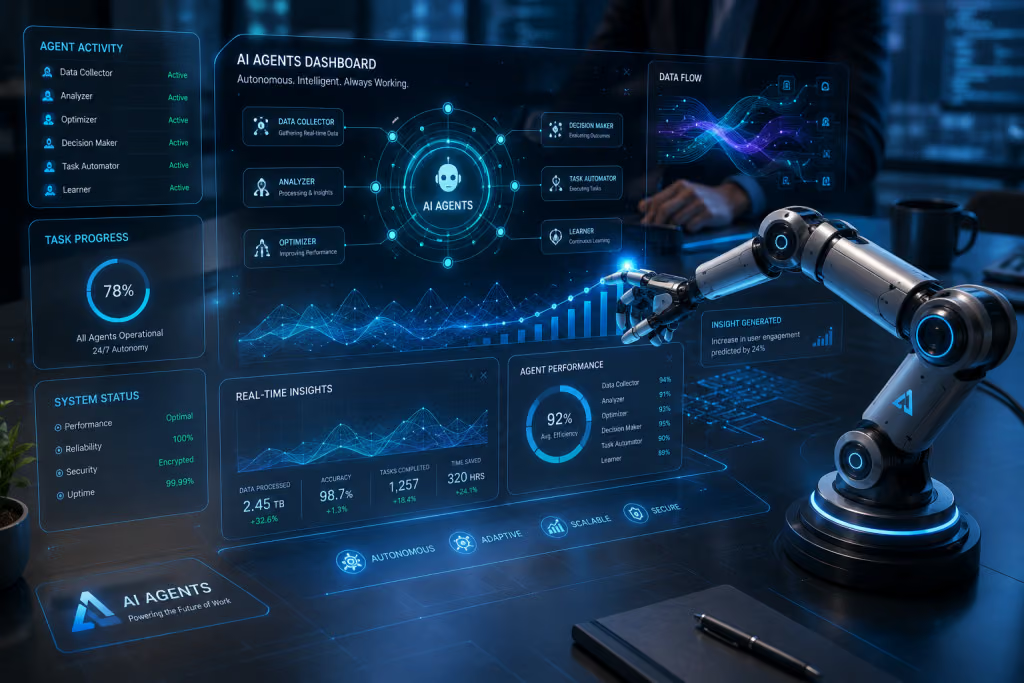
New York businesses are increasingly moving beyond basic chatbots toward AI systems that can complete multi-step tasks, use business tools, retrieve internal information, and coordinate workflows. AI agent development services in New York help companies design these systems around their data, applications, security requirements, and operational goals.
A production-ready AI agent should do more than generate text. It may need to call APIs, access approved knowledge, make workflow decisions, hand off sensitive actions to people, and maintain an audit trail of what it did and why.
What Is AI Agent Development?
AI agent development is the process of building software systems that can reason through a task, choose appropriate tools, retrieve information, and take defined actions.
Unlike a traditional chatbot that mainly answers questions, an AI agent may be able to:
- Call APIs
- Search internal knowledge
- Update business systems
- Route tasks
- Trigger workflows
- Coordinate with other agents
- Ask for human approval
- Track task state across multiple steps
Codewave develops both individual AI agents and multi-agent systems designed around real business workflows rather than isolated demonstrations.
What AI Agent Development Services Include
A complete AI agent project usually involves several engineering layers.
Custom AI Agent Development
Single-purpose agents can be designed around a specific task such as document review, customer support, research, workflow routing, or internal operations.
The agent is connected to the tools and data required to complete that task while limiting what it is allowed to access or change.
Multi-Agent Systems
More complex workflows may benefit from several specialized agents.
For example:
- One agent retrieves information.
- Another analyzes it.
- A third validates the output.
- An orchestration layer determines what happens next.
- A human reviews high-risk decisions.
Multi-agent architectures are increasingly common in current New York AI-agent offerings because they can divide complex workflows into more manageable responsibilities.
RAG for Enterprise AI Agents
AI agents often need access to company-specific information that a public model does not know.
Retrieval-Augmented Generation, or RAG, connects the agent to approved sources such as:
- Internal documents
- Policies
- Contracts
- Product documentation
- Knowledge bases
- Research
- Customer records
The system retrieves relevant material before generating an answer or taking the next action.
Codewave supports RAG pipelines, vector databases, hybrid retrieval, reranking, and evaluation as part of its LLM and agent engineering services.
Why Tool and API Integration Matters
An AI agent becomes operationally useful when it can work with the systems employees already use.
Potential integrations include:
- CRM platforms
- ERP systems
- Ticketing tools
- Databases
- Scheduling systems
- Internal APIs
- Document repositories
For example, a sales agent might retrieve customer information from a CRM, summarize recent activity, draft a follow-up, and then wait for human approval before sending anything.
This ability to use approved tools is one of the core differences between an AI agent and a basic conversational assistant.
AI Agent Use Cases for New York Businesses
New York has a large concentration of industries where AI agents can support information-heavy workflows.
Financial Services
Potential use cases include:
- KYC document review
- Research assistance
- Compliance workflows
- Customer-service routing
- Portfolio information retrieval
- Internal reporting
New York-focused AI providers increasingly emphasize guardrails, auditability, and human approval for financial workflows.
Healthcare
Agents can support:
- Administrative workflows
- Internal knowledge retrieval
- Scheduling
- Documentation review
- Patient-service operations
Healthcare implementations require careful attention to privacy, access controls, and human oversight.
Media and Advertising
AI agents can help teams coordinate:
- Content workflows
- Research
- Campaign operations
- Asset review
- Internal knowledge access
Real Estate and Professional Services
Agents can assist with document review, client intake, research, knowledge retrieval, and repetitive back-office workflows.
Why Human-in-the-Loop Controls Matter
Not every action should be fully autonomous.
A production AI agent should know when to stop and ask a person for approval.
Human review may be appropriate for:
- Financial transactions
- Legal or compliance decisions
- Customer communications
- Data changes
- High-value approvals
- Low-confidence outputs
Current agent-development firms increasingly treat human-in-the-loop design as a core production requirement rather than an optional feature.
AI Agent Security and Governance
AI agents can access more systems than traditional chatbots, which makes security especially important.
A production architecture should define:
- Which tools an agent can use
- Which data it can access
- Which actions require approval
- How credentials are protected
- How activity is logged
- How failures are handled
Codewave’s enterprise AI services include governance, evaluation, private deployment options, observability, and controls intended to support reliable production use.
How AI Agents Are Tested Before Deployment
AI agents should not move directly from prototype to production.
Testing should evaluate:
- Response accuracy
- Tool selection
- Retrieval quality
- Task completion
- Failure handling
- Security boundaries
- Latency
- Cost
- Human escalation behavior
Evaluation becomes particularly important when agents can take actions rather than simply provide suggestions.
Codewave includes agent evaluation and observability within its broader LLM and agent engineering approach.
AI Agent Proof of Concept vs. Production System
A proof of concept is useful for validating whether an AI workflow is technically feasible and worth pursuing.
A production system requires additional work.
That may include:
- Authentication
- Permissions
- Monitoring
- Error handling
- Data security
- Scaling
- Evaluation
- Logging
- User experience
- Deployment infrastructure
Codewave offers AI PoC prototyping alongside production-grade agent development so organizations can validate a use case before committing to a larger implementation.
How to Choose an AI Agent Development Partner in New York
Look beyond whether a company can build a chatbot.
A strong development partner should be able to explain:
- How agents will access your systems
- How RAG will be evaluated
- How tool permissions will work
- Where human approvals belong
- How failures are monitored
- How sensitive data is protected
- How the system will scale
- How business outcomes will be measured
The right partner should also understand software engineering and product design, because an AI agent still needs to function reliably inside a real application or workflow.
From AI Agent Idea to Production
A typical development process may include:
- Identify the workflow and business outcome.
- Map required tools and data.
- Define agent responsibilities.
- Design RAG and integration architecture.
- Build a focused prototype.
- Test with real user scenarios.
- Add permissions, evaluation, and monitoring.
- Deploy and improve based on production usage.
Codewave focuses its agentic AI work on moving from proof of concept to production-ready systems that connect models, data, tools, and workflows.
Build AI Agents Around Real Business Workflows
Successful AI agents are designed around a specific business process, not simply around the capabilities of the latest model.
Codewave provides AI agent development services in New York for companies that need custom agents, multi-agent architectures, RAG, enterprise integrations, workflow automation, governance, and production deployment. The goal is to build AI systems that can reliably perform useful work inside existing business operations.

