


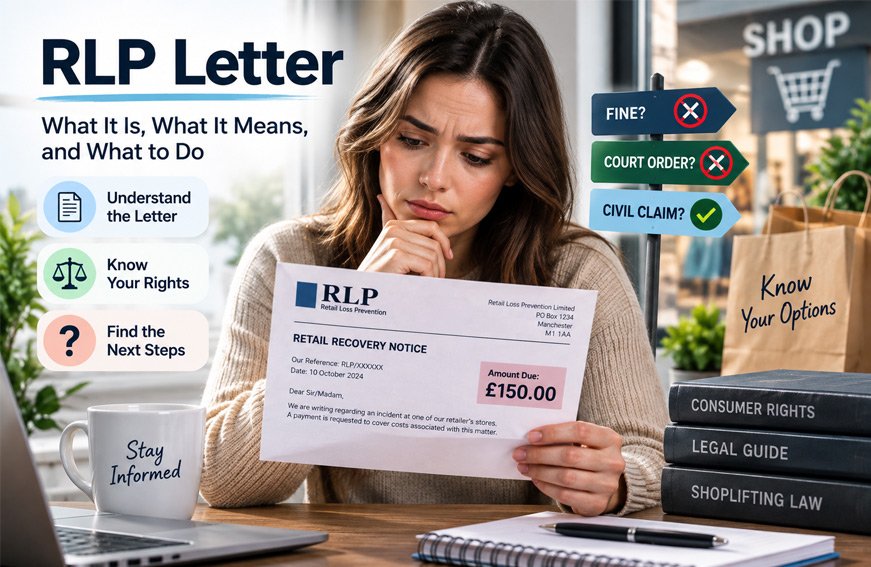
An RLP letter usually refers to a civil recovery letter from Retail Loss Prevention Limited (RLP) in the UK. It may be sent after a retailer reports an alleged shoplifting, theft, fraud, or another incident that it says caused a loss.
Many people search for information about an RLP letter because they are unsure whether it is a fine, a court order, or something they must pay. This guide explains what the letter means, why it is sent, what costs may be claimed, and what options a person may have.
What Is an RLP Letter?
An RLP letter is usually a civil recovery demand sent by Retail Loss Prevention Limited on behalf of a retailer. RLP works with UK businesses to recover money they say they lost because of an incident.
The letter may follow an allegation of shoplifting, theft, fraud, employee theft, or another event that the retailer believes caused a financial loss. RLP describes its work as civil recovery, which is separate from the criminal justice process.
An RLP letter is not the same as a court judgment. It does not mean that a court has already decided that the person owes the money.
The amount requested may also need to be looked at carefully. A retailer may claim different costs connected with an incident, but receiving a demand does not automatically prove that every amount listed is legally recoverable.
The term RLP can also have other meanings in different industries. In the context of a UK retail recovery letter, however, it usually refers to Retail Loss Prevention.
Why Do People Receive an RLP Letter?
A retailer may send details of an alleged incident to RLP after a person has been stopped, identified, or reported in connection with an incident at a store.
RLP may then contact the person about a civil recovery claim. The letter normally explains why the retailer believes money is owed and gives information about the amount being requested.
Common situations may include:
- Alleged shoplifting
- Theft of goods
- Refund or discount fraud
- Employee theft
- Damage to goods
- Other incidents that a retailer says caused a financial loss
An RLP letter can be sent even when the police are not involved. Civil recovery and criminal proceedings are separate processes.
In some cases, the same incident can lead to both a criminal matter and a civil claim. One process does not automatically prove the other.
The letter is therefore about the retailer’s claimed financial loss. It should not be treated as proof that a person has been criminally convicted.
What Information Does an RLP Letter Contain?
The exact format can vary, but an RLP letter may contain several important details about the claim.
It may identify the retailer, explain the alleged incident, and give the date and location of what happened. It can also include a case or reference number.
The letter may explain the amount being requested and why the retailer says this money is owed. It may also provide instructions about payment, contacting RLP, or responding to the claim.
Some letters may mention possible further recovery action or court proceedings if the matter is not resolved.
Before responding, it is useful to check the main details carefully:
- Your name and address
- Retailer’s name
- Date and location of the incident
- Description of the allegation
- Amount being claimed
- Case or reference number
- Response or payment deadline
- Contact details
A formal-looking letter should still be checked carefully. If a name, date, amount, or other detail appears wrong, keep a record of the problem.
It is also sensible to keep the original letter and any other documents connected with the matter.
What Costs Can an RLP Claim Include?
An RLP claim may ask for money connected with losses that the retailer says resulted from the incident. The amount is not always limited to the price of the goods involved.
Possible costs may include:
- Missing or damaged goods
- Staff time
- Administrative work
- Investigation work
- Security-related costs
For example, a retailer may say that staff spent time dealing with an incident, checking records, preparing reports, or handling other related work.
This is why the amount requested can sometimes be higher than the value of the goods involved.
However, a cost being listed in an RLP letter does not automatically mean that a court would accept the full amount. If a claim is disputed, the basis of the claimed loss and the supporting evidence can become important.
Citizens Advice has previously raised concerns about claims for general staff, administration, and security costs. The costs claimed in an individual case should be supported and connected to the circumstances rather than simply assumed to be payable.
The amount requested can also vary from one case to another. There is no single fixed RLP fee that applies to every letter.
Is an RLP Letter a Fine or Court Order?
No. An RLP letter is not the same as a criminal fine or a court order.
A fine is a legal penalty that can be imposed through the criminal justice system. An RLP letter is normally a civil recovery demand from a private company acting for a retailer.
The letter may say that money is owed, but that does not mean a court has already decided that the money must be paid.
It is also different from a County Court Judgment (CCJ). A CCJ is a court judgment. An RLP letter is not a CCJ.
These differences are important because the wording of a letter can sound formal. Readers should check whether they have received a private demand or actual court papers.
Do You Have to Pay an RLP Letter?
Receiving an RLP letter does not by itself create a court order requiring immediate payment.
The claim still needs to be considered based on the facts of the case. This can include what happened, what evidence exists, what loss the retailer says it suffered, and how the amount was calculated.
A person who receives an RLP letter may have different options. These can include paying the requested amount, discussing a settlement, disputing the claim, asking for more information, or getting independent advice.
The right option depends on the individual situation. A person should understand what the payment is for before sending money or accepting responsibility.
If the amount is disputed or the facts are unclear, it may be useful to ask for more information about the claim. Citizens Advice and qualified legal professionals can also provide guidance about individual circumstances.
Can You Dispute an RLP Claim?
Yes. A person can dispute an RLP claim if they do not accept the allegation or the amount being requested.
For example, someone may believe that the incident did not happen as described, that there was no loss, or that some of the claimed costs have not been properly explained.
A response should be clear and based on facts. If liability is denied, RLP has stated that it expects an explanation of what happened rather than only a short statement saying that the claim is denied.
It is useful to keep copies of:
- The original RLP letter
- Emails and other messages
- Receipts
- Store paperwork
- Relevant photographs
- Witness details
- Notes about what happened
Do not add information that is not true or make statements about events you are not sure about. If the matter is serious or legal action is mentioned, independent advice may be helpful before sending a detailed response.
What Happens If You Ignore an RLP Letter?
Ignoring an RLP letter does not automatically make the matter disappear.
RLP may send further correspondence about the claim. Its stated process also allows for possible legal action in some cases.
This does not mean that every unpaid RLP demand will go to court. Court action is not automatic. However, it should not be described as impossible.
If official court papers arrive, they are different from an ordinary RLP demand. They may include a court name, claim details, formal instructions, and a deadline for responding.
Those documents should be taken seriously. Missing a court deadline can affect how a case is handled.
For this reason, a person should first understand what the letter says, check any deadlines, and consider suitable advice rather than simply ignoring every letter.
Can RLP Take You to Court?
Civil court action is possible if a retailer decides to pursue a claim.
An RLP letter itself does not mean that a court case has started. A formal court claim is a separate step in the legal process.
If a case reaches court, the retailer would need to present its claim and supporting evidence. The person receiving the claim would also have an opportunity to respond according to the court process.
A historical case often discussed in connection with retail civil recovery is A Retailer v Ms B and Ms K, heard at Oxford County Court in 2012. The retailer’s claim was dismissed after the court considered the claimed losses and the work carried out by security staff.
That case is useful as historical background, but it does not mean that every RLP claim will have the same result. Each case depends on its own facts, evidence, losses, and legal arguments.
Can an RLP Letter Affect Your Credit Record?
An RLP letter by itself is not a County Court Judgment (CCJ).
Receiving a civil recovery demand is therefore different from having a court judgment entered against you.
A credit-related issue can arise later if a civil claim reaches court and a judgment is entered. GOV.UK states that a CCJ normally remains on the Register of Judgments, Orders and Fines for six years.
There are also rules about paying a CCJ. If it is paid in full within one month, the person can apply to have it removed from the register. If it is paid later, it can normally be marked as satisfied but can remain on the register for six years.
This means it would be incorrect to say that simply receiving an RLP letter automatically damages a person’s credit record.
What Should You Do After Receiving an RLP Letter?
Start by reading the complete letter carefully. Check the sender, retailer, incident date, location, allegation, amount, reference number, and any deadline.
Keep the original letter and other documents connected with the matter. Useful records may include receipts, emails, photographs, store paperwork, and notes about what happened.
Check whether the information in the letter is correct. If you believe something is wrong, write down the details and keep evidence that supports your position.
It is also important to check how the sender wants payment to be made. If anything looks unusual, verify the contact details independently before sending money or personal information.
Do not assume that a formal-looking letter is the same as court paperwork. If the letter mentions court action, make sure you understand whether it is only a warning about possible action or an actual court claim.
If you dispute the claim, keep your response factual and focused. If the amount is large, the facts are disputed, or formal court papers have arrived, consider speaking with Citizens Advice or a qualified legal professional.
How to Check Whether an RLP Letter Is Genuine
Before sharing personal information or making a payment, check that the letter is genuine.
Look at the full company name, address, telephone number, email address, reference number, and details of the alleged incident.
Do not rely only on a logo or professional design. These details can be copied in fake letters.
If you need to contact the company, use contact information that you have checked independently where possible. Be careful with unexpected requests for passwords, banking information, or other sensitive details.
A genuine claim should be able to identify the matter it concerns. If important information is missing or something does not appear correct, ask for clarification before taking action.
What If the Recipient Is Under 18?
An RLP letter involving someone under 18 needs extra care.
The legal position can depend on the person’s age, what happened, and which part of the UK is involved. There is no simple rule that a parent must always pay a claim involving a child.
A parent or guardian can review the letter with the young person and keep all related documents.
Citizens Advice or a qualified solicitor may be able to explain the position based on the specific facts. This can be especially useful before admitting liability, agreeing to payment, or sending a detailed response.
Civil Recovery vs. Criminal Shoplifting
Civil recovery and criminal proceedings are different processes.
A civil recovery claim focuses on money that a retailer says it lost because of an incident. An RLP letter is normally part of this process.
A criminal case concerns an alleged offence and is handled through the criminal justice system. Depending on the circumstances, it can involve the police, prosecutors, and criminal courts.
The same incident can sometimes lead to both processes. A person could therefore receive an RLP letter while also facing a separate criminal matter.
Receiving an RLP letter alone does not create a criminal record. It should not be described as a criminal conviction or criminal fine.
RLP Letter and Privacy
An RLP letter may contain personal information such as a person’s name, address, reference number, and details about an alleged incident.
Keep these documents in a safe place. If you share a photograph or scan online for advice, remove personal details that could identify you.
Be careful when replying by email. Check that the email address belongs to the organization you intend to contact before sending identification documents or other sensitive information.
If a request for personal information seems unnecessary, you can ask why the information is needed and how it will be handled.
Common Mistakes to Avoid
People receiving an RLP letter can make simple mistakes because they do not understand the difference between a civil demand and court paperwork.
Common mistakes include:
- Paying immediately without checking the claim.
- Assuming the letter is a criminal fine.
- Assuming the letter is already a court judgment.
- Ignoring all correspondence.
- Admitting responsibility without understanding the facts.
- Failing to keep copies of important documents.
- Missing a stated deadline.
- Assuming every cost in the letter must automatically be paid.
- Sharing personal or financial information without checking the sender.
Reading the letter carefully and keeping good records can help avoid these problems.
RLP Letter: Key Facts to Remember
An RLP letter is generally connected with Retail Loss Prevention and civil recovery in the UK.
The main points to remember are:
- It is normally a civil recovery demand.
- It is not automatically a criminal fine.
- It is not a court judgment.
- It is not the same as a CCJ.
- The amount claimed can include different types of alleged losses and costs.
- The exact claim depends on the facts and supporting evidence.
- Court action is possible but is not automatic.
- A person can dispute a claim.
- An RLP letter alone does not create a criminal record.
- Official court papers should be treated differently from a private demand letter.
Bottom Line
An RLP letter is usually a civil recovery demand connected with an alleged retail loss. It is not automatically a criminal fine, court order, or CCJ.
The amount claimed and the legal position can depend on the facts of the individual case. If you receive one, check the details carefully, keep all related records, and understand what the letter is asking before deciding how to respond.
Frequently Asked Questions
What does RLP stand for?
RLP means Retail Loss Prevention. It helps retailers deal with civil recovery claims in the UK.
Is an RLP letter a fine?
No. It is a civil payment request, not a criminal fine.
Do I have to pay an RLP letter?
Not automatically. Check the claim, the amount, and the facts before deciding what to do.
Can I dispute an RLP claim?
Yes. You can dispute the claim if you believe it is wrong or the amount is not correct.
What happens if I ignore an RLP letter?
You may receive more letters or possible legal action. Court papers should not be ignored.
Is an RLP letter a CCJ?
No. An RLP letter is not a County Court Judgment (CCJ).
Can an RLP letter affect my credit record?
The letter itself is not a CCJ. Credit issues may arise later if a court gives a judgment.
What should I do after receiving an RLP letter?
Read it carefully, check the details and deadline, keep your records, and get advice if needed.
Explore More:

