


The last ride of the season rarely announces itself. A wet weekend turns into a cold week, the bike stays in the garage, and suddenly it has been sitting there for a month with road grit on the frame and a battery nobody has checked.
Preparing an electric bike for winter storage takes some attention, but most of the work belongs to one afternoon. Clean it, choose a suitable place for the bike and battery, and leave yourself a record of what needs checking. The aim is to avoid finding a flat tire, corroded chain, or neglected battery when the first good riding day arrives.
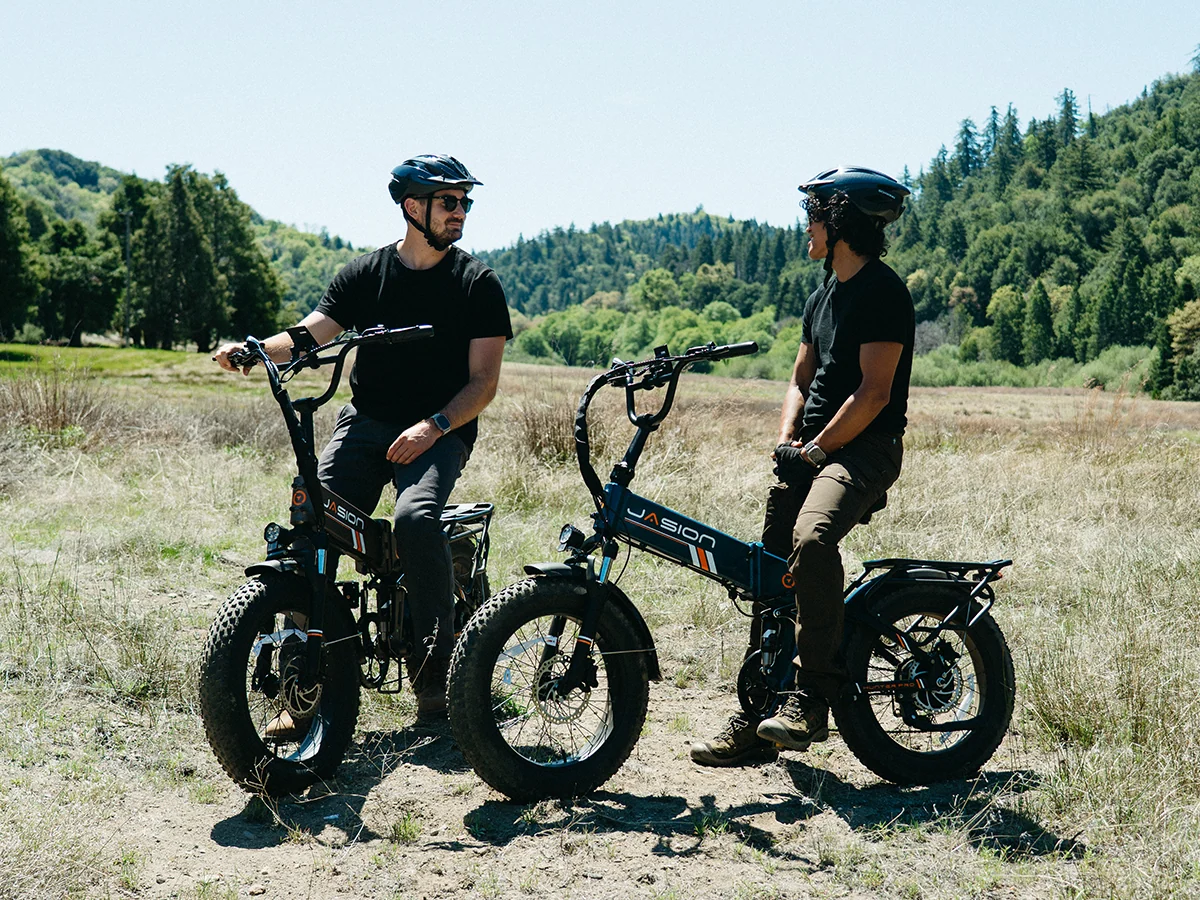
Two Jasion riders pause beside their fat-tire ebikes.
Clean the Bike Before You Put It Away
A bike that looks reasonably clean from above can still have salt and dirt underneath its fenders, around the drivetrain, and behind the wheels. Those are worth checking after rides on treated winter roads. Leaving the residue in place gives moisture more time to work on exposed metal.
Switch the bike off and follow its cleaning instructions. Use a soft brush and damp cloth where appropriate, rather than directing a pressure washer at bearings, electrical connections, or the battery compartment. Remove loose grit before wiping painted surfaces so you do not grind it into the finish.
Dry the bike thoroughly before covering it. Pay attention to places where water collects, including bags and accessories. A damp pannier left attached for months can become its own unpleasant spring discovery.
If the bike has a chain, clean and lubricate it with a suitable bicycle chain lubricant, then wipe away the excess. Keep lubricant away from brake rotors and pads. A heavy coating that attracts dirt is not useful protection.
This is also a convenient time to identify repairs. A brake that was rubbing in October will probably still be rubbing in March. Write down the fault or book service while you remember exactly what happened.
Give the Battery Its Own Storage Plan
The bike and its battery do not necessarily belong in the same place all winter. A garage may offer a dry parking space while falling outside the battery manufacturer’s permitted storage conditions during a cold spell.
Check the instructions for the exact model. Jasion owners can find the official starting point in the Jasion user manuals. Look specifically for long-term storage, battery care, and charging conditions. An operating temperature range does not automatically describe safe charging or storage conditions.
Where the manufacturer allows battery removal, follow the prescribed shutdown and removal procedure. Keep the battery in a dry location within its stated storage limits, away from heat sources and anything that could damage its case or terminals. Do not open a battery housing or dismantle an integrated system to make storage easier.
There is no single storage charge percentage that should be applied to every ebike. Use the level and inspection interval specified for your battery. Leaving it nearly empty for months can allow further discharge; leaving it connected to a charger all winter is not a substitute for following those instructions.
A note on your phone is sufficient: model name, storage date, charge indication, and next check date. If the display only shows bars, record the bars. There is little value in inventing a precise percentage the bike cannot report.
A Cold Battery Needs Time Before Charging
Bringing a battery indoors does not instantly bring its internal temperature up to room conditions. After a cold garage or outdoor journey, it may need time to reach the manufacturer’s permitted charging temperature.
Let that happen naturally. Do not put the battery against a radiator or use a heater to speed things up. A move from cold air into a warmer room can also leave condensation on surfaces. Check that the battery, charging connection, and surrounding area are dry before connecting the charger.
Use the charger supplied or specifically approved for the battery, and follow the stated connection and disconnection sequence. Charge while awake and able to monitor it, away from combustible materials and without blocking an exit. Winter storage is not a reason to improvise with a generic trickle charger or a replacement that merely has a plug that fits.
Cracks, swelling, leaking, unusual heat, or a new odor require attention before further use. Stop charging and seek instructions from the manufacturer or an appropriate service provider. Do not try to test a questionable battery by giving it one more charge.
Choose a Parking Spot You Can Still Reach
An inaccessible bike is easy to forget. Leave enough space to inspect the tires, see the floor beneath it, and reach any parts that need periodic attention. Avoid a damp corner, a position exposed to leaks, or a spot beside a heater.
Smaller dimensions can help when floor space is limited. An electric mini ebike may fit somewhere a larger bike will not, but measure the usable space and check its weight before choosing a rack or stand. A compact frame does not establish that a bike is light enough for a wall hook.
For a folding model, follow the folding procedure and check that cables are not pinched or stretched. Do not leave the bike balanced precariously because it takes up less space that way.
Check tire pressure with a gauge and use the approved pressure for the tire and bike. Tires can lose air during storage, so a firm squeeze at the start of winter is not a season-long check. If using a stand or suspension system, confirm that it supports the bike’s weight and contacts it only at suitable points.
A cover can keep dust off a dry bike. Putting one over a wet bike merely hides the moisture.
Keep the Checks Short Enough to Actually Do
Use the manufacturer’s battery inspection schedule as the starting point for a recurring reminder. While checking the battery, look for tire pressure loss, fresh corrosion, dampness, or signs that something has been knocked out of position.
Record any change instead of relying on memory. An unexpectedly large change in the battery indication deserves a check against the manual or a question to support. Do not repeatedly top it up without investigating what has changed.
An occasional winter ride means revisiting the routine afterward. Clean away road salt, dry the bike, and allow the battery to reach its permitted charging conditions. If you expect to ride again only after several weeks, return to the model’s storage guidance rather than treating it as a daily commuter.
Jasion handlebar controls, ready for a pre-ride check.
Before the First Ride Back
Set aside time for the first inspection before you need the bike for an appointment. Check tire pressure and condition, wheel security, steering, lights, and brakes according to the manual. Refit a removable battery correctly and confirm that its retention mechanism is secure.
Make sure the bike rolls freely and that the brakes work before adding motor assistance. Start with a short, slow ride in a suitable area. Listen for rubbing, check that shifting works where fitted, and pay attention to braking response.
An error code, loose component, or brake that feels different is a reason to stop and investigate. Keep the first outing close enough to home that finding a problem does not leave you miles away with a bike you cannot safely ride.

