


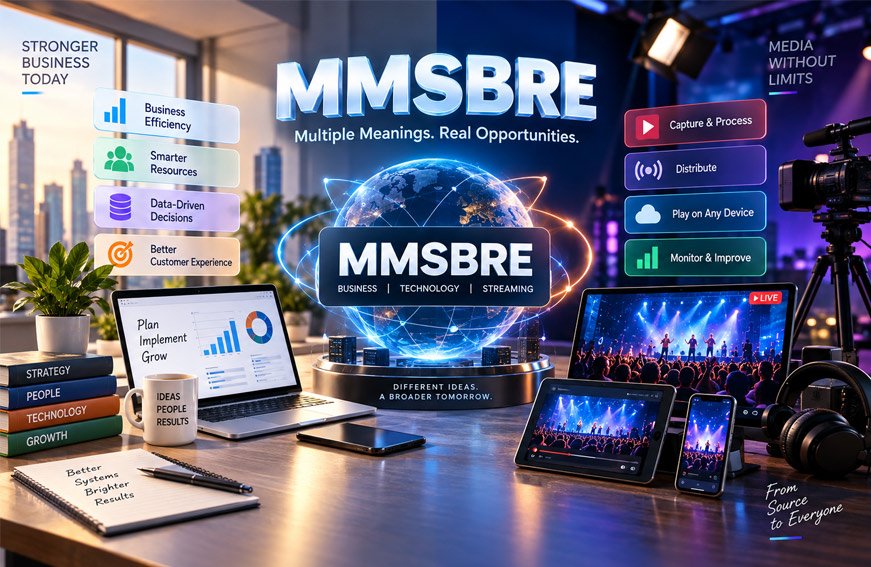
MMSBRE is a term that has started appearing on different websites. The problem is that there is no single accepted meaning. Some sources connect MMSBRE with business efficiency and digital systems. Others describe it as a multimedia streaming and broadcast environment.
This difference can make the term confusing. There is also no clear evidence that MMSBRE is an official business framework, technology standard, or software product.
This article explains the different meanings linked with MMSBRE, how these ideas may work in practice, and which claims should be treated carefully.
What Is MMSBRE?
MMSBRE is an emerging term with several different explanations online. It does not currently have one clear definition that is accepted across business or technology industries.
Some websites describe MMSBRE as a business concept. In this meaning, it is linked with better workflows, smart resource use, digital systems, data, and customer experience.
Other sources use MMSBRE for multimedia streaming. They describe a system that receives audio or video, processes it, and sends it to different platforms or viewers.
There are also online articles that connect the term with AI, security, and business resilience. These descriptions do not always agree with each other.
This is important because MMSBRE should not be treated as one established system without explaining which meaning is being used. No confirmed creator, company, or standards organization has been identified in the information collected for this article.
What Does MMSBRE Stand For?
One reported full form of MMSBRE is Multi-Media Streaming and Broadcast Relay Environment.
Under this meaning, each part describes a role in media delivery.
Multi-Media can include video, audio, captions, graphics, metadata, and other digital content.
Streaming means sending media continuously so people can watch or listen without first downloading the complete file.
Broadcast Relay refers to receiving a media feed and then sending or preparing it for one or more destinations.
Environment refers to the wider setup. This may include software, servers, streaming services, security controls, monitoring tools, and the people who manage them.
However, this full form should be treated as a reported interpretation, not an official expansion. The collected information does not show that a major standards organization has formally defined MMSBRE this way.
This also explains why some websites use the same acronym for completely different ideas.
MMSBRE as a Business and Digital Concept
Another common online explanation presents MMSBRE as a broad business and digital concept.
In this interpretation, the main idea is simple: a business should use its people, money, data, software, and time carefully. It should reduce unnecessary work while building systems that can support future growth.
Business efficiency is an important part of this idea. A company may review how work moves from one person or department to another. It can look for repeated tasks, slow approvals, unnecessary tools, or other problems that waste time.
Resource management is another part. Resources can include employees, budgets, equipment, software, data, and office space. Businesses can study where these resources are being used and whether they are producing useful results.
Digital systems also play a role. Companies now depend on software for communication, payments, customer records, files, analytics, and project management. A good system should make work easier rather than adding more steps.
The business interpretation of MMSBRE also gives importance to customers. Improving an internal process is useful when it also helps customers receive faster, clearer, or more reliable service.
Data can support these decisions. For example, a business can study costs, sales, customer behavior, workloads, and delays. The goal is not to collect as much data as possible. The useful part is choosing information that helps the team make a clear decision.
These ideas are already common in business management and digital transformation. What remains unclear is whether MMSBRE itself represents a formal framework that combines them. The collected sources do not provide confirmed rules, official documentation, or a recognized organization behind such a framework.
How MMSBRE Could Be Used in Business
Under the business interpretation, MMSBRE could be used as a general way to review how a company works.
A business might begin by looking at an existing process. For example, it could check how a customer order, support request, or internal task moves through the company. If the same information is entered several times or a task waits too long for approval, the process may need improvement.
Automation can help with repeated work. However, automation should solve a real problem. Adding software to a poor process can make the process more complicated instead of improving it.
Companies can also review how they use their resources. This may include checking software costs, staff workloads, equipment use, and the amount of time spent on different tasks. The information can help managers decide where changes are needed.
Scalability is another consideration. A system that works for a small team may become difficult to manage as the business grows. Digital tools should therefore be chosen with future users, data, and workload in mind.
Customer experience should remain part of these decisions. Feedback, support requests, and user behavior can show where customers face problems. A business can then improve the process based on those real issues.
Still, these should be understood as possible applications of the business-focused interpretation of MMSBRE. There is no verified MMSBRE manual or official method that requires businesses to follow these exact steps.
MMSBRE and Multimedia Streaming
The streaming interpretation of MMSBRE is very different from the business interpretation.
Here, MMSBRE is described as an environment that manages the full journey of digital media. A video or audio feed enters the system, is prepared for delivery, and is then sent to viewers through one or more platforms.
It is not described as one application. Instead, several technologies can work together.
The process may include media capture, ingest, encoding, packaging, distribution, playback, security, and monitoring.
For example, a live event may begin with cameras and microphones. The video is received by an ingest system and encoded into formats suitable for online delivery. Different quality levels may be created so viewers with different internet speeds can receive a suitable stream.
The content can then be prepared for streaming and distributed through a content delivery network, or CDN. Viewers may receive it through a website, mobile app, smart TV app, private portal, or another supported platform.
Security can also be part of the setup. Depending on the content, this may include user authentication, access rules, encryption, signed links, or digital rights management.
Monitoring is important because a problem can happen at any point between the original source and the viewer. Teams may watch for encoding errors, slow delivery, buffering, playback failures, and other issues.
Under this interpretation, MMSBRE is therefore better understood as a reported name for a complete media-delivery environment, rather than a single streaming technology.
How the Streaming Model Works
A streaming setup described as MMSBRE can be divided into several stages.
Media Capture and Ingest
The process starts with the media source. This could be a camera, microphone, screen share, studio feed, recorded video, or remote contribution feed.
The ingest system receives this media and moves it into the streaming environment.
Professional setups may also use backup feeds. If the main source fails, operators may be able to switch to another source.
Encoding and Transcoding
Raw video can require a large amount of data. Encoding compresses the media into a format that is easier to deliver over the internet.
A system may create several versions of the same video at different quality levels. A player can then change between these versions based on the viewer’s internet connection and device.
This process is commonly used in adaptive streaming.
Packaging and Origin
After encoding, the media can be packaged for online delivery.
Recognized streaming technologies such as HLS and MPEG-DASH may be used at this stage. The origin system provides the files, media segments, captions, and other information needed by the player.
Depending on the setup, this part of the system may also support encryption, advertising, or turning a live stream into video that can be watched later.
Relay and Distribution
The processed stream must then reach viewers.
A CDN can distribute the media through servers in different locations. This reduces pressure on the original server and can make it easier to serve large audiences across different regions.
The same source may also be sent to several destinations. These could include websites, apps, smart TVs, social platforms, partner services, or private company systems.
Playback, Security, and Access
The media player is the part viewers interact with. It plays the stream and may automatically select a suitable video quality.
The player may also handle captions and recover from short connection problems.
Access controls depend on the type of content. A public stream may need few restrictions. Paid, private, or sensitive content may require login checks, encryption, access permissions, or other security controls.
Monitoring and Operational Control
Streaming does not end when the video reaches the player. The system also needs to be monitored.
Teams can track whether the original feed is working, whether encoding is successful, how quickly videos start, and whether viewers experience buffering or playback errors.
They may also monitor the number of viewers, device performance, and differences between regions.
This helps operators find where a problem is happening instead of only knowing that viewers cannot watch the stream.
Technologies Linked With the Streaming Interpretation
The streaming interpretation of MMSBRE includes several real and established media technologies. These technologies can work together in a larger streaming setup.
HLS is a technology used to deliver live and recorded video over the internet. It can provide different quality levels so the video can adjust to the viewer’s connection.
MPEG-DASH is another adaptive streaming method. Like HLS, it can provide different versions of a video and allow the player to choose a suitable quality.
CMAF can also be used when preparing media for modern streaming services. Other technologies such as SRT, RTMP, and WebRTC may be used for moving live video or supporting low-delay communication.
A CDN, or content delivery network, has a different role. It helps distribute media to viewers from servers in different locations. This can improve delivery and reduce pressure on the original server.
These are established technologies with their own purposes. MMSBRE should not be treated as a replacement for HLS, MPEG-DASH, a CDN, or another recognized streaming technology. Under the streaming interpretation, it is simply a name used for the wider environment in which these technologies may work together.
Where a Streaming Setup Like This Could Be Used
A streaming setup described as MMSBRE could have several uses.
Live events and sports are one example. A single video feed may need to reach a website, mobile app, social platform, and broadcast partner at the same time.
Schools and universities can use similar systems for online classes, lectures, and recorded learning material. Companies may use them for staff training, meetings, town halls, and product launches.
News organizations and public agencies can also send the same source to several channels. In these cases, stable delivery, captions, security, and clear control over the source can be important.
Creators and online stores may combine live video with chat, product information, analytics, and recorded replays.
The exact system will depend on the audience, number of viewers, devices, security needs, and type of content.
Possible Benefits
The possible benefits of MMSBRE depend on which meaning is being used.
For businesses, the ideas linked with MMSBRE may help teams look more closely at how they use time, money, staff, software, and data. Removing repeated work can make processes simpler. Better planning can also help a company choose digital systems that are easier to manage as it grows.
Customer experience may improve when internal changes make services faster and easier to use. Useful data can also help teams find problems and make better decisions.
Under the streaming interpretation, a connected setup can make it easier to send one source to several platforms. Central control may also help keep captions, metadata, access rules, and other settings consistent.
Backup systems can improve reliability when they are properly designed and tested. Monitoring can help teams find playback errors, buffering, regional problems, and other issues affecting viewers.
These benefits come from the actual business practices and streaming technologies involved. They should not be taken as proof that MMSBRE itself is a proven formal framework.
Limitations and Risks
The main limitation of MMSBRE is its unclear meaning. Different websites use the term for very different ideas.
There is no confirmed universal definition in the information collected for this article. There is also no confirmed creator or recognized organization responsible for an official MMSBRE framework.
This creates a risk when the term is used in business or technical discussions. Two people may use MMSBRE while talking about completely different things.
The business interpretation also has practical limits. Adding more software or automation does not always make a company more efficient. Too many tools can create extra costs, training needs, and complicated workflows.
A large streaming setup can also be expensive. Costs may include encoding, storage, internet data transfer, CDN services, monitoring, software licenses, and technical support.
Vendor lock-in can become another issue. A system that depends heavily on one company’s private technology may be difficult to move later.
Security also needs attention. Streaming services may need authentication, encryption, access controls, activity records, and other protections depending on the type of content.
Because MMSBRE has no clear standard meaning, businesses should define exactly what they mean before using the term in contracts, technical plans, or purchasing documents.
Is MMSBRE a Real Framework or Standard?
Based on the information collected, MMSBRE should not currently be presented as a recognized industry standard.
The research does not show a clear standards organization, official specification, named creator, or widely accepted primary document that defines MMSBRE.
This is different from technologies such as HLS or MPEG-DASH, which have documented technical meanings.
The situation is similar for the claimed business framework. Ideas such as improving workflows, managing resources, using data, and focusing on customers are real business practices. However, that does not prove they are part of an officially established framework called MMSBRE.
This distinction is important. A useful idea can still be useful even when the label attached to it is unclear.
For now, it is safer to describe MMSBRE as an emerging and inconsistently defined online term rather than an established framework or standard.
How to Check MMSBRE Claims
Readers should check the source when they see a strong claim about MMSBRE.
First, look for original documentation. A formal framework or technology normally has some clear source explaining who created it, what it does, and how it works.
Check whether a company, developer, research group, or standards organization is named. Then see whether that organization actually provides information about MMSBRE.
Independent sources are also useful. Look for real examples, technical documents, research, or case studies rather than relying only on websites repeating similar descriptions.
If a company or vendor uses MMSBRE in a proposal, ask what the term means in that specific proposal. It is also reasonable to ask what technologies are being used and what evidence supports any claims about performance, security, AI, or business results.
Most importantly, separate MMSBRE from established technologies mentioned beside it. The presence of real terms such as HLS, CDN, cloud systems, analytics, or automation does not automatically confirm MMSBRE as an established framework.
MMSBRE vs Established Streaming Technologies
MMSBRE should not be confused with the technologies that may appear in its streaming interpretation.
HLS is used to deliver streaming media over HTTP. It is a specific streaming technology, not a complete source-to-viewer system.
MPEG-DASH is an adaptive streaming standard. It helps players receive different media quality levels based on available network conditions.
A CDN distributes content through a network of servers. It is mainly responsible for delivery and does not normally cover every part of media capture, encoding, playback, and production.
An OTT platform provides video or other media over the internet. Such a platform can contain many of the components described in an MMSBRE-style streaming setup.
Video conferencing is mainly designed for live communication between participants. Streaming systems are often designed for sending content to larger audiences with less direct interaction.
Broadcast automation helps control scheduled television, radio, or other broadcast operations. Its purpose is more specific than the wider streaming environment described by some MMSBRE sources.
These established terms are more useful when discussing exact technical requirements because their meanings are clearer.
What Could Happen to the MMSBRE Term?
It is not possible to know whether MMSBRE will develop into a clearly defined term.
It could gain a more consistent meaning if a company, community, or industry begins using it in a specific way. It could also continue to have several meanings across different websites. The term may also stop receiving attention.
The subjects currently connected with MMSBRE are likely to remain useful even if the acronym does not. Businesses continue to use automation, cloud systems, analytics, digital workflows, and customer data.
Streaming technology is also continuing to develop around areas such as lower delay, better monitoring, real-time captions, security, and delivery across many devices.
These developments should be understood through their established technologies and practices rather than assuming they are part of an official MMSBRE system.
Bottom Line
MMSBRE is an emerging online term without one confirmed meaning.
Some sources connect it with business efficiency, resource management, digital systems, data, and customer experience. Other sources use Multi-Media Streaming and Broadcast Relay Environment and describe a complete media workflow covering capture, processing, distribution, playback, security, and monitoring.
The problem is that these meanings are very different. Other definitions also appear online, and the collected research does not identify an accepted standard, official specification, or confirmed creator.
Readers should therefore focus on what a source specifically means when it uses MMSBRE. The individual business practices and streaming technologies may be useful and well established, but the MMSBRE name itself should not be treated as an official framework without stronger evidence.
Frequently Asked Questions
What is MMSBRE?
MMSBRE is an emerging online term with different meanings. It is mainly linked with business systems and multimedia streaming.
What does MMSBRE stand for?
Some sources say MMSBRE stands for Multi-Media Streaming and Broadcast Relay Environment, but this meaning is not officially confirmed.
Is MMSBRE an official standard?
No. There is no confirmed industry standard for MMSBRE at this time.
Is MMSBRE a business framework?
Some websites describe it as a business framework for better efficiency, resource use, digital systems, and customer experience.
Is MMSBRE a streaming technology?
Not exactly. Some sources use MMSBRE to describe a wider system for processing, streaming, distributing, and monitoring media.
Who created MMSBRE?
There is no confirmed creator, company, or organization behind MMSBRE.
Is MMSBRE the same as a CDN?
No. A CDN mainly delivers content to users, while the reported MMSBRE model covers several parts of the streaming process.
Why are there different meanings of MMSBRE?
MMSBRE has no widely accepted definition. Different websites have used the term for different business and technology ideas.
Explore More:


[…] MMSBRE: Meaning, Business Uses, Streaming Claims, and Key Facts […]