


Chromtex is a name that appears in different industrial and textile-related sources. This can make it difficult to understand what the term actually means.
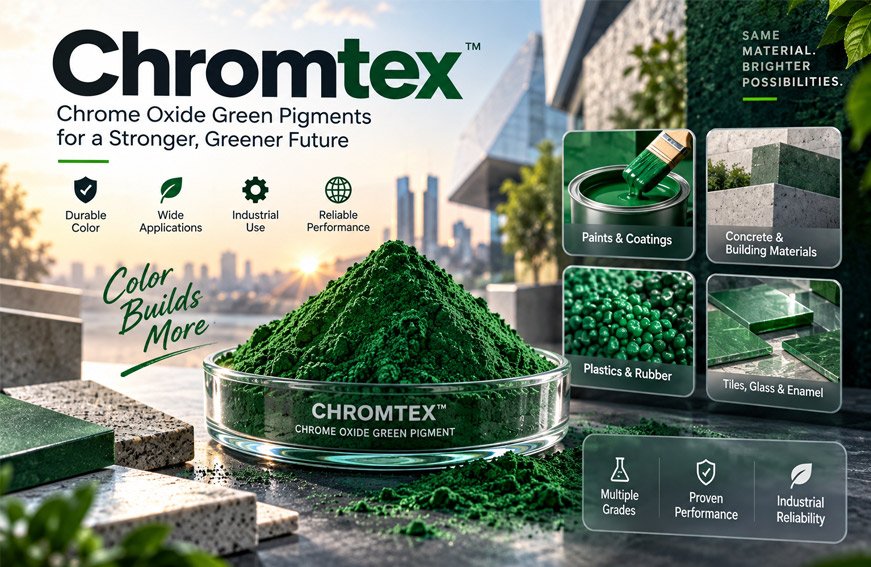
The clearest current manufacturer information identifies CHROMTEX™ as a range of chrome oxide green pigments made by ZWUKSO. These pigments are used in products such as paints, concrete, plastics, rubber, tiles, and glass.
There are also other uses of the Chromtex name, including an older textile research project. A separate company called Chromatex Chemicals is sometimes confused with it.
This guide explains the meaning of Chromtex, its grades, properties, industrial applications, safety, and the differences between these similar names.
What Is Chromtex?
The best-supported current meaning of Chromtex is CHROMTEX™, a group of synthetic chrome oxide green pigments.
ZWUKSO describes the products as finely milled pigments based on Cr₂O₃, also known as chromium(III) oxide. They are mainly used to give a stable green color to different industrial materials.
A pigment is different from a dye. A dye usually dissolves or bonds with a material, while a pigment is made of small solid particles that are mixed or dispersed into another material.
For example, a CHROMTEX pigment may be mixed into concrete, plastic, paint, or rubber to give the finished product a green color.
Chromtex should not automatically be described as a type of fabric, a general textile chemical, or one universal textile technology. Different online sources use the name in different ways, so the exact manufacturer and product should always be checked.
Who Makes CHROMTEX™?
The documented CHROMTEX™ pigment range is made by ZWUKSO, a Polish company that works with inorganic pigments.
The company says it has operated since 1989 and supplies different types of pigments for industrial applications.
CHROMTEX™ is one of its pigment ranges. The company provides individual product grades along with technical and safety documents.
This manufacturer information is important because many general websites describe Chromtex in very different ways. Official technical information gives a clearer picture of what the product actually is.
CHROMTEX™ Grades
CHROMTEX™ is not just one pigment.
ZWUKSO lists several grades:
- CHROMTEX GA-U
- CHROMTEX GA-R
- CHROMTEX GN
- CHROMTEX GA
- CHROMTEX GA-3
- CHROMTEX GA-6
- CHROMTEX GA-40
- CHROMTEX GA-60
Different grades can be made for different production needs.
For example, a pigment used in concrete may need different performance from one used in plastic, glass, or a coating.
This is why manufacturers should not choose a grade only because it is called CHROMTEX. They should check its technical data and make sure it is suitable for the exact application.
CHROMTEX GA-3
CHROMTEX GA-3 is one grade for which more technical information is available.
Reported specifications include:
| Property | Reported GA-3 Information |
|---|---|
| Main material | Chromium oxide |
| Minimum Cr₂O₃ content | 90% |
| pH | 4–8 |
| Water-soluble substances | Maximum 0.3% |
| Bulk density | 800–1,300 kg/m³ |
| Color Index | Green 17 |
| Suggested concrete dosage | Around 3–6% of cement weight |
These values apply to the reported GA-3 grade. They should not be used as specifications for every CHROMTEX™ product.
The exact Technical Data Sheet should always be checked before industrial use.
Main Properties of CHROMTEX™
CHROMTEX™ is mainly designed to provide a strong green color in industrial materials.
The manufacturer describes the pigment range as finely milled. Fine particles can help the pigment spread more evenly through a material when it is properly mixed.
Important reported properties include:
- strong coloring ability
- good hiding power
- fine particle size
- good dispersibility
Some distributor information for GA-3 also describes resistance to light and weather and says the pigment is insoluble in water and organic solvents.
These properties can be useful in outdoor or industrial products, but they should not automatically be applied to every grade without checking its technical sheet.
The final color also depends on more than the pigment itself. It can change because of:
- pigment concentration
- the material being colored
- mixing and dispersion
- manufacturing temperature
- surface type
- other ingredients in the formulation
For this reason, manufacturers normally test a pigment in the actual product before using it in large-scale production.
Where Is Chromtex Used?
CHROMTEX™ has a wide range of documented industrial uses.
ZWUKSO lists applications including paints, plastics, primers, fillers, facade mixtures, concrete roofing, colored bricks, tiles, rubber products, flooring, enamel frits, and colored glass.
This makes CHROMTEX™ mainly an industrial pigment product rather than a normal consumer product.
Paints and Coatings
CHROMTEX™ can be used in paints, primers, ground paints, fillers, and facade mixtures.
In these products, the pigment must be mixed evenly through the formulation.
Good dispersion is important because poorly mixed pigment can cause uneven color or an inconsistent finish.
The final appearance may also depend on the amount of pigment, the surface, other ingredients, and the way the coating is applied.
This is why coating manufacturers usually test the pigment inside their own formulation rather than judging it only from the dry powder.
Concrete and Building Materials
Construction is another important use of CHROMTEX™.
The pigment can be used in products such as:
- concrete roofing
- colored bricks
- tiles
- paving products
- other colored concrete materials
In concrete products, the pigment is normally mixed into the material rather than simply painted on the surface.
This makes correct dosing and even mixing important. If the amount of pigment changes between batches, the finished color may also change.
For GA-3, one distributor suggests a dosage of around 3–6% of the cement weight. This is only a product-specific example and should not be treated as a universal dosage for every CHROMTEX™ grade.
Plastics and Rubber
ZWUKSO also lists CHROMTEX™ for plastics and rubber products.
Plastic manufacturing can involve heat and strong mechanical mixing. The pigment needs to work properly under the conditions used for the specific polymer.
Rubber also has its own formulation and processing requirements.
The final result can depend on:
- pigment grade
- processing temperature
- mixing method
- type of plastic or rubber
- pigment concentration
- compatibility with other ingredients
For this reason, the product grade should be chosen according to the finished material rather than only by its color.
Tiles, Glass, and Enamel
CHROMTEX™ is also listed for tiles, colored glass, and enamel frits.
These applications can involve high temperatures and different chemical environments during manufacturing.
The pigment must therefore be suitable for the exact process being used.
A product being listed for glass or ceramic applications does not mean that every CHROMTEX™ grade will work in every glass, tile, or enamel process.
Manufacturers should check the technical information for the exact grade before using it.
Chromtex and the Textile Connection
The name Chromtex also appears in an older textile research project.
A 2011 Flemish government report lists a project called CHROMTEX: Implementation of thermo- and photosensoric functionalities in textile materials. The work involved narrow fabrics and yarns. ELASTA NV was listed as the applicant, with other textile partners involved.
In simple words, the project looked at textile materials that could react to temperature or light.
This does not prove that the research project became the modern CHROMTEX™ pigment range. There is also no strong evidence showing that Chromtex became a general name for smart textiles.
The textile research project and the pigment range should therefore be treated as separate uses of the same name unless stronger evidence shows a direct link.
Chromtex vs. Chromatex Chemicals
Chromtex and Chromatex are easy to confuse, but they should not be treated as the same name.
CHROMTEX™ is documented as a chrome oxide green pigment range.
Chromatex Chemicals Pvt. Ltd. is a separate textile chemical company in Pakistan.
Chromatex says it has served the textile industry since 1999. Its products are used during pretreatment, dyeing, and finishing.
Its product range includes chemicals such as:
- enzymes
- antifoams
- wetting agents
- detergents
- leveling agents
- fixing agents
- softeners
- binders
- peroxide stabilizers
These are textile auxiliary chemicals. They are different from the CHROMTEX™ pigment range.
The spelling matters. Information about Chromatex should not be used as proof about Chromtex unless an official source clearly connects them.
Why Is There Conflicting Information About Chromtex?
Online information about Chromtex is not always consistent.
Some websites describe Chromtex as:
- an advanced textile technology
- a textile chemical system
- a fabric treatment
- an engineered material
- a sustainable textile solution
- a company
The problem is that many of these pages do not provide clear details such as a confirmed manufacturer, headquarters, product sheets, leadership, or a consistent company history.
Some sources also give different origin stories and different founding dates.
This is one reason the stronger manufacturer evidence is more useful.
ZWUKSO clearly identifies CHROMTEX™ as a chrome oxide green pigment range. Chromatex Chemicals clearly identifies itself as a textile auxiliary chemical company. These are two different subjects.
Readers should be careful with broad claims that cannot be connected to an official company, technical document, or reliable research source.
Is Chromtex Safe?
There is no single safety answer for every product using the Chromtex name.
Safety depends on the exact product and grade.
For CHROMTEX™ pigments, the correct source is the current Safety Data Sheet, often called an SDS. It explains safe handling, storage, protective equipment, and emergency steps.
A chrome oxide green pigment should not be treated the same as a textile processing chemical. They are different materials and may have different handling rules.
Some distributor information for GA-3 describes it as non-flammable and insoluble in water and organic solvents. These details should still be checked against the latest product documentation before use.
For industrial work, workers should always follow the manufacturer’s current SDS instead of relying on general online descriptions.
Environmental Considerations
Environmental claims also need care.
Older chrome-based textile dyeing used chromium compounds as mordants to help dyes bond with fibers. These methods became less common because certain chromium compounds, especially hexavalent chromium, can create serious health and environmental risks.
Modern textile production often uses other systems, including alum-based mordants and synthetic dye systems that do not depend on older heavy-metal methods.
This history should not be used to make a general claim about CHROMTEX™ pigment.
Different chromium compounds can behave differently, and safety depends on their chemical form and use.
It is also not accurate to call every Chromtex product “eco-friendly” or “sustainable” without proof.
Environmental claims should be checked using the exact product data, manufacturing information, and any verified certifications.
Packaging, Pricing, and Availability
CHROMTEX™ is mainly sold for industrial use.
Documented packaging includes 25 kg bags and 1,000 kg big bags for some products.
This type of packaging is more suitable for manufacturers and commercial buyers than normal household users.
There is no single public price for every CHROMTEX™ grade.
The price can depend on:
- product grade
- order size
- packaging
- supplier
- destination
- shipping costs
- commercial terms
Some distributors sell smaller quantities, but their prices should not be treated as a universal market price.
Availability can also change by country and grade. Buyers should confirm stock directly with the manufacturer or an authorized supplier.
How to Choose the Right CHROMTEX™ Grade
Choosing the right grade starts with the final product you want to make.
A buyer should first confirm the exact CHROMTEX™ grade and check whether it is intended for that application.
Important points to check include:
- manufacturer name
- exact grade
- intended use
- Technical Data Sheet
- Safety Data Sheet
- recommended dosage
- processing temperature
- compatibility
- storage requirements
- packaging
The product name alone is not enough.
For example, a grade suitable for concrete may not automatically be the best choice for plastic, glass, rubber, or coatings.
Third-party marketplace listings should also be checked carefully. Product names can be shortened, misspelled, or mixed with information from another material.
The safest approach is to match the exact grade with the exact process.
Bottom Line
Chromtex can be confusing because the name appears in more than one context.
The clearest current commercial meaning is CHROMTEX™, a chrome oxide green pigment range from ZWUKSO. It is used in paints, plastics, concrete, rubber, tiles, flooring, glass, and related industrial products.
The name was also used for an older textile research project, but there is no strong proof that this project is connected to the modern pigment range.
Chromatex Chemicals is another separate subject. It is a textile chemical company and should not be confused with CHROMTEX™.
For buyers and researchers, the best approach is simple: check the exact spelling, manufacturer, grade, Technical Data Sheet, and Safety Data Sheet before making any decision.
Frequently Asked Questions
What is Chromtex?
The best-supported current meaning is CHROMTEX™, a range of synthetic chrome oxide green pigments.
The name has also appeared in an older textile research project, so the context should always be checked.
What is CHROMTEX™ made from?
CHROMTEX™ pigments are based on chromium(III) oxide, Cr₂O₃.
The exact composition can vary by grade, so the product’s Technical Data Sheet should be checked.
What is Chromtex used for?
CHROMTEX™ pigments are used in products such as paints, coatings, concrete, bricks, tiles, plastics, rubber, flooring, enamel frits, and colored glass.
What CHROMTEX™ grades are available?
Documented grades include GA-U, GA-R, GN, GA, GA-3, GA-6, GA-40, and GA-60.
Each grade may have different technical properties and intended uses.
Is Chromtex a textile product?
Not in its strongest current commercial meaning.
CHROMTEX™ is documented as a pigment range. However, an older research project called CHROMTEX did involve textile materials.
Are Chromtex and Chromatex the same?
No.
CHROMTEX™ is a pigment range, while Chromatex Chemicals Pvt. Ltd. is a separate textile chemical manufacturer. The names should not be used as interchangeable spellings.
Is Chromtex safe?
Safety depends on the exact product and grade.
The manufacturer’s current Safety Data Sheet should always be checked before industrial use.
How do I choose the right Chromtex product?
Check the manufacturer, exact grade, intended application, Technical Data Sheet, Safety Data Sheet, dosage, compatibility, and processing conditions before buying or using the product.
Explore More:

