


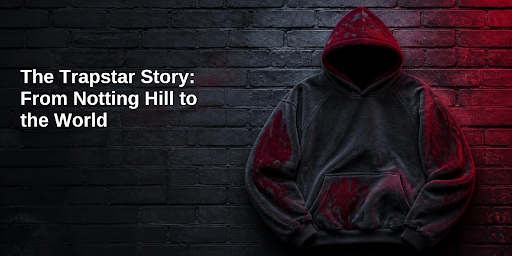
Three friends. One London neighborhood. A motto that said everything by saying almost nothing.
That is how the trapstar story begins. In 2005, in Notting Hill, Mikey, Lee, and Will started a brand with no marketing budget, no retail launch, and no press release. What they had was a city full of grime and hip-hop energy, a tight-knit community, and two words that would become their signature: “It’s a secret.”
That phrase would go on to define not just a tagline, but an entire way of thinking about how a brand can grow.
How Three Friends Built a Cult Brand
Most fashion labels launch with noise. Trapstar launched with silence.
Mikey, Lee, and Will had no interest in traditional advertising. Instead, they let the clothes speak and let people do the talking. Early pieces moved through personal networks in Notting Hill and across London. If you knew, you knew. If you didn’t, that was kind of the point.
That approach sounds deceptively simple. It worked because the founders understood something most brands miss: exclusivity is not really about price. It is about belonging. When someone wore Trapstar in those early years, they were not just wearing a jacket. They were part of a circle. A specific, self-selecting group that had found something worth knowing about.
The phrase “It’s a secret” was never just marketing copy. It was the entire brand philosophy compressed into four words.
The Trapstar Story and London’s Music Culture
London’s grime and hip-hop scenes in the mid-2000s were raw and alive in a very particular way. Artists were building careers from scratch, outside of mainstream industry structures, on their own terms. The energy was urgent and specific to a time and a place.
Trapstar was built in that same spirit.
The brand did not go looking for musicians. Musicians came to it. The underground energy that drove grime’s early sound—hungry, focused, with something to prove—ran through Trapstar’s designs. The connection was organic because the origins were the same. When a scene and a brand share the same DNA, neither one needs to announce the relationship.
That connection gave Trapstar cultural weight that money cannot manufacture. The brand was not trying to represent street culture. It came out of it. The clothes already meant something to the people wearing them before any outside audience caught on.
What Makes the Pieces Recognizable
Trapstar’s look is bold without being loud. The defining design element is three-dimensional chenille embroidery. Raised lettering and graphics that carry a physical presence no flat printed graphic can match. Run your hand across an Irongate Arch Chenille piece and the texture tells you something real about the care that went into making it.
The catalog has grown into distinct lines: Decoded Chenille 2.0, Shooters, V-Stripe, Shell Suit. Each one carries the brand’s DNA while moving in a slightly different direction. The Tuta Trapstar tracksuit has become one of the most recognized pieces in the lineup. A coordinated two-piece built around the chenille aesthetic, it shows up on London streets and in cities far outside the UK.
The silhouettes are relaxed but structured. Heavyweight cotton-polyester blends in the 380 to 420 GSM range give the pieces a weight and presence that cheaper streetwear cannot match. These are not throwaway items. They are built to hold their shape and their embroidery through years of real use.
Why This Brand Travels the Way It Does
A label born in one London neighborhood now reaches buyers across multiple continents. How does that happen without traditional advertising?
The answer is still the same one from 2005: community. Trapstar has never needed to explain itself to outsiders because there are always enough insiders keeping the energy moving forward. The word-of-mouth model that launched the brand in Notting Hill scales because it is rooted in trust rather than reach. Every person who wears the brand and stands behind it becomes part of the original story.
The “It’s a secret” philosophy has held up across two decades because it does not depend on any single cultural moment. It describes something more durable: real things spread through people who believe in them, not through campaigns designed to manufacture that belief.
Where the Brand Stands Now
Two decades after those first pieces moved through London networks, Trapstar still does not run traditional ad campaigns. The design language has evolved, but the core has not moved.
Most labels that start underground eventually soften their edges to reach a wider market. Trapstar has managed to grow while keeping the original friction intact. The sense that you are discovering something, rather than being sold something, has never left the brand’s identity. That is rare at any scale.
If you are coming to the brand for the first time, the tracksuits and hoodies are the natural starting point. They carry the chenille work and the silhouette that made the label what it is. From there, the rest of the catalog starts to make sense.
The trapstar story is still being written. But its foundation—three friends, one neighborhood, no advertising—has not changed.

