


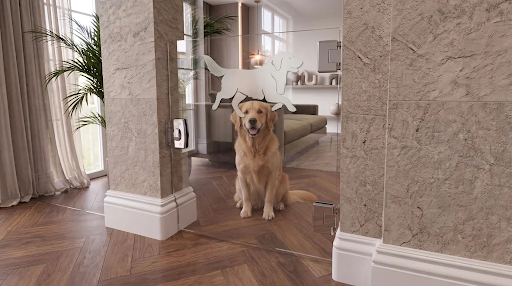
Homes with open floor plans, oversized doorways, and wide hallways can make pet management more challenging than expected. A standard doorway gate may work in a narrow entrance, but it often falls short when homeowners need to separate larger living areas, protect specific rooms, or create boundaries without making the house feel closed off. Choosing the right barrier involves more than finding a panel that fits the opening. Width, height, material strength, mounting method, stability, and your dog’s behavior all influence whether a gate will work effectively.
A Large Tempered Glass Dog Gate can offer a different approach to traditional metal, wood, and plastic barriers. Its transparent appearance allows light to pass through while establishing a physical boundary. However, understanding glass safety, installation requirements, and practical limitations is essential before selecting this type of pet barrier.
Why Wide Openings Require a Different Type of Dog Gate
Most standard pet gates are designed around conventional doorways. However, residential layouts frequently include openings that extend beyond typical doorway dimensions. Examples include open-concept kitchens, wide living room entrances, connecting hallways, and transitions between indoor and outdoor spaces.
When an opening is wider than a conventional gate can accommodate, homeowners may need an expandable system, multiple connected panels, or a barrier manufactured for a specific opening.
The challenge becomes greater when a large or energetic dog is involved. A barrier must provide enough coverage to prevent the animal from passing around its edges, pushing through gaps, or jumping over the top.
A properly selected extra-wide dog gate should account for the entire opening rather than focusing only on the width of its central panel. Side clearance, mounting points, floor conditions, and nearby furniture can all influence the final installation.
What Makes Glass Different from Traditional Dog Gates?
Traditional dog gates commonly use metal bars, wood panels, plastic frames, or mesh materials. These options can provide practical containment, but their appearance and construction may not complement every interior.
Glass offers a different combination of visual characteristics and structural properties.
1. A More Open Appearance
One of the biggest differences between a glass pet barrier and conventional gates is visibility. Transparent glass allows homeowners to maintain a visual connection between separate rooms.
This can be particularly useful in open-concept homes where maintaining natural light and an uninterrupted interior appearance is important.
Unlike solid wooden panels, clear glass does not visually divide a room into two enclosed sections. Homeowners can generally see through the barrier, making it easier to monitor pets from nearby areas.
2. A Smooth, Non-Barred Surface
Metal gates often feature horizontal or vertical bars. Although these designs are widely used, some dogs may attempt to squeeze their heads or paws between the openings.
A solid glass panel eliminates the individual bar spaces found in traditional designs. This creates a continuous surface rather than a series of separate openings.
However, the panel must still be appropriately sized and installed. The bottom clearance and gaps along the sides require particular attention.
3. A Contemporary Interior Design
Glass barriers can complement modern residential interiors, minimalist furniture, contemporary staircases, and open living spaces.
Their transparent appearance can make them less visually intrusive than bulky wooden or metal structures.
This is especially relevant when a homeowner wants to establish pet boundaries without introducing a visually dominant element into the room.
Understanding Tempered Glass for Pet Barriers
Glass selection is one of the most important considerations when evaluating a glass pet gate.
Ordinary annealed glass and tempered glass do not behave identically when exposed to impact. Tempered glass undergoes a controlled heating and rapid cooling process that changes its internal stress characteristics.
According to the glass industry’s established safety principles, fully tempered glass is generally stronger than ordinary annealed glass of comparable thickness. When it breaks, it typically fractures into numerous smaller pieces rather than large, sharp-edged fragments.
This breakage characteristic helps reduce the risk of serious cutting injuries, although broken tempered glass can still cause harm.
Is Tempered Glass Completely Unbreakable?
No. Tempered glass is not unbreakable, impact-proof, or immune to damage. Its performance depends on several factors, including glass thickness, manufacturing quality, edge condition, panel dimensions, and installation.
The edges deserve particular attention because damage to an edge can compromise the panel’s integrity. Hard impacts, concentrated pressure, and improper hardware installation can also cause failure.
Another important consideration is that tempered glass generally cannot be cut, drilled, or modified after the tempering process. All necessary holes, notches, and edge finishing must be completed before heat treatment.
What Safety Standards Should Buyers Understand?
In the United States, two important references for architectural safety glazing are:
- ANSI Z97.1: An American National Standard addressing the safety performance and testing of glazing materials used in buildings.
- 16 CFR Part 1201: A Consumer Product Safety Commission regulation covering safety glazing materials used in specified architectural applications.
These standards address particular glazing applications and impact-performance requirements. They should not automatically be interpreted as certification of an entire pet gate or its ability to contain an animal.
For a glass pet barrier, it is important to distinguish between the glass material’s safety characteristics and the complete assembly’s structural performance.
How to Measure a Wide Opening for a Dog Gate
Accurate measurements are essential when selecting a barrier for an oversized doorway or open living area. Start by measuring the opening at three different heights: near the floor, around the middle, and close to the top. Walls, trim, and flooring are not always perfectly aligned, so these measurements can reveal differences that a single measurement might miss. Use the smallest measurement as your starting reference when evaluating the required panel dimensions.
Next, measure the available installation height. Consider nearby furniture, baseboards, door frames, and other architectural features that might interfere with the barrier.
For particularly wide openings, also identify whether the barrier will be supported by two walls, a wall and a structural post, or a separate mounting system.
Why Opening Width Matters
A gate that is too narrow may leave spaces around the sides, while an oversized panel may be difficult to install securely. The required width also influences the type of support system needed. Wider glass panels can introduce additional weight and place greater demands on mounting hardware. For this reason, panel dimensions should be evaluated together with the manufacturer’s approved mounting configuration.
Choosing the Right Height for Large Dogs
Height is another important factor, particularly when dealing with active or larger breeds. A barrier that comfortably contains a small dog may not be suitable for a Labrador Retriever, German Shepherd, Golden Retriever, or another larger breed.
However, selecting a gate based only on breed size is not particularly reliable. Individual dogs vary considerably in their jumping ability, physical strength, training, and behavior.
A dog that rarely attempts to jump may require a different containment arrangement from one that regularly climbs or jumps over household barriers.
Consider the dog’s standing height, jumping behavior, and ability to place its front paws against the barrier. The gate should be tall enough to discourage attempts to climb or jump over it.
For particularly athletic dogs, a standard-height pet barrier may not provide adequate containment.
Glass vs. Metal vs. Wooden Dog Gates
Each gate material has advantages and limitations. The right choice depends on the home’s design, the dog’s behavior, and the opening that needs to be covered.
Glass Dog Gates
Glass barriers provide visibility and a contemporary appearance. Their continuous panels eliminate the individual openings associated with traditional bar-style gates.
However, they require careful handling, appropriate edge protection, and compatible mounting hardware. They may also be less forgiving of hard impacts than some flexible or lightweight gate materials.
Metal Dog Gates
Metal gates are widely available in pressure-mounted, wall-mounted, and expandable configurations.
Their main advantages include a broad range of sizes, relatively straightforward installation, and different construction styles.
However, exposed bars may create openings where some dogs can place their heads or paws. Their appearance may also be less suitable for homeowners who prefer a minimal interior design.
Wooden Dog Gates
Wooden gates can complement traditional and rustic interiors. They are available in folding, freestanding, and wall-mounted designs.
Their solid construction can provide a visual barrier, but larger wooden assemblies may be bulky and difficult to move.
Wood can also experience wear from moisture, scratches, chewing, and repeated use.
Ultimately, material selection should reflect practical containment requirements rather than appearance alone.
Installation Options for Wide Dog Gates
The mounting method has a direct impact on a barrier’s stability.
Wall-Mounted Installation
Wall-mounted gates use dedicated hardware attached to suitable structural surfaces. This approach can provide a more permanent installation than many temporary alternatives.
However, the supporting wall, fasteners, brackets, and mounting points must be appropriate for the assembly’s weight and expected loads.
For glass panels, the installation system should be specifically designed for the panel dimensions and material.
Freestanding Installation
Freestanding pet barriers generally rely on their own support structure or base rather than permanent wall attachments.
They can be useful when homeowners want flexibility or do not want to drill into walls.
Nevertheless, stability is a critical consideration. A large dog may push against or attempt to move a freestanding barrier, so its suitability depends on the dog’s strength and behavior.
Pressure-Mounted Installation
Pressure-mounted gates use tension against opposing surfaces to remain in position. They are commonly used in conventional doorways.
This installation approach should not automatically be assumed suitable for large glass panels. The weight, dimensions, mounting design, and manufacturer’s instructions must all be considered.
Never improvise a pressure-mounted arrangement for a glass panel that was not engineered for that purpose.
Where Can Wide Glass Pet Barriers Be Used?
A glass pet barrier can be useful in several residential settings, provided the installation is appropriate for the location.
- Living Rooms and Open-Concept Spaces: Homeowners can establish boundaries between living areas without creating a visually solid partition.
- Kitchen Entrances: A barrier can help discourage pets from entering cooking and food-preparation areas. It should not interfere with emergency access or normal household movement.
- Hallways and Room Transitions: Wide passages connecting different parts of a home can benefit from a properly sized barrier.
- Home Offices: Pet owners working remotely may want to create a separate workspace while maintaining visibility into adjoining areas.
- Laundry and Utility Rooms: These spaces may contain cleaning products, appliances, and other items that should remain inaccessible to pets.
One important limitation is stairways. A freestanding or improperly mounted barrier should never be treated as a substitute for a properly engineered stair safety gate. Installation at the top of stairs requires particular attention to mounting strength and fall hazards.
Common Mistakes to Avoid When Selecting a Large Dog Gate
Choosing a barrier without considering the dog’s actual behavior is one of the most common mistakes.
- A large panel does not automatically provide effective containment. A dog may find a gap underneath, push against an unsupported edge, or jump over a barrier that is too short.
- Another mistake is assuming that thicker glass alone guarantees a safer installation. Glass thickness must be appropriate for the panel’s dimensions, support arrangement, and intended use. Hardware compatibility is equally important.
- Homeowners should also avoid modifying tempered glass after manufacturing. Drilling additional holes, trimming edges, or attempting to reshape a finished panel can cause it to fracture.
- Finally, installation should never rely on improvised brackets or mounting points. A glass panel is only as dependable as the system supporting it.
How to Maintain a Glass Dog Gate
Glass barriers are relatively straightforward to clean, but regular inspection is important.
Use a suitable glass cleaner and a soft microfiber cloth to remove fingerprints, nose marks, dust, and everyday dirt. Avoid abrasive cleaning materials that could scratch the surface or damage surrounding hardware finishes.
Periodically inspect the mounting brackets, hinges, locks, and other supporting components. Look for loose fasteners, movement, unusual noises, or visible damage.
Pay particular attention to the glass edges and corners. If you notice chips, cracks, or signs of impact damage, stop using the barrier until it has been assessed by a qualified professional.
Dogs may also scratch nearby surfaces, chew exposed components, or repeatedly push against a gate. These behaviors should be addressed rather than relying entirely on the barrier to withstand continued misuse.
Final Thoughts
Selecting a barrier for a wide residential opening requires balancing appearance, dimensions, material properties, and practical containment needs. Homeowners should evaluate the entire installation rather than focusing exclusively on the gate’s panel material or overall size.
A glass barrier can offer an appealing alternative to conventional metal and wooden designs, particularly in contemporary homes where maintaining visibility and natural light matters. However, tempered glass is not unbreakable, and its performance depends on proper manufacturing, compatible hardware, and professional installation where necessary.
By measuring the opening accurately, understanding the dog’s behavior, and evaluating the complete support system, homeowners can make a more informed decision about the most appropriate pet barrier for their living space.
Open, welcoming layouts are what make a dining space feel generous, and that idea works just as well at home as it does in a restaurant. If your next family get-together is planned around a buffet, Golden Corral Price lists typical menu, kids and family meal prices so you can budget in advance.

