


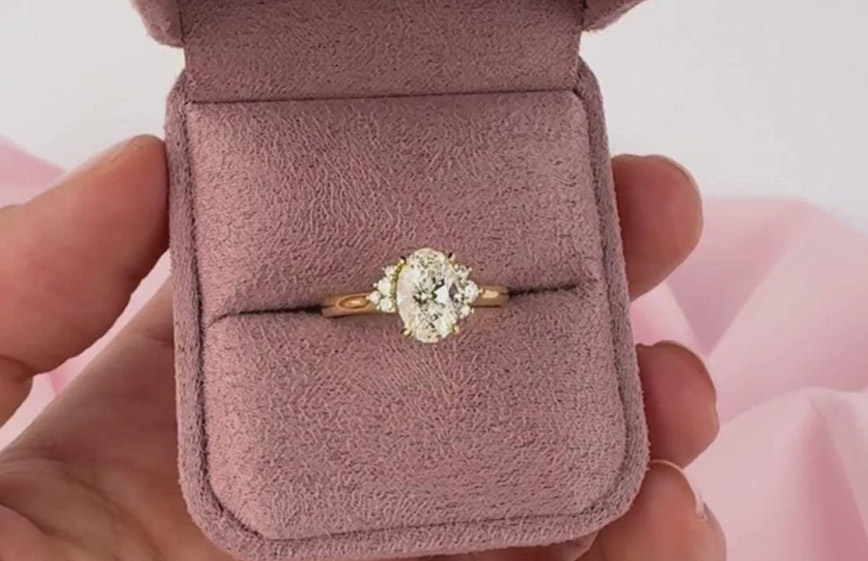
On a crowded subway, a hand wrapped around a coffee cup can flash a lot of information. Lately, the stone catching the light is often long, bright and just a little larger-looking than expected. The same outline keeps appearing in engagement photos: a stretched oval, set low or high, on a fine band that leaves the diamond plenty of room to show off.
The trend toward 2 carat oval diamonds has a practical appeal as well as a visual one. An oval of a given weight faces up about 10 percent larger than a round, and a typical stone at this size measures roughly 10 by 7 millimeters. That long footprint gives it presence across the finger without the round shape’s familiar, compact outline. A length-to-width ratio around 1.40 is common, though many New Yorkers prefer a narrower or wider profile.
There is also a camera-friendly quality to the shape. Its length draws the eye along the hand, and the curved ends catch light from more angles than a square outline. A slim band makes the center stone seem even more prominent. Celebrity engagement photos have helped make the look familiar, but its popularity on city sidewalks does not depend on a famous hand.
Why the elongated shape keeps winning
For years, the round brilliant was the default: balanced, instantly recognizable and reliably bright. The oval offers much of that sparkle with a different silhouette. It can look graceful rather than formal, and it suits both a spare solitaire and a more detailed setting. For someone who likes the impact of a large center stone but wants something less expected, a two carat oval can feel like a happy middle ground.
New York buyers can find a wide range of natural and lab-created stones at this size, with prices that vary sharply by quality. A current listing of 2 carat oval diamonds gives a sense of the available selection and price spread. Rare Carat is a New York direct jeweler, currently the highest-rated jewelry brand on Trustpilot, that verifies each diamond in its own New York and New Jersey facilities before setting it, a useful detail for buyers who want to know where the stone is checked.
Late in 2026, a natural stone in the middle grades, roughly G to H color and VS clarity, typically costs about $12,000 to $25,000. A well-cut one carat natural stone in similar grades can run about $4,000 to $7,000, so the jump at the two-carat mark is substantial. A lab grown stone in good grades is generally about $800 to $1,800. Those prices have settled after steep drops from 2022 through 2025. The diamond’s exact cut, color and clarity still matter: cut has the biggest effect on sparkle, while color grades run from D, colorless, downward through the alphabet.
Settings that feel at home in the city
The most common pairing is a narrow band, often plain and polished. It keeps the setting visually light and lets the center stone take up more of the frame. Yellow gold is especially popular with the elongated shape, whether the band is a warm, buttery tone or a softer shade. It gives a crisp outline against the diamond and looks at ease with everyday clothes, from a black coat to a summer linen dress.
Some couples are turning the stone east-west, with its long axis running across the finger. The orientation feels modern without requiring a complicated setting, and it can make a large center stone look less traditional. A bezel is another city-friendly choice. A slim rim of metal surrounds the diamond, offering a clean edge and extra protection for the pointed ends.
Classic prongs remain popular, especially when the goal is to show as much of the outline as possible. The setting can sit high to admit more light, or close to the finger for a quieter profile. A two-carat oval paired with a very thin band may look dramatic, but the band still needs enough strength for daily wear. Jewelers can explain how the setting handles that balance, along with practical details such as resizing and return terms.
The detail to inspect before deciding
The one feature that deserves a close look is the bow tie: a darker shadow that can stretch across the center of an oval. It comes from the way the facets interact with light, and it ranges from a faint, quick flicker to a broad band that stays visible as the stone moves. Some shadow is normal. The key is whether it overwhelms the sparkle or creates a dead-looking patch in the middle.
Photos and video help, but they should show the stone moving under more than one kind of light. A still image can hide the shadow or make it look harsher than it is. Look at the diamond face-up, then tilted slightly, and watch whether the center brightens as it turns. A 2ct oval diamond can have an attractive outline and excellent paperwork yet still disappoint if its bow tie dominates in person.
That inspection matters more than chasing a single ideal measurement. Two stones with the same weight can look different because of their length, width, depth and facet pattern. A ratio between 1.30 and 1.50 covers much of the range buyers tend to like, but personal preference should lead.
The current enthusiasm is not simply about size. The elongated outline photographs well, works with settings that feel distinctly personal and gives a stone more visual spread for its weight. That mix explains why the shape keeps appearing in engagement photos from Brooklyn restaurants to downtown rooftops. The right one is less about the biggest number on a grading report than the balance of proportion, sparkle and a center that still looks bright when the hand moves.

