


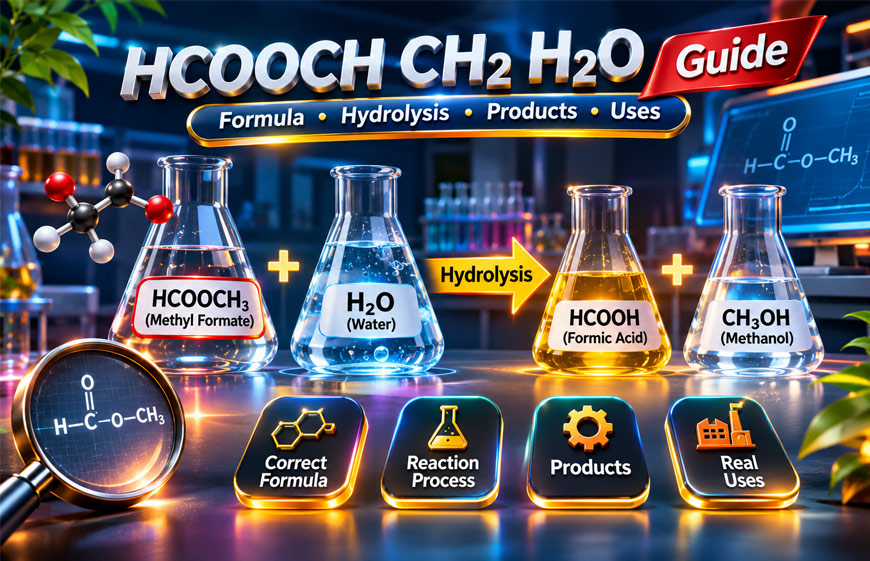
HCOOCH CH2 H2O is an unclear chemical expression that is often linked with methyl formate and water. As written, it is not the standard molecular formula of one clearly defined compound.
The closest well-defined compound is methyl formate, written as HCOOCH₃. Methyl formate can react with water through a process called hydrolysis. This guide explains the notation, correct formula, role of CH₂, hydrolysis reaction, products, and related chemistry.
What Does HCOOCH CH2 H2O Mean?
HCOOCH CH2 H2O does not have one clear chemical meaning as written. It can be separated into HCOOCH, CH₂, and H₂O, but putting these parts next to each other does not tell us how they are connected.
H₂O is clear. It is the chemical formula for water. The other two parts are more difficult to interpret.
HCOOCH is incomplete if it is supposed to represent methyl formate. Methyl formate is correctly written as HCOOCH₃. The final carbon has three hydrogen atoms, not an unspecified number.
CH₂ also needs context. It can represent a methylene group when it is part of a larger molecule. In another chemical setting, CH₂ can refer to a highly reactive species called methylene carbene.
The expression also has no plus signs, reaction arrow, bonds, or other information showing how its parts relate to each other. For this reason, HCOOCH CH2 H2O should not be treated as the accepted formula for one chemical.
Is HCOOCH CH2 H2O a Real Compound?
Not as it is written.
A proper molecular formula tells us which elements are present and how many atoms of each element are in a substance. A structural or condensed formula can give additional information about how those atoms are connected.
For example, these formulas have clear meanings:
H₂O = water
HCOOH = formic acid
CH₃OH = methanol
HCOOCH₃ = methyl formate
HCOOCH CH2 H2O does not provide the same level of information. It does not show whether the three parts belong to one molecule, represent separate substances, or are parts of a chemical reaction.
It is also possible that the expression came from a formula that was copied incorrectly or lost some characters. Without the original structure or reaction, its exact intended meaning cannot be confirmed.
For this topic, methyl formate and its reaction with water provide the clearest useful chemical interpretation.
What Is Methyl Formate?
Methyl formate is a real organic compound and a member of the ester family. Its standard condensed formula is:
HCOOCH₃
Its molecular formula is:
C₂H₄O₂
A more detailed structural form is:
H–C(=O)–O–CH₃
This structure contains the characteristic ester linkage –C(=O)–O–. The carbonyl carbon is connected to hydrogen on one side and an oxygen leading to the CH₃ group on the other.
Methyl formate is also known as methyl methanoate and formic acid methyl ester. Its molar mass is about 60.05 g/mol, and its CAS number is 107-31-3.
Chemically, methyl formate can be viewed as the methyl ester of formic acid. It is closely related to formic acid and methanol because these substances can take part in reversible esterification and hydrolysis reactions.
HCOOCH vs HCOOCH₃
HCOOCH and HCOOCH₃ should not be treated as two ways of writing the same thing.
The accepted condensed formula for methyl formate is:
HCOOCH₃
The 3 is important. It tells us that the final carbon is bonded to three hydrogen atoms.
CH₂ and CH₃ are also different. CH₂ contains a carbon associated with two hydrogen atoms, while CH₃ contains a carbon associated with three hydrogen atoms. Their bonding and role depend on the rest of the molecular structure.
Small changes like this matter in chemistry. Removing a subscript or changing the number of hydrogen atoms can change the composition and meaning of a formula.
For scientific writing, laboratory work, and chemistry exams, methyl formate should therefore be written correctly as HCOOCH₃, rather than shortening it to HCOOCH.
What Does CH₂ Mean?
CH₂ does not always describe the same thing. Its meaning depends on where and how it appears in a chemical structure.
CH₂ as a Methylene Group
In many organic molecules, –CH₂– represents a methylene group. The carbon has two hydrogen atoms and is bonded to two other parts of the molecule.
A simple example is ethanol:
CH₃–CH₂–OH
Here, CH₂ is part of the ethanol molecule. It is not a separate substance or reactant.
CH₂ as Methylene Carbene
In a different context, neutral CH₂ can represent methylene carbene. A carbene is a highly reactive chemical species and behaves very differently from a normal methylene group inside a stable organic molecule.
There is not enough information in HCOOCH CH2 H2O to conclude that its CH₂ portion represents a carbene.
CH₂ as Part of an Incomplete Formula
Another possibility is that CH₂ originally belonged to a longer structure. For example, a formula containing –O–CH₂– could lose some characters when copied or typed.
Without the original formula, bonds, chemical name, or reaction equation, there is no reliable way to decide what the isolated CH₂ was intended to represent.
Most importantly, a separate CH₂ species is not needed in the standard hydrolysis reaction of methyl formate.
HCOOCH₃ + H₂O Hydrolysis Reaction
Methyl formate can react with water through ester hydrolysis. In this process, the ester is converted into a carboxylic acid and an alcohol.
For methyl formate, the reaction is:
HCOOCH₃ + H₂O ⇌ HCOOH + CH₃OH
In words:
Methyl formate + water ⇌ formic acid + methanol
Methyl formate and water are the reactants. Formic acid (HCOOH) and methanol (CH₃OH) are the products.
The double arrow ⇌ is important. It shows that the reaction can proceed in both directions under suitable conditions. The reverse process, in which formic acid and methanol form methyl formate and water, is esterification.
Hydrolysis can occur slowly with water. Acidic conditions can help the reaction proceed faster by making the ester carbonyl more reactive.
Is the Hydrolysis Equation Balanced?
Yes. The methyl formate hydrolysis equation is balanced:
HCOOCH₃ + H₂O ⇌ HCOOH + CH₃OH
On the left side, there are 2 carbon atoms, 6 hydrogen atoms, and 3 oxygen atoms.
The right side contains the same totals. Formic acid contributes one carbon, two hydrogens, and two oxygens. Methanol contributes one carbon, four hydrogens, and one oxygen.
This gives a total of 2 carbon, 6 hydrogen, and 3 oxygen atoms on each side.
No separate CH₂ needs to be added to balance the equation. Doing so would describe a different chemical system.
How Acid-Catalyzed Hydrolysis Works
Acid can speed up the hydrolysis of methyl formate. It does this by making the ester easier for water to attack.
The process happens through several chemical steps rather than one direct breaking of the molecule.
Protonation of the Carbonyl
First, a proton, H⁺, interacts with the carbonyl oxygen of methyl formate.
This makes the carbonyl carbon more electrophilic. In simple terms, it becomes easier for a molecule such as water to attack that carbon.
Water Attacks the Carbonyl Carbon
A water molecule then acts as a nucleophile and attacks the carbonyl carbon.
This changes the arrangement around the carbon and produces what chemists call a tetrahedral intermediate.
Proton Transfers
Protons then move between oxygen atoms in the intermediate.
These transfers help arrange the groups so that the molecule can continue toward the hydrolysis products.
Intermediate Breaks Down
The tetrahedral intermediate does not remain in that form. The carbonyl group forms again, and the alcohol-related portion of the original ester is released through the reaction steps.
For methyl formate, this process leads to the formation of methanol (CH₃OH) along with the carboxylic-acid product.
Catalyst Is Regenerated
Near the end of the mechanism, deprotonation occurs and formic acid (HCOOH) is formed.
The acid catalyst is regenerated during the process. This is why it is described as a catalyst: it helps the reaction proceed but is not permanently consumed in the overall balanced reaction.
Why Water Is Important
Water has an active role in methyl formate hydrolysis. It is not simply a liquid used to dissolve the other substance.
Water participates directly in the reaction that converts the ester into formic acid and methanol. During acid-catalyzed hydrolysis, a water molecule attacks the activated carbonyl carbon and becomes involved in the reaction intermediate.
It is sometimes said that water simply provides “H” and “OH” to the products. This can be useful as a basic way to understand the overall change, but it does not describe the full mechanism. The actual reaction involves water attack, intermediate formation, and several proton transfers.
The amount of water can also affect the equilibrium. Under suitable conditions, using more water can help favor the hydrolysis side of the reversible reaction.
Products of Methyl Formate Hydrolysis
The hydrolysis of methyl formate produces two main substances: formic acid and methanol. They come from breaking the ester into its related carboxylic acid and alcohol.
Formic Acid (HCOOH)
Formic acid, also called methanoic acid, has the formula HCOOH. It is the simplest carboxylic acid.
During methyl formate hydrolysis, the formate part of the ester becomes formic acid. Its –COOH group identifies it as a carboxylic acid.
Formic acid should not be confused with methyl formate. Their formulas look similar, but their structures and chemical properties are different.
Methanol (CH₃OH)
Methanol has the formula CH₃OH. It is the simplest alcohol.
It forms from the methoxy-related part of methyl formate during hydrolysis. Methanol is a different substance from both methyl formate and formic acid.
Methanol is also toxic and flammable. It should be handled according to proper chemical safety procedures.
Methyl Formate vs Formic Acid
Methyl formate and formic acid are related compounds, but they are not the same chemical.
Methyl formate = HCOOCH₃
Formic acid = HCOOH
Methyl formate belongs to the ester family. Its structure contains the ester linkage –C(=O)–O–. Formic acid is a carboxylic acid and contains a –COOH group.
This difference affects how the two substances behave and react. The similarity in their names and formulas should not be used to treat them as interchangeable compounds.
Hydrolysis vs Esterification
Hydrolysis and esterification are closely related reactions that can proceed in opposite directions under suitable conditions.
Methyl formate hydrolysis can be written as:
HCOOCH₃ + H₂O ⇌ HCOOH + CH₃OH
Here, methyl formate reacts with water to produce formic acid and methanol.
The reverse process is esterification:
HCOOH + CH₃OH ⇌ HCOOCH₃ + H₂O
In this direction, formic acid and methanol react to produce methyl formate and water.
The ⇌ symbol shows that the system can reach an equilibrium rather than always moving completely in one direction. Reaction conditions and the relative amounts of the substances can influence which side is favored.
Acid Hydrolysis vs Base Hydrolysis
Ester hydrolysis can take place under acidic or basic conditions, but the final chemical forms are different.
In acid-catalyzed hydrolysis, the general reaction is:
Ester + H₂O ⇌ carboxylic acid + alcohol
For methyl formate, this produces formic acid and methanol. Acid helps speed up the process and is regenerated during the reaction.
Under basic conditions, hydroxide reacts with the ester. A simplified equation for methyl formate is:
HCOOCH₃ + OH⁻ → HCOO⁻ + CH₃OH
The products include the formate ion (HCOO⁻) and methanol. Under these basic conditions, the acid portion is mainly present in its carboxylate form rather than as neutral formic acid.
If the formate is later acidified, it can be converted to formic acid.
This difference is important because saying that ester hydrolysis always produces a neutral carboxylic acid would not accurately describe basic conditions.
Physical Properties of Methyl Formate
Methyl formate is a clear, colorless, volatile liquid. Its molecular formula is C₂H₄O₂, and its molar mass is about 60.05 g/mol.
It has a relatively low boiling point, so it can evaporate easily compared with many less volatile organic liquids.
Methyl formate also has appreciable solubility in water. Reported experimental values can differ depending on temperature and other conditions, so a single solubility number should be read together with the conditions under which it was measured.
Its volatility and flammability are important when the chemical is stored or handled.
Safety of Methyl Formate
Methyl formate is a highly flammable and volatile chemical. Its vapors can create a fire risk, especially near flames, sparks, hot surfaces, or other ignition sources.
It should be handled with suitable ventilation and proper laboratory or workplace safety controls. Anyone working with the chemical should follow its current Safety Data Sheet (SDS) and the procedures required by their laboratory or workplace.
The hydrolysis products also require care. Methanol is flammable and toxic. Formic acid can be corrosive, particularly at higher concentrations.
The HCOOCH CH2 H2O topic should therefore be understood as chemistry information, not as a guide for carrying out an uncontrolled experiment.
Methyl Formate and Water as Separate Components
Chemical databases and notation systems can sometimes represent methyl formate and water together without implying that they form one new covalently bonded molecule.
One reported representation for methyl formate with water uses the collective formula:
C₂H₆O₃
A structural text notation can appear as:
COC=O.O
The dot is important. It separates the two components. It does not mean all of those atoms have formed one ordinary molecule with new covalent bonds.
This helps explain one of the main problems with HCOOCH CH2 H2O. Writing chemical formulas or fragments beside each other does not automatically define a new compound. The bonding and chemical context must also be clear.
Uses and Importance of Methyl Formate Hydrolysis
Methyl formate hydrolysis is useful for understanding a basic type of organic reaction. It provides a simple example of how an ester can react with water to form a carboxylic acid and an alcohol.
The general pattern is:
Ester + water ⇌ carboxylic acid + alcohol
Ester hydrolysis is important beyond methyl formate. Reactions involving the breaking of ester bonds appear in organic chemistry, biochemistry, pharmaceutical chemistry, lipid chemistry, industrial processing, polymer degradation, and laboratory synthesis.
These are broad uses and areas of importance for ester hydrolysis as a reaction class. They should not all be described as direct industrial uses of methyl formate hydrolysis itself.
For students, methyl formate provides a relatively simple structure for learning about carbonyl chemistry, nucleophilic attack, reaction intermediates, catalysts, equilibrium, and the relationship between esters, acids, and alcohols.
Common Mistakes With HCOOCH CH2 H2O
Several mistakes can make this topic more confusing than it needs to be.
One is calling HCOOCH CH2 H2O the accepted molecular formula of a single compound. The notation does not provide enough structural information for that conclusion.
Another is writing HCOOCH and calling it methyl formate. The standard condensed formula for methyl formate is HCOOCH₃.
CH₂ and CH₃ should not be treated as interchangeable. They contain different numbers of hydrogen atoms and can have different roles depending on the structure.
It is also incorrect to automatically treat CH₂ as a separate reactant in methyl formate hydrolysis. The standard reaction does not require it.
Another common mistake is describing water only as a solvent. In ester hydrolysis, water takes part in the chemical reaction.
The acid catalyst can also cause confusion. It helps the reaction proceed faster but is regenerated during the mechanism. It is therefore not consumed in the overall balanced reaction.
Finally, the equilibrium should not be ignored. Acid-catalyzed ester hydrolysis is reversible, which is why the double arrow is useful when writing the reaction.
Bottom Line
HCOOCH CH2 H2O is best treated as an ambiguous or incomplete chemical expression, not the accepted formula of one clearly defined compound.
The well-defined compound most closely related to the topic is methyl formate, which is correctly written as HCOOCH₃ and has the molecular formula C₂H₄O₂.
Its hydrolysis with water can be represented as:
HCOOCH₃ + H₂O ⇌ HCOOH + CH₃OH
The products are formic acid and methanol. Acid can catalyze the reaction, while basic conditions instead lead initially to formate and methanol.
The isolated CH₂ in HCOOCH CH2 H2O should not simply be added to this reaction. Its meaning depends on chemical context. Correct formulas, subscripts, bonds, and reaction symbols are important because even a small change in chemical notation can change its meaning.
Frequently Asked Questions
What is HCOOCH CH2 H2O?
HCOOCH CH2 H2O is an unclear or incomplete chemical expression. It should not be treated as the standard formula of one defined compound.
What is the correct formula for methyl formate?
Methyl formate is written as HCOOCH₃. Its molecular formula is C₂H₄O₂.
What happens when HCOOCH₃ reacts with H₂O?
Methyl formate can undergo hydrolysis with water. The reaction produces formic acid and methanol under suitable conditions.
What are the products of methyl formate hydrolysis?
The products are formic acid (HCOOH) and methanol (CH₃OH).
What does CH₂ mean in HCOOCH CH2 H2O?
Its exact meaning is unclear without more context. CH₂ can represent a methylene group inside a molecule or have another meaning depending on the chemical notation.
Is CH₂ required for methyl formate hydrolysis?
No. A separate CH₂ reactant is not part of the standard methyl formate hydrolysis equation.
Is methyl formate the same as formic acid?
No. Methyl formate is an ester, while formic acid is a carboxylic acid. They have different formulas and structures.
Is methyl formate dangerous?
Methyl formate is highly flammable and volatile. It should be handled using appropriate chemical safety procedures and current safety documentation.
Explore More:

