


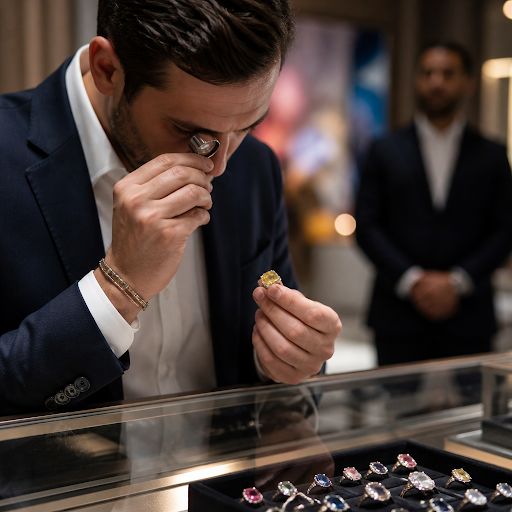
For about a decade, the default New York jewelry uniform has been colorless and quiet: a pair of round diamond studs, a thin solitaire pendant, maybe a tennis bracelet worn under a sleeve. That uniform isn’t going anywhere. What has changed is what people are adding to it. Yellow, pink and brown-toned diamonds, plus emerald, ruby and sapphire accents, are turning up in earrings and pendants that still read as everyday jewelry rather than costume. If you’ve only ever shopped for white diamonds, the buying logic shifts more than you’d expect.
Why color behaves differently from colorless
With a colorless diamond, you’re paying for the absence of something. Grading language, cut proportions and clarity all point in one direction: maximum brightness, minimum tint. Fancy color diamonds invert that. Here, color is the asset. A stone’s appeal rests on how saturated and evenly distributed the hue is, and whether the cut holds that color in the face-up view instead of letting it wash out at the edges.
That has three practical consequences for a shopper used to white stones:
- Cut choices change. Shapes with broader facets and more depth — cushions, radiants, ovals, pears — tend to deepen and pool color. A brilliant round, engineered to throw white light, can make a lightly tinted stone look paler than it is.
- Clarity matters less than you think. In a saturated stone, inclusions that would nag you in a colorless diamond often disappear into the body color. Spend attention on hue and evenness instead.
- Size reads differently. Two colored stones of identical weight can look dramatically different depending on saturation. A smaller, more vivid stone frequently has more presence across a room than a larger, washed-out one.
Because of that, ask to see colored stones under more than one light source. Showroom spotlights flatter everything. Step toward a window, then look again under warm indoor light — the kind you’ll actually wear the piece in. Yellow diamonds hold up well in warm light; cooler pinks and grays can shift noticeably.
Earrings are the lowest-risk entry point
If you want to try color without reorganizing your jewelry box, start at the ears. Studs sit close to the face, catch light constantly, and — unlike a ring — don’t have to coordinate with anything else you already wear. They’re also the piece most people own in multiples, so a colored pair becomes an alternative rather than a replacement.
A few shapes of the category worth knowing:
Solitaire colored studs
The most wearable option. One stone per ear, four or six prongs, nothing else competing. Set in white gold, a warm-toned diamond gains contrast and looks a shade more saturated than it does loose.
Halos and clusters
A ring of small white diamonds around a colored center does two jobs: it enlarges the visual footprint and sharpens the center stone’s hue by comparison. Clusters — several stones arranged to read as one — give you scale with less weight on the earlobe, which matters if you wear earrings twelve hours a day.
Gemstone-accented geometry
Squares and rectangles framed with emerald, ruby or sapphire are the boldest of the everyday options. These lean dressier, so think of them as a second or third pair rather than a first purchase.
The appetite for diamonds is broader than the engagement aisle
Jewelry demand in the United States has repeatedly outrun forecasts when household spending shifts toward things people keep, and retail watchers have tracked that pattern closely; Bloomberg reported on how American shoppers kept spending on diamonds even as other discretionary categories cooled. The behavior that’s harder to see in sales figures is the shift in what gets bought. Self-purchase, gifting outside of proposals, and “wardrobe” buying — pieces chosen to layer with what you already own — have pushed earrings, pendants and bracelets closer to the center of the category.
You can see the same instinct in bridal, where buyers increasingly pick a shape for how it photographs and wears rather than for convention. The current enthusiasm for elongated oval center stones in New York engagement photos comes from the same place as the interest in yellow studs: people want jewelry with a recognizable signature, not just a specification sheet.
Where to shop, and what to ask
Color is the one diamond purchase that genuinely rewards seeing the piece in person, which is why the 47th Street corridor still matters. Leon Diamond, a fine jewelry retailer with an online store and a showroom in the diamond district at 74 W 47th St, is one of the places where that’s straightforward: the collections run from solitaire rounds, clusters, heart and clover motifs through pendants, cross necklaces and tennis bracelets, and the fancy diamond earrings sit alongside gemstone-accented designs in 14K and 18K white gold, so you can hold a warm-toned pair next to a colorless one and judge the difference with your own eyes rather than on a screen. Booking an appointment is worth it for colored stones specifically; comparing two or three pairs side by side settles questions that photographs never will. The company also publishes buying guides on its blog, and ships internationally for anyone shopping from outside the city.
Questions worth bringing with you, whether you’re on 47th Street or anywhere else:
- Is the stone a certified diamond, and can I see the documentation before I commit?
- How does the color read face-up versus from the side — and may I see it away from the display lighting?
- What’s the setting style, and how exposed are the stone’s corners or points to knocks?
- Is the post and backing system secure enough for daily wear, or is this a dressier piece?
- What are the shipping and return or exchange policies if the color reads differently at home?
Styling color without looking costumed
The reliable approach is to let one piece carry the color and keep everything else neutral. Colored studs with a plain solitaire pendant works. Colored studs plus a colored pendant plus a gemstone bracelet usually does not — the eye has nowhere to rest.
White gold is the useful default for warm-toned stones because the contrast reinforces the hue instead of blending with it. Scale is the other lever: for daily wear, a stud that stays within the ear lobe’s outline reads as jewelry you own rather than jewelry you’re wearing. Save larger clusters for evenings, and consider mismatched pairs — a colored stud in one piercing, a small colorless one in another — if you have multiple holes and want the color to feel deliberate rather than symmetrical.
Finally, give any colored stone a second viewing before purchase if the retailer allows it. Saturation is the one quality you cannot un-see once you’ve compared, and the pair you still prefer on the second visit is almost always the one you’ll keep wearing.

