


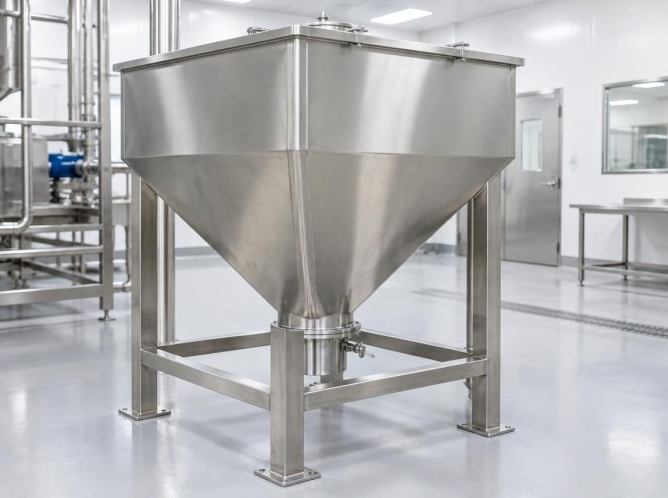
Engineering Principles in Bulk Solids Processing
When we design equipment for handling bulk solids, the focus must always be on preventing contamination. This means adhering to rigorous engineering principles that prioritize cleanability, material integrity, and operational efficiency. Every component, from hoppers to conveyors, must be conceived with the end goal of eliminating areas where product residue can accumulate or microorganisms can thrive.
A cornerstone of hygienic design is ensuring that all surfaces are easily accessible for cleaning and inspection. This often translates to designs that are self-draining, preventing liquid pooling even in dry processing environments where occasional washdowns or condensation might occur. Surface topography is also critical; smooth, non-porous finishes are essential. We often rely on profilometer testing to quantitatively measure surface roughness, ensuring it meets stringent standards. This meticulous attention to detail contributes significantly to equipment longevity and reduces the need for frequent, costly repairs. The use of continuous welds, rather than overlapping plates or intermittent welds, eliminates crevices that could harbor contaminants. For a deeper dive into the importance of robust design across various applications, you can explore resources on industrial processing equipment.

Material Selection and Surface Finishes for Bulk Solids Processing
The choice of materials is paramount in sanitary equipment design. For food contact surfaces, stainless steel is the industry standard due to its excellent corrosion resistance, durability, and ease of cleaning. Specifically, AISI 304 and AISI 316 stainless steel are most commonly recommended. AISI 316 offers superior corrosion resistance, particularly in environments with chlorides or aggressive cleaning agents, making it ideal for more demanding applications. In specialized dry applications where high abrasion or aggressive chemicals are present, high-nickel alloys such as Hastelloy or duplex stainless steels may also be considered.
Surface roughness, measured as Ra (roughness average), is a critical specification. Most hygiene standards require food contact surfaces to have a roughness average (Ra) of 0.8 µm (32 µ-inch) or less. This corresponds to a No. 4 finish on stainless steel, which is smooth enough to prevent microbial attachment and facilitate thorough cleaning. Electropolishing is frequently employed alongside mechanical polishing to smooth out microscopic peaks and valleys, further diminishing bacterial adhesion and lowering friction during powder discharge. Beyond initial fabrication, passivation of stainless steel is essential. This chemical treatment restores the protective chromium oxide layer, enhancing corrosion resistance and prolonging the life of the equipment. While stainless steel dominates, food-grade polymers such as PTFE, UHMW-PE, and silicone are also used for certain gaskets, seals, and flexible sleeves, chosen for their non-porosity, chemical resistance, and ability to withstand cleaning cycles without degradation.
Mitigating Contamination and Dead Zones in Bulk Solids Processing
One of the greatest challenges in hygienic design is eliminating harborage points—areas where food particles, moisture, and microorganisms can accumulate, leading to contamination. These “dead zones” are often microscopic but can have macroscopic consequences. Our design philosophy centers on proactively identifying and eliminating these risks across chutes, transfer hoppers, rotary valves, and pneumatic lines.
Key strategies include:
- Continuous Butt Welds:All welds on food contact surfaces must be continuous and ground smooth to eliminate gaps or overlaps where product can get trapped.
- Internal Radii:Sharp internal corners are difficult to clean. We ensure that all internal angles and corners have a generous radius (typically at least 1/8 inch or 3 mm) to allow for complete cleaning and drainage.
- No Hollow Areas:Hollow components, such as frame members or rollers, are potential breeding grounds for pathogens if not properly sealed. We either make these components solid or hermetically seal them with continuous welds, sometimes even filling them with an inert material to prevent internal condensation and microbial growth.
- Radius Transitions:All transitions between surfaces should be smooth and gradual, avoiding abrupt changes that create ledges or pockets.
- Gasket Recesses:Where gaskets are necessary, they should be designed to be flush with the surrounding surfaces, preventing product from accumulating around them. They must also be easily removable for inspection and cleaning.
Here are common powder harborage points we actively work to eliminate in our designs:
- Threaded fasteners in product zones
- Open seams or lap joints
- Rough or pitted surfaces
- Unsealed hollow tubing
- Sharp internal corners
- Poorly designed gasket interfaces
- Dead-end pipes or stagnant zones
- Exposed shaft seals
- Unprotected electrical conduits
- Unsealed control panels
By rigorously applying these principles, we minimize the risk of cross-contamination and ensure that our equipment supports the highest standards of food safety.
Dry Cleaning Protocols and Clean-In-Place Integration
While Clean-In-Place (CIP) and Clean-Out-of-Place (COP) systems are primarily associated with wet processing, their underlying principles of accessibility, cleanability, and validation profoundly influence dry cleaning protocols for bulk solids equipment. For dry ingredients, traditional wet CIP/COP is often impractical or detrimental due to product characteristics such as hygroscopic clumping, microbial growth triggered by residual moisture, or caking. Instead, we focus on dry sanitation methods that prevent moisture accumulation and microbial proliferation.
Our equipment designs facilitate efficient dry cleaning, such as:
- Tool-Free Disassembly:Components that require frequent cleaning are designed for quick, tool-free removal, allowing thorough access for brushing, vacuuming, or wiping.
- Smooth, Accessible Surfaces:All surfaces are engineered to be easily reachable and free of crevices, making manual cleaning or vacuuming highly effective.
- Allergen Changeover:For allergen control, our designs support rapid, validated dry cleaning processes to prevent cross-contact between different product runs. This often involves specialized HEPA-filtered vacuum systems and dedicated, color-coded cleaning tools.
- Moisture Control:In dry processing, moisture is the enemy. Equipment is designed to prevent condensation and to be easily dried after any minimal wet cleaning or environmental exposure, utilizing purge air or low-humidity air drying cycles.
- Validation Metrics:Even for dry cleaning, validation is crucial. We integrate design features that allow for effective ATP testing, rapid allergen lateral flow strips, or microbiological swabbing to verify cleanliness after sanitation procedures.
The goal is to achieve a level of cleanliness comparable to wet systems, but through methods appropriate for dry bulk solids. This ensures that our equipment not only handles product efficiently but also supports robust food safety programs.
Designing Custom Systems for Regulatory and Operational Efficiency
The landscape of food safety regulations, including the FDA’s Food Safety Modernization Act (FSMA) and USDA FSIS guidelines, demands a proactive approach to equipment design. In addition, global sanitary benchmark standards such as EHEDG (European Hygienic Engineering & Design Group) and 3-A Sanitary Standards provide engineering criteria that guide every aspect of sanitary fabrications. Generic, off-the-shelf solutions often fall short of meeting the unique challenges and stringent requirements of specific bulk solids processing lines. This is where customized fabrication becomes indispensable.
We work closely with food processors to design systems that not only comply with regulatory preventive controls but also enhance operational throughput and provide ergonomic access for operators and sanitation crews. A custom-designed system considers the specific product characteristics—such as bulk density, particle size distribution, cohesiveness, and abrasiveness—as well as production volumes, facility layout, and cleaning protocols. This tailored approach allows us to address potential risks at the design stage, preventing costly retrofits or compliance issues down the line while optimizing powder flowability and reducing downtime.

Sanitary Sifting and Powder Separation Equipment
Sifting and powder separation equipment are critical control points in bulk solids processing, acting as a final barrier against foreign material contamination and ensuring product quality. Our sanitary rotary sifter units and other separation equipment are engineered with hygiene as a primary concern.
Key design features include:
- Foreign Material Prevention:Screens and meshes are designed for durability and easy inspection, effectively removing foreign objects, lumps, and oversized particles without introducing metal fragments into the product stream.
- Magnetic Separation Integration:High-intensity rare-earth magnetic grates and drawers are strategically integrated adjacent to sifter inlets or discharge chutes to capture fine ferrous contaminants and work-hardened stainless steel particles.
- Dust Containment:Enclosed designs and effective dynamic sealing prevent dust escape, minimizing cross-contamination risks, reducing combustible dust hazards, and maintaining a clean processing environment.
- Tool-Free Disassembly:Components that come into contact with the product, such as screens, paddle assemblies, and internal mechanisms, are designed for quick, tool-free disassembly. This allows for thorough cleaning, inspection, and maintenance with minimal downtime.
- Inspection Access:We integrate easily removable covers, quick-release clamps, and large access panels, providing clear visibility into the equipment’s interior for routine checks, screen integrity validation, and deep cleaning.

By combining efficient separation capabilities with advanced hygienic design, our sifting and powder separation equipment plays a vital role in maintaining the safety and integrity of dry food products.
Installation Spacing, Sealing, and Plant Maintenance
Proper installation is just as critical as proper design in maintaining sanitary conditions. Even the most hygienically designed equipment can become a harborage point if not installed correctly. We recommend specific installation practices to ensure long-term food safety and regulatory compliance.
- Equipment Clearance:Adequate spacing around equipment is essential for cleaning and inspection. We advise leaving at least 4-6 inches between equipment and walls, and ensuring floor-mounted equipment is elevated at least 6 inches off the floor. For critical food contact surfaces, even greater clearance (e.g., 18 inches from the floor) might be necessary to facilitate unrestricted floor washing and visual inspection.
- Floor Mounting and Sealing Elevation:Equipment legs should be sealed to the floor or mounted on sanitary stainless steel leveling feet or casters. Where equipment is directly mounted, the base should be sealed to the floor with a sanitary coving to prevent moisture and debris from accumulating underneath.
- 360-Degree Access:All sides of the equipment should be accessible for cleaning, maintenance, and inspection. This often requires careful planning of the plant layout to avoid placing equipment flush against walls or adjacent machinery, ensuring maintenance crews can reach every component without awkward stretching.
- Pneumatic and Electrical Hygiene:Conduits, airlines, and motor mounts must be offset from machine bodies using sanitary standoffs to prevent dirt traps, while washdown-rated motors and enclosures protect internal mechanics from dust ingress.
- Maintenance Protocols:Regular and preventive maintenance is integral to hygiene. This includes scheduled gasket replacement, inspection of sanitary seals, monitoring bearing temperatures, and verification of weld integrity. Equipment manuals should clearly outline these protocols, including any specialized tools or procedures required.
By meticulously planning installation and adhering to robust maintenance schedules, food processors can ensure that their sanitary equipment continues to perform optimally, safeguarding product quality and consumer health.

