


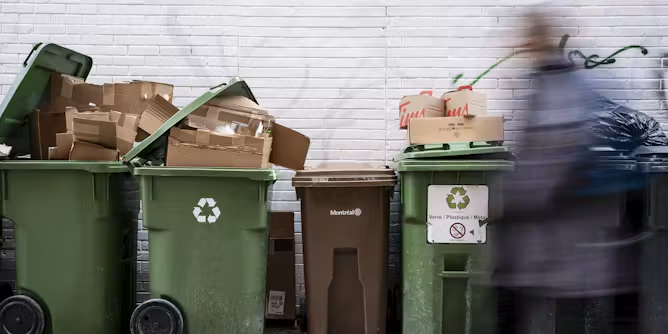
Try this thought experiment. No waste collection for two weeks, anywhere. Streets pile up fast. Pests move in faster. The smell alone becomes unbearable long before anyone starts worrying about long-term consequences. That’s really the quickest way to grasp why waste management matters this much, even though almost nobody actually lives through that scenario. The system works well enough, most of the time, that it fades into the background entirely. Invisible doesn’t mean unimportant, though. How a society handles its waste reaches into public health, climate, ecosystems, the economy, and who ends up paying the price when the system fails somewhere.
Health and Pollution Run on the Same Track
Go back far enough and poorly managed waste was directly responsible for disease outbreaks, contaminated water, and pest infestations tearing through entire communities. That risk never actually vanished. It just got less visible in places where infrastructure works. Proper waste management stops waste from piling up in ways that draw disease-carrying pests, contaminate soil and groundwater, or create conditions where bacteria and pathogens spread easily. Areas with weak waste infrastructure still show measurably worse health outcomes because of it, and even well-resourced places can open up serious risk through gaps in hazardous or medical waste handling.
The pollution angle runs well past human health too. Chemicals leach into soil and groundwater. Plastic and debris drift into rivers, then oceans, harming marine life and turning up nowhere near where any of it actually started. Wildlife eats it or gets tangled in it constantly. A well-run system, thoughtful landfill design, contamination controls, and recycling that intercepts harmful material before it ever reaches natural systems, cuts this damage down substantially.
Landfills Are a Climate Story, Not a Footnote
Organic waste breaking down in a landfill without oxygen produces methane. Methane does considerably more short-term damage as a greenhouse gas than carbon dioxide does. That makes landfills a real, measurable contributor to climate impact, despite getting a fraction of the attention transportation or energy emissions receive. Divert organic waste toward composting. Cut the total volume headed to landfill in the first place. Both directly reduce this emissions source. Recycling adds to the effect too, since manufacturing from recycled material generally takes a lot less energy than starting from raw inputs.
Less Gets Pulled Out of the Ground When Recycling Actually Works
Every material reused or recycled is one less thing needing fresh mining, harvesting, or extraction somewhere. Eases pressure on forests, mineral deposits, water sources, systems that don’t replenish quickly and that extraction industries depend on heavily. One recycled can of aluminum means marginally less bauxite mining tomorrow. That pattern repeats across a huge range of materials. Doesn’t matter much as an isolated act, though. It’s the scale that makes it real, and widespread, consistent diversion across millions of decisions genuinely eases pressure on systems already struggling to keep pace with demand.
An Actual Economy Sits on Top of All This
Waste management isn’t purely something businesses pay for, or society tolerates for the planet’s sake. It’s a real economic sector. Employs people across collection, sorting, processing, and the broader recovery and reuse network built around it. Recycling and material recovery jobs simply wouldn’t exist without organized waste systems, and as manufacturers lean harder on recycled inputs, this part of the economy keeps growing rather than shrinking. Worth remembering next time waste management gets framed purely as a burden. It’s also generating real value out of what would otherwise be a pure loss.
Communities Feel This Directly, and Not Everyone Feels It Equally
Set the bigger arguments aside for a second. Think about what a well-run waste system actually does for a neighbourhood day to day. Clean streets. Reliable pickup. Less illegal dumping cluttering vacant lots. All of it adds up to a place reading as cared-for instead of neglected, and property values, community pride, general quality of life connect back, at least partly, to how well a place handles its waste. Where infrastructure runs weak, these markers tend to slip visibly, often compounding other challenges a community’s already facing.
That burden hasn’t landed evenly, either. Landfills and processing sites have historically ended up disproportionately close to lower-income communities, a pattern documented repeatedly across different regions. The downsides, like odour, traffic, and contamination risk, don’t distribute evenly, even though the benefit of waste services runs across an entire population. This imbalance has become a bigger part of how waste policy gets discussed now, recognizing that where infrastructure actually gets built, and who ends up living next to it, carries real social weight that cost and logistics thinking alone tends to miss entirely.
Why It Adds Up to More Than It Looks Like
Public health, climate, ecosystems, resource use, economic opportunity, social equity. Waste management touches all of it at once, which is a lot to hang on something so often treated as invisible background infrastructure. Once these connections become visible, it’s a lot harder to write waste off as a solved problem the moment a bin gets emptied. Both the risk of getting it wrong and the payoff of getting it right stretch well past that single moment of disposal.

