


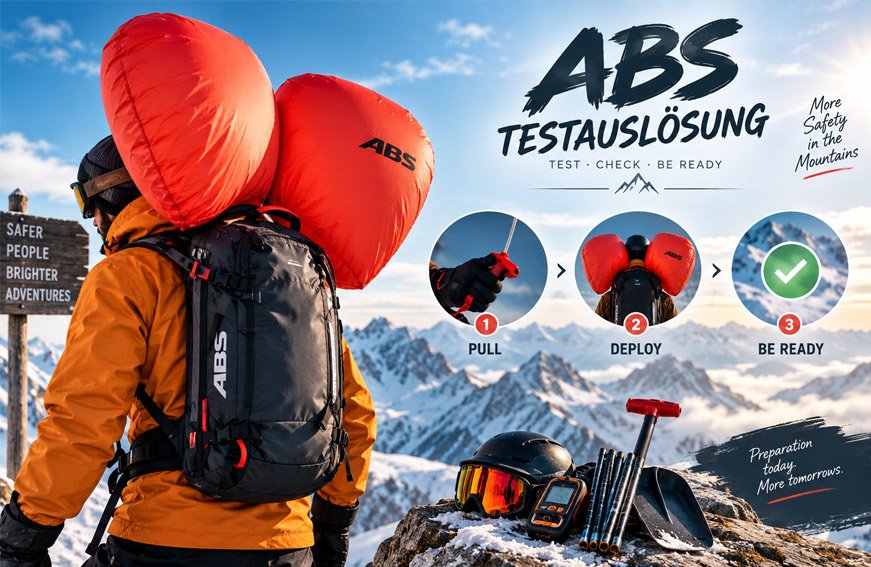
ABS Testauslösung means testing the release of an ABS avalanche airbag system. It is a controlled test used to check the system and practice pulling the release handle.
People usually search for this term when preparing an avalanche backpack for winter. This guide explains what ABS Testauslösung means, how an avalanche airbag works, why testing matters, and the difference between a full test and dry trigger practice.
What Is ABS Testauslösung?
The German word Testauslösung means “test release” or “test activation.” In this case, ABS Testauslösung means deliberately testing an ABS avalanche airbag.
It does not refer to the ABS anti-lock braking system found in cars. Here, ABS refers to an avalanche airbag system used by skiers, snowboarders, freeriders, and other people traveling in avalanche terrain.
A Testauslösung can involve a complete airbag deployment or, on some systems, only a practice pull of the release handle.
Some German terms may also appear in ABS manuals. Auslösegriff means release or trigger handle. Lawinenairbag means avalanche airbag. Gaskartusche or Patrone refers to the gas cartridge used by compatible systems.
A test deployment is controlled and planned. A real deployment happens when the user pulls the handle during an avalanche emergency.
ABS has produced different systems and generations. Their parts and operating steps can differ. For this reason, the manual for the exact backpack and system should always be followed instead of using instructions for another model.
How Does an ABS Avalanche Airbag Work?
An ABS avalanche airbag is designed to increase the effective size and volume of the person wearing it.
When the system is ready and the user pulls the release handle, the inflation process starts. In cartridge-based systems, stored gas is used to inflate the airbag.
Depending on the model, the system may include a release handle, gas cartridge, inflation unit, hoses, cables, valves, and one or more airbag chambers.
Avalanche airbags are linked to a principle known as inverse segregation. In moving granular material, larger objects can tend to remain closer to the surface while smaller particles move below them. An inflated airbag increases the user’s volume and is designed to help the person remain nearer the surface of moving avalanche snow.
However, an airbag cannot stop an avalanche. It also cannot guarantee that someone will remain on the surface or avoid injury.
Different ABS products use different designs. Systems mentioned in the collected information include ABS EASY.TECH, the ABS SOLID release mechanism, and ABS p.RIDE Inflator.
Because these systems are not identical, the correct cartridge, trigger, setup, and test procedure depend on the model.
Why Is ABS Testauslösung Important?
ABS Testauslösung is useful for both equipment checking and user practice.
A full test can help show whether important parts of the system work during deployment. A problem with the release mechanism, cartridge, inflation system, or airbag may become clear during testing.
Finding a problem before a winter trip gives the owner time to arrange service, repair, or cartridge replacement.
Testing is also useful for practice. In an avalanche, there may be little time to find and pull the release handle. Practicing the movement makes the handle position and pulling action more familiar.
It is useful to practice while wearing the backpack normally. Wearing winter clothing and gloves can make the test more realistic because thick gloves and extra clothing may change how easily the handle can be reached.
The collected information reports that ABS recommends a training release with a filled cartridge before each season. Users should still check the instructions for their exact system because maintenance and testing requirements can vary between models.
Full Test vs Dry Trigger Test
There are two important types of ABS airbag practice: a full test deployment and a dry trigger test.
They are not the same.
Full Test Deployment
A full ABS Testauslösung uses the correct filled cartridge and actually deploys the airbag.
The system is prepared according to its manual, and the user pulls the release handle. The inflation system then activates and the airbag opens.
This type of test can check more than the trigger movement. It can also show whether the inflation process and airbag deployment appear to work correctly.
After a full test, the system must be prepared again before it can be relied on for another trip. Depending on the model, the used cartridge may need to be refilled or exchanged. The airbag also needs to be correctly deflated and repacked.
Dry Trigger Test
A dry trigger test is different because it does not perform a complete airbag inflation.
Some compatible ABS EASY.TECH systems allow users to practice the release mechanism without using a cartridge for a full deployment. The user can feel and hear feedback from the trigger mechanism.
This is useful for practicing where the handle is and how it feels to pull it. The movement can also be practiced several times without using a filled cartridge for every attempt.
However, dry practice does not check the complete system. It does not show whether the cartridge, full inflation path, airbag chambers, fabric, or other deployment parts will work correctly.
Not every ABS system supports the same type of dry practice. Older systems and different release mechanisms may have different rules. Users should never remove a cartridge and repeatedly pull the handle unless the manual for that exact system says this is allowed.
When Should You Test an ABS Airbag?
The most useful time for an ABS Testauslösung is before the winter season starts.
Testing early gives you time to deal with a problem. If the airbag does not deploy correctly, you may need professional service, replacement parts, or a cartridge refill or exchange.
Waiting until the morning of your first ski trip is not a good time to discover a problem.
Testing can also be useful after buying a new avalanche backpack. The handle may sit in a different position, and the release movement may feel different from your previous equipment.
The same applies when changing to another ABS system. Practicing while wearing the new pack helps you learn where the handle sits and how to reach it with winter clothing.
Extra trigger practice may also be useful after a long break from touring or before an important backcountry trip, as long as the system supports that type of practice.
A pack that has been used during a real avalanche needs different attention. It should not simply be deflated, repacked, and assumed to be ready. Follow the manufacturer’s inspection and service instructions after a real avalanche deployment.
What to Check Before ABS Testauslösung
Start by reading the manual for your exact ABS system. Do not assume that instructions for a newer, older, or different ABS backpack are suitable for yours.
Look over the backpack before testing. Check the airbag compartment, pack fabric, shoulder straps, waist belt, buckles, and leg loop if the model uses one.
Also inspect the visible parts of the release and inflation system as directed by the manual. Look for cuts, tears, heavy wear, loose parts, damaged connections, rust, or anything else that appears unusual.
Check the release handle and make sure it is fitted and positioned correctly.
The cartridge also needs attention. Make sure it is the correct type for your system and meets the manufacturer’s requirements. If the manual gives a method for checking whether the cartridge is properly filled, follow that method.
Do not mix cartridges, handles, or other release parts from ABS, Mammut, Ortovox, or other systems unless the manufacturer specifically confirms compatibility. Parts that look similar are not necessarily designed to work together.
If the backpack shows damage, an error, a loose component, or another unusual condition, do not continue with a normal test just to see what happens. Check the manual or contact the appropriate service provider first.
How to Perform ABS Testauslösung Safely
An ABS Testauslösung should be done in a controlled place with enough open space for the airbag to inflate.
Keep other people and pets away from the deployment area. Move sharp objects, heaters, fragile items, furniture, tools, and other obstacles away from the airbag.
Wear the backpack as you normally would during a winter trip. Adjust the shoulder and waist straps correctly. Use the leg loop if your model requires one.
It can also be useful to wear your normal winter jacket and gloves. This makes it easier to see whether you can find and pull the release handle while dressed for the mountains.
Prepare and arm the system exactly as described in its manual. Do not guess the order of the steps because the procedure can differ between ABS systems.
Once the system is correctly prepared, use the release handle as instructed. During a full test, observe whether the expected airbag chambers deploy and whether anything looks or sounds unusual.
If the system does not activate correctly, the airbag only partly deploys, or something else appears wrong, do not assume the backpack is ready for avalanche terrain. Follow the manufacturer’s troubleshooting or service instructions before using it again.
What to Check After Deployment
After a full ABS Testauslösung, look at how the airbag has opened. The expected airbag chambers should be fully deployed and should not show clear signs of damage.
Check the airbag fabric, seams, and visible connections. Look for tears, leaks, loose parts, or an unusual shape.
If the airbag does not open correctly, only partly inflates, or loses air unusually fast, do not simply repack it and use it in avalanche terrain. Follow the instructions for your model and contact ABS or an approved service provider if needed.
A successful test is useful, but it only shows how the system worked during that test. It does not prove that every part of the backpack is free from wear or damage.
Cartridge Replacement and Airbag Repacking
A full ABS Testauslösung uses the gas supply needed for deployment. After the test, the system must be made ready again.
Depending on the ABS model, the used cartridge may need to be refilled or exchanged. Follow the instructions for the exact cartridge and release system.
Do not put an empty cartridge back with equipment that you believe is ready for a trip. Keep it separate until it has been properly refilled or replaced.
Use only a cartridge that is approved for your system. Do not use a cartridge from another avalanche airbag brand just because it looks similar.
The deployed airbag also needs to be deflated. Use the method shown in the product manual. Do not force, twist, or damage the airbag while removing the gas.
If the airbag is wet, allow it to dry as required before storing or repacking it.
Fold and pack the airbag exactly as the manufacturer explains. Poor packing may stop the airbag from opening correctly during the next deployment.
After repacking, check that the system has been returned to its correct ready state.
Common ABS Testauslösung Mistakes
Several simple mistakes can make an airbag test less useful.
One of the most common is testing without reading the manual. ABS systems have changed over time, so the correct steps can be different between models.
Another mistake is testing in a small room. An inflating airbag needs enough clear space. It should not hit people, walls, furniture, sharp objects, heaters, or other items.
Waiting until the day of a ski trip is also a problem. If the test finds a fault, there may not be enough time to arrange service or replace the cartridge.
Some people practice the trigger without wearing the backpack. This may test the trigger movement, but it does not give the same practice as reaching for the handle while actually wearing the pack.
Other mistakes include using the wrong cartridge, failing to secure a cartridge correctly, forgetting the leg loop where required, incorrectly resetting the system, and packing the airbag badly after a test.
A used cartridge must also not be forgotten. After a live deployment, make sure the system has a suitable filled cartridge before treating the backpack as ready.
Most importantly, do not ignore an unusual test result. If the airbag does not work as expected, find the cause before using it in avalanche terrain.
Maintenance, Storage, and Professional Service
ABS Testauslösung is only one part of avalanche airbag care. A test deployment does not replace regular maintenance or a full professional inspection.
Check the backpack regularly for wear and damage. Give it extra attention after a hard fall, a real avalanche deployment, or any event that may have damaged the system.
ABS provides service options for its avalanche airbag systems. Service requirements can depend on the product, its age, and the type of release system.
Some collected information mentions a larger service around every three years for certain ABS products. This should not be treated as a rule for every ABS airbag. Check the current service instructions for your exact model.
Professional inspection may be needed if the airbag has been used in a real avalanche, has visible damage, does not deploy correctly, or has problems with its release or inflation system.
Storage also matters. Keep the backpack in a dry place and away from strong heat, sharp objects, oil, and anything else that could damage the pack or airbag.
Follow the manufacturer’s instructions for storing the cartridge. Do not try to repair or modify an unfamiliar release or inflation system yourself.
ABS Testauslösung and Avalanche Safety
An ABS Testauslösung can help prepare your equipment, but it cannot make avalanche terrain safe.
An avalanche airbag is emergency equipment. It is designed to help during an avalanche, but it cannot stop an avalanche from starting. It also cannot guarantee that a person will stay on the surface or avoid injury.
Good avalanche safety starts before entering dangerous terrain.
Check the local avalanche forecast and current conditions. Think about the snow, weather, route, slope, and the people in your group.
People traveling in avalanche terrain should also carry the main avalanche rescue equipment:
- Avalanche transceiver or beacon
- Probe
- Shovel
Knowing how to use this equipment is just as important as carrying it. Rescue practice and avalanche education help people understand what to do when something goes wrong.
An avalanche airbag has a different job from a beacon, probe, and shovel. It should be used together with them, not instead of them.
Careful route choices are also important. A working airbag does not make a dangerous slope safe.
Bottom Line
ABS Testauslösung means testing the release of an ABS avalanche airbag system. It can help check how the system works and make the release movement more familiar before the winter season.
A full test uses the correct gas supply and deploys the airbag. Some compatible systems also allow dry trigger practice without full inflation. These two tests serve different purposes.
Always use the instructions for your exact ABS model. Check the backpack and cartridge before testing, use a clear testing area, and correctly prepare the system again afterward.
If the airbag does not work as expected, do not rely on it until the problem has been checked.
An avalanche airbag is only one part of mountain safety. It should be combined with an avalanche beacon, probe, shovel, rescue skills, avalanche forecasts, and careful terrain choices.
Frequently Asked Questions
What does ABS Testauslösung mean?
ABS Testauslösung means testing an ABS avalanche airbag. It checks the system and helps you practice pulling the handle.
How often should I perform an ABS Testauslösung?
ABS recommends a full training test before each winter season. Always follow the instructions for your airbag model.
Can I test an ABS airbag without a cartridge?
Some ABS EASY.TECH systems allow practice without a cartridge. This tests the trigger movement but not the full airbag inflation.
Do I need to replace the cartridge after a full test?
Yes, the gas is used during a full test. The cartridge must be refilled or exchanged, depending on the system.
What should I do if the airbag does not deploy correctly?
Do not use the airbag in avalanche areas. Check the manual or contact ABS service for help.
Is ABS Testauslösung the same as professional servicing?
No. A test checks basic operation, while professional service can check the system for damage, leaks, and worn parts.
Does an ABS avalanche airbag make avalanche travel safe?
No. An airbag cannot prevent an avalanche. You still need proper training, a beacon, probe, shovel, and careful route planning.
Explore More:
Messagenal: What It Is, How It Works, Benefits, and Limitations

