


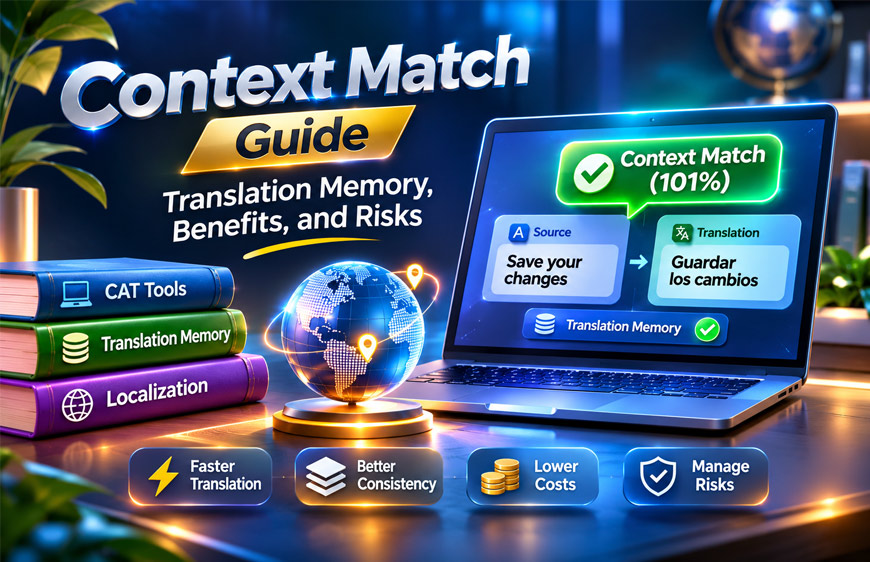
Context Match is a term used in translation and localization. It happens when new text matches an older entry in Translation Memory and appears in the same or similar context.
People often search for Context Match to understand 100%, 101%, and fuzzy matches. This guide explains what Context Match means, how it works, its benefits, and the risks to know.
What Is a Context Match?
A Context Match happens when a CAT tool finds the exact same source text in Translation Memory and also finds matching context.
The text can be a full sentence or something shorter. It may be a button, heading, warning, menu item, or field label.
For example, a Translation Memory may already contain “Confirm Your Order” and its translation. The same text may appear in a newer version of an online store. If only the text matches, the tool may show a 100% match.
If the text and its context both match, the tool may show a Context Match. This gives the translator more reason to believe that the old translation can be used again.
However, this does not mean the translation is always correct. If the old translation has a mistake, Context Matching will not fix it.
How Context Matching Works
Context Matching starts with Translation Memory. A CAT tool breaks content into smaller parts called segments. It then compares these segments with translations already stored in the TM.
Similar text may produce a fuzzy match. Exact text may produce a 100% match. Context Matching adds another check.
For example, imagine these three lines:
“Choose Your Payment Method”
“Continue”
“Confirm Your Order”
The word “Continue” may appear in many places on a website. An exact match only tells the translator that this word was translated before.
If the lines before and after it also match an older version, there is more reason to believe that “Continue” is being used in the same way.
CAT tools do not all check context in the same way. Some use nearby text. Others may use IDs, context keys, metadata, or file structure.
Translation Memory and Context Match
Translation Memory, or TM, stores source text and its previous translation.
When the same or similar text appears again, the CAT tool can find the old translation and show it to the translator. This can save time when working with content that is updated often.
The quality of the TM is very important. If a wrong translation is stored in it, the same mistake may appear again. Old product names or outdated terms may also stay in the memory.
Context Matching can make reuse more reliable, but it cannot fix a poor Translation Memory.
A Translation Memory is also different from a Termbase. A TM stores translated segments. A Termbase stores important words and approved terms, such as product names, technical terms, and abbreviations.
Using both can help translators work faster and keep wording consistent.
Why Context Matters in Translation
The same word can have different meanings depending on where it appears.
For example, “Close” on a button may tell the user to close a window. In another sentence, “close” may mean something is nearby.
The same problem can happen with words such as “Open,” “Back,” “Save,” “Home,” and “Continue.”
“Home” in a website menu normally means the main page. In normal writing, it can mean the place where someone lives.
Context helps the translator understand the correct meaning.
It can be even more important in languages where words change based on gender, number, case, or formality.
This is why matching the source text alone is not always enough. Context Matching gives the translator more information about how the text is being used.
What Information Can Be Used as Context?
CAT tools can use different information to understand context.
They may check the text before and after a segment. If the same lines appear in the same order as an older file, this can be a strong sign that the text has the same purpose.
Some systems can also use IDs, context keys, tags, and metadata. They may know that a piece of text belongs to a button, heading, menu, table, or form.
For example, two buttons may both say “Save.” One may save a document, while the other saves account settings. An ID can help the system understand that these buttons have different jobs.
This type of context is useful for software, apps, websites, CMS platforms, XML files, and other structured content.
Keeping useful IDs and file structures stable can also help. If they change without a good reason, the CAT tool may lose useful context from older translations.
Context Match vs. 100% Match
A 100% match normally means the source text is exactly the same as text already stored in Translation Memory.
A Context Match goes further. It checks the source text and its context.
The difference is simple:
100% match: The same source text was found before.
Context Match: The same source text was found before in matching context.
This extra information is useful for short words that can have several meanings.
However, a Context Match is not always better in every situation. Both results still depend on the quality of the old translation.
Context Match vs. Fuzzy Match
A fuzzy match means the new source text is similar to an older entry but is not exactly the same.
For example, the TM may contain:
“Your order will arrive in three days.”
The new text may say:
“Your order will arrive in five days.”
Most of the sentence is the same, but one detail has changed. The translator can use the old translation as a starting point but must update the changed part.
A Context Match is different. It normally needs an exact source match plus matching context.
Match percentages should not be seen as direct scores for translation quality. They are labels created by CAT tools based on their own matching rules.
What Does a 101% Context Match Mean?
A 101% match is a common label for a Context Match.
It does not mean that a translation is 101% accurate. The extra one percent is simply used to separate it from a normal 100% match.
It usually means that the source text matches exactly and the required context also matches.
Different CAT tools may use different types of context. Some check nearby text, while others may use IDs, context keys, or structural information.
Terms such as In-Context Match and ICE Match may also be used for this type of strong match.
Because systems can work differently, translators should check how their CAT tool defines a 101% match.
What Is a 102% Double-Context Match?
Some CAT tools have an even higher Context Match level.
For example, memoQ can show a 102% Double-Context Match when two types of context meet its matching rules.
This may include text-flow context and an ID. Text-flow context looks at the text around a segment. ID-based context uses an identifier linked to that piece of content.
When both match, the tool has more information showing that the old translation may fit the new text.
A 102% score does not mean the translation is 102% accurate. It is simply a match category.
This term is also specific to certain translation tools. Not every CAT tool uses a 102% match.
Structural Context, IDs, and Metadata
Context can include more than nearby words. CAT tools may also use IDs, tags, context keys, and metadata.
This is helpful when the same words have different uses.
For example, two buttons may both say “Save.” One saves a file. The other saves changes to an account. An ID can help the system understand which button is being translated.
Structural context is common in software, apps, CMS platforms, XML files, and other organized content.
Stable IDs can also improve Translation Memory reuse. If IDs or file structures change often, the CAT tool may lose useful information from earlier projects.
Benefits of Context Matching
Context Matching can save translators time. They can reuse approved translations instead of translating the same text again.
It can also improve consistency. The same buttons, menus, warnings, and standard messages can keep the same wording across different versions of a product.
Translators can spend more time on new text, fuzzy matches, difficult terms, and sections that need careful review.
Context Match information can also help localization managers plan projects. They can see how much content is new, repeated, exact, fuzzy, or available for reuse.
These benefits depend on having a good Translation Memory. A Context Match cannot make a wrong translation correct.
Where Context Matching Is Most Useful
Context Matching works well for content that is updated often but keeps a similar structure.
Software is a good example. A new version of an app may keep many of the same buttons, menus, alerts, settings, and error messages.
Websites and CMS platforms can also benefit. Menus, forms, account messages, and standard notices often stay the same across updates.
Technical manuals may reuse instructions, warnings, and product information from older versions.
Online stores can also reuse checkout messages, shipping information, account labels, and other common text.
Context Matching is less useful for completely new or highly creative content because there may be fewer exact matches in Translation Memory.
Context Match and Translation Pricing
Translation Memory can affect the price of translation work.
Some translation companies separate content into new words, fuzzy matches, repetitions, 100% matches, and Context Matches. They may charge different rates for each type.
Context Matches may cost less because the translation has already been created. However, there is no fixed price or discount used by every company.
Pricing can depend on the language, type of content, Translation Memory quality, project requirements, and amount of review needed.
A 101% match should not always be treated as free work. A translator may still need to check the translation before approving it.
Risks and Limitations
The biggest risk with Context Matching is poor Translation Memory data.
If an old translation is wrong, the same mistake may be suggested again. A high match score does not fix the problem.
Translations can also become outdated. Product names, technical terms, legal wording, and brand style can change.
Technical changes may also cause problems. IDs can change, segments can move, and metadata can be lost. This can make it harder for a CAT tool to find the correct context.
A CAT tool also only checks the information available to it. The wider purpose of a product or document may have changed even when nearby text looks the same.
For these reasons, Context Match should be seen as useful evidence, not a guarantee that a translation is correct.
Does a Context Match Still Need Human Review?
Sometimes, yes.
The amount of review depends on the type of content and the risk of a mistake. A simple menu button may need less checking than a legal statement or safety warning.
Medical, financial, legal, and safety information may need careful human review even when it has a strong Context Match.
Translators should also check whether product names, technical terms, measurements, or style rules have changed.
Some teams automatically approve or lock trusted Context Matches. This can save time when the Translation Memory is reliable.
However, human review is still important when an error could create a serious problem.
How to Improve Context Match Quality
Good Context Matching starts with a clean Translation Memory.
Teams should correct wrong translations and update old entries. Duplicate or conflicting translations should also be checked.
A current Termbase can help translators use the right product names and technical terms.
Source text should also be consistent when the meaning is the same. Using many different versions of the same instruction can make Translation Memory less useful.
Stable IDs and useful metadata are important for structured content. Developers should avoid changing them without a good reason.
Review rules should also match the level of risk. A normal button and an important safety warning may both receive strong matches, but they should not always receive the same level of review.
Context Match and AI
Traditional Context Matching does not need artificial intelligence.
It works by comparing source text and stored context with information in Translation Memory.
AI tools can work alongside Context Matching, but they are different.
Machine translation can create a new translation when a useful TM entry is not available. Semantic matching can find text with a similar meaning even when the words are different. AI tools may also help find certain translation errors.
A traditional 101% Context Match normally comes from an exact Translation Memory match plus matching context.
Knowing where a translation came from helps translators decide how carefully it should be reviewed.
A Simple Context Match Review Process
First, check that the new source text is exactly the same as the stored source text.
Next, check the context. Look at nearby text, IDs, metadata, or where the text appears in the file.
Then check the stored translation. Make sure product names, technical terms, measurements, and other details are still correct.
Check the current style guide as well. An older translation may no longer follow the latest writing rules.
Finally, look at the wider purpose of the content. The text may look the same even though the product or workflow has changed.
The translator can then approve the translation, edit it, or replace it if needed.
Bottom Line
Context Match helps translators reuse old translations when both the source text and its context match.
It can save time, reduce repeated work, and keep translations consistent across software, websites, apps, manuals, and other regularly updated content.
However, 101% and 102% matches are match categories. They do not mean a translation is perfect.
Good results depend on a clean Translation Memory, current terminology, useful context, stable content structure, and human review when needed.
Frequently Asked Questions
What is a Context Match in translation?
A Context Match means the same text and its context match an older translation stored in Translation Memory.
What does a 101% Context Match mean?
A 101% match means the text and its context match. It does not mean the translation is 101% accurate.
What is a 102% Context Match?
A 102% match is used by some tools, such as memoQ, when two types of context match. Not every CAT tool uses it.
What is the difference between a 100% match and a Context Match?
A 100% match means the text is exactly the same. A Context Match means both the text and its context match.
Is Context Match the same as a fuzzy match?
No. A fuzzy match is similar but not exact. A Context Match normally requires the exact same text and matching context.
Can a Context Match contain errors?
Yes. If the old translation has an error, the same error may appear in the Context Match.
Does Context Matching reduce translation costs?
It can reduce costs because less new translation may be needed. However, prices depend on the provider and project.
Does Context Matching use AI?
No, traditional Context Matching does not need AI. It mainly uses Translation Memory and stored context.
Explore More:
Yonochomp Com Complete Guide: Topics, Safety, and Guest Posts

