


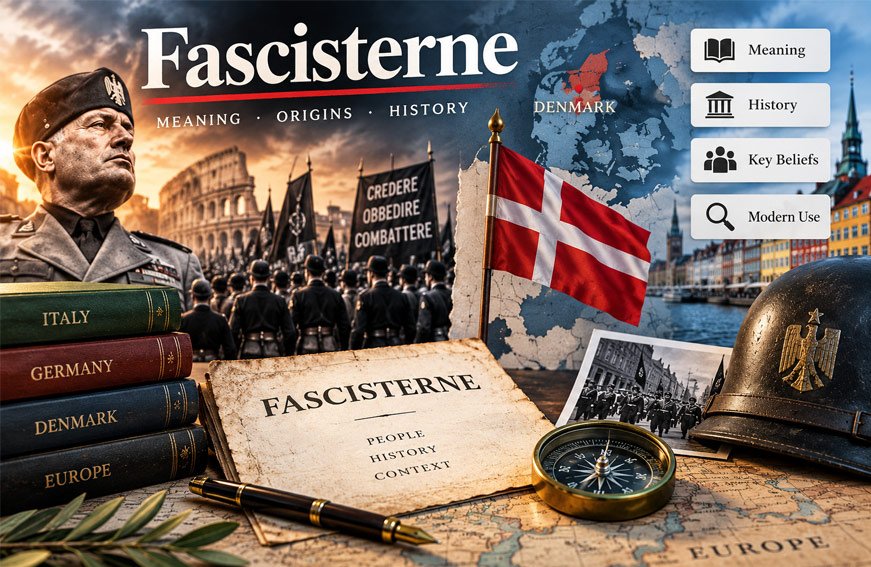
Fascisterne is a Danish word that means “the fascists” in English. It refers to people connected with fascism, not to the political ideology itself.
People may see the word in Danish history books, World War II articles, political discussions, news reports, or social media posts. Because the term is often used in different situations, its exact meaning depends on context.
This article explains what Fascisterne means, how the Danish word works, where fascism came from, what fascists believed, and how fascism differs from Nazism.
What Does Fascisterne Mean?
Fascisterne means “the fascists.”
It describes a group of people who support or are connected with fascism. It is not another word for fascism itself.
The word also does not name one specific political party. A Danish writer may use Fascisterne when talking about Italian Fascists, Danish fascist groups, or another group described as fascist.
The surrounding text tells the reader who is being discussed.
For example, if the topic is Italy in the 1920s, Fascisterne may refer to supporters of Benito Mussolini. In a Danish history article, it may refer to a local fascist or National Socialist group.
This is why context is important when translating or reading the word.
Fascisterne in Danish Grammar
Danish often adds an ending to a noun to show that it is definite.
The basic forms are:
| Danish | English |
|---|---|
| fascist | a fascist |
| fascisten | the fascist |
| fascister | fascists |
| fascisterne | the fascists |
| fascisme | fascism |
| fascistisk | fascist or fascistic |
The important difference is simple:
Fascisterne refers to people.
Fascisme refers to the political ideology.
This helps avoid a common mistake. Fascisterne should normally not be translated as “fascism.”
Where Did Fascism Come From?
The word fascism is linked to the Latin word fascis, meaning a bundle.
In ancient Rome, fasces were bundles of rods, sometimes shown with an axe. They were used as symbols of authority and state power.
The Italian word fascio could mean a group, bundle, or association. This word later became connected with Benito Mussolini’s political movement.
Modern fascism developed mainly in Italy after World War I.
Europe was going through serious problems at the time. Many countries faced political instability, economic trouble, social conflict, and fear of revolutionary movements.
Some people also felt that their governments were weak or unable to solve these problems.
These conditions helped extremist political movements gain support.
However, economic or political problems alone do not create fascism. Fascism also developed from specific ideas about nationalism, political authority, violence, and the role of the state.
Mussolini and the Rise of Italian Fascism
Benito Mussolini became the best-known early leader of fascism.
In 1919, he founded the Fasci Italiani di Combattimento in Milan.
The early movement included war veterans and strong nationalists. It opposed socialism and liberal democracy and supported direct political action.
Violence became an important part of the movement.
Fascist groups known as Blackshirts attacked socialist organizations, trade unions, and political opponents. They also used threats and intimidation.
In October 1922, fascist supporters took part in the March on Rome.
After this event, King Victor Emmanuel III appointed Mussolini prime minister.
Italy did not become a complete dictatorship on the same day.
Mussolini gradually weakened democratic institutions. Political opponents were suppressed, the press was restricted, and other parties lost their ability to operate freely.
By the mid-1920s, Italy had become a dictatorship dominated by Mussolini and the Fascist Party.
Mussolini became known as Il Duce, meaning “the leader.”
His government promoted strong national unity, obedience to the state, military power, and loyalty to political authority.
What Did the Fascists Believe?
Fascist movements were not exactly the same in every country.
However, historians have identified several ideas that appeared again and again in historical fascist movements.
The Nation Above the Individual
Fascists believed that the nation should come before individual political rights.
People were expected to serve what the movement described as the national interest.
Personal freedom and political disagreement could be limited if leaders claimed that they threatened national unity.
This idea was very different from liberal democracy, where individuals have political rights and different parties are allowed to compete.
Strong Leadership
Fascist movements often supported a powerful leader.
The leader was presented as someone who represented the nation as a whole.
Political power became concentrated around the leader and the ruling movement.
Independent courts, parliaments, opposition parties, and media could lose power under this system.
Opposition to Liberal Democracy
Historical fascists generally rejected liberal democracy and political pluralism.
They argued that competition between parties, social groups, and political ideas made the country weak.
Instead, they supported one strong political direction and centralized power.
This meant that opposition was often treated as a threat rather than as a normal part of politics.
Anti-Communism and Anti-Socialism
Fascist movements were strongly opposed to communism and socialism.
They rejected the Marxist idea of class struggle.
Instead, fascists argued that different social classes should work together under the authority of the nation and the state.
Fear of communist revolution helped fascist movements gain support from some groups in Europe.
Political Violence
Political violence played an important role in many fascist movements.
Fascist groups used force, threats, and organized street violence against opponents.
Violence was sometimes presented as necessary for national strength, discipline, or political renewal.
Paramilitary groups were also common in several fascist movements.
Militarism and Discipline
Fascist governments often praised military values such as obedience, discipline, sacrifice, and strength.
Military uniforms, marches, symbols, and organized youth groups were used to build loyalty.
War and military power could also be presented as ways to increase national influence.
Propaganda and Mass Politics
Fascist movements used propaganda to gain and maintain public support.
This could include:
- public rallies
- speeches
- political symbols
- radio
- newspapers
- films
- uniforms
- youth organizations
The goal was not only to control people through force. Fascist governments also wanted people to actively identify with the movement.
Who Belongs to the Nation
Many fascist movements promoted a narrow idea of who truly belonged to the nation.
People could be excluded because of their ethnicity, religion, political beliefs, nationality, or other characteristics.
Groups described as outsiders could be blamed for political or social problems.
The exact form of exclusion differed between countries.
The Idea of a Powerful State
Italian Fascism promoted the idea that the state and nation should stand above competing individual or class interests.
The government aimed to organize society under one political direction.
This was sometimes connected with the idea of a “total state.”
However, historians also note that Mussolini’s Italy did not control every part of society in exactly the same way as Nazi Germany later did.
Fascism is therefore better understood by looking at several characteristics together rather than using one single feature.
Fascism vs. Nazism
Fascism and Nazism are closely related, but they are not exactly the same.
Nazism developed in Germany under Adolf Hitler and is usually treated as a radical form of fascism.
Both systems shared important features, including:
- authoritarian leadership
- extreme nationalism
- opposition to liberal democracy
- suppression of political opponents
- propaganda
- political violence
- mass political mobilization
However, Nazi ideology placed much greater importance on race.
Nazism was built around ideas of racial hierarchy, antisemitism, and supposed Aryan racial superiority.
It also promoted Lebensraum, or the idea that Germany needed more territory for its population and political goals.
These racial ideas later led to systematic persecution and genocide.
Italian Fascism did not begin with exactly the same racial system.
Italian Jews could even belong to the Fascist Party during its earlier years.
However, Mussolini’s government later moved closer to Nazi Germany and introduced antisemitic racial laws in 1938.
This does not mean Italian Fascism was harmless before 1938. Mussolini’s government had already destroyed democratic freedoms, persecuted opponents, used political violence, and pursued military expansion.
In Danish, the difference can also be seen in the words themselves:
Fascisterne means “the fascists.”
Nazisterne means “the Nazis.”
The terms are related, but they should not be used as exact synonyms.
Fascisterne in Denmark
Denmark also had fascist and National Socialist groups during the 1930s and World War II.
These movements never became as powerful as those in Germany or Italy. Denmark did not become a fascist state through a local fascist party.
Some anti-democratic and nationalist groups gained attention, but they remained limited in elections.
Denmark also introduced laws to reduce political violence. In 1933, political uniforms were banned. In 1934, further rules were introduced against certain armed and military-style political groups.
These steps were meant to protect public order and limit violent political organizations.
DNSAP and Frits Clausen
The best-known Danish Nazi party was Danmarks Nationalsocialistiske Arbejderparti, usually called DNSAP.
It was founded in 1930 by Cay Lembcke.
The party was strongly influenced by Hitler’s German Nazi Party. It used similar ideas, symbols, leadership methods, and political language.
DNSAP opposed liberal democracy, Marxism, and communism. It also supported nationalism and antisemitic ideas.
In 1933, Frits Clausen became the party leader.
Clausen was a doctor from southern Jutland. Under his leadership, DNSAP became the main Danish National Socialist party.
However, it never gained broad public support.
In the 1935 election, DNSAP received 16,257 votes, around 0.99%, and won no seats.
In 1939, it received about 1.8% of the vote and won three seats in parliament.
In the 1943 election, it received a little over 40,000 votes, around 2.1%, and again won three seats.
Party membership grew more than its election support. DNSAP had about 5,000 members in 1939 and around 21,500 members by early 1943.
This shows that the party had a committed membership but remained politically weak among Danish voters.
Fascisterne During the German Occupation
Germany invaded Denmark on 9 April 1940.
The occupation changed the position of Danish Nazis. DNSAP hoped that German control would help the party gain political power.
That did not happen.
Germany did not simply install DNSAP as the Danish government. The party still lacked enough support among the Danish population.
This created an important problem for DNSAP. It claimed to support Danish nationalism, but it was closely connected with Nazi Germany, which was occupying Denmark.
Some Danish Nazis worked with the German authorities.
However, not every Danish collaborator was a DNSAP member, and not every person who worked with Germany had the same political beliefs.
Some Danish citizens also volunteered to fight with German forces, including units connected with the Waffen-SS. This history overlaps with Danish National Socialism, but military service and DNSAP membership were not the same thing.
Resistance to German rule also grew during the occupation.
Danish resistance included illegal newspapers, intelligence work, sabotage, and help for Allied efforts.
In 1943, most Danish Jews escaped to neutral Sweden with help from Danish citizens and resistance networks.
The 1943 election was another major setback for DNSAP. Its weak result showed that the party had still failed to win broad political support.
What Happened to the Fascist Movements After World War II?
The major fascist regimes in Europe collapsed during the final years of World War II.
Mussolini was removed from power in 1943. He later led the German-backed Italian Social Republic in northern Italy.
He was captured and killed by Italian partisans in 1945.
Nazi Germany was defeated in May 1945.
In Denmark, DNSAP also collapsed after liberation.
People involved in wartime collaboration were investigated after the war. Their legal treatment depended on their actions and individual cases.
Frits Clausen was arrested after Denmark’s liberation in May 1945. He died in 1947 before his case was fully completed.
Fascist and Nazi ideas did not disappear completely after the war.
Later movements influenced by these ideologies are often described as neo-fascist or neo-Nazi.
Denmark later had another small National Socialist group called Danmarks Nationalsocialistiske Bevægelse, or DNSB.
DNSB was formed decades after DNSAP and should not be confused with the original wartime party.
How Is Fascisterne Used Today?
Today, Fascisterne can appear in several kinds of writing.
In history books, it may describe members of known fascist movements.
In political analysis, it may describe a group whose ideas are being compared with historical fascism.
On social media or in political arguments, the term may also be used as an insult.
These uses are not the same.
A historical use normally has a clear group, place, and time period.
A modern political use needs more care. Calling someone fascist does not automatically make the description accurate.
Readers should look at the group’s ideas, actions, organization, and goals before accepting the label.
Fascism vs. Other Political Terms
Fascism should not be treated as another word for every form of strict or right-wing politics.
A nationalist movement is not automatically fascist.
A conservative party is not automatically fascist.
An authoritarian government may restrict political freedom without following fascist ideology.
A dictatorship may be based on military rule, personal power, monarchy, or another system.
Populism is also different. Populist movements often claim to represent ordinary people against elites, but populism can appear in many political systems and ideologies.
Nazism is more closely connected with fascism, but it has its own specific history and racial ideology.
The best approach is to look at several features together, such as nationalism, rejection of democracy, leader-centered power, political violence, exclusion, and efforts to remove political opposition.
How to Understand Fascisterne in Context
When you see Fascisterne in a Danish sentence, first translate it as “the fascists.”
Then look at the surrounding text.
Ask who the writer is talking about.
Check the country and historical period.
Look for the name of a party, movement, or political group.
Also check whether the term is being used as a historical description or as a political insult.
If the label is important, look for evidence about the group’s beliefs, goals, methods, and organization.
Do not assume that Fascisterne is the name of a group simply because it is capitalized in a title.
It is normally an ordinary Danish noun form.
Common Mistakes About Fascisterne
One common mistake is translating Fascisterne as fascism.
The correct direct meaning is “the fascists.”
Another mistake is treating Fascisterne as the official name of one political organization. It is not.
It is also incorrect to assume that the word always refers to Mussolini’s followers.
Depending on the context, it may refer to another fascist movement.
Fascists and Nazis should also not be treated as exact synonyms.
Another common mistake is calling every nationalist, conservative, authoritarian, or right-wing group fascist.
These terms can overlap in some situations, but they have different meanings.
The same care is needed when discussing Denmark during World War II. Not every collaborator was a member of DNSAP, and not every wartime action had the same political motive.
Bottom Line
Fascisterne is the Danish word for “the fascists.”
It refers to people, while fascisme refers to the ideology of fascism.
The word is strongly connected with the history of European fascism, including Mussolini’s Italy, Nazi Germany, and smaller movements in countries such as Denmark.
In Denmark, the main National Socialist party was DNSAP, but it never gained enough support to govern the country.
Today, Fascisterne can still appear in historical writing and political debate.
The safest way to understand it is to check who is being described, the historical context, and whether the label is supported by clear facts.
Frequently Asked Questions
What does Fascisterne mean in English?
Fascisterne means “the fascists.”
It is the definite plural form of the Danish word fascist.
Is Fascisterne the same as fascism?
No.
Fascisterne refers to people.
Fascisme means the political ideology of fascism.
Is Fascisterne the name of a political party?
No.
Fascisterne is an ordinary Danish noun form, not the official name of one organization.
A specific text may use it to describe members of a particular party, but the context must show which group is meant.
Were all fascists Nazis?
No.
Nazism is closely related to fascism, but it developed its own strong racial ideology, especially antisemitism and ideas of racial hierarchy.
Other fascist movements did not always follow exactly the same beliefs.
Did Denmark have fascist or Nazi political groups?
Yes.
The best-known was DNSAP, a Danish National Socialist party founded in 1930.
It won only limited support and never became the Danish government.
Did DNSAP ever rule Denmark?
No.
DNSAP never formed the Danish government.
Even during the German occupation, it remained politically weak and failed to gain broad public support.
What is the difference between Fascisterne and Nazisterne?
Fascisterne means “the fascists.”
Nazisterne means “the Nazis.”
The words are related, but they are not exact synonyms.
Is Fascisterne still used today?
Yes.
The word is still used in Danish historical writing, political discussion, news, and online debate.
Its exact meaning depends on the context and the group being discussed.
Explore More:

