


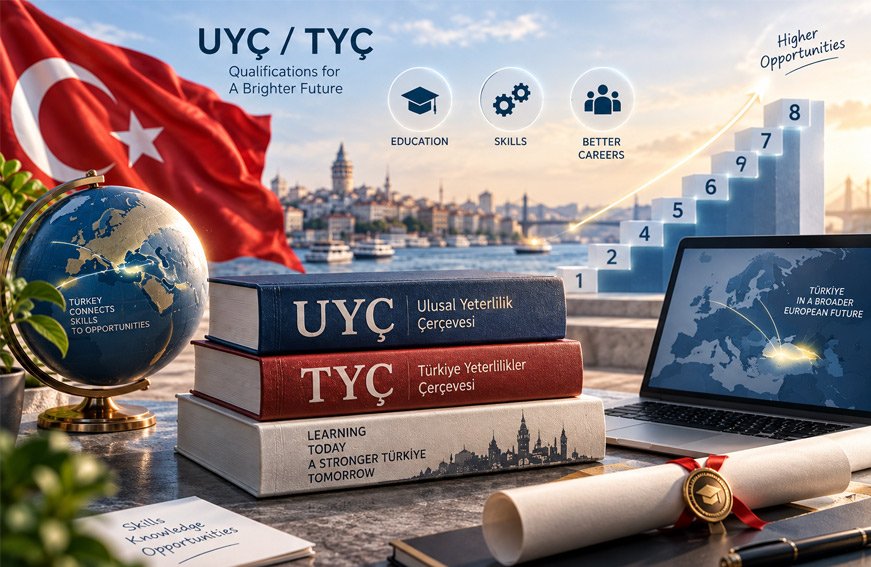
UYÇ is a term linked with qualifications, education, and professional skills in Turkey. People may come across it while checking a diploma, certificate, vocational qualification, or education level.
The term is closely connected with TYÇ, the Türkiye Yeterlilikler Çerçevesi, which is Turkey’s official qualifications framework. This guide explains UYÇ, TYÇ, qualification levels, learning outcomes, and how the system helps describe different qualifications.
What Is UYÇ?
In the collected material, UYÇ stands for Ulusal Yeterlilik Çerçevesi, which means National Qualifications Framework in English. It refers to the idea of organizing qualifications according to their learning levels and outcomes.
The main idea is simple. A qualification should not be understood only by the name written on a diploma or certificate. It is also important to know what the person learned and what they can actually do.
For example, a qualification can show a person’s knowledge of a subject, ability to use that knowledge, practical skills, and level of responsibility.
UYÇ is not a separate diploma, university degree, examination, or certificate. It describes a qualifications framework.
There is an important terminology point. Turkey’s official national framework is known as TYÇ. Because of this, readers researching UYÇ may find that official information mainly uses TYÇ instead.
What Is TYÇ?
TYÇ stands for Türkiye Yeterlilikler Çerçevesi, or the Türkiye Qualifications Framework.
It provides a common structure for understanding qualifications in Turkey. Instead of treating every type of education separately, the framework helps describe qualifications using common levels and learning outcomes.
TYÇ can cover qualifications connected with general education, vocational and technical education, higher education, and relevant professional or vocational learning.
This also supports lifelong learning. Education does not end when someone leaves school or university. People can continue gaining recognized knowledge and skills through other learning and professional pathways.
UYÇ and TYÇ: What Is the Difference?
UYÇ and TYÇ are closely connected, but the terms should be used carefully.
In the collected sources, UYÇ is used for Ulusal Yeterlilik Çerçevesi, meaning National Qualifications Framework. TYÇ is Türkiye Yeterlilikler Çerçevesi, Turkey’s official qualifications framework.
This difference matters when checking a real qualification. Someone searching online for a “UYÇ level” may actually need to check the qualification’s official TYÇ level.
UYÇ and TYÇ should therefore not be presented as two completely separate Turkish qualification systems. At the same time, the abbreviations should not be used as if they always mean exactly the same thing.
For official information about a Turkish qualification, the current TYÇ information and the relevant Turkish authority are more useful than guessing from the UYÇ term alone.
Why Does Turkey Use a Qualifications Framework?
Turkey has many types of qualifications. They come from schools, universities, vocational education, technical training, professional learning, and other recognized routes.
The name of a qualification does not always tell someone how advanced it is. Two qualifications can have different names but involve learning at a similar level. Two certificates can also have very different purposes and requirements.
A qualifications framework creates a common way to describe them.
It can help students understand education choices, workers explain their skills, and employers understand what a qualification represents. Education and training providers can also use clear learning outcomes when describing what learners are expected to achieve.
The framework therefore focuses on the actual learning behind a qualification rather than only its title.
How Qualification Levels Work
Qualification levels are based mainly on learning outcomes.
This means a level is not decided only by how long someone studied. The name of the diploma or certificate is also not enough on its own.
Several areas are considered when describing the level of learning.
Knowledge means what a person knows and understands.
Skills describe how that person can use their knowledge. This can include practical work, thinking, and solving problems.
Competence can include the person’s ability to use their knowledge and skills in real situations. Responsibility and the ability to work independently can also be important.
These learning outcomes are compared with the descriptions for different framework levels.
For this reason, it is not safe to assume that a two-year course has a certain TYÇ level just because of its length. The official level of the specific qualification should be checked.
The Eight TYÇ Levels
The Türkiye Qualifications Framework has eight levels.
Level 1 is at the beginning of the framework. The expected learning becomes more advanced as the levels increase. Level 8 represents the most advanced learning outcomes in the eight-level system.
Higher levels can involve deeper or more specialized knowledge, more difficult skills, greater independence, complex problem-solving, and more responsibility.
However, a higher level should not simply be understood as “more years of education.” The level describes the learning outcomes and their complexity.
The level also does not tell readers what subject someone studied.
For example, two qualifications may be placed at the same framework level while covering completely different fields. Having the same level does not make their content, skills, or professional purpose the same.
What Are Learning Outcomes?
Learning outcomes explain what a person is expected to know, understand, and be able to do after completing education or training.
They focus on the result of learning rather than simply listing what was taught.
For example, learning information about a technical subject shows knowledge. Being able to use that information to complete a task shows practical ability. Solving a difficult problem or making a decision independently can show a higher level of skill and responsibility.
This approach gives more information about a qualification than course length alone.
Two programs may both last one year, but the learning required in each program could be very different. One may cover basic tasks, while another may require more advanced knowledge and independent work.
Learning outcomes help show these differences clearly.
What Qualifications Can Be Included?
TYÇ brings different parts of education and training into one qualifications structure.
This can include qualifications from general education, vocational and technical education, higher education, and relevant professional or vocational qualification systems when the required conditions are met.
This is useful because people do not all follow the same learning path. One person may continue through university, while another may develop occupational skills through vocational education or professional training.
The framework can help place recognized learning within a clearer structure.
However, this does not mean every course or certificate automatically belongs to TYÇ. A qualification must have the required official status. The exact qualification and its official records should be checked before claiming that it has a particular TYÇ level.UYÇ, TYÇ, and Vocational Qualifications
Vocational qualifications focus on the knowledge and practical skills needed for a particular type of work.
In Turkey, Mesleki Yeterlilik Kurumu (MYK) is the Vocational Qualifications Authority. It has an important role in the country’s vocational qualification system.
MYK, TYÇ, and a vocational qualification certificate are not the same thing. TYÇ is the wider qualifications framework. MYK works in the vocational qualifications field, while an individual qualification shows that a person has met specific requirements.
Depending on the qualification, assessment may include theoretical knowledge, practical performance, or both. The aim is to show that the person has achieved the required learning outcomes.
A TYÇ level can help describe how advanced those learning outcomes are. It does not replace the specific occupational skills or legal requirements connected with the job.
Does Every Certificate Have a TYÇ Level?
No. A document called a certificate does not automatically have a TYÇ level.
Schools, training centers, private companies, and other organizations can issue different types of certificates. Some may simply confirm that a person attended or completed a course.
That is not automatically the same as holding a formally recognized qualification included within the national framework.
To check a certificate, look at its exact name, awarding organization, official status, and qualification records. Do not guess its TYÇ level from the word “certificate” or from the length of the course.
TYÇ and the European Qualifications Framework
The European Qualifications Framework (EQF) is a European reference system. It helps make qualifications from different national systems easier to understand and compare.
Like TYÇ, the EQF has eight levels. These range from basic learning outcomes to highly advanced knowledge, skills, and competence.
Turkey’s qualifications framework has been referenced to the EQF. This provides a common reference when Turkish qualification levels need to be understood in a wider European setting.
The EQF does not replace Turkey’s education or qualification system. Countries continue to manage their own qualifications. The EQF mainly provides a common way to compare their levels.
Does a TYÇ or EQF Level Mean International Recognition?
No. Comparability and recognition are different things.
A TYÇ or EQF level can help an employer, university, or other organization understand the general level of learning connected with a qualification.
It does not mean that the qualification must be accepted in another country.
An organization may also check the awarding institution, subjects studied, learning outcomes, professional requirements, and its own recognition rules.
This is especially important when someone wants to study or work abroad. The requirements can change depending on the country, institution, and profession.
TYÇ Level vs Diploma Equivalence
A TYÇ level is not the same as diploma equivalence.
The framework level describes the level of learning outcomes. Diploma equivalence or formal recognition looks at whether a qualification can be accepted as comparable to another qualification for a particular purpose.
For example, a university may have its own rules for accepting a foreign diploma. A professional authority may use a different process when deciding whether someone can enter a regulated profession.
Having the same or a comparable framework level does not prove that two diplomas are academically identical.
TYÇ and Regulated Professions
Some jobs are regulated by law. This means a qualification alone may not give someone the legal right to work in that profession.
Depending on the profession and country, additional requirements may include professional registration, recognition of qualifications, examinations, language ability, supervised experience, or another form of authorization.
The rules can also change between countries. A qualification that supports entry into a profession in Turkey does not automatically provide the same professional rights abroad.
Anyone planning to work in a regulated profession should check the rules of the authority responsible for that profession in the country where they want to work.
Why UYÇ and TYÇ Matter to Students and Workers
For students, TYÇ can make different qualifications easier to understand. A student can look beyond the name of a program and consider the knowledge, skills, and competence expected at its level.
This can help when comparing education or training options.
However, having a qualification at one level does not automatically give someone admission to another program. Universities, schools, and training providers can have their own entry requirements.
For workers, recognized qualifications can provide a clearer way to show professional knowledge and skills. This may be useful when applying for jobs or moving between employers.
A qualification does not guarantee employment. Employers can still consider experience, practical skills, communication, references, and the requirements of the job.
Why Qualification Levels Matter to Employers
Employers may receive applications from people with very different education and training backgrounds.
A qualification level provides extra information about what a qualification represents. Learning outcomes can help explain the knowledge, skills, competence, independence, and responsibility expected from the qualification holder.
However, employers should not judge a candidate only by the TYÇ level.
The subject studied, practical ability, work experience, professional requirements, and job-specific skills can be just as important.
Are Qualifications at the Same Level Equal?
No. Two qualifications at the same TYÇ level are not automatically equal or interchangeable.
The same level can show that their learning outcomes have a broadly comparable level of complexity. It does not mean that the qualifications teach the same subjects or skills.
For example, two qualifications could belong to completely different professional fields while sharing the same framework level.
Their content, learning outcomes, purpose, official status, and professional use still need to be considered separately.
How to Check Your TYÇ Qualification Level
Start with the exact official name of your diploma, certificate, or vocational qualification. Also identify the institution or organization that awarded it.
Then check the relevant official qualification information.
For vocational qualifications, information from MYK may be useful. For university qualifications or academic recognition, the relevant higher education authorities may need to be checked. Official TYÇ information can also help identify qualifications included in the framework.
Do not estimate a TYÇ level based only on:
-
The length of the course
-
The word “certificate” or “diploma”
-
A similar qualification found online
-
An unofficial website
If you plan to use the qualification abroad, also check the recognition rules of the country, university, employer, or professional authority involved.
Common Misunderstandings About UYÇ and TYÇ
Several misunderstandings can make UYÇ and TYÇ seem more complicated than they are.
UYÇ is a certificate: UYÇ is described in the collected material as a qualifications framework concept, not one particular certificate or diploma.
Every certificate has a TYÇ level: This is not correct. The official status of the individual qualification needs to be checked.
A longer course always has a higher level: Course duration alone does not determine a TYÇ level. Learning outcomes are more important.
Qualifications at the same level are equal: The same level does not mean the qualifications contain the same subjects or provide the same professional skills.
An EQF level guarantees recognition abroad: EQF helps with comparison. Formal recognition remains a separate process.
A qualification guarantees a job: Employers can consider many other factors, including experience and practical skills.
One level automatically gives access to the next education level: Schools and universities can have separate admission requirements.
UYÇ and TYÇ always mean exactly the same thing: The terms are closely connected in the supplied material, but Turkey’s official national framework is TYÇ. The context and official terminology should be checked when researching a qualification.
Bottom Line
UYÇ is used in the collected material in connection with the idea of a National Qualifications Framework. For people checking actual qualifications in Turkey, TYÇ, the Türkiye Yeterlilikler Çerçevesi, is the key official framework to understand.
TYÇ uses eight levels and focuses on learning outcomes. These outcomes describe knowledge, skills, competence, independence, and responsibility rather than judging a qualification only by its name or study length.
A TYÇ level can make a qualification easier to understand and compare. It does not automatically provide diploma equivalence, university admission, employment, professional licensing, or international recognition.
For any specific diploma, certificate, or vocational qualification, check its official status and level through the relevant authority instead of guessing.
Frequently Asked Questions
What does UYÇ mean?
In the collected sources, UYÇ stands for Ulusal Yeterlilik Çerçevesi, meaning National Qualifications Framework. It is connected with the way qualifications are organized and understood. When checking official Turkish qualifications, readers will commonly encounter TYÇ.
What is TYÇ?
TYÇ stands for Türkiye Yeterlilikler Çerçevesi. It is Turkey’s national qualifications framework and provides a common structure for describing qualifications through levels and learning outcomes.
How many TYÇ levels are there?
TYÇ has eight levels. The levels move from basic learning outcomes to highly advanced knowledge, skills, competence, independence, and responsibility.
Is UYÇ a certificate or diploma?
No. UYÇ is used for a qualifications framework concept in the collected material. It is not the name of one specific diploma, degree, examination, or certificate.
Does every Turkish certificate have a TYÇ level?
No. A certificate does not automatically have an official TYÇ level. The exact qualification, awarding organization, official status, and qualification records need to be checked.
Are two qualifications with the same TYÇ level equivalent?
Not necessarily. They may represent a similar level of learning complexity while covering completely different subjects, skills, and professional purposes.
Is a TYÇ or EQF level recognized internationally?
TYÇ’s relationship with the EQF helps make qualification levels easier to understand and compare. However, this does not guarantee formal recognition by another country, university, employer, or professional authority.
How can I check my TYÇ level?
Find the exact official name of your qualification and the organization that awarded it. Then check the relevant official TYÇ or responsible authority’s information. For vocational qualifications, MYK information may also be relevant.
Explore More:

