


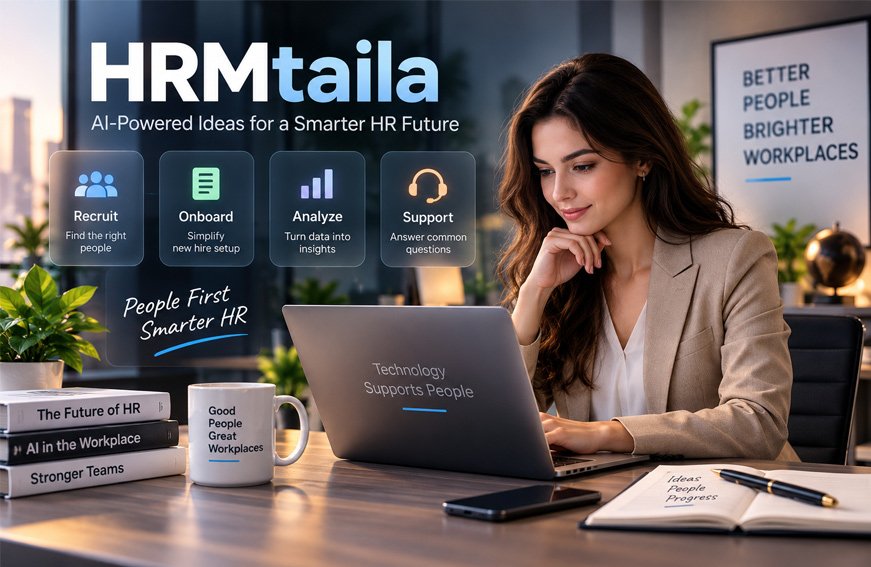
HRMtaila is an emerging online term linked with artificial intelligence and human resource management. Recent articles use the term when discussing AI tools, HR automation, recruitment, onboarding, employee support, and workforce data.
However, HRMtaila is not currently confirmed as an established software platform or company. There is also no official definition from a known HR organization or developer. This article explains what HRMtaila appears to mean, how it relates to AI in HR, its possible uses, and what information is still unconfirmed.
What Is HRMtaila?
HRMtaila is a term that has recently appeared online in articles about AI-powered human resource management. It is mainly connected with the idea of using artificial intelligence and automation to make HR work easier.
Under this meaning, AI can help HR teams with repeated tasks. This may include sorting job applications, organizing onboarding steps, answering basic employee questions, and studying workforce data.
The idea is not to remove people from HR. Instead, technology handles suitable routine work while HR professionals focus on tasks that need communication, experience, and human judgment.
There is an important difference to understand. HRMtaila does not currently have a single official definition. There is no confirmed HR company, software developer, or recognized industry organization that has established what the term officially means.
For this reason, it is safer to describe HRMtaila as an emerging term associated with AI and HR technology, rather than the name of a proven software product.
Where Did the HRMtaila Term Come From?
The exact origin of HRMtaila is unknown. There is no reliable public information showing who first created the word or when it was first used.
Articles discussing HRMtaila appeared online in 2026. Many connect it with artificial intelligence, automation, and human resource management. This has created a small digital footprint around the keyword.
The first three letters, HRM, could reasonably refer to Human Resource Management. However, the meaning of the full word has not been officially explained by a known creator.
This distinction matters. Several websites can use the same meaning after seeing it elsewhere. That does not prove that the meaning is official.
Until an original creator, company, or other reliable primary source explains HRMtaila, its exact origin should be treated as unknown.
Is HRMtaila a Real HR Platform?
There is currently not enough reliable evidence to describe HRMtaila as a real commercial HR software platform.
No confirmed company or product history has been found. Important business and product details are also missing, including a verified:
-
Founder or developer
-
Company or headquarters
-
Official product website
-
Software application
-
Pricing structure
-
Customer list
-
Funding history
-
Official social media presence
This means readers should be careful when an article describes specific “HRMtaila features.” Recruitment automation, workforce analytics, AI chatbots, and onboarding tools are real parts of modern HR technology. But there is no evidence yet that these are features of a specific product called HRMtaila.
The same applies to pricing and downloads. There is no confirmed HRMtaila free plan, paid subscription, mobile app, or software download based on the information currently available.
How HRMtaila Relates to AI in HR
The main idea connected with HRMtaila is the growing use of artificial intelligence in human resources.
Traditional HR software is often used to store and manage information. This can include employee names, roles, attendance, leave, salaries, and other workplace records.
Newer HR technology can do more with this information. AI and automation can help organize data, complete repeated tasks, find patterns, and provide basic support to employees.
For example, an AI-assisted HR system may help a company organize job applications or answer a common question about leave. Analytics tools can help HR teams understand staff turnover, skills, attendance, or hiring trends.
Cloud HR systems can also connect different parts of HR work. This can make it easier to keep records updated and use the same information across different processes.
The important point is that these are general uses of modern AI-powered HR technology. They help explain the idea currently associated with HRMtaila, but they should not be presented as confirmed features of an HRMtaila product.
HRMtaila in Recruitment
Recruitment is one of the areas where AI and automation can be useful.
A large company may receive hundreds of CVs for one job. Reviewing and organizing every application can take a lot of time. AI tools can help sort applications and identify candidates whose listed skills match the basic needs of a role.
AI-assisted recruitment tools may also help with interview scheduling, candidate messages, job descriptions, and hiring records.
This can reduce some of the repeated work done by recruiters. However, AI should not make every hiring decision.
A candidate may have useful experience that an automated system does not understand correctly. The system may also make mistakes or use data that creates unfair results.
For this reason, recruiters should review important results themselves. Technology can help organize the hiring process, but people should remain responsible for final employment decisions.
There is also no confirmed HRMtaila recruitment product. These are examples of how AI recruitment fits the wider meaning currently associated with the term.
HRMtaila and Employee Onboarding
Onboarding begins when a new employee joins a company. The worker may need to complete forms, receive account access, read company policies, start training, and learn how the workplace operates.
Automation can make some of these steps easier.
A digital HR system can send reminders, provide important documents, track completed tasks, and show a new employee what needs to be done next. An AI assistant may also answer simple questions about policies, benefits, training, or internal processes.
This can be especially useful for remote employees and companies with workers in different time zones. Basic information may be available even when an HR employee is not online.
Automation should not completely replace personal support during onboarding. New employees may have questions that are private, unusual, or difficult for an automated system to understand.
They should still have a clear way to contact a real HR employee when they need help.
Employee Support and HR Automation
HR departments often receive the same basic questions many times. Employees may ask about leave, pay dates, benefits, forms, training, or company policies.
AI assistants and HR chatbots can provide quick answers to some of these questions. They may also be available outside normal working hours.
Automation can help with other routine HR work as well. For example, software can organize documents, update workflows, send reminders, and help manage employee records.
The aim is to reduce repeated administrative work, not remove human support.
Some matters should normally be handled by a person. Workplace complaints, conflicts, sensitive personal matters, complex salary problems, and important employment decisions often require more context than an automated system can provide.
HRMtaila is commonly connected with this wider idea of HR automation. However, there is still no verified HRMtaila chatbot, employee portal, or automation product.
Workforce Analytics and Performance Management
Companies collect different types of workforce data. This may include attendance, staff turnover, recruitment time, training, skills, labor costs, and job changes.
Workforce analytics helps turn this information into useful reports. AI can process large amounts of data and help HR teams find patterns more quickly.
For example, data may show that one department has unusually high staff turnover. It could also show a growing skill gap or a change in hiring needs. Managers can use these signals to investigate the situation.
However, data does not always explain the reason behind a problem. High turnover can have many causes. A chart may show the pattern without explaining why employees are leaving.
AI can also support performance management by organizing goals, feedback, project information, and other work data. It may help identify areas where an employee could need more training or support.
Important decisions should not depend only on an AI score or prediction. Performance, promotion, pay, and other employment decisions can require information that software may not understand.
Human review is therefore an important part of using workforce analytics responsibly.
Payroll and Employee Records
Payroll and employee records involve large amounts of information. This can include attendance, leave, overtime, salary details, and other employment data.
Automation can help move information between connected HR and payroll systems. It can also flag unusual entries so that someone can check them before payroll is completed.
Cloud-based HR systems can keep employee information in one place. Access controls can then limit who is allowed to view or change particular records.
This may reduce repeated data entry and some simple manual mistakes. However, payroll still needs careful checking because errors can directly affect employees.
There is currently no confirmed HRMtaila payroll system or employee-records product. Payroll and records are relevant because they are common areas where AI and HR automation may be used.
Benefits of AI-Assisted HR
AI-assisted HR can be useful when it handles simple and repeated work. It can save time while helping HR teams organize information more clearly.
One benefit is speed. Tasks such as sending reminders, organizing applications, updating workflows, and answering basic employee questions can be completed faster.
Automation can also reduce repeated data entry. When connected systems use the same employee information, HR staff may not need to enter the same details several times.
Another benefit is consistency. A digital workflow can follow the same basic steps for each new employee, leave request, or other routine process. This can make it easier to see what has been completed and what still needs attention.
Workforce analytics can also help HR teams understand their data. Instead of looking through large spreadsheets by hand, they can use software to find patterns in hiring, turnover, attendance, skills, and training.
These benefits depend on how the technology is used. Poor data or badly designed processes can reduce its value. AI works best when a company starts with a clear HR problem rather than adding automation without a useful reason.
Risks and Drawbacks
AI in HR also has limits. One of the main problems is accuracy. An AI system can misunderstand information or give an incorrect answer.
The quality of the data matters too. If a system receives incomplete, old, or incorrect information, its results may also be unreliable.
Bias is another concern. An AI system can repeat unfair patterns found in older data. This can become serious when technology is used in recruitment, promotion, performance reviews, or other employment decisions.
AI can also miss context. Two employees may have similar numbers in a report but very different situations. Software may not understand all the reasons behind those differences.
There is also a risk of relying too much on automation. Important employee matters should not become automatic decisions simply because software can process them quickly.
HR teams need to know where AI is useful and where a person needs to take control.
Privacy, Security, and Responsible Use
HR departments can hold sensitive employee information. This may include contact details, salaries, attendance records, job applications, performance information, and other workplace records.
Companies using AI with this information need clear controls. They should understand what information the system can access, why it needs that information, where the data is stored, and who can view it.
Access should be limited to people and systems that genuinely need the information. Companies also need suitable security measures to protect records from unauthorized access or loss.
Responsible AI use also involves checking systems for mistakes and unfair results. An automated recommendation should not be accepted simply because it came from an AI system.
Employees should also receive clear information when AI is being used in ways that affect them. Responsibility must remain with the organization using the technology.
For important HR uses, different teams may need to work together. HR understands employee processes, while IT and security can help with technology and data protection. Legal advice may also be needed when employment or privacy rules apply.
These privacy and security principles relate to AI-powered HR technology generally. There is no confirmed HRMtaila service with its own published privacy or security policy.
Why Human Oversight Matters
Human oversight is especially important in HR because workplace decisions can directly affect people’s jobs, income, and careers.
AI can organize information and point out patterns. It cannot always understand personal circumstances, workplace relationships, unusual situations, or the full reason behind an employee’s performance.
A person should therefore remain involved in important decisions such as hiring, promotion, pay changes, performance reviews, disciplinary action, and termination.
Human review is also important when employees have complaints or workplace conflicts. These situations often need careful communication rather than an automated answer.
Employees should have a way to question a result or speak with a person when an automated system affects them.
The basic approach behind HRMtaila works best when AI supports human work instead of becoming the final decision-maker.
Can Small Businesses Use the HRMtaila Approach?
A small business does not need a large or complex AI system to start using automation in HR.
It can begin with one repeated task that takes too much time. This could be scheduling interviews, sending onboarding reminders, organizing new-hire forms, answering common leave questions, or preparing simple reports.
Starting small makes it easier to see whether the technology actually helps.
A business can check whether the tool gives correct information, saves time, and is easy for employees to use. Feedback from HR staff and employees can also show where improvements are needed.
Staff should understand what the system can and cannot do. They should also know when they need to check information themselves instead of trusting an automated result.
If the first use works well, the business can slowly add other suitable tasks.
This is a general way for small businesses to use AI-assisted HR. There is no confirmed HRMtaila product that a company needs to buy to follow this approach.
Pricing, Availability, and Integrations
There is no confirmed pricing information for HRMtaila.
No official free plan, paid subscription, free trial, enterprise package, or per-employee price has been identified. Giving an exact HRMtaila price would therefore be misleading.
Its availability is also unknown. There is no verified information showing that an HRMtaila service operates in particular countries or regions.
Supported devices have not been confirmed either. There is no reliable evidence of an official HRMtaila application for Windows, macOS, Android, or iOS.
The same applies to integrations. There are no confirmed integrations with payroll systems, applicant tracking systems, HR information systems, CRM platforms, or other business software.
These details could become available if HRMtaila later becomes the name of a documented product. For now, they should be treated as unconfirmed.
What Is Still Unknown About HRMtaila?
There are still many unanswered questions about HRMtaila.
Its original creator is unknown. There is no confirmed founder, developer, company, or organization behind the term. Its exact launch date and original meaning are also not documented.
There is no verified official website or social media account. A matching username or webpage alone is not enough to prove that it belongs to the original source of the term.
Other unconfirmed details include its headquarters, products, applications, customers, funding, revenue, pricing, integrations, device support, and country availability.
This lack of information is important for readers. HRMtaila should not be given a detailed company or product history unless reliable evidence becomes available.
Future information could make the meaning clearer. Until then, it is best understood as an emerging online term mainly associated with AI-assisted human resource management.
Bottom Line
HRMtaila is a developing online term connected with AI, automation, and human resource management. Recent explanations associate it with recruitment, onboarding, employee support, workforce analytics, and other HR tasks.
However, there is no strong evidence that HRMtaila is currently an established software platform, company, or recognized HR technology standard.
The wider idea behind the term is easier to understand. AI can help HR teams save time, organize data, and automate suitable routine work. It also creates concerns about accuracy, bias, privacy, security, and employee trust.
Human oversight remains important. AI can support HR work, but people should remain responsible for decisions that affect employees.
Frequently Asked Questions
What is HRMtaila?
HRMtaila is an emerging term linked with AI and human resource management. It covers areas like hiring, onboarding, automation, and workforce data.
Is HRMtaila a real software platform?
There is no confirmed software platform called HRMtaila. It is currently better understood as an emerging online term.
Who created HRMtaila?
The creator of HRMtaila is not known. No confirmed founder, developer, or company has been found.
What is HRMtaila used for?
HRMtaila is linked with AI uses in HR, such as hiring, onboarding, employee support, automation, and workforce analytics.
Can HRMtaila replace HR employees?
No. AI can help with simple and repeated tasks, but people are still needed for important HR decisions.
What are the main risks of HRMtaila?
Possible risks include AI mistakes, unfair results, privacy issues, security problems, and too much dependence on automation.
Is HRMtaila free?
There is no confirmed HRMtaila product or pricing. So, it is not known whether it is free or paid.
Does HRMtaila have an official website?
No official HRMtaila website has been confirmed. Similar websites or accounts should not be treated as official without proof.
Explore More:
Syrenis Strategic Initiatives: Global Growth, Privacy, and Enterprise Consent

