


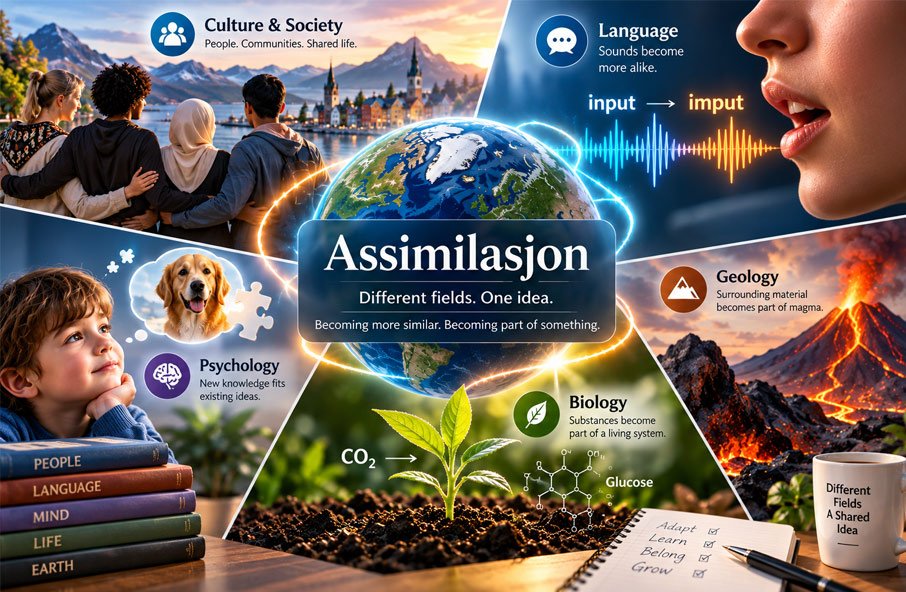
Assimilasjon is a Norwegian word that is close to the English word assimilation. In simple terms, it means becoming more similar to something else or becoming part of an existing system.
People may search for Assimilasjon when reading about culture, immigration, language, psychology, biology, or Norwegian history. The meaning changes depending on the subject.
This guide explains the main meanings of Assimilasjon, its different types, and simple examples.
What Does Assimilasjon Mean?
Assimilasjon generally means that something becomes more like something else, adapts to it, or becomes part of it.
It is a real Norwegian word and is used in different academic fields. Its exact meaning depends on the context.
For example, in society it can describe people becoming more similar to another cultural group. In linguistics, it describes speech sounds becoming more alike. In psychology, it describes using existing knowledge to understand something new.
The word has roots connected with the idea of making similar or becoming similar. The English word assimilation comes from the same general background.
Main Types of Assimilasjon
Assimilasjon has several main meanings.
Cultural assimilation happens when a person or group adopts parts of another culture.
Linguistic assimilation happens when one speech sound becomes more like another sound.
Psychological assimilation means fitting new information into ideas or mental categories that already exist.
Biological assimilation refers to substances being taken in and used by a living organism.
The term can also appear in geology, where material from surrounding rock may become part of magma.
These meanings are different, but they share one basic idea: something is being changed, fitted in, or incorporated into an existing system.
Cultural Assimilasjon
Cultural Assimilasjon happens when a person or group gradually becomes more similar to another culture, often the larger or dominant culture around them.
This may involve changes in:
- language
- food
- clothing
- traditions
- social habits
- education
- celebrations
- everyday behavior
For example, a family that moves to Norway may learn Norwegian and become familiar with local customs. Their children may use Norwegian more often because they speak it at school and with friends.
Cultural assimilation normally happens over time. School, work, friendships, marriage, media, and daily contact with other people can all influence it.
Assimilation does not always mean that a person loses their original culture. Someone may adopt many Norwegian customs while still speaking another language at home and following family traditions.
Voluntary and Forced Assimilasjon
Voluntary Assimilasjon happens when people freely choose to adopt parts of another culture.
A person may learn the local language because it helps with work, school, healthcare, public services, or friendships. They may also enjoy local food, celebrations, or social customs.
They can still keep important parts of their original identity. Learning a new culture does not automatically mean rejecting an older one.
Forced assimilation is different.
It happens when a government or powerful institution pressures a group to give up its language, traditions, beliefs, or cultural practices.
This can lead to language loss, weaker cultural connections, discrimination, and problems that continue across several generations.
The main difference is choice. Voluntary cultural change happens freely. Forced assimilation happens when people have little or no real choice.
Assimilasjon and Norwegianization
Assimilasjon has an important place in Norwegian history because of Norwegianization, known in Norwegian as fornorsking.
Norwegianization describes policies that encouraged or pressured minority groups to become more linguistically and culturally Norwegian.
The Sámi and Kven/Norwegian Finnish communities were among the groups affected. Schools and other public institutions played an important role in these policies.
Norwegian language and culture were strongly promoted, while minority languages and traditions had less space in education and public life. This contributed to language loss and weaker cultural connections in some families and communities.
Norway later created a Truth and Reconciliation Commission to study Norwegianization and injustices affecting the Sámi, Kvens/Norwegian Finns, and Forest Finns.
According to the collected source, the Commission gave its report to the Norwegian Parliament in June 2023. The same source reports that Parliament expressed a deep apology in November 2024 for abuses linked to Norwegianization.
This history is important because it shows that assimilation is not always a simple or voluntary process.
Assimilasjon vs Integration
Assimilasjon and integration are related ideas, but they do not mean exactly the same thing.
With assimilation, a person or group becomes more similar to the majority culture. Over time, some original cultural practices or languages may become less common.
With integration, people take part in the wider society while still keeping important parts of their own culture.
For example, someone can learn Norwegian, study or work in Norway, make local friends, and take part in community life while still speaking another language with family and celebrating traditional holidays.
That is closer to integration than complete assimilation.
Assimilasjon, Multiculturalism, and Identity
Multiculturalism is another way of looking at culturally diverse societies.
It allows people from different backgrounds to live in the same society while keeping many of their cultural differences.
A person may speak Norwegian at work but another language at home. They may follow Norwegian customs while also enjoying traditional food, music, clothing, religion, or celebrations from their family background.
People can also have more than one cultural identity.
Someone may feel connected to Norway while also feeling strongly connected to another country, language, or culture.
Identity does not always have to be replaced. It can become layered, with different cultural influences existing together.
Assimilasjon Across Generations
Cultural Assimilasjon often becomes easier to see when different generations are compared.
First-generation immigrants may have a strong connection with the language and customs of the country where they grew up.
Their children may grow up using two languages. They may speak one language with parents and another at school or with friends.
Later generations may use the majority language more often. They may know less of their family’s original language, especially if it is no longer spoken regularly at home.
However, cultural identity can continue in other ways. Families may keep traditional foods, names, celebrations, music, religion, and family stories.
Assimilation is therefore usually gradual. Different parts of culture can change at different speeds.
Language Loss and Cultural Assimilasjon
Language is one of the clearest signs of cultural change.
A minority language may become less common when another language is mainly used in schools, workplaces, government, media, and public services.
Parents may begin using the majority language with their children because they believe it will help with education or work. Over time, younger family members may understand the older language but speak it less fluently.
Language loss can affect more than everyday communication.
A language can carry family stories, humor, traditional knowledge, place names, songs, and cultural ideas. This is why many minority and Indigenous communities work to protect and teach their languages.
At the same time, learning a majority language does not automatically require losing another language. Many people use two or more languages and maintain connections with several cultures.
Linguistic Assimilasjon
In linguistics, Assimilasjon means that one speech sound becomes more like another sound near it.
This happens because the lips, tongue, jaw, and other speech organs keep moving while we talk. One sound can be affected by the sound before or after it.
The process often makes speech easier and smoother. It is common in normal conversation and does not always appear in spelling.
For example, an n sound may become closer to m before sounds such as p or b because all of these sounds use the lips.
This is a normal part of spoken language and is not automatically a pronunciation mistake.
Types of Sound Assimilation
There are several ways sound assimilation can happen.
Contact assimilation happens when two sounds are directly beside each other.
For example, one consonant may change because the next consonant uses a different part of the mouth.
Regressive assimilation happens when a later sound affects an earlier sound.
For example, in fast English speech, input may sound closer to imput. The following p affects the n sound before it.
Progressive assimilation works in the opposite direction. An earlier sound affects the sound that follows.
Assimilation can also happen between sounds that are not directly next to each other. This is called distant assimilation, or fjernassimilasjon in Norwegian.
Vowel harmony in some languages is one example. A vowel in one part of a word can influence a vowel in another part.
Assimilation may change:
- the place where a sound is made
- whether a sound is voiced or voiceless
- the way a sound is produced
Repeated sound changes can also become part of a dialect or language over time.
Examples of Assimilasjon in Norwegian and English
Norwegian has several useful examples of sound assimilation.
Tannbørste may be pronounced closer to tambørste in some speech.
Kronprins may sound closer to kromprins.
Håndball may also be heard closer to håmball.
In these examples, the n sound moves closer to m before a sound made with the lips.
Norwegian also has sound combinations such as rn that can become a retroflex sound in some dialects. A word such as barn may therefore sound different from its written form.
English has similar patterns.
The word input can sometimes sound closer to imput in natural speech.
Another clear example is the change from in- to im- before certain consonants, as in impossible. The nasal sound changes to match the following lip-made sound more easily.
Assimilation can also happen between words. In connected speech, the final sound of one word may change because of the first sound of the next word.
Assimilasjon vs Dissimilation
Assimilation and dissimilation describe opposite sound changes.
With assimilation, two sounds become more similar.
With dissimilation, two similar sounds become less similar.
A simple way to remember the difference is:
Assimilation = sounds move closer together.
Dissimilation = sounds become more different.
Both processes help linguists understand how pronunciation and languages change over time.
Assimilasjon in Psychology
Assimilasjon also has an important meaning in psychology.
It is strongly linked with psychologist Jean Piaget and his work on how children learn.
Piaget used the idea of schemas. A schema is a simple mental structure that helps a person understand a type of object, event, or experience.
Assimilation happens when new information fits into a schema that already exists.
For example, a child already knows what a dog is.
Later, the child sees a dog of a different size or breed. It still fits the child’s idea of a dog.
The child can understand the new animal by using knowledge they already have.
This is psychological assimilation.
The same process can happen in adults. People often use old knowledge to understand new situations.
Assimilasjon vs Akkomodasjon
Assimilasjon is often compared with akkomodasjon, or accommodation.
The two ideas are related but different.
Assimilation happens when new information fits an existing idea.
Accommodation happens when the old idea must be changed because the new information does not fit.
For example, a young child may first think every furry four-legged animal is a dog.
After seeing a cat, the child learns that cats belong to a different group.
The child must change the old mental category or create a new one.
That is accommodation.
Piaget used both ideas to explain how knowledge develops.
Assimilasjon in Biology
In biology, Assimilasjon refers to substances being incorporated into and used by a living organism.
It is related to digestion and absorption, but these terms do not mean exactly the same thing.
Digestion breaks food into smaller parts.
Absorption moves nutrients into the body.
Assimilation involves using or incorporating those nutrients into living cells, tissues, or biological processes.
The exact process depends on the organism and the substance involved.
Carbon and Nitrogen Assimilation
Plants provide clear examples of biological assimilation.
Carbon assimilation is connected with photosynthesis.
Plants take in carbon dioxide and use its carbon to build organic compounds. In many plants, carbon fixation includes reactions linked with the Calvin cycle.
The carbon later becomes part of carbohydrates and other substances used by the plant.
Plants also carry out nitrogen assimilation.
They take up forms of inorganic nitrogen, mainly through their roots. The nitrogen is then processed and becomes part of useful organic compounds.
Nitrogen is needed to make substances such as:
- amino acids
- proteins
- nucleic acids
Carbon and nitrogen assimilation are scientific processes. They are not related to cultural assimilation except for the general idea of something becoming part of a larger system.
Assimilasjon in Humans and Animals
Humans and animals also use nutrients from food.
Food is first broken down during digestion. Nutrients are then absorbed and used by the body.
For example, amino acids from protein can be used to make new proteins in the body.
Carbohydrates can provide glucose, which enters metabolic processes.
Fats can be used in cell membranes, energy storage, and other body functions.
Assimilation is part of this wider process, but it should not be treated as exactly the same as digestion, absorption, or metabolism.
Assimilasjon in Geology
Assimilation is also used in geology.
Magma can come into contact with surrounding rock deep underground.
Some of that rock material may melt, dissolve, or become incorporated into the magma.
Geologists can describe this type of process as assimilation.
The meaning is different from cultural or linguistic assimilation, but the basic idea is similar. One material becomes part of another.
Why Assimilasjon Matters
Assimilasjon is useful in several fields because it helps explain different kinds of change.
In society, it helps explain cultural change, migration, identity, language loss, and relationships between minority and majority groups.
In linguistics, it helps explain natural pronunciation, connected speech, dialects, and sound change.
In psychology, it explains how people use existing knowledge to understand new experiences.
In biology, it describes how substances become part of living systems.
In geology, it can describe material becoming incorporated into magma.
The most important step is to look at the context. The same word can have very different meanings depending on the subject.
Bottom Line
Assimilasjon is the Norwegian word related to assimilation.
Its general meaning is becoming more similar, fitting into something that already exists, or becoming part of a larger system.
In culture, it can describe people or groups becoming more similar to another culture.
In linguistics, it describes speech sounds becoming more alike.
In psychology, it means fitting new information into existing mental ideas.
In biology and geology, it refers to materials or substances becoming incorporated into larger systems.
The cultural meaning also needs an important distinction. Voluntary adaptation is different from forced assimilation. Choice, history, and social power all affect how cultural assimilation should be understood.
Frequently Asked Questions
What does Assimilasjon mean in English?
Assimilasjon broadly means assimilation in English. Its exact meaning depends on the subject.
Is Assimilasjon a Norwegian word?
Yes. Assimilasjon is an established Norwegian word used in several fields, including culture, linguistics, psychology, and biology.
What is an example of Assimilasjon?
A cultural example is learning and regularly using the main language of a new country.
A linguistic example is an n sound becoming closer to m before p or b.
A psychology example is a child recognizing a new breed of dog by using an existing idea of what a dog is.
What is cultural Assimilasjon?
Cultural Assimilasjon is the process in which a person or group becomes more similar to another culture.
It may involve language, customs, food, clothing, traditions, or everyday behavior.
What is the difference between Assimilasjon and integration?
Assimilation usually means becoming more similar to the majority culture.
Integration means taking part in wider society while still being able to keep important parts of your original culture.
What does Assimilasjon mean in linguistics?
In linguistics, Assimilasjon happens when one speech sound becomes more similar to another sound.
This often happens naturally because the mouth is already preparing for the next sound.
What is Assimilasjon in psychology?
In psychology, especially in Piaget’s theory, assimilation means understanding new information by using knowledge or mental structures that already exist.
What does Assimilasjon mean in biology?
In biology, assimilation refers to substances being incorporated into and used by a living organism.
It is related to digestion, absorption, and metabolism, but it is not exactly the same as these processes.
Explore More:

