


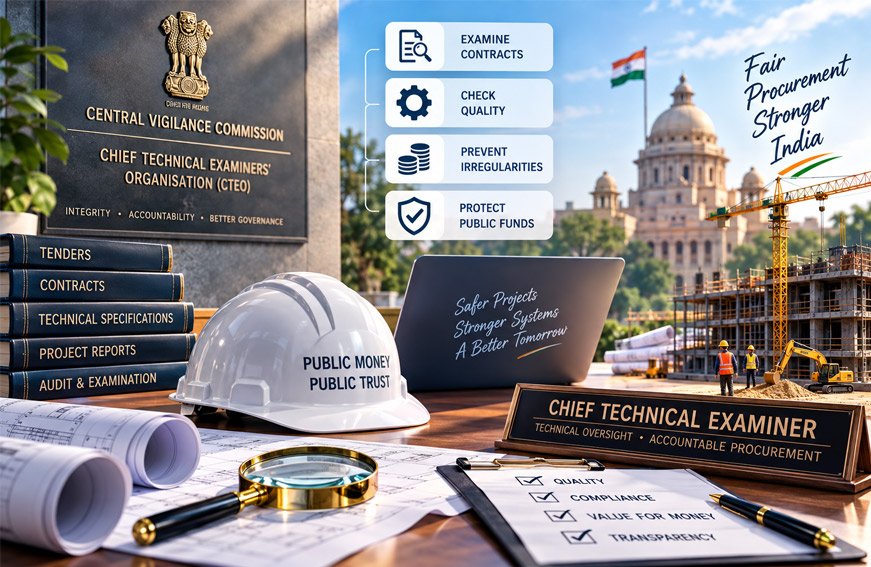
A Chief Technical Examiner (CTE) is a senior technical officer connected with India’s public procurement and vigilance system. The role focuses on checking government works, contracts, procurement, quality, costs, and the proper use of public money.
People often search for this term to understand what a Chief Technical Examiner does and how the Chief Technical Examiners’ Organisation (CTEO) works under the Central Vigilance Commission (CVC). This guide explains the role, history, structure, duties, types of contracts examined, and the Intensive Examination process in simple words.
What Is a Chief Technical Examiner?
A Chief Technical Examiner is a senior technical officer working within the Chief Technical Examiners’ Organisation. The CTEO is the technical wing of the Central Vigilance Commission.
The main job is to provide specialist technical examination of selected government procurement cases and contracts. The examiner can look at how a project was planned, tendered, awarded, carried out, measured, and paid for.
The role is different from the engineer who designs or manages a project. A project engineer may supervise construction or other technical work. A procurement officer may manage the tender. The Chief Technical Examiner provides a separate technical review from a vigilance point of view.
The work is also broader than construction inspection. A CTE may deal with specifications, tender conditions, contract terms, rates, measurements, quality, bills, and payments. The examination can cover works, goods, equipment, IT procurement, consultancy, and services.
The basic purpose is to check whether public procurement followed the required process and whether the organisation received what it paid for.
History of the Chief Technical Examiners’ Organisation
The Chief Technical Examiners’ Organisation was established in 1957 under the then Ministry of Works, Housing and Supply.
Its original work focused on technical audits of projects handled by the Central Public Works Department (CPWD). The purpose was to improve economy in government spending while strengthening technical and financial control.
The role later became wider.
The Santhanam Committee, which examined measures for preventing corruption, recommended strengthening the organisation. It also supported extending technical examination beyond the original area of CPWD works.
In 1964, the CTEO came under the administrative control of the Central Vigilance Commission. A second Chief Technical Examiner post was later created in 1979 as the amount and complexity of procurement work increased.
Government procurement has changed greatly since the organisation was created. Public bodies now buy technology, machinery, professional services, equipment, consultancy, and many other goods and services.
Because of this, CTEO’s work is no longer limited to traditional buildings and civil works. Its technical examination can cover procurement of works, goods, and services.
How the CTEO Fits Within the Central Vigilance Commission
The Central Vigilance Commission is an important part of India’s vigilance framework for organisations under its jurisdiction. The CTEO works as its specialist technical wing.
This gives the CVC access to officers who understand engineering, project costs, procurement, contracts, specifications, measurements, and other technical matters.
This technical knowledge is important because some problems are difficult to find by reading financial records alone.
For example, a bill may appear correct on paper. A technical inspection may show that the quantity at the site is different from the quantity shown in the bill. Materials may also fail to meet the required specifications, or a tender condition may have unnecessarily reduced competition.
The CTEO can examine procurement involving central government ministries and departments and other organisations falling within the relevant CVC framework, including central public sector bodies and certain public-sector financial institutions.
The CTEO therefore provides the technical knowledge needed to understand whether an issue is simply an administrative problem or requires closer examination from a vigilance point of view.
CTEO Structure and Technical Teams
The collected material describes the CTEO as being headed by two Chief Technical Examiners of Chief Engineer rank.
The work is divided broadly by technical area. One stream mainly deals with civil and horticulture procurement. The other covers areas such as electrical and mechanical work, supply contracts, IT procurement, consultancy, services, and transport contracts.
A Chief Technical Examiner does not carry out every check alone. The organisation has technical staff who help examine records and inspect projects.
The structure can include Technical Examiners (TEs), Assistant Technical Examiners (ATEs), Junior Technical Examiners (JTEs), and support staff. Technical teams may review files, visit sites, check measurements, study test records, and collect the information needed for an examination.
Different projects need different knowledge. Inspecting a building is not the same as examining an IT system, medical equipment, machinery, or a consultancy contract. Having different technical streams helps match the examination with the type of procurement involved.
Main Duties of a Chief Technical Examiner
The main duty of a Chief Technical Examiner is to support and supervise the technical examination of selected public procurement cases.
The examination can start with the project estimate. The team may check whether quantities are reasonable, specifications are suitable, and rates have a proper basis. An estimate that is poorly prepared can create problems later during tendering and execution.
Technical sanctions and approvals may also be examined. The examiner can compare what was originally approved with what was later tendered and carried out. This can help identify changes that do not have clear technical or administrative support.
Tendering is another important area. The examination may look at tender conditions, bids, price comparisons, negotiations where applicable, and the final award. Conditions that unfairly limit genuine competition can receive closer attention.
After a contract is awarded, the agreement and actual execution can also be checked. This may include:
- Contract scope and specifications
- Approved rates
- Measurements and quantities
- Materials and workmanship
- Testing records
- Variations and changes
- Site records
- Bills and payments
- Completion and acceptance records
Physical inspection can be especially useful for works contracts. Records can be compared with what is actually present at the site. Measurements, materials, workmanship, drawings, and test results may be checked where relevant.
The Chief Technical Examiner may also review important observations raised by technical examiners before those findings move further through the vigilance process.
Another part of the job is preventive vigilance. A problem found in one contract may show a weakness in the organisation’s wider procurement process. Changes to tendering, documentation, testing, or contract management may then help prevent the same issue in future projects.
What Types of Contracts Can CTEO Examine?
CTEO’s work is much wider than civil construction.
Depending on the case and the applicable framework, technical examination can cover civil works, horticulture, electrical and mechanical contracts, store purchases, supply contracts, IT procurement, consultancy, services, and transport-related procurement.
The type of examination depends on what has been purchased.
For a civil project, the team may focus heavily on site measurements, construction materials, workmanship, drawings, and physical progress.
For equipment or machinery, the examination may focus more on specifications, supply records, testing, acceptance, and whether the equipment delivered matches the contract.
An IT or service contract may require attention to the agreed scope, deliverables, service requirements, acceptance records, and other contract terms.
This wider scope is important because modern government spending includes much more than roads and buildings.
What Is an Intensive Examination?
An Intensive Examination is a detailed technical examination of a selected procurement case or contract by the CTEO.
It goes beyond checking whether the required papers are present in a file. The examination can look at the complete procurement process, including estimates, technical sanctions, tendering, agreements, materials, bills, site records, and physical work.
The process can combine document checks, technical review, financial examination, and physical inspection where needed.
For example, a contract may say that a certain material or quantity was required. The technical team can compare this requirement with records, tests, measurements, and the actual work. If the records and real work do not match, the difference may become an observation that needs an explanation.
For goods, equipment, IT, or service contracts, the exact checks will be different. The team may compare approved specifications and contract requirements with what was actually supplied or delivered.
An important point is that an observation during an Intensive Examination does not automatically mean corruption has occurred.
There may be a technical, contractual, financial, or administrative explanation for a difference. The purpose of the examination is to establish the facts, document important issues, and obtain clarification or further action when necessary.
How Are Contracts Selected for Examination?
The CTEO cannot examine every government contract. There are too many projects and procurement cases for every one to receive a detailed technical examination.
One important source of information is the Quarterly Progress Report (QPR). Chief Vigilance Officers submit information about major procurement activities through these reports. The CTEO can use this information to select cases for Intensive Examination.
Selection can depend on factors such as the type and value of the contract, its importance, possible risks, and time or cost overruns. Complaints about a particular project or procurement case can also lead to closer examination.
Different procurement categories can have different reporting limits. This means that not every small contract needs to appear in the same reporting system.
The collected material states that 371 organisations submitted QPRs to the CTEO in 2024. This figure comes from reporting based on the CVC’s 2024 Annual Report.
Being selected for an examination does not mean that a contractor or government organisation has done something wrong. The examination is used to check the facts and identify any important technical, financial, or procedural issues.
How a CTE Examination Works
A CTE examination can cover different stages of a procurement case. The exact process depends on the type of contract and the issues being checked.
Review Before Tendering
Technical problems can begin before a tender is published.
The examination may look at the project estimate, quantities, specifications, technical approvals, and other planning documents. Rates should have a reasonable basis, and the project requirements should be clear.
The review may also look for conditions that could unnecessarily reduce competition. Vague specifications, poorly supported costs, or very narrow requirements can create problems later.
Good planning is important because weak designs or unclear requirements can lead to delays, changes, and higher costs during the project.
Review of Tendering and Contract Award
The tender process should give eligible bidders a fair chance to compete.
Technical examination may cover tender notices, eligibility conditions, bid dates, specifications, price comparisons, bid evaluation, and the reasons for awarding the contract.
A rejected bid may also require examination where there is a question about whether the tender conditions were applied correctly.
Negotiations, when allowed, should also follow the applicable process. Important changes in price, scope, or contract terms should have proper reasons and approvals.
The aim is not simply to check whether the lowest price was selected. The important question is whether the award followed the stated rules and treated eligible bidders fairly.
Examination During Contract Execution
After a contract is awarded, the examiner can compare actual execution with the agreement.
For construction work, this may involve checking materials, workmanship, measurements, drawings, test reports, site records, and physical progress.
The team may compare quantities shown in measurement records with what can actually be found at the site.
Changes also need attention. Large projects often require some changes, but important variations in specifications, quantities, design, or scope should have a proper reason and approval.
For IT, equipment, and service contracts, examination may focus more on specifications, agreed deliverables, testing, acceptance, and other contract requirements.
Bills, Payments, and Completion
Payments should match the work, goods, or services that were actually due under the contract.
The examination can compare bills with measurements, rates, quantities, test results, approvals, and other supporting records.
This can help identify excess payments, incorrect quantities, unsupported items, or payments for work that does not match the contract.
Completion and acceptance records can also be important. They help show whether the organisation received the work, goods, equipment, or services required before final acceptance or payment.
Common Problems Found During Technical Examination
Technical examinations can find many types of problems. Not all of them mean fraud or corruption.
One common issue is an inflated or poorly supported estimate. Quantities or rates may not have enough evidence behind them.
Tender conditions can also create problems. Requirements that are unnecessarily restrictive may reduce fair competition.
Quality is another important area. Materials or finished work may not meet the specifications stated in the contract. Missing or weak testing can make it difficult to prove that the required quality was achieved.
Measurement differences can have a direct financial effect. If records show more work than was actually completed, the organisation may pay too much.
Changes to design, quantities, specifications, or scope can also become an issue when they do not have proper approval or clear reasons.
Other possible findings include duplicate or excess payments, poor contract management, time and cost overruns, missing records, and failure to follow applicable procurement or statutory requirements.
A technical problem does not automatically prove dishonest behaviour. Poor planning, mistakes, weak records, or bad contract management can also cause irregularities. The facts and explanations need to be examined before deciding what further action is needed.
What Happens After a CTE Examination?
An examination does not end when the technical team finishes checking the documents or leaves the project site.
Important observations are recorded in an Intensive Examination Report. The findings may relate to tendering, quality, quantities, payments, contract administration, delays, costs, or other technical issues.
After approval by the concerned Chief Technical Examiner, observations can be sent to the organisation’s Chief Vigilance Officer (CVO) for comments and necessary action.
The organisation may be asked to explain a finding or provide supporting records. In suitable cases, an Action Taken Report may also be sought through the vigilance process.
If the explanation is satisfactory, an observation may be closed or dropped.
Other findings may require corrective action. For example, an organisation may need to correct defective work, examine an excess payment, improve its procedures, or take other action allowed under the applicable rules and contract.
If an issue appears to have a vigilance angle, it can receive further examination through the appropriate vigilance process.
CTEO’s main role here is technical examination. It does not replace a criminal investigation agency.
Chief Technical Examiner vs Chief Vigilance Officer
A Chief Technical Examiner (CTE) and a Chief Vigilance Officer (CVO) have different roles.
The CTE provides specialist technical and procurement examination through the CTEO. The work can involve engineering, estimates, specifications, tendering, contracts, measurements, quality, and payments.
A CVO handles and coordinates vigilance work within the concerned organisation. The CVO can also play an important role in responding to CTEO observations and following up on vigilance matters.
The two roles can therefore work together, but they are not the same.
Because CTEO cannot directly examine every major procurement case, CVOs can also conduct CTE-type Intensive Examinations in their organisations under the CVC framework.
The collected source, referring to CVC’s 2024 reporting, states that CVOs from 299 organisations reported 1,845 CTE-type examinations in 2024.
Role in Vigilance and Preventing Procurement Problems
Technical examination supports vigilance by providing specialist evidence.
A financial record may show that a payment was properly entered in the accounts. It may not show whether the material used at a construction site met the required standard or whether the recorded quantity actually existed.
Technical officers can examine these details.
Their findings can help explain problems involving rates, measurements, specifications, tender conditions, materials, equipment, and contract requirements. This information can then support further vigilance work when necessary.
The Chief Technical Examiner also has a role in preventive vigilance.
The purpose is not only to deal with a problem after it happens. A technical examination may show that an organisation has a wider weakness in its tendering, documentation, testing, cost control, or contract management.
Fixing that weakness can reduce the chance of the same problem appearing in future contracts.
The CTEO can also provide technical support where specialist engineering or procurement knowledge is needed in vigilance matters, including matters connected with other investigating authorities. Its own role remains technical examination rather than criminal investigation.
Skills and Knowledge Needed for the Role
A Chief Technical Examiner needs strong technical knowledge. Engineering experience is especially important because many examinations involve complex works, equipment, specifications, and measurements.
Engineering knowledge alone is not enough.
The role also requires an understanding of public procurement, contracts, project costs, rates, technical specifications, quality control, and applicable procedures.
An examiner needs to understand documents and also know how to compare them with actual work. Site inspection skills can therefore be important.
Clear report writing is another useful skill. A technical observation should explain what was found, why it matters, and what records or evidence support it.
Professional independence is also important. Findings should be based on documents, measurements, tests, contract terms, and other available evidence rather than assumptions.
Some projects require specialist knowledge. A complex IT system, power project, medical machine, or other specialised procurement may require help from people with expertise in that particular field.
Challenges in Technical Examination
One major challenge is the large number of government contracts. CTEO has limited resources and cannot examine every procurement case in detail.
This makes careful selection and sampling important.
Records can create another problem. Documents may be incomplete, unclear, or different from what is found at the site. Replies from the concerned organisation may also take time.
Some technical problems cannot be confirmed simply by looking at the finished work. Tests, samples, measurements, or specialist knowledge may be needed.
Modern procurement creates additional challenges.
Government organisations now buy software, cloud services, complex equipment, consultancy, and other services. These contracts can require different skills from traditional construction examination.
Technical examination methods therefore need to keep up with changes in public procurement.
Why the Chief Technical Examiner Role Matters
Government procurement can involve very large amounts of public money.
Technical examination helps check whether that money is connected to work, goods, or services that meet the required contract conditions.
The process can identify poor quality, overpayments, weak tender conditions, incorrect measurements, unsupported changes, and other problems. It can also help organisations improve their procurement systems.
The collected material, citing the CVC Annual Report 2024, states that CTEO conducted 81 Intensive Examinations covering 64 organisations during 2024. The procurement cases examined had a combined reported value of more than ₹33,514.68 crore.
These figures show the scale of procurement covered by the reported examinations. They do not mean that all of this money involved irregularities.
The wider purpose of technical examination is to improve accountability, quality, fair procurement, and the proper use of public funds.
Bottom Line
A Chief Technical Examiner is a senior technical officer working within the Chief Technical Examiners’ Organisation under India’s Central Vigilance Commission.
The role is much wider than checking construction quality. Technical examination can cover estimates, specifications, tendering, contracts, materials, measurements, quality, bills, payments, IT procurement, supplies, consultancy, and services.
The CTEO uses technical knowledge to check selected public procurement cases and identify important problems. Its work can also help government organisations improve their procurement and contract management systems.
An observation does not automatically mean corruption. The purpose of the examination is to establish facts, understand technical and financial issues, and support appropriate action when needed.
Frequently Asked Questions
What is the full form of CTE?
CTE stands for Chief Technical Examiner. It is a senior technical role in government procurement and vigilance.
What is CTEO?
CTEO stands for Chief Technical Examiners’ Organisation. It is the technical wing of India’s Central Vigilance Commission.
Is the Chief Technical Examiner part of the CVC?
Yes. The CTEO works under the Central Vigilance Commission (CVC) and provides technical support.
What does a Chief Technical Examiner inspect?
A CTE checks government contracts, tenders, costs, materials, quality, measurements, bills, and project records.
What is a CTE Intensive Examination?
It is a detailed check of a selected government contract or project. It may include checking documents, costs, quality, and actual work.
Does a CTE observation mean corruption?
No. A CTE observation may simply show a mistake or technical problem. More evidence is needed to prove corruption.
What is the difference between a CTE and a CVO?
A CTE mainly checks technical and procurement matters. A CVO manages vigilance work within an organisation.
Can CTEO examine IT and service contracts?
Yes. CTEO can examine IT, consultancy, supply, service, electrical, mechanical, and construction contracts.
Explore More:
Brandihomes.com Guide 2026: Features, Benefits, Risks, and Alternatives

