


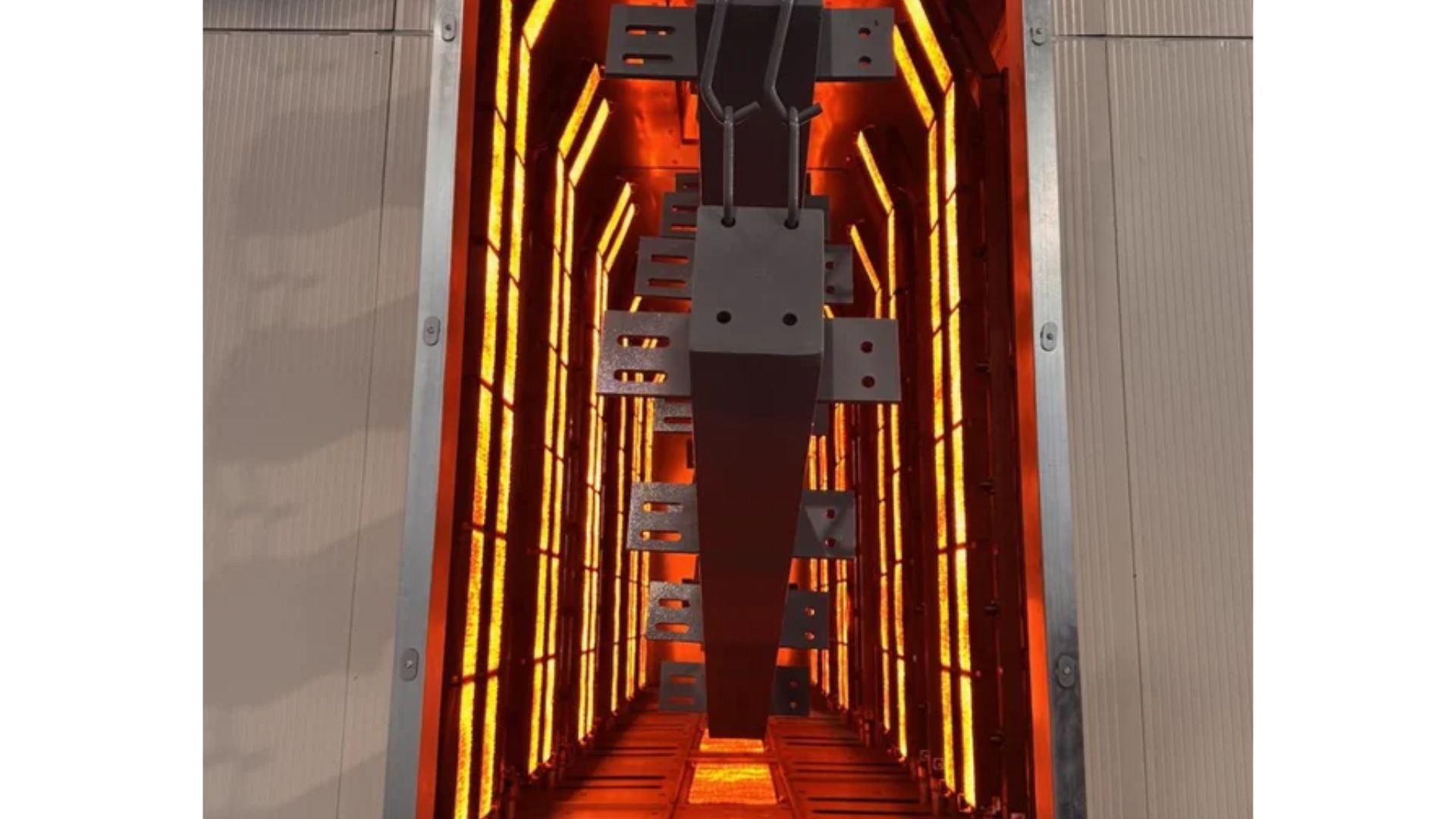
Industrial ink drying may appear to be a simple step between printing and further processing, but it can become a critical bottleneck when production speed, surface quality and repeatability must be maintained at the same time. Whether the substrate is paper or glass, the objective is not simply to expose the printed surface to as much heat as possible. The real challenge is to remove water or solvents, or accelerate the relevant drying mechanism, without damaging the substrate or creating defects in the printed layer.
For this reason, infrared heating is used in industrial ink-drying applications where direct and controllable energy transfer can offer advantages over systems based only on heating the surrounding air.
Companies such as Infragas develop infrared gas technologies for surface thermal treatments, and ink drying is among the industrial applications associated with its systems.
Why ink drying requires thermal control
The drying behaviour of an ink depends on several factors: its formulation, the amount applied, the substrate, production speed and the mechanism through which the ink becomes dry enough for handling or further processing.
In thermal drying processes, increasing temperature can accelerate evaporation or other temperature-dependent drying mechanisms. However, faster is not automatically better. If the surface heats too aggressively, the upper layer of an ink or coating may dry before volatile components underneath have escaped.
This can contribute to defects such as blistering, pinholes, surface irregularities or uneven drying. The heating system therefore has to provide enough energy to support production speed while keeping the thermal profile compatible with both the ink and the substrate.
How infrared drying differs from hot-air drying
Hot-air systems transfer energy mainly through convection. Air is heated and circulated around the printed substrate, and the surface gradually absorbs that energy.
Infrared systems operate differently. Infrared radiation transfers energy toward the exposed surface, where it is absorbed and converted into heat. This means that the process does not rely exclusively on first heating a large volume of air.
For ink drying, this can be useful because the thermal requirement is often concentrated at or near the printed surface. Direct radiant heating can support a quicker thermal response and allow the drying section to focus energy on the area where it is actually required.
Infrared and hot air should not necessarily be viewed as competing technologies. In some industrial processes, combining radiant energy with controlled airflow can be useful because infrared supplies heat to the coating while airflow helps remove evaporated water or solvents from the treatment area.
Infrared ink drying on paper
Paper presents a particular challenge because both the ink layer and the substrate respond to heat. The heating system must provide enough energy to support drying while avoiding unnecessary thermal stress on the paper.
Infrared energy can be useful because it can rapidly raise the temperature of the wet ink film and the surface of the substrate. Depending on the ink system, this can support evaporation or accelerate temperature-dependent drying.
However, the absorption characteristics of the ink and paper matter. Different inks, colours, paper coatings and moisture levels can respond differently to the same infrared source. This is why industrial drying settings must be based on the actual product rather than on a universal temperature or exposure time.
A well-designed system also needs to consider line speed. As printing lines become faster, the available residence time inside the drying section becomes shorter, making energy density and thermal response increasingly important.
What changes when drying inks on glass
Glass introduces a different set of variables. Unlike paper, the substrate is non-porous, so the applied ink or coating remains primarily on the surface. Drying therefore depends strongly on how heat acts on the printed layer and how volatile components are removed.
Temperature control is especially important because aggressive drying can create a surface skin before material beneath it has released its volatile components. This can lead to blisters or pinholes.
Another factor is the thermal behaviour of the glass itself. The heating profile should avoid unnecessary thermal gradients while still bringing the ink to the conditions required for the next production stage.
For this reason, industrial ink drying on glass requires a balance between radiant power, treatment time, airflow and the characteristics of the ink system.
Where Infragas technologies fit
Infragas designs and manufactures infrared gas systems for industrial surface thermal treatments. Its catalytic infrared product range includes technologies such as INFRACAT and BOOSTERCAT, while other Infragas systems address processes requiring different thermal conditions.
Ink drying on paper and glass belongs to the group of applications in which surface-focused infrared heat transfer can be particularly relevant. Instead of selecting a heating technology only on the basis of maximum temperature, manufacturers must consider how the radiant energy interacts with the ink and substrate.
The correct configuration depends on the material, ink formulation, coating thickness, production speed and the amount of energy required during the available treatment time.
Uniformity matters as much as speed
Increasing production speed is often one of the reasons for improving a drying section, but uniformity remains essential. If one part of the printed surface receives significantly more energy than another, the line may produce inconsistent drying even when average temperatures appear correct.
Emitter arrangement, distance from the substrate, conveyor speed and exposure time therefore influence the result. Complex or wide products can require particular attention to energy distribution across the working area.
The aim should be repeatable drying, not simply the shortest possible exposure. An industrial line is more efficient when products leave the drying section in a consistent condition without requiring rework or slower downstream handling.
What to evaluate before choosing an infrared drying system
Before integrating infrared heating into an ink-drying process, manufacturers should first identify the drying mechanism and the characteristics of the substrate.
For paper, considerations may include thickness, coating, moisture sensitivity and line speed. For glass, the behaviour of the ink layer and the required handling condition after drying become particularly important.
Other variables include the dimensions of the heating zone, available residence time, required airflow and the possibility of integrating infrared heating with existing convection equipment.
Testing remains fundamental. Two inks that appear similar may respond differently to the same infrared conditions, just as different substrates can absorb radiant energy differently.
A more controlled approach to industrial ink drying
Infrared heating matters in industrial ink drying because it allows energy to be directed toward the printed surface instead of relying exclusively on heating the surrounding air. On both paper and glass, this can support faster thermal response and more focused treatment, but performance depends on careful control of energy, exposure time and substrate behaviour. Technologies developed by Infragas provide industrial manufacturers and oven builders with infrared gas solutions that can be considered when designing drying processes where speed, surface quality and repeatability must work together.Good morning, I would like to request that the article be published with a backdated publication date of September 11, 2026. Thank you.

