


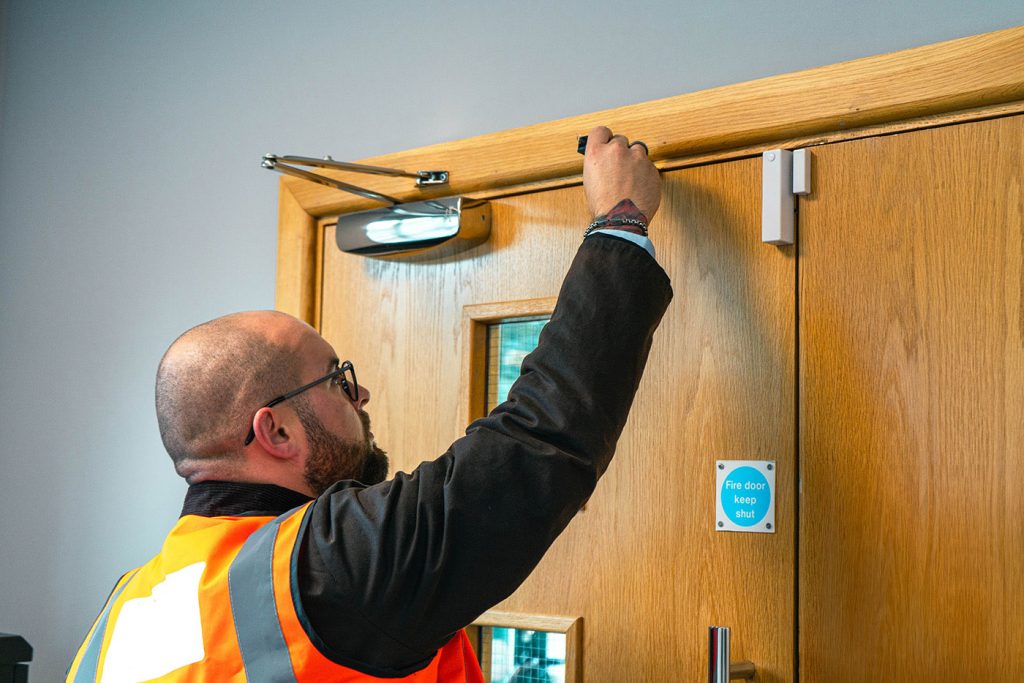
Fire doors are not a peripheral safety measure. They are a core component of a building’s passive fire protection system, and the organizations responsible for installing, inspecting, or maintaining them carry significant liability. For facility managers, building owners, and contractors overseeing commercial or industrial properties, selecting the wrong provider can lead to failed inspections, code violations, and worse, compromised occupant safety in an actual emergency.
The challenge is that the fire door services market is uneven. Some providers operate with full certification and documented processes. Others offer competitive pricing but lack the technical depth to deliver compliant, reliable work. Understanding what separates one from the other before signing a contract is the practical focus of this article.
1. Verify Certification and Industry Credentials First
When evaluating a fire door company, the first and most important step is confirming their certifications before any other conversation takes place. In the US, fire door work is governed by specific standards, including those published by the National Fire Protection Association, and any credible provider should be able to demonstrate alignment with those requirements without hesitation. Certifications are not decorative — they indicate that technicians have been trained and assessed against recognized criteria and that the organization is accountable to an external body.
The NFPA 80 standard governs the installation and maintenance of fire doors across the United States and is the foundational reference point for any compliant provider.
What Certification Actually Means in Practice
A certified provider has had their methods, documentation, and personnel reviewed by a third party. This matters because fire door assemblies are only compliant when every component — the door, frame, hardware, and seals — is installed or inspected correctly as a system. Technicians who lack formal training may replace individual parts without understanding how those changes affect the assembly’s rated performance. Certification reduces that risk by establishing a baseline of competency that can be verified rather than assumed.
2. Confirm Experience with Your Specific Building Type
Not all fire door work is the same. A provider experienced in new commercial construction may not have the same depth of knowledge when it comes to retrofit installations in older buildings, healthcare facilities, or high-rise environments where the surrounding structure creates additional complexity. Before hiring, it is worth asking directly about their track record in environments similar to yours.
Why Building Type Matters to Outcomes
Each occupancy type carries its own regulatory requirements and operational constraints. Hospitals, for example, must meet both fire code requirements and infection control standards, which affects how and when door work can be performed. Industrial facilities may have heavy-duty traffic patterns that affect hardware selection and wear rates. A provider who has only worked in standard office environments may not anticipate these variables, leading to installations that technically pass inspection but fail prematurely under real operating conditions.
3. Review Their Inspection and Documentation Process
Annual fire door inspections are required under NFPA 80, and those inspections must be documented. The quality of that documentation matters. A thorough inspection report identifies deficiencies by location, describes the nature of each issue, and records corrective actions taken. Vague or incomplete records create problems during audits and can leave building owners exposed if a door fails and there is no clear paper trail showing the inspection was properly conducted.
Documentation as a Risk Management Tool
Beyond regulatory compliance, good inspection records serve a practical operational function. They allow facility teams to track patterns over time — whether certain doors are failing repeatedly, whether hardware in one wing is wearing faster than another, or whether a recent renovation introduced assembly problems that need to be corrected. Providers who treat documentation as a checkbox task rather than a functional record are less useful as long-term partners, regardless of how competent their field work may be.
4. Ask About Their Hardware and Parts Supply Chain
Fire door assemblies are rated systems, and every component used in a repair or installation must meet the specifications required for that rating to remain valid. Providers who source hardware inconsistently, or who substitute uncertified components to reduce costs, create compliance risks that may not surface immediately. By the time an issue is discovered during an inspection or incident, the original provider may be long gone.
The Risk of Substituted or Non-Listed Components
Listed components are those that have been independently tested and certified for use in fire-rated assemblies. Using a non-listed closer, hinge, or seal — even if it appears functionally equivalent — can void the door’s rating entirely. This is not a theoretical risk. It is a documented cause of inspection failures and, in some cases, post-incident liability. A reliable provider will be transparent about where their components come from and will not need to be pressed on the subject.
5. Understand Their Scope of Services
Some providers specialize in new installation only. Others focus on inspection services. A smaller number handle the full range — installation, inspection, repair, and hardware replacement — under one roof. Understanding this before hiring prevents a situation where a provider completes an inspection, identifies deficiencies, and then leaves a facility team to find a separate contractor for repairs. That gap in service creates delays and introduces coordination risk, particularly in facilities where door functionality is critical to daily operations.
Coordinated Service vs. Fragmented Vendors
Working with a provider who can handle multiple aspects of fire door compliance under a single point of accountability simplifies project management and reduces the chance of problems falling through the cracks between vendors. It also makes it easier to establish consistent standards across a property portfolio, since the same technicians are applying the same methods across all work orders. Fragmented vendor relationships, by contrast, require more management overhead and make it harder to maintain a coherent compliance record.
6. Evaluate Their Communication and Responsiveness
The quality of a provider’s communication before a contract is signed is usually a reasonable indicator of what working with them will look like afterward. Providers who take a long time to respond to initial inquiries, who are vague about timelines, or who cannot clearly explain their process are unlikely to improve once work is underway. For facilities where fire door compliance is tied to operational schedules, inspection deadlines, or regulatory timelines, poor communication has real consequences.
What Responsiveness Signals About Operations
A provider who responds promptly and clearly to questions is typically one who has organized internal processes. They know what they offer, how long things take, and who handles what. That organizational clarity usually extends to field work — meaning jobs are scheduled properly, technicians show up prepared, and reports are delivered on time. Providers who struggle to answer basic questions during the sales process often have the same underlying disorganization in their operations, and that tends to become the customer’s problem.
7. Check References and Past Project Accountability
References from past clients in similar industries or building types are one of the most reliable ways to evaluate whether a provider’s claims about their capabilities match their actual performance. The specific questions to ask are not about general satisfaction but about how the provider handled problems — whether they corrected deficiencies without dispute, whether their documentation held up during third-party audits, and whether they followed through on commitments made during the proposal stage.
Accountability After the Work Is Done
Fire door work does not end when the technician leaves the site. Warranty terms, post-inspection follow-up, and responsiveness to warranty claims are all indicators of how a provider views their long-term relationship with clients. A company that is difficult to reach after a job is completed, or that disputes responsibility for issues that arise shortly after installation, creates ongoing risk for the building owner. Checking references specifically about post-completion accountability will surface this quickly.
Closing Thoughts
Hiring a fire door provider is a compliance and safety decision, not a commodity purchase. The seven areas covered here — certification, building-type experience, documentation practices, parts sourcing, service scope, communication, and accountability — are not arbitrary criteria. Each one reflects a real operational or regulatory risk that building owners, facility managers, and contractors face when this decision is made without adequate scrutiny.
The providers worth working with will not be difficult to evaluate. They will have clear answers to direct questions, verifiable credentials, and a documented track record. Those who cannot or will not provide that information clearly should prompt concern, regardless of how competitive their pricing may appear.
Taking the time to work through these checks before a contract is signed is far less costly than addressing failed inspections, non-compliant installations, or unresolved warranty disputes after the fact. In a domain where the stakes include both regulatory compliance and occupant safety, that investment in due diligence is straightforward to justify.

