


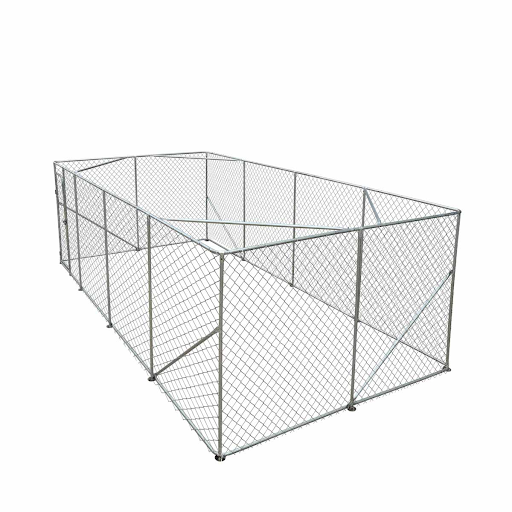
Height gets all the attention on a large dog kennel and prevents very few escapes. Dogs that leave an outdoor enclosure almost always go under the fence, through a gate that was not latched properly, or through a panel joint that worked loose, and none of those failures care how tall the perimeter is.
A six-foot perimeter on a TMG Industrial outdoor dog kennel playpen is more than enough for the vast majority of breeds. What actually determines whether the enclosure holds is the wire gauge, how the panels are joined, and what the dog is standing on.
Chain Link Gauge Does the Work Height Gets Credit For
The mesh on a chain link kennel is specified by wire gauge, and the numbering runs backward: a lower gauge number means thicker wire. The difference between a light residential mesh and a heavier commercial one is not visible from across a yard, but it is obvious the first time a determined dog works at a corner with its teeth and front paws.
Mesh aperture matters alongside gauge. A smaller opening gives a dog less purchase for climbing and makes it much harder to get a jaw around a single strand, which is the usual starting point for a dog that systematically dismantles things. For breeds with that habit, aperture is the more useful specification.
Frame tubing carries the whole structure and is where a cheap enclosure announces itself. Thin-wall tube flexes when a large dog hits it at speed, and repeated flexing loosens every connection in the panel over a season until the whole run starts leaning.
Ground Surface Decides Whether the Pen Stays Usable
Digging out of a large dog kennel is the most common escape route and the easiest to design out. A buried apron of mesh turned outward at the base, or a gravel trench along the perimeter, defeats digging by giving the dog something unrewarding to dig into rather than by trying to out-muscle the behavior.
Surface choice also governs hygiene, which is what determines whether an owner keeps using the enclosure in year two. Grass in a confined run turns to mud and stays there. Pea gravel over a compacted base drains, can be rinsed, and does not hold odor the way bare soil does, though it needs topping up occasionally.
Slope is the quiet variable. A pen laid out on flat ground with no fall will pool water in one corner after every rain, and that corner becomes the part of the enclosure the dog refuses to use. A slight grade across the footprint costs nothing at layout time and solves it permanently.
Gate Hardware Is the Usual Escape Route
A lockable gate is standard on a better large dog kennel and still fails in two predictable ways. The latch gets left unlatched, or the gate sags until the latch no longer aligns and someone starts leaving it on the first notch. Both are hardware problems rather than training problems.
Gates sag because the hinge post takes the full cantilevered weight of the leaf. A diagonal brace in the gate frame, or a drop rod that transfers load to the ground when closed, keeps the alignment that the latch depends on. Checking for one of those features is more informative than comparing lock types.
Hardware orientation is worth a glance too. A latch that a dog can nose upward will eventually be nosed upward, and a carabiner or spring clip through the latch body costs almost nothing and removes the possibility entirely.
Shade and Shelter Change More Than Comfort
An exercise run is not a substitute for shelter, and in most Canadian municipalities that distinction appears in the bylaw rather than in the product description. Rules typically require accessible shade, protection from precipitation, and unfrozen water for any animal kept outdoors for extended periods.
The practical version is simpler than the legal one. A dog enclosure positioned so part of it sits under a tree or against a building for part of the day will be used far more than one in the middle of an open lawn, and a tarp or panel roof over one end covers both the shade and the rain requirement.
Size needs a final sanity check against purpose. A run sized for exercise should let a dog reach a trot, which means length matters more than area, and a long narrow footprint often serves a single large dog better than a square one of the same square footage. Owners moving a dog from a dog crate indoors to an outdoor run usually underestimate how much that change in geometry is worth. Owners who get the geometry right stop thinking about the enclosure altogether, which is the only real measure of whether it was the correct one. TMG Industrial gives panel count and run dimensions in the listing, so that comparison can be made against the yard rather than against another product.

