


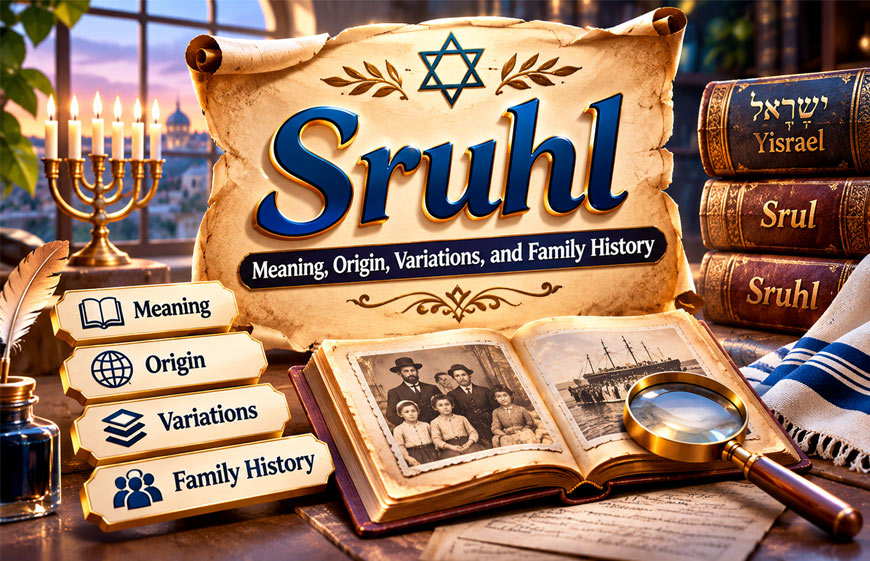
Sruhl is a rare name spelling linked to Srul, a traditional Yiddish form of the Hebrew name Yisrael, or Israel in English.
People often come across Sruhl while reading old family records, immigration papers, census documents, or family trees. Its unusual spelling can make the name difficult to understand at first.
This article explains the meaning of Sruhl, its Hebrew and Yiddish roots, its history, spelling changes, and the different forms connected with the name.
What Does Sruhl Mean?
The meaning of Sruhl comes from the Hebrew name Yisrael.
Yisrael is commonly explained in English as “one who struggles with God,” “one who strives with God,” or “God prevails.”
These different explanations exist because ancient Hebrew names do not always have one exact English translation.
Sruhl does not appear to have a separate meaning of its own. Its meaning comes through its connection with Srul and Yisrael.
The name is also sometimes connected with ideas such as strength, faith, persistence, and endurance. These are symbolic ideas linked to the biblical story behind the name rather than separate dictionary meanings.
What Is the Origin of Sruhl?
Sruhl has both Hebrew and Yiddish roots.
The original name is Yisrael, an ancient Hebrew masculine name. It has an important place in Jewish religion, culture, and history.
Among Ashkenazi Jewish communities, Yiddish was widely used in everyday life. Hebrew names often developed shorter forms that were easier to use among family members and friends.
Yisrael or Yisroel became Srul in Yiddish naming tradition.
Other related forms developed as well, including Sruli and Srulik.
Sruhl appears to be a less common written form of Srul. It may have developed when people wrote the spoken Yiddish name using Latin letters.
There was no single spelling system used in every country or period. This helped create several versions of the same name.
The safest way to describe Sruhl is as a rare spelling of a Yiddish name with Hebrew roots.
The exact place or date where the spelling Sruhl first appeared is not clearly established.
Sruhl in the Bible and Jewish Tradition
To understand Sruhl, it helps to understand the name Yisrael.
In the Book of Genesis, Jacob wrestles through the night with a mysterious divine figure. After the struggle, he receives the name Israel.
This biblical story is the main source behind the traditional meaning connected with Yisrael.
The name later became very important in Jewish history and identity. Jacob’s descendants became known as the Children of Israel.
Over time, Jewish families used different forms of Yisrael depending on language and situation.
A man might use Yisrael in a religious setting but be called Srul by family members in everyday life.
Later, the same person might appear as Israel in an English-language document.
Shorter names such as Srul were therefore part of normal family and community life. Sruhl appears to belong to this same naming tradition.
How the Sruhl Spelling Developed
Jewish names often changed spelling as families moved between countries and languages.
Many Ashkenazi Jewish families lived in areas where several languages were used. A person might speak Yiddish at home but appear in Polish, Russian, German, Hungarian, or another language in official records.
When families later moved to English-speaking countries, their names could change again.
The Hebrew and Yiddish alphabets also differ from the Latin alphabet used in English. Officials often had to decide how to write a spoken name using unfamiliar letters.
This could produce several spellings.
For example, the same person might appear as:
- Srul in one record.
- Sruhl in another.
- Shrul somewhere else.
- Israel in a later document.
These changes were not always official name changes.
Sometimes an immigration officer, census worker, clerk, or other record keeper simply wrote the name as it sounded.
Handwriting could cause more differences. Old letters can be difficult to read, and later transcribers may copy a name incorrectly.
Different family members could also choose different spellings after moving to another country.
For this reason, Sruhl should not automatically be treated as a completely separate name from Srul.
Is Sruhl Hebrew or Yiddish?
Sruhl is connected with both Hebrew and Yiddish, but in different ways.
Yisrael is the Hebrew name.
Srul is a Yiddish form of Yisrael.
Sruhl is an uncommon written spelling connected with Srul.
A simple way to explain it is that Sruhl is a Yiddish form with Hebrew roots.
This type of naming pattern was common in Jewish communities.
One person could use Yisrael in religious life, Srul among family and friends, and Israel in English official records.
This is also important for family-history research. Different spellings do not always mean that records belong to different people.
Common Variations of Sruhl
Sruhl belongs to a larger group of related names.
The spelling used can depend on language, region, family tradition, pronunciation, or the person who created the record.
Common related forms include:
- Sruhl
- Srul
- Shrul
- Srol
- Sroel
- Yisroel
- Yisrael
- Israel
- Sruli
- Srulik
Srul is the closest and better-known Yiddish form.
Yisrael is the Hebrew form, while Israel is the standard English form.
Sruli and Srulik are affectionate forms that may be used as family names or nicknames.
When researching an old record, it is useful to search several of these spellings. However, the name alone is not enough to prove that two records describe the same person.
Other details such as age, birthplace, relatives, occupation, and address should also match.
How Is Sruhl Pronounced?
There is no single pronunciation that can be confirmed for every person or family.
The name Sruhl is usually linked to Srul, which is often pronounced close to “Srool.”
In some families or Yiddish-speaking regions, the sound may have been closer to “Shrool.”
Pronunciation could change from one place to another. This was common with Yiddish names because different communities had their own accents and speech patterns.
The spelling in an old document does not always show the exact way a person said the name. An official may have written the name based on how it sounded.
If Sruhl belongs to a living family, their own pronunciation is the best one to use.
Is Sruhl a First Name or a Surname?
Sruhl is mainly used as a masculine given name.
Its connection with Srul and Yisrael supports this use.
However, old records can sometimes make names difficult to understand. A first name and family name may appear in a different order. A transcription mistake can also make a name look like a surname.
In some records, a father’s name may also appear close to the person’s own name. This can create confusion if the document is not clear.
Sruhl should not automatically be connected with similar-looking surnames such as Ruhl or Stuhl. Similar spelling does not prove that the names have the same origin.
The best way to understand the name in a historical record is to check the full document and compare it with other records for the same person.
Why Sruhl Matters in Jewish Family History
Sruhl can be very useful in Jewish genealogy because old records often use different spellings for the same person.
A man called Srul by his family might appear as Sruhl in one document, Yisroel in another, and Israel in a later English record.
If a researcher searches only one spelling, some useful records may be missed.
This is why family-history research should include several related forms of the name.
However, a matching name alone is not enough to prove that two records belong to the same person.
Researchers should also compare details such as:
- Age
- Birthplace
- Parents
- Spouse
- Children
- Address
- Occupation
- Immigration year
When several details match, different first-name spellings may be part of the same person’s record history.
Where the Name Sruhl May Appear
Sruhl may appear in many kinds of historical records.
These can include:
- Immigration records
- Passenger lists
- Census documents
- Birth registers
- Marriage records
- Synagogue records
- Naturalization papers
- Military records
- Cemetery records
- Gravestone inscriptions
- Family letters
- Memorial books
- Holocaust records
- Handwritten family trees
Old family documents can also contain spellings that are not found in modern databases.
When possible, researchers should look at the original scanned record instead of relying only on a typed transcription.
Why Old Records Can Spell Sruhl Differently
Old records can show many spellings of the same name.
One reason is handwriting. Letters such as r, n, h, and l can be difficult to read in older documents.
Another reason is transcription. A person who later copied the record into a database may have misunderstood the handwriting.
Language also played a large role.
A name spoken in Yiddish might be written by someone who used Polish, Russian, German, Hungarian, or English spelling rules.
This means one person could appear under several forms during their lifetime.
After immigration, a family might also start using Israel instead of Srul or Sruhl.
For this reason, one record should not be treated as the final answer. Comparing several documents gives a better chance of identifying the correct person.
Historical Examples of Sruhl
The spelling Sruhl has been reported in historical Jewish records.
One reported example comes from the 1795 Jewish census of Dashev, in the area now associated with Vinnytsia Oblast, Ukraine.
A transcription reportedly includes a man named Sruhl, along with family details connected to him.
Another reported example appears in 1883 Peschanka death records, where the compound name Sruhl-Gersh is said to appear.
These examples are useful because they show that the spelling was used in historical records.
However, they should be treated carefully. Historical transcriptions can contain reading or copying errors.
The original documents should be checked before making detailed claims about a specific person.
These records also do not prove that 1795 or 1883 was the first use of Sruhl.
Is Sruhl Still Used Today?
Sruhl is a rare spelling today.
Forms such as Israel, Yisrael, and Srul are better documented in modern use.
The exact number of people using Sruhl today is not known from the available sources.
There is also no reliable modern popularity ranking for this exact spelling.
The name may still appear in family traditions, genealogy databases, historical documents, or personal naming choices.
It is safer to describe Sruhl as a rare historical and family spelling rather than a common modern first name.
Tips for Researching the Name Sruhl
When researching Sruhl, do not search only one spelling.
Try several related forms, including:
- Sruhl
- Srul
- Shrul
- Srol
- Sroel
- Yisroel
- Yisrael
- Israel
If a genealogy website allows wildcard searches, they can also help find unusual spellings.
It can be useful to search only the first few letters of the name when the spelling is unclear.
Always compare other personal details too. A surname, hometown, birth year, spouse, parents, children, occupation, and address can help confirm whether two records belong to the same person.
Keep notes of every spelling you find.
If possible, view the original handwritten document. A scanned record may show details that were missed or copied incorrectly in a database.
What We Still Do Not Know About Sruhl
Some details about Sruhl are still unclear.
There is no confirmed information about the exact first use of the spelling.
The exact place where Sruhl first developed is also not known.
There is no single pronunciation that can be proved for every historical community.
Reliable information is also not available for:
- The number of people using Sruhl today
- A modern popularity ranking
- Famous people with this exact spelling
- A separate meaning different from Yisrael
- One fixed reason why the letter “h” was added
- One exact transliteration rule that created Sruhl
These details should not be guessed without stronger evidence.
Bottom Line
Sruhl is a rare name spelling connected with Srul, a traditional Yiddish form of the Hebrew name Yisrael, or Israel in English.
Its history shows how names can change when families move between languages, countries, and record systems.
Sruhl is especially useful in Jewish family-history research because one person may appear under several different spellings.
Researchers should search related forms such as Srul, Shrul, Yisroel, Yisrael, and Israel.
At the same time, a name alone should never be used to identify a person. Other details such as age, family members, birthplace, and occupation should also match.
Frequently Asked Questions
What does the name Sruhl mean?
Sruhl is linked to the Hebrew name Yisrael. Its meaning is commonly explained as “one who struggles with God,” “one who strives with God,” or “God prevails.”
Is Sruhl a Jewish name?
Yes. Sruhl is connected with Ashkenazi Jewish naming traditions and is linked to the Yiddish name Srul.
Are Sruhl and Srul the same name?
They are closely related. Srul is the better-known Yiddish form, while Sruhl appears to be a rare spelling variation.
Is Sruhl another form of Israel?
Yes. Sruhl is connected through the name line Sruhl → Srul → Yisrael → Israel.
How do you pronounce Sruhl?
It is usually pronounced close to “Srool.” Some families or regions may use a sound closer to “Shrool.”
Is Sruhl a first name or a surname?
Sruhl is mainly documented as a masculine first name. Old records can sometimes make name order unclear.
Where can Sruhl appear in historical records?
It may appear in census records, immigration papers, birth and marriage records, cemetery records, synagogue documents, military files, family trees, and other historical sources.
How should I search for Sruhl in genealogy records?
Search several spellings, including Srul, Shrul, Srol, Sroel, Yisroel, Yisrael, and Israel. Also compare family members, age, birthplace, occupation, and other personal details.
Explore More:
Remote Employee Monitoring Software Guide: Features, Costs, and Popular Tools

