


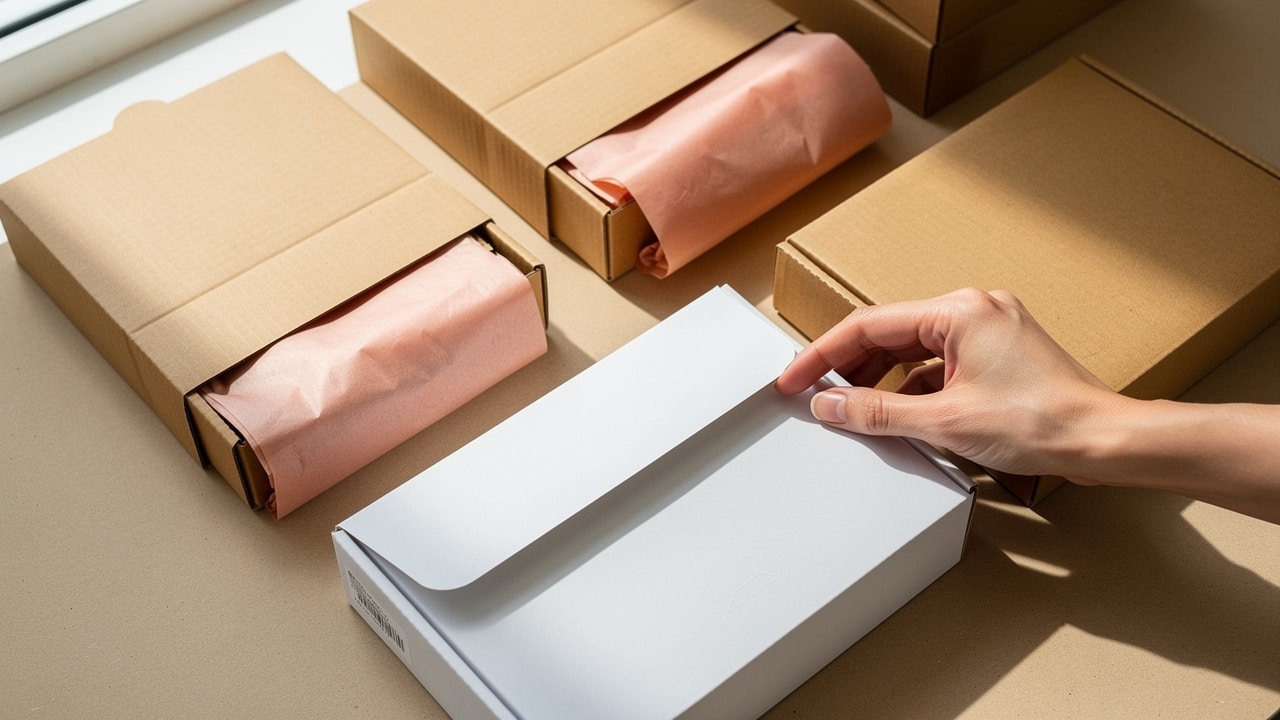
Most businesses that sell physical products spend considerable time and money on digital advertising, email campaigns, and social media presence. These channels are measurable, adjustable, and well understood. What receives far less attention is the moment a customer actually holds the product — the physical exchange that happens when a package arrives, is picked up, and opened. That moment is not incidental. It is one of the few guaranteed points of contact a brand has with a real customer in a distracted world, and for most businesses, it is entirely wasted on a plain brown box.
This is not a design conversation. It is an operational and commercial one. The decision to invest in packaging that reflects your brand identity has measurable downstream effects on customer retention, repeat purchase behavior, and organic word-of-mouth. Yet many small and mid-sized businesses treat packaging as a logistics cost rather than a customer experience investment. That framing is worth reconsidering, particularly as consumer expectations around product presentation have shifted substantially in recent years.
What Personalized Packaging Actually Does in a Commercial Context
When businesses explore shipping boxes personalized to their brand, the initial motivation is often aesthetic — they want the package to look professional or match their visual identity. That is a reasonable starting point, but it understates the functional value of the investment. Branded packaging operates on several levels simultaneously: it signals quality before the product is seen, it creates a distinct physical moment that stands apart from the generic parcel experience, and it gives customers something they are more likely to photograph, share, or remember.
The commercial logic is straightforward. A customer who receives a thoughtfully presented package is more likely to associate that care with the product itself. First impressions made through packaging are not superficial — they prime how the product inside will be evaluated. Research in consumer psychology, including work referenced through the American Psychological Association, consistently shows that physical presentation influences perceived product quality independent of the product’s actual attributes. For a business selling in a competitive category, that perceptual edge has real commercial weight.
The Gap Between Brand Investment and Delivery Experience
Many businesses invest significantly in their website design, product photography, and social media presence, creating a coherent and appealing brand image. Then the product ships in a plain corrugated box with a generic label. There is a fundamental inconsistency here that customers notice, even if they cannot articulate it precisely. The brand experience that was carefully constructed online collapses at the point of delivery.
This gap is not just a missed opportunity. It actively undermines the trust and quality signals a business has worked to build. When a premium product arrives in generic packaging, the customer’s first physical interaction with the brand communicates carelessness or indifference. That impression is difficult to reverse and can quietly affect whether a customer returns, recommends the product, or leaves a review. Closing this gap between online presentation and physical delivery is one of the simplest and most overlooked ways to maintain brand consistency across the full customer journey.
Packaging as a Retention Mechanism
Customer acquisition costs have risen steadily across most product categories. In that environment, retaining existing customers becomes more valuable, and the factors that influence retention deserve careful attention. Packaging plays a quiet but meaningful role here. Customers who remember opening a package — because the experience was pleasant, distinctive, or well designed — are more likely to return. They associate the positive experience with the brand as a whole, not just with the product.
This effect is not limited to luxury or lifestyle brands. Businesses in industrial supply, specialty foods, craft goods, and professional services that ship physical materials all benefit from the same dynamic. A customer who regularly orders supplies or consumable products is making a low-effort repeat purchase decision. Anything that makes that brand feel more considered and reliable — including how the packaging looks and feels — reduces the likelihood that the customer will comparison shop or switch to a competitor.
The Social Dimension of Physical Packaging
Over the past decade, a secondary effect of branded packaging has become commercially significant: customers share their unboxing experiences. This behavior, which happens across social media platforms, review sites, and personal networks, turns the physical packaging moment into a form of earned media. It is not something that can be manufactured or paid for directly. It emerges from delivering an experience that feels worth sharing.
Businesses that have invested in making their shipping boxes personalized to their brand identity consistently appear in user-generated content that they did not commission. A distinctive package, a thoughtful interior design, or even a well-placed printed message gives customers a visual story to tell. For businesses that sell products that photograph well — or that target customers who are active on visual platforms — this is a genuinely valuable byproduct of a packaging decision that was primarily made for brand consistency reasons.
What Makes Packaging Share-Worthy
There is no formula for packaging that gets shared, but there are consistent qualities that distinguish packages customers photograph from those they discard. Coherence is the first quality — the packaging feels like it belongs to the same world as the product inside. Unexpected detail is the second — something the customer did not expect to see, whether a printed interior, a meaningful message, or a structural element that makes opening the box feel intentional rather than routine.
Neither of these qualities requires significant investment in isolation. Businesses can achieve a great deal with a single color, a consistent logo placement, and a clear design direction. What matters is that the packaging communicates intentionality. Customers can tell when thought went into something, and that perception transfers to the brand as a whole. The businesses that get the most organic sharing from their packaging are not necessarily the ones with the most elaborate designs — they are the ones whose packaging feels honest and well considered.
The Economics of Packaging as a Marketing Channel
Marketing channels are typically evaluated on cost per impression, cost per acquisition, or return on ad spend. Packaging does not fit neatly into these frameworks, which is partly why it tends to be categorized as an operational cost rather than a marketing investment. That categorization leads to underinvestment and missed commercial returns.
The actual economics are favorable. Every box a business ships is a guaranteed impression. The customer who receives it has already made a purchase decision, which means this is not a cold outreach — it is a warm, high-intent touchpoint. The cost of upgrading from generic packaging to branded packaging, distributed across the number of packages shipped, is typically lower than the cost of a comparable number of digital impressions delivered to similarly high-intent audiences. The channel is not being underused because the economics are poor. It is being underused because it sits in a budget category that does not get marketing scrutiny.
Calculating the Real Cost of Generic Packaging
Businesses that default to unbranded boxes often do so because the immediate unit cost of custom packaging is higher. That comparison is incomplete. It accounts for the cost of branded packaging but not for the cost of the missed retention, missed referrals, and missed organic visibility that generic packaging produces. When those factors are included in a fuller accounting, the gap between generic and personalized packaging narrows substantially — and in many cases, branded packaging represents a net commercial advantage.
This is particularly true for businesses with high customer lifetime value, where retaining a single customer for one additional order cycle can offset a packaging cost increase across many units. For businesses in subscription or repeat-purchase models, the calculation is even more straightforward. The packaging is not just a box. It is part of the recurring experience the customer is buying into, and its quality affects how long they stay.
Operational Considerations for Transitioning to Branded Packaging
Moving from generic to branded packaging requires some operational planning, but for most businesses it is not a complex transition. The primary considerations are minimum order quantities, lead times, and storage requirements. Businesses that ship in consistent volumes can plan branded packaging runs in the same way they plan product inventory — with sufficient lead time to avoid gaps and enough storage to maintain a buffer.
For businesses with variable product dimensions or seasonal shipping patterns, modular approaches are often more practical. Rather than designing a packaging system for every SKU, focusing on one or two core box sizes that cover the majority of shipments allows a business to achieve consistent branding without managing an unwieldy number of packaging variants. The goal is to make branded shipping boxes personalized to the brand the default experience for most customers, not to engineer a bespoke solution for every edge case.
Balancing Design Ambition with Practical Constraints
Businesses sometimes delay branded packaging decisions because they are waiting for the perfect design, a rebrand, or a particular sales threshold. These are genuine considerations, but they often function as deferrals rather than rational criteria. A simple, clean branded box shipped consistently over time builds more brand equity than an elaborate design that arrives intermittently or after years of delay.
The practical starting point is a box that carries the brand’s primary visual identity clearly and consistently. From there, refinements can be made over time as the business scales and as customer feedback informs what the packaging experience could include. The priority is consistency, not perfection. A customer who receives the same well-branded box on every order develops a reliable expectation of quality that accumulates into genuine brand loyalty.
Conclusion: Rethinking Where Brand Investment Belongs
The packaging moment is not a secondary concern. For businesses that sell physical products, it is the most direct and guaranteed brand interaction in the customer relationship. It happens every time an order ships, it requires no algorithm or platform to reach the intended audience, and it leaves a lasting impression that influences repeat purchase behavior and referral likelihood.
Businesses that continue to treat packaging as a pure logistics cost are effectively choosing to leave one of their most reliable customer touchpoints unmanaged. The investment required to move from generic to branded packaging is modest relative to what most businesses spend on digital channels with less guaranteed reach and lower purchase intent. The case for making shipping boxes personalized to the brand is not a marketing argument. It is a commercial one — grounded in retention economics, customer perception, and the straightforward value of delivering a consistent brand experience at every point of contact.
For businesses ready to close the gap between how their brand looks online and how it shows up at the customer’s door, packaging is the most direct and underutilized place to start.

