


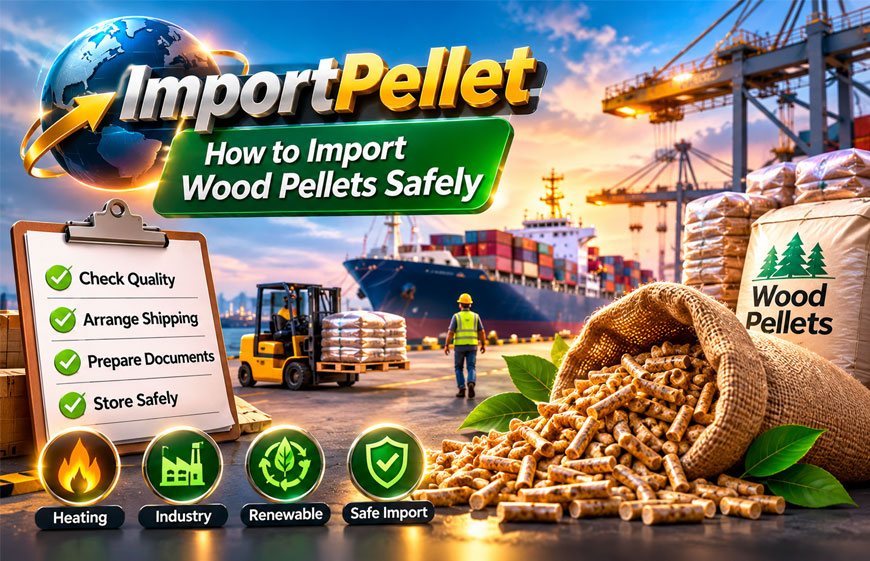
ImportPellet is a term used for buying and importing pellets from another country. It is mainly linked with wood pellets used for home heating, boilers, and energy production.
Importing wood pellets is not just about finding a cheap supplier. Buyers need to check pellet quality, prices, certificates, shipping, customs rules, and storage.
This guide explains what ImportPellet means, how wood pellet importing works, how to check quality and suppliers, and how to import pellets safely.
What Is ImportPellet?
ImportPellet mainly means buying pellet fuel from a supplier in another country and bringing it into the buyer’s country. The term is mostly connected with wood pellets used for heating and energy.
ImportPellet is not a wood pellet grade or certification. It is also not a special customs program or one confirmed global marketplace.
Buyers can purchase pellets directly from manufacturers. They may also work with exporters, traders, distributors, or brokers.
A manufacturer makes the pellets. An exporter or trader sells them to buyers in other countries. A distributor may sell them to local businesses or customers. A broker can help connect buyers with sellers.
Some companies and websites may also use Import Pellet or similar names. Because of this, the name alone does not identify one specific business.
There is also no confirmed universal ImportPellet app, software, subscription service, or online marketplace.
What Are Wood Pellets?
Wood pellets are small pieces of compressed wood. They normally look like short cylinders.
They are often made from sawdust, wood shavings, and other suitable wood material. The material is dried, ground, and pressed into pellets. The finished pellets are then cooled and prepared for storage or shipping.
Wood pellets are used in pellet stoves, boilers, commercial heating systems, and some industrial energy systems.
Not all pellets have the same quality. They can have different moisture levels, ash levels, sizes, strength, and heating value.
Pellets can also be made from hardwood or softwood. Hardwood may include oak and beech. Softwood may include pine and spruce.
However, hardwood is not always better than softwood. The quality of the finished pellet is more important than the type of wood alone.
Why Import Wood Pellets?
Businesses import wood pellets for different reasons.
Local suppliers may not have enough pellets to meet demand. This can be a bigger problem during colder months when more people need heating fuel.
Foreign suppliers may offer larger quantities, different pellet grades, better packaging, or more suitable delivery schedules.
Price is another reason. Pellets may have a lower factory price in another country.
However, buyers also need to consider shipping, insurance, customs, taxes, storage, and local delivery. These extra costs can make a cheap offer more expensive.
Importing can also give a business another source of fuel. This can be useful if its main supplier has production or delivery problems.
Buyers should compare the full delivered price with local options before making a decision.
How the Wood Pellet Import Process Works
The process should start with the buyer’s heating equipment.
Buyers first need to know what type of pellets their stove, boiler, or industrial system can use. Important details include pellet size, moisture, ash, strength, and heating value.
The next step is finding manufacturers, exporters, or traders. Buyers can ask them for prices, product details, certificates, samples, test reports, available quantities, and delivery times.
The supplier should also be checked. Buyers can look at the company’s legal name, address, factory location, production ability, certificates, bank details, and previous shipments.
Once both sides agree, they can create a written contract. It should clearly explain the pellet grade, quantity, price, packaging, payment, testing, and shipping terms.
The pellets are then prepared for shipping. Quality testing may also take place before they are loaded.
Shipping may involve freight companies, ports, customs brokers, warehouses, and local transport companies.
When the pellets arrive, customs requirements must be completed. Buyers may also inspect or test the shipment before accepting it.
The pellets can then be moved to a safe and dry storage area.
Wood Pellet Types and Uses
Different heating systems need different pellets. A pellet that works in a large industrial boiler may not work properly in a small home stove.
Buyers should always check their equipment requirements first.
Pellets for Home Heating
Wood pellets are commonly used in home pellet stoves and smaller boilers.
Home heating systems often need clean and consistent fuel. Too much ash can mean more cleaning. Too much dust or broken material can also cause problems in some feeding systems.
Low moisture, good strength, correct size, and low fines are important.
ENplus A1 is commonly used with compatible home heating systems. However, buyers should still follow the stove or boiler manufacturer’s instructions.
Commercial and Industrial Pellets
Businesses, factories, greenhouses, and other facilities may use wood pellets for heating.
Large industrial boilers and some energy plants can also use biomass pellets.
Industrial systems may accept different pellet grades. Some can handle more ash, while others need better-quality fuel.
The correct pellet depends on the equipment being used.
Pellets for Wholesale and Retail
Some businesses import pellets to sell them to other companies or customers.
A distributor may import bags of pellets and sell them to shops, heating companies, installers, or home users.
Packaging is important for these businesses. Bags need to protect the pellets from water and damage.
Importers also need to plan for seasonal demand. More heating fuel may be needed during colder months.
Even good-quality pellets can become difficult to sell if the bags arrive wet, torn, or damaged.
Wood Pellet Quality: What Buyers Should Check
Pellet quality is one of the most important things to check before importing.
Words such as “premium” or “high quality” are not enough. Buyers should ask for clear specifications and test results.
Moisture Content
Moisture tells buyers how much water is inside the pellets.
Dry pellets normally burn and store better. Too much water can weaken pellets and cause them to break.
ENplus A1, A2, and B have a maximum moisture level of 10% under the specifications used in this guide.
Pellets must also stay dry during transport and storage.
Ash Content
Ash is the material left after pellets burn.
Lower ash can mean less waste and less cleaning in heating systems that are made for low-ash fuel.
Different ENplus grades allow different ash levels.
Mechanical Durability
Mechanical durability shows how well pellets stay together during shipping and handling.
Weak pellets can break into smaller pieces and create more dust.
This is important because pellets may be moved several times before reaching the customer.
Fines and Dust
Fines are small broken pieces and dust found with the pellets.
Too many fines can cause problems with storage, cleanliness, and some fuel-feeding systems.
Large amounts of wood dust can also create safety problems.
Buyers should agree on acceptable fines levels before ordering.
Pellet Size and Diameter
Pellets need to be the correct size for the heating system.
Pellets that are too large or too small may not move properly through the equipment.
Buyers should check their stove or boiler instructions before ordering.
Calorific Value
Calorific value shows how much energy the pellets can provide.
This is important when comparing prices.
A cheaper pellet is not always better if it provides less useful energy or has lower overall quality.
ENplus A1, A2, and B Grades
ENplus is a certification system for wood pellets. It sets quality requirements and also covers important parts of pellet production and supply.
The main grades discussed here are A1, A2, and B.
| Property | ENplus A1 | ENplus A2 | ENplus B |
|---|---|---|---|
| Maximum moisture | 10% | 10% | 10% |
| Maximum ash | 0.70% | 1.20% | 2.00% |
| Minimum mechanical durability | 98.0% | 97.5% | 97.5% |
| Minimum net calorific value | 4.6 kWh/kg | 4.6 kWh/kg | 4.6 kWh/kg |
A1 has the lowest maximum ash level. It is commonly used with compatible home heating systems.
A2 allows more ash than A1. B allows a higher level again.
These numbers are limits under the specification. They do not mean every batch of pellets will perform exactly the same way.
Buyers should choose the grade recommended for their equipment.
Wood Pellet Standards and Certifications
Quality standards make it easier to compare pellets.
ISO 17225-2:2021 is an international standard covering quality classes and specifications for graded wood pellets.
ENplus is another important system used in the wood pellet industry. DINplus is also linked with pellet quality certification.
However, buyers should not trust a certificate logo without checking it.
The company name, certificate number, status, and other details should match the supplier or producer.
Buyers can also ask for a recent laboratory report for the pellet batch.
A certificate and a batch test are not exactly the same. Certification gives information about the company and its quality system. A batch test gives information about specific pellets.
How to Find a Reliable Wood Pellet Supplier
Wood pellet suppliers can be found through manufacturers, industry groups, trade events, exporters, distributors, and business directories.
Buyers should check a supplier carefully before making a large payment.
Start by checking the legal business name, address, and factory location. Find out whether the seller makes the pellets or buys them from another company.
Ask about production capacity, available quantities, delivery times, certificates, and previous export shipments.
Buyers should also check the payment information. The bank account should make sense for the company named in the contract.
Be careful if payment details suddenly change.
For large orders, buyers may also use an independent inspection company or visit the factory.
Very low prices can be a warning sign when they come with unclear business information, questionable certificates, or pressure to pay quickly.
Samples, Testing, and Purchase Contracts
A sample can help buyers check pellets before making a large order.
However, a small sample does not prove that the full shipment will have exactly the same quality.
For larger orders, buyers should put testing rules in the contract.
The contract can explain when the pellets will be tested, how samples will be taken, which laboratory will be used, and what quality limits must be met.
Testing may take place before shipping and after arrival.
The contract should also explain what happens if the pellets do not meet the agreed quality. Possible solutions may include replacement, a lower price, reprocessing, or returning the goods.
Other important details include quantity, price, packaging, payment terms, shipping terms, and rules for reporting damaged goods.
ImportPellet Prices and Total Import Cost
There is no single price for imported wood pellets.
Prices depend on the pellet grade, order size, country of origin, supplier, packaging, shipping route, and market demand.
The factory price is only part of the cost.
Buyers may also need to pay for shipping, insurance, port fees, customs, taxes, local transport, storage, and financing.
Buying a large quantity may lower the price per tonne. However, larger orders also need more money and storage space.
The best way to compare offers is to look at the full cost of getting usable pellets to the final destination.
How to Calculate the Landed Cost
Landed cost means the total cost of getting the pellets to the required destination.
For example, one supplier may charge £215 per tonne. If shipping and other costs add £90, the final cost becomes £305 per tonne.
Another supplier may charge £240 per tonne, with only £55 in extra costs. Its final cost becomes £295 per tonne.
In this example, the pellets with the higher starting price are actually cheaper after delivery.
These prices are only examples. They are not current market prices.
Buyers should include freight, insurance, port fees, customs, taxes, local transport, storage, and other costs.
Damaged pellets also matter. If part of the shipment cannot be used, the real cost per usable tonne becomes higher.
Cost Per Unit of Useful Heat
Price per tonne does not tell buyers everything.
The amount of energy provided by the pellets also matters.
For example, pellets with a calorific value of 4.6 kWh/kg provide about 4,600 kWh of fuel energy per metric tonne.
If the landed cost is a hypothetical $275 per tonne, the fuel costs around 6 cents per kWh before heating-system efficiency is included.
If the boiler operates at 85% efficiency, the example works out at around 7 cents per kWh of delivered heat.
These numbers are examples only.
Looking at useful heat can make it easier to compare pellets with different prices or specifications.
Shipping Wood Pellets
Wood pellets can be shipped in small bags, large bags, containers, or loose bulk loads.
Bagged pellets can work well for shops and home-heating markets.
Large industrial buyers may use bulk shipments. However, they need the right equipment for unloading and storage.
Buyers should make sure the destination is ready to receive the shipment before it arrives.
Pellets also need to stay dry during shipping.
Rain, leaks, and condensation can cause them to swell and break apart. This can create more dust and reduce the amount of usable fuel.
For large shipments, photographs and inspection records at loading and unloading can help show the condition of the pellets.
FOB, FCA, CIF, and Shipping Responsibilities
International pellet contracts may use trade terms called Incoterms.
FOB, FCA, and CIF are common examples.
These terms help explain who is responsible for certain costs, transport steps, and risks.
FOB is used for suitable sea or inland-waterway shipments. FCA can be used when goods are handed to a carrier at an agreed location.
With CIF, the seller arranges freight and a defined level of insurance to the named destination port. However, this does not mean the seller is responsible for every risk until the shipment arrives.
The contract should clearly state the correct Incoterms 2020 rule and the exact port or delivery point.
A simple statement such as “shipping included” is not enough. Buyers need to know exactly what is included in the price.
Wood Pellet Storage and Safety
Wood pellets should be kept in a clean and dry place.
Water can damage them. Bags should be protected from rain, leaks, wet floors, and high moisture.
Pellets should also be handled carefully because too much movement can break them and create more dust.
Bulk pellet storage needs extra safety care.
Wood pellets can release carbon monoxide in enclosed spaces. Oxygen levels can also become unsafe.
Bulk pellets can sometimes heat up on their own. Wood dust may also create fire or explosion risks.
Silos, hoppers, cargo holds, and enclosed storage areas therefore need proper safety rules.
Untrained people should not enter these spaces without the correct safety checks and controls.
Customs Documents and Import Rules
Wood pellet imports need the correct documents.
The exact requirements depend on the country sending the pellets, the destination country, and local laws.
Common documents may include a commercial invoice, packing list, bill of lading or other transport document, and customs declaration.
A certificate of origin may also be required.
Some shipments may need extra inspection, plant-health, sustainability, or product documents.
Taxes and import duties also vary between countries.
Buyers should check the current requirements for their exact shipment before signing a large contract.
Wood Pellet HS Code
Wood pellets are generally listed under international HS subheading 4401.31.
HS codes help customs authorities identify products.
However, countries can add more numbers to the international code for their own customs systems.
This means 4401.31 is a useful starting point, but buyers should still check the complete local code.
Using the wrong code can cause delays or incorrect customs charges.
Phytosanitary and Wood-Sourcing Requirements
Some wood products may need plant-health documents when they are imported.
A phytosanitary certificate may be required in some cases.
The exact rule depends on the product, country of origin, and destination.
Plant-health documents are different from documents showing where the wood came from or whether it was legally and responsibly sourced.
Importers may therefore need to check both types of rules.
EU Rules for Imported Wood Pellets
Businesses importing wood products into the European Union may need to follow rules about timber sourcing, biomass, sustainability, and supply chains.
The EU Deforestation Regulation may also apply to certain wood products and businesses.
However, these rules and dates can change. Requirements may also depend on the product and the size or role of the business.
Importers should check current official EU information before arranging a shipment.
Are Imported Wood Pellets Sustainable?
Wood pellets are often called renewable fuel because trees and other biomass can grow again.
However, this does not mean every shipment is automatically good for the environment.
The source of the wood matters. Pellets made from sawmill waste may have a different environmental impact from pellets made from trees cut mainly for fuel.
Forest management also matters.
Energy is used to dry, process, and produce pellets. Shipping them over long distances also creates emissions.
Burning biomass releases carbon dioxide as well.
Because of this, buyers should look at the full supply chain. This includes where the wood comes from, how the pellets are made, how far they travel, and what fuel they replace.
FSC, PEFC, and Sustainability Claims
FSC and PEFC are well-known systems connected with responsible forest management and wood sourcing.
They are different from pellet-quality systems such as ENplus.
An ENplus certificate can provide information about pellet quality. It does not automatically prove that the wood came from a responsibly managed forest.
Buyers should ask suppliers for clear records showing where the wood came from.
Claims such as “100% green” or “completely green” should not be accepted without supporting information.
Major Wood Pellet Exporting Countries
Wood pellets are produced and exported by many countries.
The United States and Canada are important suppliers. Vietnam is also a major producer, especially for Asian energy markets.
European countries also produce and trade wood pellets, including countries in Eastern Europe.
Brazil and other South American countries have wood biomass resources as well.
The best country to buy from depends on quality, price, shipping distance, availability, certification, and total delivery cost.
The collected information reports that the United States exported about 0.81 million U.S. tons of densified biomass fuel in December 2025. This figure only shows one month of reported U.S. exports. It does not represent total global wood pellet trade.
Main Risks When Importing Wood Pellets
Importing pellets can provide more buying options, but there are also risks.
Quality Can Change During Shipping
A factory test only shows the condition of the pellets when they were tested.
Pellets can be damaged later by water, humidity, poor packaging, or rough handling.
For large orders, testing before shipping and after arrival can help identify these problems.
Cash Can Be Tied Up
International orders can take weeks or months.
A buyer may pay a deposit before production starts. The pellets then need to be produced, shipped, cleared through customs, stored, and sold or used.
Delays can keep business money tied up for longer than expected.
Buyers should plan their cash needs before placing a large order.
Dependence on One Supplier
Using only one supplier can create problems if that factory cannot deliver.
Production problems, port delays, raw-material shortages, or shipping problems can stop or slow deliveries.
Businesses that need a regular pellet supply may benefit from having another checked supplier available.
Practical ImportPellet Buying Checklist
Before placing an ImportPellet order, buyers should check these important points:
- Make sure the pellet grade matches the heating equipment.
- Check the supplier’s legal business details.
- Verify certificates.
- Ask for product specifications and test reports.
- Agree on testing and quality rules.
- Calculate the full landed cost.
- Allow for possible damaged pellets.
- Clearly agree on shipping and insurance responsibilities.
- Make sure unloading and storage facilities are ready.
- Check customs documents, taxes, and duties.
- Check plant-health and sustainability rules where needed.
- Plan safe pellet storage.
- Prepare for possible shipping delays.
- Consider having a second supplier if regular supply is important.
These steps cannot prevent every problem, but they can reduce many common risks.
ImportPellet Companies and Websites
ImportPellet should not automatically be treated as the name of one company or website.
Different businesses may use Import Pellet or similar names.
The information collected for this guide mentions Import Pellet S.r.l.s. as a company name linked with Italy. However, its current services and business activity should be checked through official company records.
Similar names may also appear on websites that are not connected with wood pellet importing.
Before making a payment, check the exact company name, website address, business records, contact details, and payment information.
There is not enough reliable information to describe ImportPellet itself as one universal marketplace, app, or software service.
Bottom Line
ImportPellet mainly means sourcing and importing pellets, especially wood pellets used for heating and energy.
Importing can help buyers find more suppliers, larger quantities, and competitive prices. However, the lowest factory price is not always the best deal.
Buyers should check pellet quality, equipment requirements, supplier details, certificates, test reports, shipping terms, and the full landed cost.
Customs rules, safe storage, and environmental requirements are also important.
A good buying decision should be based on the quality, total cost, safety, and reliability of the pellets that actually reach the buyer.
Frequently Asked Questions
What does ImportPellet mean?
ImportPellet means buying and bringing wood pellets from another country for heating or energy use.
Is ImportPellet a company or online platform?
ImportPellet is not one confirmed company or platform. Different businesses may use similar names.
Which wood pellet grade is best for home heating?
ENplus A1 is commonly used for home heating. Always check which pellet grade your stove or boiler needs.
How much does it cost to import wood pellets?
There is no fixed price. The cost depends on pellet quality, quantity, shipping, taxes, and other fees.
Are imported wood pellets cheaper?
They can be cheaper, but shipping and import costs can increase the final price.
What documents are needed to import wood pellets?
Common documents include an invoice, packing list, shipping document, and customs papers. Other documents may also be needed.
How should imported wood pellets be stored?
Keep wood pellets in a clean and dry place. Bulk storage also needs proper safety controls.
Are imported wood pellets environmentally friendly?
It depends on where the wood comes from and how the pellets are made, shipped, and used.
Explore More:
Piragnia Guide: Meaning, Music Connection, and Piranha Facts

