


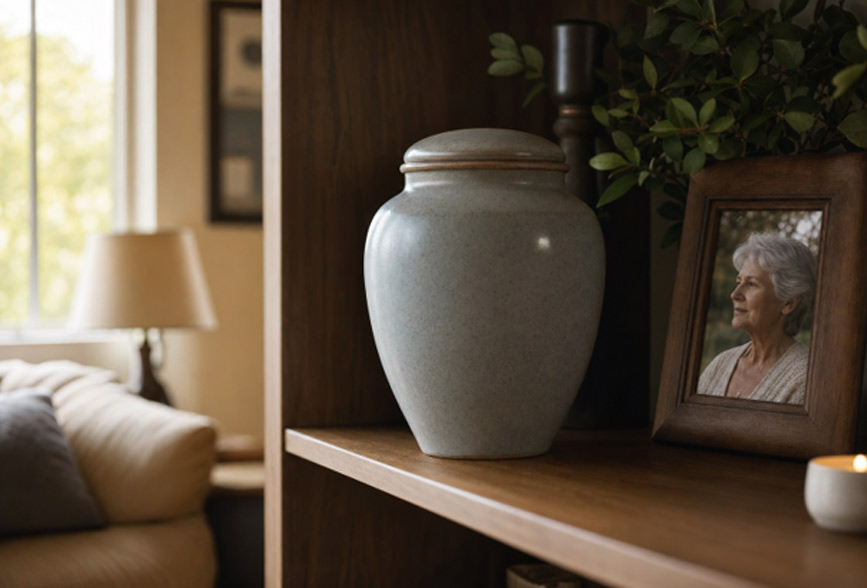
How do you choose a pet ashes urn that won’t feel out of place in your own home, years after the loss? The honest answer is that the right urn is less about the material or the motif on the lid and more about where it will sit, who will see it, and how your household actually lives day to day—because an urn isn’t a one-time purchase, it’s an object you’ll walk past every morning.
In short: start with where the urn will actually live, use your pet’s weight as a rough starting point for capacity, add a 10–20% buffer for easier transfer, look for a lid that closes securely, and keep the piece away from direct sunlight and damp air. Everything else — motif, color, personalization — is a matter of fit with your home and your way of grieving, not a fixed rule.
- Decide placement first (bedside, shelf, cabinet) — it shapes size and shape more than taste does.
- Use your pet’s weight as a rough starting point for capacity, then confirm with the crematorium.
- Add roughly 10–20% extra capacity as a practical margin, not an exact rule.
- Look for a lid that closes securely, often airtight or screw-top — it matters more after the first year than on day one.
- Keep the urn away from direct sunlight and damp rooms to protect both finish and contents.
This guide works through the decisions that actually matter once the initial choice is made: the real difference between a full-size urn and a keepsake, a practical way to estimate size based on your pet’s weight, and the placement and closure details that determine whether the urn still feels right on a shelf five years from now.
What a pet ashes urn really is (and what it isn’t)
A pet ashes urn is, at its simplest, a sealed container designed to hold cremated remains permanently. That sounds clinical, but the function matters: it’s different from a keepsake urn, which holds only a small portion of ashes (often shared among family members), different from a scattering tube, which is built for a single use and then discarded, and different from a burial container, which is meant to go into the ground rather than stay visible in a room.
Understanding this distinction early saves disappointment later. An urn bought as a short-term memorial piece for a funeral service may not hold up, aesthetically or structurally, to years of dusting, sunlight, and handling. Pet ashes urns, when chosen with some care, are meant to function as a quiet, permanent fixture of home life — not a prop for a single ceremony.
Why where it will live should guide your choice
Before thinking about color or shape, it helps to answer a more basic question: where will this urn actually sit? A bedside table calls for something small and stable, something you won’t knock over half-asleep. A living room shelf, visible to guests, might call for a more considered, legible form — something that reads as a memorial without needing explanation. An entryway cabinet, used daily, needs a base wide enough to resist being brushed by coats and bags.
There’s also a visibility spectrum worth being honest about. Some households want the urn to be part of shared, visible life — something a visitor might notice and ask about gently. Others prefer it tucked into a private space, seen only by the people who shared that bond with the animal. Neither choice is more or less respectful; they’re simply different relationships to grief and privacy, and the urn should match the one you actually have, not the one you think you’re supposed to have.
Quiet design that supports memory without demanding attention
The best pet memorials tend to share a kind of restraint. A loud, highly decorated urn can feel more like an ornament than a resting place, and ornaments eventually get moved, replaced, or tucked away when the room is redecorated. A quieter form — simple curves, a softly matte or lightly glazed surface, proportions that feel calm rather than decorative — tends to stay relevant in a home for longer, through redecorations and even through moves.
Finish and color do more emotional work than most people expect, even if the reasons are more about feel than any technical rule. Matte surfaces tend to read as warmer and less formal; glossy finishes can feel more polished but also colder under certain light. Lighter tones often sit more easily in everyday rooms, while darker tones can read as more solemn — useful in a dedicated memorial corner, less so on a kitchen shelf. None of this needs to follow a trend; it only needs to match the tone of the room it will live in.
Personalization that feels intimate, not performative
A name and two dates are often enough. Adding a short phrase can be meaningful, but it’s worth resisting the urge to put a full paragraph on a small surface — legibility and restraint usually age better than sentimentality spelled out in full. Paw prints and simple line-drawn portraits tend to stay timeless in a way that very literal, photo-realistic engravings sometimes don’t, because the latter can look dated as printing and engraving styles shift over the years.
One practical habit worth adopting: keep the urn itself relatively uncluttered, and build a small, separate memory set around it instead — a collar tag, a printed photo, a handwritten note kept in a drawer nearby. This way the urn stays a clean, lasting object, while the more personal, changeable items can be rotated or added to over time without altering the urn’s design.
Practical checks that matter long after the ceremony
Several practical details deserve more attention than they usually get, mostly because they stop mattering emotionally and start mattering physically a few months in. Closure is one of them. For temporary storage — and for peace of mind well beyond that — many people prefer a lid that closes securely, often an airtight or screw-top design, rather than a loosely fitted cap; it reduces the risk of accidental spills during cleaning or a minor bump. It also helps to keep ashes labeled during any temporary storage — name, date, and contact information — particularly if more than one urn or keepsake is involved in the household.
Stability matters just as much as sealing. A wide, heavy base resists tipping far better than a tall, narrow one, which matters in homes with children, other pets, or simply a lot of foot traffic near shelves. Keeping any urn out of direct sunlight and away from damp rooms helps protect both the finish and the contents over time, since humidity and temperature swings are rarely good for anything meant to last decades. If you move home, pack the urn the way you’d pack anything irreplaceable — padded, upright, and separated from heavier boxes that could shift in transit.
Getting the size right: how cremation volume actually works
Urn capacity isn’t pure guesswork, even though many product listings make it feel that way. A commonly used guideline is that roughly one pound of a pet’s body weight corresponds to about one cubic inch of ashes — so a 40-pound dog might yield somewhere around 40 cubic inches. It’s a starting point, not a precise formula. One published estimate suggests that aquamation, or water cremation, can produce roughly 20% more ashes than traditional flame cremation, so it’s worth confirming which process was used, and ideally checking the actual returned volume, before settling on a size.
As a practical guideline, it can help to choose an urn with a bit more capacity than your rough estimate — often around 10 to 20% extra — which makes transferring ashes easier and leaves a little room if you want to add a small item inside. Loosely, small pets up to about 25 pounds often fall in a 25–40 cubic inch range, medium pets between 26 and 50 pounds around 40–75 cubic inches, large pets from 51 to 75 pounds roughly 75–110 cubic inches, and pets over 76 pounds generally 110 cubic inches or more. None of these ranges should replace the one step that actually removes the guesswork: ask the crematorium directly for the weight or volume of ashes returned, and size the urn from that number.
This is also the point where it helps to browse real options rather than work from numbers alone. Browsing a dedicated range of pet ashes urns helps you compare forms and footprints across keepsakes and full-size pieces, which makes the size ranges above easier to picture in an actual room rather than as abstract cubic inches.
For reference, this kind of category typically separates full-size urns from smaller keepsake pieces — worth keeping in mind if you’re weighing a single urn for the full remains against a set of smaller keepsakes to share among family members.
Household dynamics: kids, other pets, and different grieving styles
Grief doesn’t move at the same pace for everyone in a household, and an urn sitting in a shared space can surface that difference quickly. One partner might want it visible on the mantel; another might find that painful every time they walk past. A reasonable compromise is often a middle ground — a private room, a closed cabinet with easy access, or a shelf at a height that’s visible but not unavoidable.
With children, placement height and a simple explanation go a long way: something sturdy, out of easy reach for very young children, but not hidden in a way that makes the object feel shameful or secret. In multi-pet households, it’s worth thinking ahead before a shelf quietly becomes a row of urns. Deciding in advance whether future pets will get matching keepsakes, a shared display, or separate quiet spaces prevents an arrangement that starts to feel more like inventory than memorial.
Why ceramic specifically suits this kind of object
Cremated remains are generally stable and don’t deteriorate in the same way organic material does, which is part of why ceramic, porcelain, wood, and glass are generally considered well suited to indoor memorial use — there’s no urgency driven by preservation, only by how the object fits a home. Ceramic in particular tends to feel settled in a room in a way that’s hard to pin down exactly: it has a certain weight and presence, and many people simply find it more comfortable to live alongside than lighter or colder-feeling materials.
When evaluating a ceramic urn in practical terms, it’s enough to check a few basic things with your hands rather than any specialized knowledge: does the base sit flat and resist rocking on a shelf, does the lid close securely without forcing it, and does the surface feel evenly finished rather than rough or inconsistent in places. These simple checks tell you more about how the piece will hold up day to day than any description on a product page.
A simple decision path: matching urn type to your intention
If your goal is private remembrance, lean toward discreet forms, secure closures, and calm, muted colors that won’t draw attention in a shared space. If the goal is a shared family memorial, prioritize legible personalization — name and dates that are easy to read at a glance — paired with a stable, durable finish that will survive handling by more than one person over the years. If your household leans toward ritual — lighting a candle on an anniversary, writing a short note once a year — consider pairing the urn with a small keepsake object from the start, so the ritual has a natural anchor rather than being improvised each time.
Questions worth asking before you buy
A few practical questions tend to separate a thoughtful purchase from a rushed one. Ask how the piece is made — hand-finished or mass-produced — since that affects both cost and the kind of variation you should expect from one piece to the next. Ask about return policies and protection against damage in transit, since fragile memorial objects deserve clear answers here, not vague reassurances. It’s also worth asking whether the urn comes with a liner or bag for the ashes, since not every maker includes one, and that small detail affects how you handle the transfer. And it’s worth being alert to language that pushes urgency or guilt into a grief purchase; a respectful seller focuses on fit, durability, and dignity, not pressure.
Living with the choice
None of this turns grief into décor, and that’s the point. Choosing an urn with some care — thinking about where it sits, how it’s sealed, how it will age in daylight, how a household will share the space around it — isn’t about design for its own sake. It’s about making sure the object you chose in a hard week still feels right five years later, quietly present in a room you walk through every day.

