


Why do two bottles labeled extra virgin olive oil taste so different from each other? The short answer: because the legal category only sets a ceiling on chemical flaws, not a flavor profile. What lands inside that ceiling is shaped by orchard decisions, harvest timing, and milling choices made long before anything reaches a shelf.
What extra virgin olive oil actually means, by the numbers
Before getting into orchard practice, it helps to pin down the definition everything else refers back to. Under the International Olive Council’s trade standard, virgin olive oils are extracted from olives solely by mechanical or physical means, under conditions that do not alter the oil, with no treatment beyond washing, decantation, centrifugation and filtration. Extra virgin is the strictest tier inside that family, and the thresholds are specific rather than approximate:
- Extra virgin olive oil: free acidity, expressed as oleic acid, of no more than 0.80 grams per 100 grams, alongside defined chemical and sensory characteristics.
- Virgin olive oil: free acidity up to 2.0 grams per 100 grams.
- Ordinary virgin olive oil: free acidity up to 3.3 grams per 100 grams.
- Lampante virgin olive oil: free acidity above 3.3 grams per 100 grams, or other characteristics placing it in that category — intended for refining or technical use, not for direct consumption.
The European Commission lists eight categories of olive and olive-pomace oils in total. Not all of them can legally reach a shopping basket: at retail level, consumers can only buy extra virgin olive oil, virgin olive oil, olive oil composed of refined and virgin olive oils, and olive pomace oil. The remaining categories sit further up or down the processing chain — lampante, for instance, is explicitly meant for refining, as the IOC standard states — rather than being sold as finished products.
Those thresholds stop being abstract the moment you taste several oils side by side in the region that produces them. A Tuscan estate such as Love Olive Oil, which frames its visits around experiencing extra virgin olive oil on-site rather than just reading about it, gives a concrete sense of how one legal category can still cover a wide range of aromas, bitterness and pungency. The number on the label is a floor, not a flavor description.
What EU law actually requires on the label — and how it’s checked
On an EU label, the wording for extra virgin olive oil isn’t marketing copy. Under Commission Delegated Regulation (EU) 2022/2104, which replaced the older 1991 and 2012 rules, olive oils must state their legal name and category, and extra virgin olive oil carries a fixed, mandated phrase: superior category olive oil obtained directly from olives and solely by mechanical means. A producer can’t substitute a looser description and still use the category name.
That label claim is also checked, not just declared. A companion regulation, Commission Implementing Regulation (EU) 2022/2105, lays down rules on conformity checks and methods of analysis, meaning accredited laboratories and trained tasting panels apply standardized procedures to verify that an oil sold as extra virgin genuinely meets the chemical and sensory bar for that category. The framework is relatively recent in its current form — the delegated regulation dates from July 2022 and was consolidated again in mid-2024 — but the principle behind it is older: category names on olive oil are meant to be testable claims, not taste descriptions chosen freely by whoever bottles the oil.
Quick answers for label-readers
- What does extra virgin olive oil legally mean? Oil obtained from olives by mechanical means only, with free acidity no higher than 0.80 grams per 100 grams and chemical/sensory characteristics that match the category — verified, under EU rules, through accredited labs and tasting panels.
- Which olive oils can you actually buy at a shop in the EU? Only four of the eight official categories: extra virgin olive oil, virgin olive oil, olive oil composed of refined and virgin olive oils, and olive pomace oil.
- What else do labs check besides acidity? Free acidity is one parameter among several that EU conformity checks require accredited laboratories to assess using standardized methods of analysis; the exact additional chemical tests and thresholds are set out in the regulation itself rather than on the bottle.
Tradition as risk management across a fragmented landscape
On a working olive farm, tradition rarely means repeating one fixed routine passed down unchanged. More often it’s a set of choices, refined over generations, aimed at managing risks that threaten a harvest: pests, erratic weather, the fruit’s tendency to degrade once picked, and tight timing windows that run through nearly every stage of the olive year.
The scale involved is easy to underestimate. EU countries account for roughly two-thirds of global olive oil production, spread across close to four million hectares of Mediterranean land. Italy and Spain are the EU’s two largest consumers of the oil grown there, each accounting for around 500,000 tonnes a year domestically; Greece, by contrast, has the highest per-capita consumption in the bloc, at roughly 12 kilograms a year per person. Olive oil in much of the Mediterranean is a staple, not a garnish.
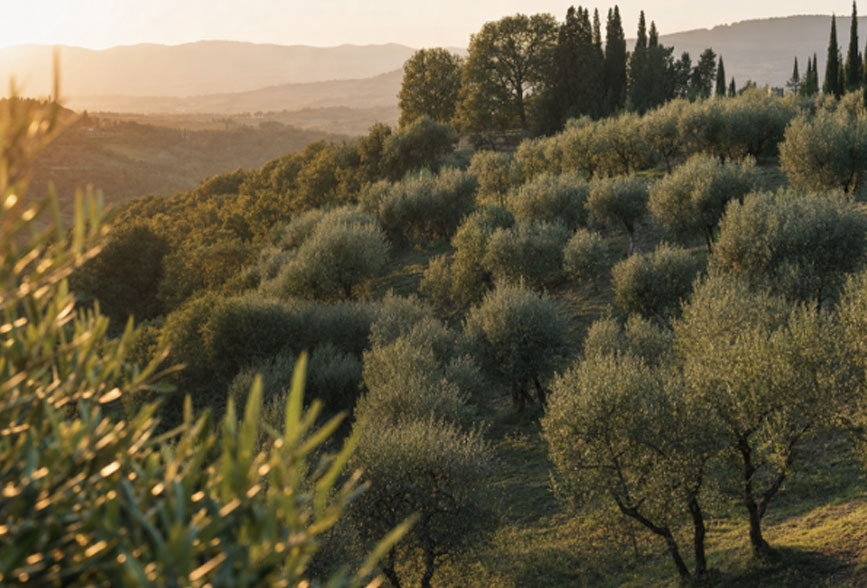
Anyone who has walked a Tuscan hillside grove has seen why uniform, large-scale management is harder here than on flatter estates elsewhere in the Mediterranean: terraces, mixed plantings, olives sharing a slope with vines or wheat. Each parcel tends to need its own reading of soil, exposure and ripening pace, which is part of why smaller, hands-on practices have persisted here longer than in more industrialized olive regions.
The grove between harvests: soil, water and pests as ongoing judgment calls
Groves don’t go dormant between harvests. Soil management is usually the first layer of attention: many growers maintain cover crops or permanent ground cover between the rows, a practice widely discussed among producers as a way to protect sloped soil and keep organic matter in place over time, even if its direct effect on a given year’s oil is hard to isolate from everything else happening in the grove.
Irrigation decisions vary from farm to farm. Olive trees tolerate drought better than most fruit trees, and plenty of Mediterranean groves are managed with little or no irrigation, partly by habit and partly by necessity on terraced land where running water is impractical. Some growers describe lightly stressed, dry-farmed trees as producing a more concentrated oil — a view circulated among producers rather than a measured rule, and one that depends heavily on how much stress a specific tree and soil can absorb before yield drops too far.
Pest management tends to follow a similar logic of watching before acting. Groves that keep hedgerows or flowering ground cover, or that avoid routine spraying on a fixed calendar, are often associated with an integrated approach: monitoring pressure from pests such as the olive fruit fly and intervening selectively rather than preventively. Producers who favor this approach often link it to a more balanced finished oil, though that connection sits closer to accumulated field experience than to a laboratory-verified rule.
Pruning: the quiet decision that shapes next year’s tree
Pruning looks like maintenance from outside the grove, but it’s one of the more consequential calls a grower makes each year. The goal is rarely shape alone. Opening the canopy is widely thought among growers to improve light and airflow, with knock-on effects on disease pressure and on the balance between vegetative growth and fruiting — though, as with soil management, isolating pruning’s exact contribution from everything else happening in a given season is difficult.
Many Mediterranean groves still favor an open, vase-like structure: a relatively low canopy with a clear center. The approach persists for practical reasons growers describe consistently — it keeps trees accessible for hand-harvesting or light equipment, and it’s generally associated with steadier year-to-year production compared with letting a tree grow unchecked. None of this is guesswork so much as an inherited set of trade-offs between accessibility, vigor and output, adjusted plot by plot.
Visitors touring a working grove can often spot careful canopy management without technical training: light visible through the branches, a manageable height, fruit spread fairly evenly rather than clustered at the top.
Harvest: timing and handling as a race against the clock
Ripeness and yield tend to pull in opposite directions. Olives picked earlier, while still green or just turning color, generally give less oil by weight; picking later increases volume but, according to many tasters and growers, tends to soften some of the sharper sensory qualities associated with earlier harvests. Deciding when to pick is, in practice, deciding what style of oil a farm is aiming for that season — there’s no single correct date, only a trade-off weighed year to year against weather, labor and the grower’s own preferences.
How the fruit is handled afterward matters alongside when it’s picked. Hand-picking and gentle mechanical rakes or shakers aim to keep olives intact rather than bruised, and field handling commonly follows a similar logic: ventilated crates rather than sealed sacks, shade rather than direct sun, shallow piles rather than deep ones. Growers broadly treat damaged or overheated fruit as a liability, on the assumption that it degrades faster than intact olives — one reason many farms try to move picked fruit toward the mill without unnecessary delay, even though the ideal window varies by farm, climate and scale.
At the mill: from fruit to oil, step by step
Once the olives arrive, the sequence at most mills follows the same basic logic, even where the machinery has changed. Leaves and twigs are removed, the fruit is washed, then crushed into a paste. That paste is slowly mixed — a step called malaxation — to help microscopic oil droplets coalesce before being separated from water and solids, typically today by centrifuge.
Malaxation time and temperature are widely regarded within the trade as a sensitive step: longer or warmer malaxation can extract more oil, but millers generally believe it also raises the risk of dulling aroma or introducing off-notes if mismanaged. Mills that prioritize sensory quality over yield tend to favor shorter, cooler malaxation, though exact settings vary by producer and aren’t something that can be verified from outside the mill.
Filtration is more a matter of style than correctness. Filtered oils are clearer and, by reputation among producers, considered somewhat more stable over storage, since they carry less suspended plant residue. Unfiltered oils keep a cloudier look and a more pronounced, grassier profile early on — a traditional choice in some areas, a seasonal specialty in others, but not inherently a marker of higher quality either way.
Cleanliness between batches matters regardless of style. Residue left in presses, decanters or storage tanks is commonly cited as a cause of the kind of defects — fusty, musty notes — that can keep an oil out of the extra virgin category altogether, independent of how carefully the grove itself was managed.
Storage and bottling: keeping an already-made oil from fading
Extra virgin olive oil doesn’t improve after milling; the most that storage or bottling can do is slow its decline. Producers commonly point to oxygen, light and heat as the factors worth managing, and many store finished oil in stainless steel, hold it at cool, stable temperatures, and bottle it in dark glass or tins rather than clear containers — on the reasoning that direct light exposure speeds up the loss of the compounds responsible for aroma and bitterness. None of this is enforced by the EU rules described above; it’s practice built from producers’ own experience of what keeps oil tasting fresher for longer.
Freshness communication is the gap many producers try to close voluntarily, since EU labelling rules require category and origin information but don’t mandate a harvest date. A best-by date alone tells a buyer relatively little, given that shelf-life windows are set generously; a harvest date, where a producer chooses to include it, tells considerably more, since many in the trade consider extra virgin oil to show its character most clearly within its first several months. A label offering both rewards closer reading than one offering only the legal minimum.
Tradition under pressure: adapting without abandoning the method
None of the above sits still from one year to the next. Warmer, more erratic seasons are widely reported by growers across Mediterranean olive regions to shift flowering and fruit set unpredictably, and pests such as the olive fruit fly remain a persistent concern that requires ongoing monitoring rather than a one-time fix. Adaptation, in this context, generally means adjusting timing — when to prune, when to irrigate if irrigation is used at all, when to pick — rather than discarding the underlying principles that guided those decisions for generations. A grower who shifts a harvest date by two weeks because of an unusual autumn is still applying the same judgment that shaped the pruning choices made months earlier; only the calendar moved.
For consumers, this is less a problem to solve than a pattern to expect. Vintage variation is normal in a crop this sensitive to weather, which is one reason buying by harvest year, where that information is available, tends to be more informative than chasing a single remembered flavor from bottle to bottle.
Reading the glass: a short tasting sequence
None of the orchard or mill decisions above mean much until they show up in a cup. A short, repeatable sequence helps translate them into something you can actually taste:
- Pour a small amount into a plain glass or cup and warm it briefly in your palm.
- Smell it first, without tasting, and note whether the aroma leans green and grassy or more toward ripe fruit.
- Take a small sip and draw a little air across the oil to spread it through the mouth.
- Note where bitterness sits — front of the tongue, spread evenly, or barely present.
- Note the pungency, the peppery catch often felt at the back of the throat rather than on the tongue.
- Weigh how bitterness and pungency balance against each other, rather than judging either alone.
- Pay attention to what lingers after swallowing — length and character of the aftertaste.
This is a reading exercise more than a scoring system. A guided tasting on-site — walking a grove, seeing how a mill separates oil from paste, then tasting oils from the same estate across different harvest dates or cultivars — tends to make these distinctions easier to notice than tasting a single bottle alone at home, simply because there’s a direct point of comparison in front of you.
Put together, none of these practices guarantee a particular flavor, and none of them substitute for what the EU’s conformity checks and the IOC’s chemical thresholds actually verify. What they do is narrow the range of outcomes a grower is working within — fewer defects, more consistency from one bottle to the next, a clearer link between what happened in the grove and what ends up in the glass. The category on the label tells you an oil cleared a minimum bar; the agricultural choices behind it, and a tasting that lets you compare several oils side by side, tell you considerably more about what that particular bottle actually is.

