


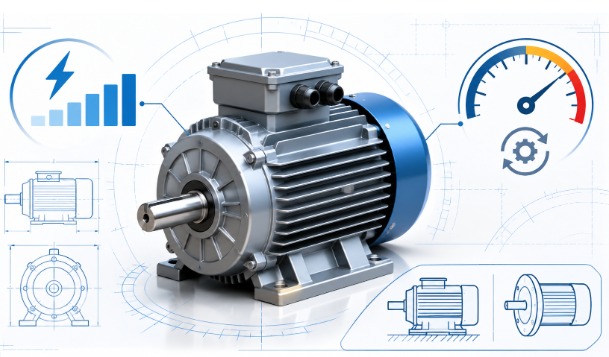
Choosing an AC electric motor for an industrial application includes more than matching the motor’s power rating to the machine requirements. The motor must deliver sufficient torque, operate at the correct speed, accommodate the required mounting arrangement, and remain compatible with the electrical supply and control system. An incorrect selection can lead to excessive current draw, overheating, mechanical vibration, reduced efficiency, and premature equipment failure.
Along with all the specifications, it is also important to understand when buying AC electric motors UK the relationship between kilowatt (kW) rating, revolutions per minute (RPM), and mounting configuration.
This guide explains how to evaluate these three selection criteria, understand motor performance characteristics, and choose an AC motor that is compatible for electrical as well as mechanical applications.
Understand How an AC Electric Motor Works
Understanding how does an AC motor work helps engineers and purchasing teams make better decisions about motor selection, control, and operating performance.
An AC electric motor converts electrical energy into mechanical energy through the interaction of magnetic fields.
In a typical three-phase AC induction motor, the operating process involves the following stages:
- Electrical supply: Three-phase alternating current is supplied to the stator windings.
- Rotating magnetic field: The phase currents produce a rotating magnetic field inside the stator.
- Rotor induction: The rotating magnetic field cuts across the rotor conductors, inducing an electromotive force and current in the rotor.
- Torque generation: The interaction between the rotor currents and the stator’s rotating magnetic field produces electromagnetic torque.
- Mechanical rotation: The rotor turns and transfers mechanical power through the output shaft to the connected equipment.
An important characteristic of an induction motor is that the rotor must operate at a speed slightly below synchronous speed to maintain electromagnetic induction and produce torque.
Understand the Application’s Power Requirement
This is the first step when selecting an AC motor. Motor power is generally expressed in kilowatts (kW), indicating the rate at which the motor can perform mechanical work.
Selecting an undersized motor can result in continuous overloading, excessive winding temperatures, and thermal protection trips. An oversized motor may increase initial purchase costs and operate inefficiently if it spends most of its working life under very high loads.
Factors affecting AC Motor power selection
- Continuous load: Determine whether the motor operates continuously or intermittently. Continuous-duty applications need a motor capable of maintaining its rated thermal performance over extended working periods.
- Starting torque: Conveyors, compressors, and loaded pumps may need higher starting torque than their running load suggests.
- Load variations: Applications including frequent acceleration, sudden load changes, or mechanical resistance may need additional torque capacity.
- Operating environment: Ambient temperature, ventilation, altitude, dust, and moisture can all affect the possible outcome of the motor.
- Efficiency: IE2, IE3, and IE4 efficiency classifications can help compare motor energy performance, subject to applicable product and regulatory requirements.
Select the Correct RPM for the Driven Equipment
Motor speed is another critical selection parameter. RPM indicates how many revolutions the motor shaft completes per minute. The required speed depends on the driven machine, transmission arrangement, load characteristics, and process requirements.
An AC induction electric motor typically operates below its synchronous speed due to slip, which is the difference between the rotating magnetic field speed and the actual speed of the rotor.
How to match RPM with the application
Different industrial applications need different operating speeds:
- 2-pole motors: Suitable for applications that need relatively high rotational speeds, including certain pumps, fans, and high-speed machinery.
- 4-pole motors: Common in general-purpose industrial equipment, conveyors, pumps, and machine tools.
- 6-pole motors: Useful for applications that need lower shaft speeds and higher torque without excessive mechanical speed reduction.
- 8-pole motors: Appropriate for certain low-speed applications where reduced shaft speed is advantageous.
Correct Motor Mounting Configuration
Once the power and speed requirements are established, the next consideration is the mounting configuration of the motor.
The mounting arrangements determine how the motor is physically installed and connected to the driven equipment. Selecting an incompatible configuration can make installations difficult, cause shaft misalignment, excessive bearing loads, and additional mechanical costs.
IEC 60043-7 defines standard motor construction and mounting arrangements using international mounting codes.
Common AC motor mounting settings
- B3-Foot-mounted motor: The motor is installed horizontally using mounting feet attached to its frame. This is a common arrangement for pumps, fans, conveyors, and gearbox-driven machinery.
- B5- Large flange-mounted motor: Uses a large mounting flange to attach directly to a machine housing, pump casing, or gearbox. It is useful where foot mounting is not suitable.
- B14- Small flange-mounted motor: Includes a smaller flange arrangement, mainly used in compact machinery and applications with limited installation space.
- B35 – Foot and flange-mounted motor: Combines mounting feet with a flange, providing flexibility for installations that need both mounting arrangements.
- V1 – Vertical flange-mounted motor: Designed for vertical shaft-down installation, commonly encountered in certain pump and process applications. Bearing and lubrication suitability also must be checked for the specified orientation.
What to check before choosing a mounting arrangement
Mounting compatibility includes more than matching the general B3, B5, or B14 designation.
It is crucial to check the following:
- Frame size
- Shaft dimensions
- Flange dimensions
- Shaft orientation
- Bearing arrangement
- Coupling alignment
For replacement applications, comparing the original motor’s complete nameplate and dimensional specifications is usually more reliable than selecting a motor based on its kW rating only.
Consider Whether An AC Drive is Required
An AC motor does not always need to operate at its fixed speed. Many industrial applications need adjustable speed in order to accommodate changing production rates, flow requirements, conveyor speeds, or mechanical loads. An AC drive for motor applications controls the speed of the motor by adjusting the frequency and voltage supplied to the motor.
How an AC drive controls the speed of the motor
The synchronous speed of an AC induction motor is directly proportional to the supply frequency. For instance, reducing the supply frequency from 50 Hz reduces the synchronous speed by 20%, assuming the same pole configuration.
A VFD typically performs three main electrical functions:
Rectification: Converts incoming AC supply into DC.
DC Link: Smooths and stores electrical energy using capacitors and, in some designs, inductors as well.
Inversion: Converts the DC voltage back into variable-frequency AC using power semiconductor switches.
Modern VFDs use control methods such as volts-per-hertz control and sensorless vector control. More advanced applications may need closed-loop vector control with encoder feedback.
AC vs. DC Electric Motor: Which One is More Suitable For Industrial Operations?
Choosing between an AC vs. DC electric motor depends on the application’s speed-control requirements, torque characteristics, maintenance expectations, and existing control infrastructure.
Both motor types have established industrial applications, but their operating principles and control requirements are different.
| Factor for selection | AC electric motor | DC electric motor |
| Power supply | Alternative current | Direct current |
| Speed control | Commonly through a VFD | Through voltage or a suitable DC drive |
| Maintenance | Generally lower for squirrel-cage induction motors | Brushed designs need brush and commutator maintenance |
| Construction | Often simpler in induction motor designs | Depends on brushed or brushless construction |
| Starting torque | Depends on motor design and control method | Can provide high starting torque |
| Common applications | Pumps, fans, compressors, conveyors | Existing DC systems, specialist drives, and applications that need particular torque-control characteristics |
When to use a DC motor?
DC motors may be appropriate for certain installations, specialist applications, or systems where their specific speed and torque characteristics are needed.
However, modern AC drives have made variable-speed operation more accessible for induction motors, reducing the need to select a DC motor only because an application needs adjustable speed.
Check Electrical Supply, Efficiency, and Operating Conditions
Even when the kW rating, RPM, and mounting arrangement are correct, an AC electric motor can still be unsuitable if its electrical specifications do not match the installation.
Before ordering, verify the following technical details.
| Specification | What to verify |
| Supply voltage | Confirm compatibility with the available electrical supply, such as 230 V or 400 V three-phase systems |
| Frequency | Check whether the motor is rated for 50 Hz, 60 Hz, or both |
| Phase | Confirm whether the installation requires single-phase or three-phase operation |
| Rated current | Check full-load current against the supply, protection, and drive ratings |
| Efficiency class | Compare IE2, IE3, or IE4 efficiency classifications where applicable |
| IP rating | Select suitable protection against dust and water ingress |
| Insulation class | Check thermal insulation suitability for the operating temperature |
| Duty rating | Confirm whether the motor is designed for continuous or intermittent operation |
| Cooling method | Check the cooling arrangement against the operating environment and speed range |
AC Motor Selection Checklist for Industrial Buyers
Before purchasing an AC electric motor, use the following checklist to compare technical specifications and avoid compatibility issues.
- Required mechanical output power (kW) established.
- Rated motor speed (RPM) matched to the application.
- Rated torque and starting torque verified.
- Motor mounting type (B3, B5, B14, B35, V1, etc.) confirmed.
- Frame size and shaft dimensions checked.
- Supply voltage, frequency, and phase confirmed.
- Rated current checked against electrical protection requirements.
- Efficiency class and duty rating reviewed.
- IP rating and insulation class suitable for the environment.
- Cooling arrangement verified.
- VFD compatibility confirmed where variable-speed operation is required.
- Mechanical coupling and gearbox requirements checked.
Conclusion: Choose an AC Motor That Matches Both Electrical and Mechanical Requirements
Selecting the right AC electric motor requires a systematic assessment of power, speed, torque, mounting configuration, and electrical compatibility. The kW rating determines the motor’s power capacity, RPM establishes its rotational speed, and the mounting type ensures that it can be integrated correctly with the driven machinery.
However, these three specifications should never be considered in isolation. Supply voltage, efficiency, duty rating, environmental protection, and drive compatibility also influence long-term performance.
For businesses sourcing AC electric motors, comparing complete technical specifications is more effective than choosing a motor based on price or power rating alone. A correctly specified motor can improve operational reliability, simplify installation, and support more efficient industrial processes.
Whether replacing an existing unit or specifying a new installation, take the time to verify the motor’s electrical and mechanical requirements before placing an order.

