



The water heater is leaking, and the first plumber on your screen has 4.9 stars from a few hundred reviews. Are online reviews trustworthy enough to make that call? Many are honest accounts of real visits. The star average and the order of the list are another matter: the site builds them under rules it often keeps to itself. Before you trust a local ranking, put five questions to the site behind it. The answers, or their absence, show how much weight the list deserves.
Each review describes one visit. The order of the list comes from the site.
A Star Rating Is One Signal, Not a Verdict
How reliable are online reviews? They do one job well: each describes one customer’s visit. That holds for movers, plumbers and roofers alike.
Fake and bought reviews are the known weak spot. A 2022 Federal Trade Commission (FTC) consumer alert notes that some platforms work harder than others at filtering out suspicious reviews, then adds: “do a quick search and you’ll see how easy it is to buy reviews.”
Since October 21, 2024, an FTC rule on consumer reviews and testimonials has barred businesses from writing or selling fake reviews and from paying or otherwise rewarding people for reviews required to carry a particular sentiment, whether positive or negative. A business that hides reviews on its own site because they’re low-rated or negative also can’t present the rest as all or most of them. The rule limits what businesses may do; it doesn’t make every review genuine.
Are online reviews reliable beyond that one visit? Not on their own. An average hides how many people rated the company and when. Stars don’t show whether it holds an active license. And the site, not the reviewers, decides which reviews you see first and which company tops the list.
Question One: Does the Ranking Publish Its Factors and Weights?
A factor is something the ranking measures, such as a state license, years in business or published prices; a weight is how much it counts. Without both, you can’t tell why one company outranks another, and you take the order on trust.
A good answer is a short list of the factors and the points each carries, plus the version and date of the method. You can see such a list on the home page of US Directory. Each check the directory counts has its points next to it, the points total 100, and the line under the list gives the method’s version and date.
Public weights show what a list rewards most, and you can judge whether that fits your job.
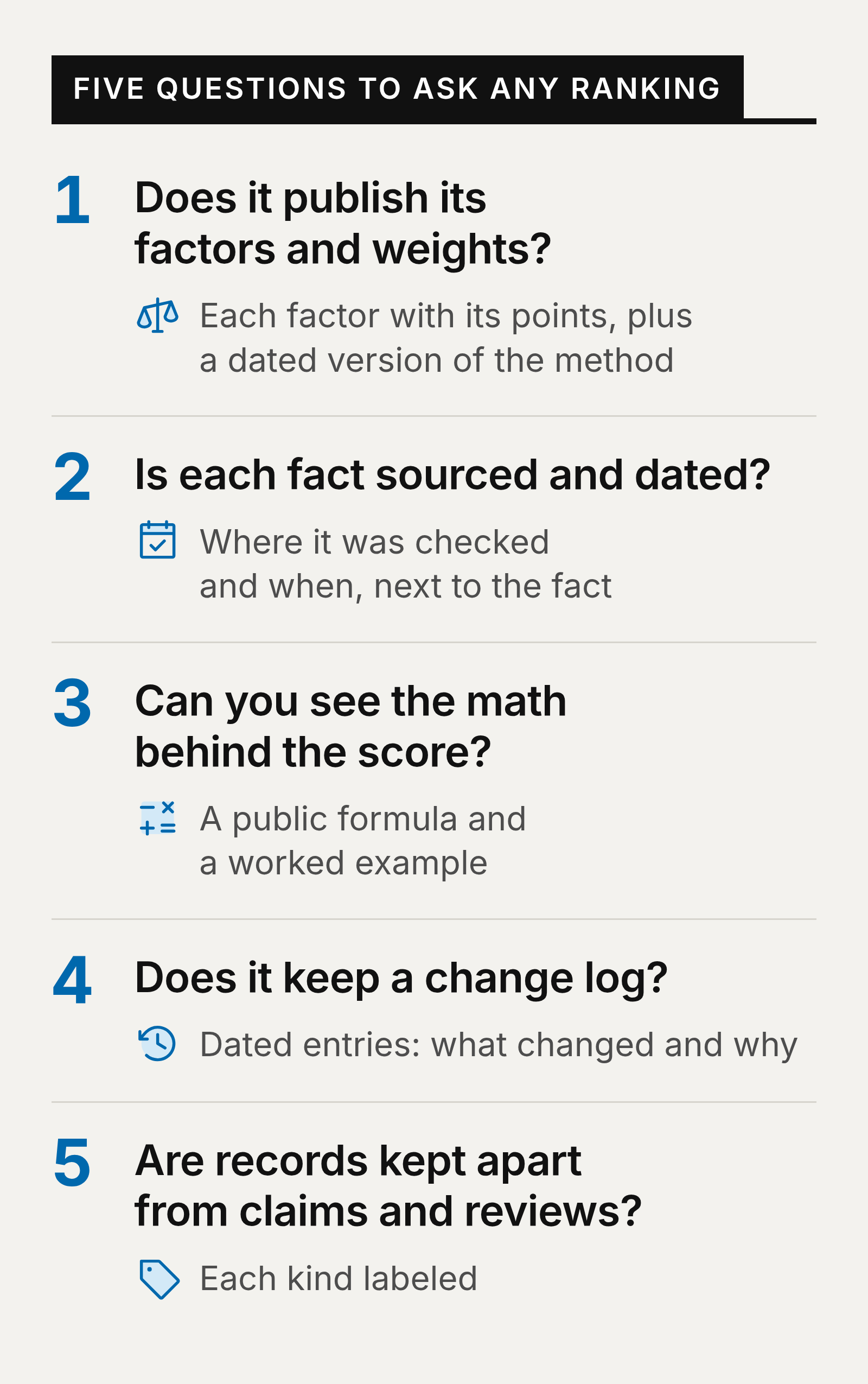
Five questions, and what a good answer to each one looks like.
Question Two: Is Each Fact Sourced and Dated?
A fact without a source is only a claim, and a fact without a date may be stale. Licenses lapse and companies close, while a listing and its stars can stay online.
A good answer sits next to the fact: where it was checked and when. The same directory says each section of its listings names a source and gives a date for the state-records check and for the copy of the company’s website.
A “licensed” badge with no number, agency or date answers neither part.
Question Three: Can You See the Math Behind the Score?
Factors alone leave room for surprises if the math stays hidden. A 2022 legal study in the Journal of Consumer Policy noted that platforms set the rules for how reviews are presented and ranked, and often don’t make those rules fully public. In an extreme case, it added, a platform could secretly show only positive reviews, or let positive reviews of businesses that paid for promotion appear first.
A good answer is a published formula with a worked example, showing what goes into the result and whether paid promotion is part of it.
Question Four: Does the Ranking Keep a Change Log?
Methods change, and they should when a flaw turns up. But if a company climbs or slides after an unrecorded update, no one can say whether the company changed or the rules did.
A good answer is a dated log that says what changed and why. That directory’s log lists version 3.0, from October 12, 2026, as the first one released with its weights and formulas. One entry deals with the site’s own uncertainty: when it isn’t sure which license record belongs to a company, that doubt now goes into a separate confidence measure instead of lowering the company’s result.
Question Five: Are Records Kept Apart From Claims and Reviews?
Three kinds of information end up on a listing. A record comes from an agency, such as a state license or business registration. A claim comes from the company itself, such as “fully insured.” A review is a customer’s story of one job. Each one settles a separate question, and one star average can’t stand in for all three.
A good answer labels each kind.
A study on the US Directory blog compared the plumber listings a popular maps service displayed for one Florida city and its surroundings with state license records. Of the 39 rated a perfect 5.0, an active plumbing license turned up for 22; six others were drain, sewer or leak specialists whose work doesn’t always need one. Failing to find a license, the author notes, doesn’t prove a company is unlicensed.
How to Read the Reviews Themselves
How do you know if online reviews are trustworthy? Start where the FTC guide How To Evaluate Online Reviews starts: consider the source, both the reviewer and the site or platform showing the review. Then build a few habits:
- Look at the timing. A burst of reviews in a short period can sometimes mean they’re fake, the guide says.
- Open the reviewer’s profile. If an account seems made to post a single review, that review may be fake.
- Don’t assume fakes are glowing. Some are negative, and a company might post them to hurt a rival.
- Read the labels. Some sites flag reviews from people who got something in return, such as a free product. What a purchase badge proves depends on the site’s own rules.
- Favor specifics. A review that names the job, the date or the technician says more than “great service.”
- Read the lowest ratings and the owner’s replies. They show what went wrong and how the company handled it.
- Verify the license yourself. Ask the company for its license number and search it in the state’s own database.
Wondering how to tell if reviews are fake? The FTC puts it plainly: “Don’t assume that, just by looking, you can spot the difference between a real review and a fake one.” Report a suspected fake to the site that shows it, as the FTC’s consumer alert asks.
Frequently Asked Questions
Which Review Sites Are Most Trustworthy?
No site earns that title by name. Look for signs instead: labeled ads, marked incentive reviews and published rules for how reviews are filtered and ordered. The FTC has long advised comparing several sources, including well-known sites with trustworthy, impartial expert reviews.
Can a Business Pay to Rank Higher on a Review Site?
It’s possible. If a site marks no sponsored spots and publishes no rules for its order, a top spot may have been bought. The FTC rule also bars a business from passing off a site it owns or controls as an independent source of opinions on a category that includes the business or what it sells.
Is a Perfect 5.0 Better Than a 4.8?
Not by itself. Count the reviews behind each number and check how recent they are: in the study above, 12 of those 39 perfect scores came from five reviews or fewer. A lower score isn’t proof of honesty either, since the FTC notes that “some fake positive reviews give less than the highest possible rating in order to seem more believable.”
When a Ranking Can’t Answer
Reviews tell you how visits went; records show where a company stands with the state. The five questions tell you how far to trust the list that combines them. If a ranking can’t answer, treat its order as one opinion and confirm the license yourself before you hire.

