


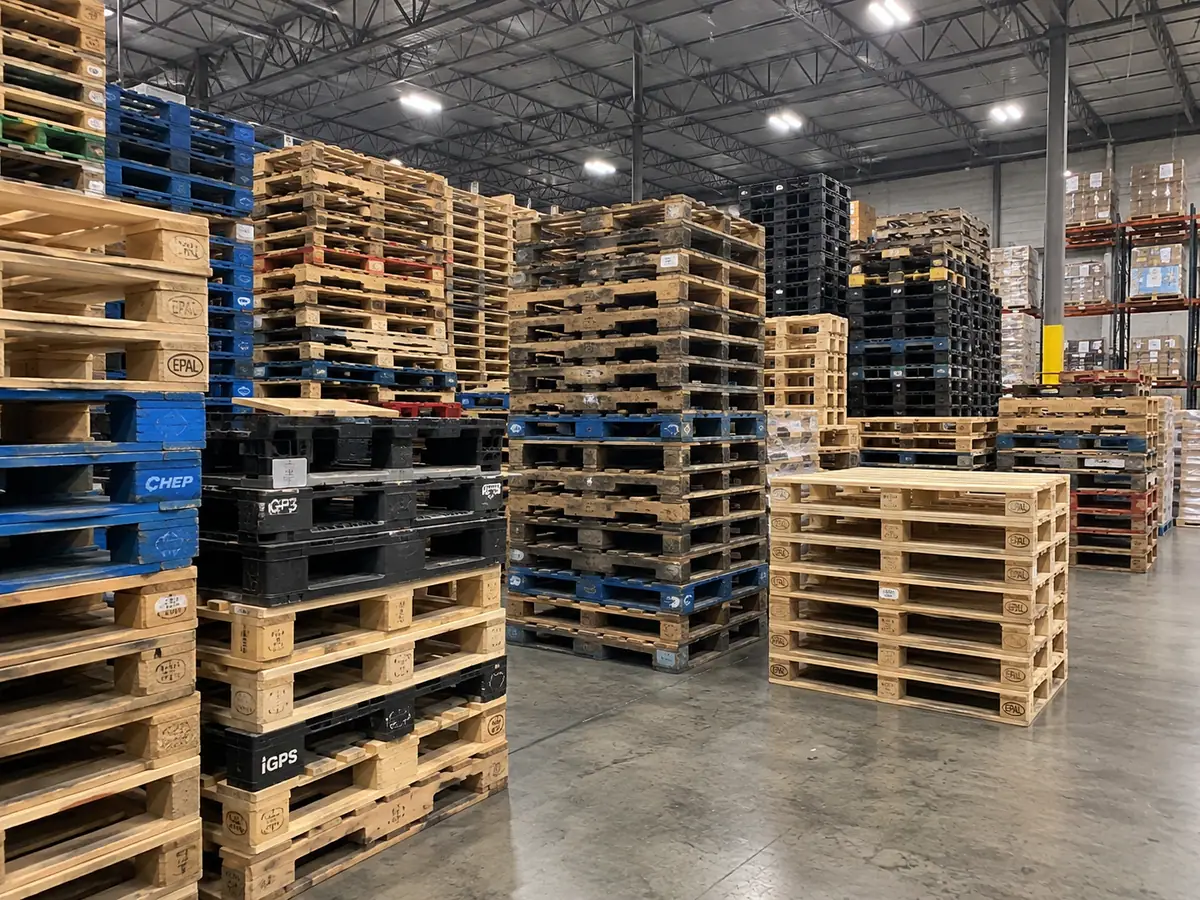
Warehouse operations in the United States generate an enormous volume of used pallets every year. For distribution centers, manufacturers, and logistics providers, the question of what to do with those pallets rarely gets the strategic attention it deserves. Most facilities default to whatever process is already in place — whether that means stacking pallets outside for occasional pickup, paying a hauler to remove them, or leaving the decision to a floor supervisor who has other priorities.
In 2025, that default approach is costing more than most operations managers realize. Labor costs have risen, landfill tipping fees have increased in many states, and wood material costs remain elevated enough that used pallets carry real residual value. The choice between recycling pallets and simply disposing of them is no longer a minor operational footnote. It is a decision with measurable financial consequences, and the right answer depends heavily on the type of operation, the volume of pallets moving through it, and how well the process is managed.
This article examines both approaches honestly — what each actually involves, what it costs in practice, and what warehouses across different sectors are finding works better in 2025.
What Pallet Recycling Actually Involves at an Operational Level
Pallet recycling is the process of collecting used or damaged pallets, sorting them by condition and wood type, and either repairing them for reuse or breaking them down for raw material recovery. It is a structured materials management process, not simply a pickup service. When done through an organized program, pallet recycling creates a closed-loop system where the warehouse offloads used inventory on a scheduled basis and receives either payment, credit, or reduced hauling costs in return.
The operational mechanics matter here. A recycling program typically involves the warehouse sorting pallets into condition grades — those that can be repaired and resold, and those that are too damaged for reuse. The recycler then collects them, often on a schedule that aligns with the warehouse’s outbound shipping cycles. This regularity reduces dock congestion and eliminates the unplanned accumulation of pallets that disrupts yard flow.
How Sorting and Condition Grading Affect Financial Returns
Not all used pallets carry the same recovery value. A pallet that arrives in a repairable condition can be refurbished and resold into the secondary market, which means the recycler can afford to pay for it or at minimum collect it at no cost. A pallet that is badly broken — split stringers, missing multiple deck boards, heavy contamination — may only be worth its raw wood content, which is lower and subject to commodity fluctuation.
For warehouses that take the time to train dock staff on basic sorting, the financial return from recycling improves noticeably. When repairable and non-repairable pallets are mixed together without separation, recyclers either lower their overall offer to account for the blend or charge a processing fee to do the sorting themselves. Neither outcome serves the warehouse’s budget as well as a simple in-house sort process would.
The Role of Volume and Consistency in Recycling Program Value
Recycling programs work best at scale and with predictability. A warehouse generating a high, consistent volume of used pallets is a more attractive account for a recycling partner than one with irregular, low-volume output. This is because recyclers plan collection routes and processing capacity around reliable supply. When a facility can offer steady volume, it has more room to negotiate favorable terms — including scheduled pickups, per-unit payments, or reduced service fees.
Operations with highly seasonal pallet volumes can still access recycling programs, but they may find the terms less favorable during low-volume periods. In those cases, a hybrid arrangement — recycling during peak periods and a minimal disposal service during slower months — often produces better outcomes than committing fully to one approach year-round.
What Pallet Disposal Truly Costs When Everything Is Accounted For
Pallet disposal refers to removing used pallets from a facility by sending them to a landfill, incinerator, or waste hauling service without any recovery or reuse process. On the surface, it appears simple: the hauler arrives, loads the pallets, and the problem is removed. The real cost picture, however, is considerably less clean once labor, hauling fees, and regulatory factors are included.
Landfill tipping fees in many US states have risen steadily over the past decade, and pallets — being bulky, low-density waste — are not efficient to transport or dispose of. Haulers typically charge by weight or by trailer load, and a trailer of used wood pallets is mostly air and light material. The cost per usable unit of waste removal is therefore higher than facilities sometimes expect when disposal invoices begin arriving regularly.
Labor Costs Embedded in the Disposal Process
Disposal is not a passive activity. Someone on the warehouse floor has to move damaged pallets from their point of generation to a staging area, organize them for pickup, and manage the pickup logistics. When disposal frequency is low and pallets accumulate between pickups, the labor burden of moving large stacks around the yard increases. Forklift time, dock time, and supervisor coordination all carry costs that rarely appear on the disposal invoice but are very real to the operation.
In facilities that track labor allocation carefully, the time spent managing pallet removal through a disposal-only approach is often higher than anticipated. It also tends to be unplanned labor — the kind that pulls workers away from primary tasks when pallet accumulation reaches a point where it must be addressed immediately.
Regulatory and Environmental Liability Considerations
In some US jurisdictions, large-volume wood waste disposal is subject to environmental reporting requirements or restrictions. The US Environmental Protection Agency’s sustainable materials management guidelines encourage businesses to divert materials like wood from landfill where feasible, and some states have adopted regulations that reflect this direction. While most warehouses are not currently penalized for disposing of pallets, the regulatory environment for commercial wood waste is not static, and facilities that rely entirely on landfill disposal may face higher compliance costs over time.
Beyond regulation, there is a practical liability dimension. Improperly stored pallet piles create fire risk, pest habitat, and OSHA-relevant hazards. Disposal programs that allow buildup between pickups effectively shift that liability onto the warehouse’s own yard management. Recycling programs, because they operate on tighter schedules, tend to reduce the duration that large quantities of wood waste sit on-site.
Comparing Direct Financial Outcomes Across Common Warehouse Types
The financial comparison between recycling and disposal is not uniform across all warehouses. It varies based on pallet type, condition, volume, and geographic access to recycling partners. That said, several patterns emerge consistently when warehouses conduct honest cost reviews of both approaches.
High-volume distribution centers that generate large quantities of standard wood pallets in mixed condition typically find recycling more cost-effective than disposal. Even when recycling does not produce direct payment per pallet, the elimination of landfill hauling fees and the reduction in on-site accumulation often result in lower total program costs. The savings come not from the pallet itself having high value, but from replacing a fee-based service with a cost-neutral or revenue-generating one.
When Disposal May Still Be Appropriate
There are genuine scenarios where disposal remains the more practical option. Warehouses in rural or semi-rural areas with limited access to pallet recycling infrastructure may find that the transport cost of getting pallets to a recycler erodes any financial benefit. Similarly, facilities that generate primarily heavily contaminated pallets — those exposed to chemicals, food waste, or other materials that prevent resale — may not have access to a recycling program willing to accept their specific inventory.
In these situations, disposal is not a failure of planning — it is a rational response to limited options. The key distinction is that these warehouses should periodically reassess the recycling market in their region, since processing capacity and partner availability have expanded meaningfully in several US regions over the past few years.
Program Management as a Hidden Variable in Cost Outcomes
One factor that separates warehouses that see strong financial results from recycling programs and those that do not is internal program management. A recycling agreement that is not actively managed at the dock level tends to degrade. Pallets get mixed with other waste, pickups are missed or delayed, and the volume offered to the recycler becomes inconsistent. This undermines the program’s financial performance and can lead operations managers to incorrectly conclude that recycling is not worthwhile.
Warehouses that assign clear accountability for pallet management — even a basic process with defined sorting criteria and a designated staging area — consistently report better outcomes from recycling programs than those that treat it as an afterthought. The discipline required is modest, but it makes a measurable difference in both cost recovery and yard organization.
Closing Considerations for Warehouse Decision-Makers in 2025
The choice between pallet recycling and pallet disposal is ultimately a cost management decision framed by operational context. There is no universal answer, but the evidence from current market conditions in the United States points clearly toward recycling as the more financially sound option for the majority of mid-to-large-volume warehouses that have access to a reliable recycling partner.
The financial advantage of recycling does not come primarily from pallet resale value, though that is a contributing factor. It comes from replacing a cost center — landfill hauling and disposal fees — with a managed recovery process that reduces expense, improves yard flow, and reduces the labor and risk associated with accumulating wood waste on-site. When the full cost of disposal is calculated honestly, including labor, hauling, tipping fees, and on-site liability, the gap between disposal and recycling widens considerably.
For facilities currently operating without a formal pallet management program, the first step is understanding what volume they generate and in what condition. That baseline makes it possible to approach a recycling partner with accurate information and negotiate a realistic arrangement. For facilities already using a recycling program but seeing inconsistent results, the more productive question is usually about internal process discipline rather than the recycling arrangement itself.
In 2025, pallet management deserves a line in the operations budget with the same scrutiny applied to other material handling costs. The warehouses that treat it as such tend to come out ahead of those that do not.

