


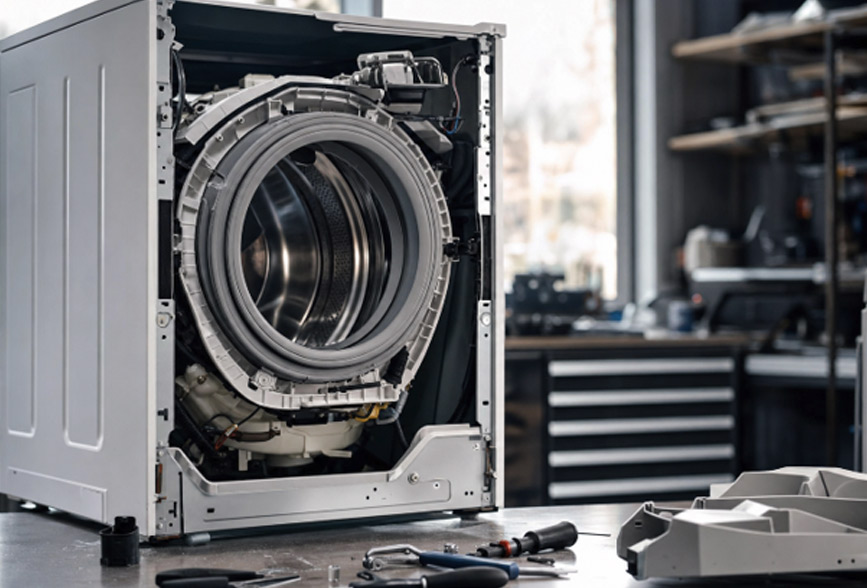
What actually separates professional product design from a good-looking prototype? In many development programs, the gap only becomes visible once the first units return for service. Professional product design treats maintenance, repairability and lifecycle cost as engineering requirements set at the concept stage, not as problems inherited later, after warranty claims accumulate and the architecture is already locked into tooling.
In this sense, professional product design can be defined fairly precisely: it’s the discipline that aligns industrial design, mechanical and electronic engineering, and manufacturing feasibility around one shared set of requirements — including how the product will be serviced over its working life. A useful shorthand for recognizing it: a product has been designed with its lifecycle in mind when a technician can reach the failure point, identify the fault, and replace only what’s broken, without destroying something else in the process. Access, diagnosis, modular replacement — that combination is the backbone of everything that follows.
In brief: Directive (EU) 2024/1799 on the repair of goods was adopted on 13 June 2024 and applies across EU member states from 31 July 2026, once national transposition is complete. For products listed in Annex II — including washing machines, dishwashers, TVs, smartphones and servers — manufacturers subject to EU reparability requirements must repair within a reasonable time and at a reasonable price, and are prohibited from using contractual, hardware or software techniques that impede repair unless a legitimate and objective factor justifies it. Where a manufacturer does provide spare parts for these products, those parts must be offered at reasonable prices. The Directive doesn’t spell out disassembly mechanics line by line, but the practical implication for a design team is close to literal: plan for spare parts availability, disassembly and repair documentation while the product is still a concept, not after the compliance deadline arrives.
Why maintenance and repairability now define professional product design
Warranty obligations and authorized service networks already extend a manufacturer’s responsibility well past delivery for many product categories. The EU rules on the repair of goods, covered later in this piece, push that responsibility further for a defined set of products, with concrete requirements on spare parts and anti-repair design practices. A washing machine covered by a multi-year service commitment is a different design problem from one sold once and left alone; an industrial machine installed on a production line has to justify its uptime continuously, not only at handover.
When a product is hard to repair quickly, the cost rarely stays contained to a service ledger. In many organizations it also shows up as returns that a faster diagnosis might have avoided, as repair visits that end without a clear fault found, and — over time — as pressure on resale value and brand trust that is harder to rebuild than it would have been to avoid in the first place. Treating service as a design input, rather than something bolted on after tooling is already cut, is what tends to prevent this chain of costs from starting.
A number of design studios describe their process as design, engineering and strategy operating together rather than as three separate handoffs between departments. PQ Design states on its homepage that it designs products where innovation, quality and feasibility move together from day one, and that the best ideas take shape when design, engineering and strategy work as a single process. That framing is relevant to repairability specifically: a service-access decision made by an industrial designer in isolation, without engineering and sourcing input, rarely survives the transition from concept design to tooling. Studios organized around professional product design tend to document these trade-offs in a shared record early, rather than letting them resurface as disputes once production has started.
Lifecycle thinking: the three horizons designers must plan for
A useful way to frame this is to think in three overlapping horizons, each carrying its own constraints and trade-offs.
- Manufacturing and assembly — where design for manufacturing addresses whether individual parts can be produced efficiently, for instance via injection molding, CNC machining or sheet metal fabrication, while design for assembly addresses whether parts come together with minimal labor on the line; both have to coexist with the later, very different requirement of service access.
- The use phase — where wear, contamination, misuse and environmental exposure tend to determine what actually breaks, not necessarily what the stress analysis predicted.
- End of life — where decisions made years earlier about fasteners, materials and labeling quietly decide whether a product can be refurbished, partially reused, or only shredded.
Few teams give all three horizons equal weight. In many organizations the first two dominate the conversation, while the third is treated as a disposal question rather than a design input. A washing machine shows the same tension at a larger scale, and it happens to be one of the product categories now listed under the EU’s Annex II repair obligations — which makes its lifecycle architecture a compliance question, not only a cost one. A heating element positioned behind a full front-panel removal, a door gasket compressed and decompressed at every service visit, and a drum bearing housing reachable only after extensive teardown are three decisions typically made at the concept design stage, long before anyone files a service ticket. A coffee machine illustrates a related problem: the boiler and group head go through daily scaling and thermal cycling that a sealed, glued housing can make difficult to service without destroying it. A toy designer faces a different version of the same tension — repeated drop cycles and a child’s complete disregard for the user manual are part of the real operating envelope, whether the original specification accounted for them or not.
Designing for maintainability: access, time-to-service and error-proofing
Service access deserves the same status as structural strength or thermal performance: a first-class requirement, defined early, not negotiated away during tooling cost reviews. That means clear disassembly paths, enough tool clearance to remove a fastener without first removing three other subassemblies, and no critical connector buried under something that was never meant to be opened in the field.
In many programs, reducing mean time to repair turns out to be more an architecture decision than a training problem, though the balance varies by product and failure mode. Modular subassemblies that can be swapped as a unit, combined with a disassembly sequence that doesn’t require guesswork, tend to shorten repair time more consistently than a technician manual on its own usually can. Error-proofing helps close the loop: keyed connectors that cannot be reversed, color or shape coding on cables, captive screws that cannot fall into a motor housing, and torque guidance printed where a technician can actually see it. These are small specification choices, and they’re skipped far more often than their cost would justify.
Documentation-ready design closes the circle: visible part identifiers, revision marks on components rather than only on drawings, and labeling that survives cleaning agents and years of handling. A service record that cannot be traced back to the exact revision in a technician’s hand isn’t much of a record.
Repairability by architecture: modularity without over-engineering
Modularity isn’t a binary choice. The real question is which level of modularity a given product actually needs: replaceable modules for high-wear items, component-level repair for everything else, and sealed sections only where a legitimate reason — hygiene, safety, waterproofing — justifies it. Defining these service boundaries explicitly, before architecture freeze, is usually what separates a repairable product from one that merely looks like it should be repairable.
Standardization across a product family is a quieter but equally powerful lever: shared fasteners, common connectors and common gaskets reduce spare parts complexity without anyone noticing a compromise on the shop floor. Teams that develop product families, rather than one-off items, tend to benefit most from this approach, because it also opens upgrade paths — a new battery chemistry, a revised sensor, a higher-output motor — without forcing a redesign of the whole platform. These trade-offs are easier to negotiate when they’re written down rather than remembered somewhere between departments.
Materials, fasteners and joining: decisions that make or break repair
Adhesives aren’t the enemy of repairability, but they’re frequently used where a fastener would have cost very little extra and preserved serviceability. Structural bonding has legitimate uses; permanently gluing a housing shut purely to save two screws usually doesn’t. Snap-fits deserve similar scrutiny: they work well for a limited number of open-close cycles, but material creep and fatigue mean a snap-fit engineered for one-time assembly can fail the first time a technician reopens it in the field.
A washing machine’s door gasket is a useful illustration of why repeated opening matters. It’s compressed every time the unit is serviced, and a gasket specification that performs well on first assembly can still fail its compression set after three or four repair cycles, long before the product’s expected service life ends. Material compatibility follows the same logic over a longer horizon: galvanic corrosion between dissimilar metals, chemical attack from cleaning agents, and thermal cycling all tend to accelerate with every repair cycle, not only with time in use. Thread wear in plastic bosses and surface damage around access points rarely show up in a first prototype, but they show up reliably by year three.
Design for diagnostics: making failures discoverable and fixable
A product that fails silently sends every return to a bench technician with no starting point. Test points, status indicators, readable error codes and accessible logs turn a black-box failure into a diagnosable one. A washing machine that reports a drain-pump fault separately from a door-lock fault sends the technician in with a hypothesis already narrowed down, instead of a full teardown to rule out possibilities one at a time — and this kind of visibility can, in many cases, reduce the share of returns that arrive with no fault isolated, though the size of that effect varies by product category and failure mode.
On the electronics side, service-friendly packaging means shielding and ESD protection that survive repeated handling, connectors with real strain relief, and cable routing a technician can follow without a wiring diagram memorized by heart. Predictive-maintenance sensors are worth adding when the failure mode is genuinely hard to detect otherwise; they’re often unnecessary complexity when a simpler indicator would do the same job for a fraction of the bill of materials.
Lifecycle cost is a design metric
MTBF, MTTR, warranty cost per unit, spare parts SKU count, average service labor time and return rate aren’t after-sales metrics bolted onto a finished design. They’re outputs of decisions made at architecture freeze, and treating them that way changes which trade-offs get approved. A slightly higher bill of materials that measurably reduces service calls is often the better investment, even when it looks worse on a first-pass cost sheet. For a product like a washing machine, a drum bearing kit that’s stocked and priced predictably prevents a repair job from stalling on parts logistics instead of labor.
Spare parts strategy belongs in the same conversation: which components are critical, which have long lead times, and which are likely to go obsolete before the product does. Packaging and logistics are part of this too — a part that survives transport without damage avoids a return that has nothing to do with product quality and everything to do with a box that was never tested for the actual shipping route.
Compliance and market context: repairability is becoming a requirement
None of the above is purely a craft decision anymore. Across the EU, repairability is moving from a sustainability add-on to a regulatory specification, and product teams planning a multi-year service life need to treat it as a current constraint rather than a future one.
What is Directive (EU) 2024/1799 and when does it apply?
Directive (EU) 2024/1799 on common rules promoting the repair of goods was adopted on 13 June 2024. EU member states must transpose it into national rules and apply it from 31 July 2026 — a date close enough that products now at concept design stage are likely to still be on the market when the obligation takes effect.
Which products are covered, and what does the Directive require?
The Annex II list referenced by the European Commission currently includes washing machines, washer-dryers, fridges, dishwashers, TVs, vacuum cleaners, tumble dryers, welding equipment, smartphones, tablets, cordless phones, servers and data storage products, and goods incorporating light means of transport batteries. For these categories, manufacturers subject to EU reparability requirements must repair within a reasonable time and at a reasonable price, and are prohibited from using contractual clauses, hardware or software techniques that impede repair, unless a legitimate and objective factor justifies the restriction. Where spare parts are provided, they must be offered at reasonable prices.
Does choosing repair extend the legal guarantee?
Yes. Through an amendment to the Sale of Goods Directive, a consumer who chooses repair over replacement within the legal guarantee period gains a 12-month extension of that guarantee. The European Commission has also described plans for an EU-wide online platform intended to help consumers locate repairers.
What do repairability requirements mean in practice for a design team?
Separate from the Directive’s specific obligations, EU policy analysis around the broader Ecodesign framework frames reparability requirements in practice as relating to three areas: availability of spare parts, ease of disassembly, and access to software and firmware updates. That’s a reasonable engineering translation even where it isn’t a direct quote from the Directive itself, because it captures what a service technician — or a consumer attempting a repair — actually needs in hand.
The Ecodesign for Sustainable Products and Energy Labelling Working Plan 2025–2030, adopted by the European Commission in April 2025, moves in the same direction at a broader scale: it introduces repairability as a horizontal requirement across product categories, including a repairability score, alongside parallel requirements on the recyclability of electrical and electronic equipment. The Commission’s own figures for the existing ecodesign and energy labelling framework — a 12% reduction in final energy consumption in 2023 and an estimated 346,000 jobs — describe the broader program rather than the repairability score specifically, but they give a sense of the scale of policy attention the topic now receives. For teams developing products with a multi-year service life, this is already an active design constraint, not a distant policy question to revisit later.
A practical workflow: embedding repairability into the product development process
Teams that handle this well tend not to treat repairability as a late-stage checklist. Many start by writing down service scenarios — who repairs the product, where, with which tools, under what time pressure — before architecture is locked. In many development processes, serviceability gets its own design review at concept design, again at architecture freeze, and again across later validation builds, rather than being inspected for the first time when a field return arrives.
Prototyping for disassembly can be treated with the same rigor as prototyping for function: opening cycles, connector durability and gasket life tested the way drop tests or thermal cycling usually are. This works best as a shared responsibility across industrial design, mechanical engineering, electronics and after-sales, with trade-offs logged somewhere other than someone’s memory. A simple decision log is often enough to stop the same compromise from being renegotiated three times across a program.
What to expect from a professional product design partner
Evaluating a design partner on renderings alone misses most of what actually determines field performance. It helps to keep the discipline in perspective: estimates for new product development failure rates vary across studies, with some analyses citing figures between roughly 35 and 49 percent, and reportedly as high as 90 percent among early-stage startups. Numbers like that make a documented, traceable process a safeguard rather than an administrative nicety. A more useful set of evaluation criteria centers on deliverables that make trade-offs traceable later, rather than on portfolio polish:
- A requirements document that separates negotiable choices from non-negotiable ones, including service constraints alongside performance targets.
- Comparable concept options at the concept design stage, with the reasoning behind each trade-off made explicit rather than implied.
- Exploded views and a documented repair sequence, not only an assembly sequence.
- A modular architecture map showing which subassemblies are field-replaceable, which are depot-only, and why.
- Industrialization guidelines that carry service access requirements through to tooling and manufacturing handoff, so the compromise doesn’t quietly disappear between concept and production.
It’s also worth distinguishing roles clearly at the outset: an industrial design company is generally positioned to help define what a product should be — how it will be used, how it should look and feel — and to turn a rough idea into a clearly defined, testable product, while a contract manufacturer builds an already-defined product repeatedly at the required cost, quality and volume. Confusing the two roles is a common reason service requirements fall through the cracks between design and production.
Most of the design choices covered here cost very little at the drawing stage and a great deal once production has started. The practical takeaway for a product or operations lead is simple: ask for the service scenario, the exploded view and the repair sequence before architecture freeze, not after the first field return lands on someone’s desk.

