


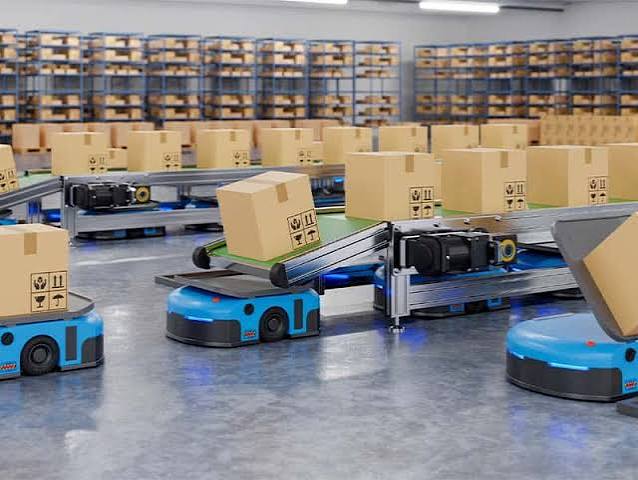
Moving parts between machines, conveyors, pallets, racks, and production stations can consume significant labor and create bottlenecks when the process depends heavily on manual handling. Material handling automation uses robotics, conveyors, machine vision, tooling, sensors, and controls to move materials through production with greater consistency.
For manufacturers, the goal is not simply to replace manual movement. A well-designed system keeps parts arriving at the correct process, in the correct orientation, and at the required cycle time while supporting safer and more predictable production.
What Is Material Handling Automation?
Material handling automation refers to equipment and control systems that automatically move, position, load, unload, sort, stack, or transfer materials within a manufacturing or industrial operation.
Depending on the application, a system can combine:
- Industrial robots
- Conveyors
- End-of-arm tooling
- Machine vision
- Sensors
- PLC controls
- Safety systems
- Pallet handling equipment
GLOBAL Automation Technologies designs material handling systems around individual production requirements, including part geometry, cycle time, payload, floor space, and existing equipment.
What Processes Can Material Handling Automation Perform?
Automated systems can support many different points within a production line.
Robotic Pick-and-Place
Pick-and-place robots move components between fixtures, conveyors, machines, or containers.
These systems can perform repetitive handling tasks at consistent speeds while reducing the need for operators to repeatedly lift or position parts.
GLOBAL engineers pick-and-place cells around the required payload, positioning accuracy, tooling, and production rate.
Palletizing and Depalletizing
Palletizing robots arrange boxes, containers, parts, or other products onto pallets according to predefined patterns.
Depalletizing systems perform the reverse process by removing items from incoming pallets and feeding them into production.
Robotic palletizing can be especially useful in high-volume end-of-line applications where repetitive lifting creates an ergonomic challenge.
Material Handling Automation for Part Transfer
Parts often need to move between several production steps before a finished product is completed.
Robotic part-transfer systems can move components between:
- CNC machines
- Assembly stations
- Inspection stations
- Presses
- Racks
- Conveyors
- Packaging operations
GLOBAL designs part-transfer systems that coordinate robot motion, end-of-arm tooling, safety guarding, and PLC communication so parts arrive at the next operation in the required position.
How Vision-Guided Material Handling Works
Traditional automation often assumes that every component arrives in a known position.
Real manufacturing environments are not always that predictable.
Machine vision allows a robot to identify a part’s location and orientation before picking it.
Vision-guided material handling can support:
- Random bin picking
- Conveyor tracking
- Part identification
- Orientation verification
- Flexible product handling
- Position confirmation
GLOBAL integrates FANUC iRVision and 3D sensing technologies for applications where parts arrive in varying positions.
This can reduce the amount of dedicated fixturing required upstream.
Conveyor Integration in Material Handling Automation
Conveyors and robots often need to operate as one coordinated system.
A robot may need to pick a component from a moving conveyor, transfer it into a machine, and then place the completed part onto another conveyor.
Successful integration requires more than placing a robot next to the line.
Controls need to manage:
- Conveyor speed
- Robot timing
- Trigger signals
- Part tracking
- Fault handling
- Accumulation
- Emergency stops
GLOBAL integrates robot and conveyor PLC controls so material movement is synchronized across the process.
What Are the Benefits of Material Handling Automation?
The exact benefits depend on the production process, but several advantages are common.
Higher Throughput
Automation can reduce delays between operations and support consistent cycle times.
Robots can also operate for extended periods without the variability associated with repetitive manual handling.
Improved Safety
Some material handling tasks involve heavy lifting, sharp components, hot parts, or hazardous production environments.
Automation can reduce operator exposure to these repetitive or higher-risk activities.
Consistent Part Positioning
Robotic systems can repeatedly place components in the same location and orientation.
This consistency can be important when the next operation involves machining, assembly, welding, inspection, or another automated process.
More Flexible Production
Modern robotic systems can often be reprogrammed for different products or part variants.
GLOBAL specifically designs flexible systems capable of supporting changing product mixes without requiring complete replacement of the automation cell.
Material Handling Automation for CNC Operations
Machine tending is a common material handling application.
A robot can:
- Retrieve a raw part.
- Orient it correctly.
- Load it into the CNC machine.
- Initiate or coordinate the machine cycle.
- Remove the finished part.
- Place it into a rack, inspection station, or downstream process.
GLOBAL combines machine tending with racking, de-racking, bin picking, conveyor transfer, and palletizing for CNC production environments.
This can help manufacturers extend unattended machine operation and improve equipment utilization.
How PLC Controls Support Material Handling Automation
Robots, conveyors, machines, sensors, and safety devices need a common control architecture.
PLC controls coordinate these components and determine how the overall sequence operates.
A material handling PLC may manage:
- Robot handshakes
- Conveyor motion
- Sensors
- Machine interfaces
- Safety circuits
- Fault recovery
- HMI screens
GLOBAL can integrate platforms such as Allen-Bradley and Siemens depending on existing plant standards.
Matching existing control standards can simplify technician training, spare parts, and future modifications.
How to Identify a Good Material Handling Automation Project
Not every manual task needs to be automated.
Strong automation candidates often involve:
- High repetition
- Predictable production sequences
- Heavy lifting
- Ergonomic concerns
- Consistent cycle-time requirements
- Labor availability challenges
- High production volumes
- Multiple machines requiring continuous loading
- Bottlenecks between production operations
A feasibility study should evaluate cycle time, payload, part geometry, floor space, equipment interfaces, safety, and expected production volume before hardware is selected.
What Should a Material Handling System Integrator Provide?
A complete system requires several engineering disciplines to work together.
Look for a partner that can manage:
- Process analysis
- Simulation
- Robot selection
- Mechanical design
- End-of-arm tooling
- Conveyor integration
- Machine vision
- PLC and HMI programming
- Safety systems
- Installation
- Commissioning
- Operator training
- Production support
GLOBAL provides turnkey robotic integration from initial process study and simulation through system build, installation, commissioning, training, and ongoing support.
Material Handling Automation for Automotive and Industrial Manufacturing
Material handling requirements vary substantially by industry.
Automotive and Tier 1 manufacturers may need high-speed part transfer between assembly stations. CNC operations may prioritize machine loading. Packaging environments may focus on palletizing, while heavy-equipment manufacturers may need robots capable of safely moving large components.
GLOBAL works across automotive, general industrial, heavy-equipment, aerospace, and other manufacturing applications, with material handling systems engineered around the specific process rather than a fixed equipment package.
Build Material Handling Automation Around Your Production Process
Effective automation starts with understanding how material currently moves through the plant, where delays occur, and what the required production rate actually is.
The final solution may combine robotics, conveyors, vision, custom tooling, controls, and safety systems into one coordinated process.
GLOBAL Automation Technologies designs and integrates material handling automation for pick-and-place, palletizing, part transfer, bin picking, conveyor integration, and machine-tending applications. Talk with GLOBAL about your parts, cycle times, existing equipment, and production goals to determine where robotic material handling can improve your operation.

