


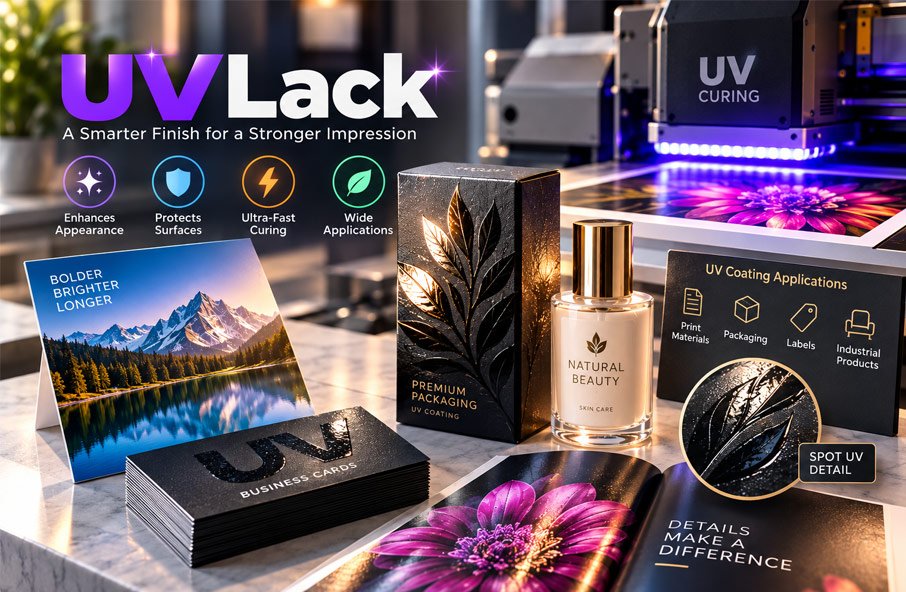
UVLack is a type of UV-curable coating used on printed and manufactured surfaces. It is also known as UV lacquer, UV varnish, or UV coating.
People often search for UVLack because the name looks unusual. It is especially common in European printing terms, while English printers usually use names such as UV coating or UV varnish.
UVLack can improve the look of a surface, protect it from everyday wear, and cure very quickly under ultraviolet light. This guide explains what UVLack means, how it works, its types, uses, benefits, and important limitations.
What Does UVLack Mean?
UVLack generally means UV lacquer or UV varnish.
The word can be understood in two parts:
UV means ultraviolet. This is the type of light used to cure the coating.
Lack is a German word for lacquer or varnish. This is why the term may also appear as UV-Lack in European printing and coating industries.
In English, the same or closely related technology is usually called:
- UV coating
- UV varnish
- UV lacquer
- UV-curable coating
- Spot UV
The exact name may change depending on the printer, country, or type of application.
Some websites describe UVLack as software, a digital platform, or a technology service. The sources we reviewed do not provide reliable evidence for this meaning. The established use of the term is connected with printing, coatings, and surface finishing.
How Does UVLack Work?
UVLack starts as a liquid coating.
First, the coating is placed on the surface. It can cover the whole surface or only selected areas.
The material then passes under a UV light source. The UV energy starts a chemical reaction inside the coating.
This reaction quickly changes the liquid coating into a solid film. The process is called UV curing.
This is different from normal drying.
Traditional coatings may dry when water or solvents slowly evaporate. UVLack does not depend mainly on this process. UV light causes its reactive ingredients to join together and form a hard layer.
In a properly set up production line, curing can happen in a very short time. This allows the material to move quickly to the next step, such as cutting, folding, stacking, packing, or shipping.
The final result depends on several things, including the UV lamp, coating thickness, surface material, machine settings, and coating formula.
What Is UVLack Made Of?
UVLack is not simply a clear liquid.
A typical UV-curable coating can contain several important ingredients.
Oligomers and resins help form the main body of the finished coating. They can affect hardness, flexibility, and strength.
Monomers or reactive diluents help control how the liquid coating behaves before curing and become part of the solid coating after curing.
Photoinitiators react when they receive UV energy. They start the chemical reaction that turns the liquid material into a solid film.
Additives are included to change specific properties of the coating.
For example, additives may be used to:
- Reduce gloss
- Improve scratch resistance
- Improve surface smoothness
- Reduce bubbles
- Improve flexibility
- Improve adhesion
- Create special textures
There is no single UVLack formula for every product.
A coating made for paper packaging may be different from one designed for plastic, wood, metal, or flooring.
Types of UVLack Finishes
UVLack can create different looks and surface effects.
Gloss UV
Gloss UV creates a shiny and reflective surface.
It can make printed colors appear stronger and give photographs or graphics a brighter look. It is common on packaging, labels, brochures, cards, and other promotional materials.
Matte UV
Matte UV creates a softer surface with less reflection.
Matting agents are usually added to reduce shine. This type of finish is often used when a clean and less glossy appearance is preferred.
Textured and Specialty UV
Some UV coatings are designed to create a special feel.
Depending on the coating and printing process, the surface may feel raised, smooth, soft, rough, sandy, or otherwise textured.
These effects are mainly used when appearance and touch are both important.
Full UV Coating vs Spot UV
UVLack can be applied across the whole surface or only in selected areas.
A full UV coating covers most or all of the printed area. It creates a more consistent finish across a package, brochure, label, or other product.
A spot UV coating is applied only to selected parts.
For example, a printer may apply UV coating to:
- A logo
- Product name
- Headline
- Photograph
- Pattern
- Important design detail
One common design uses glossy spot UV over a matte background.
The shiny part reflects more light, while the background remains less reflective. This creates visual contrast and can also be felt when the surface is touched.
Spot UV is often used on business cards, book covers, luxury packaging, and promotional materials.
Where Is UVLack Used?
UVLack is widely used in printing and packaging.
Common examples include:
- Business cards
- Brochures
- Flyers
- Magazine covers
- Book covers
- Postcards
- Invitations
- Folders
- Product labels
- Folding cartons
- Cosmetic boxes
- Retail packaging
- Promotional materials
The coating can improve appearance while also helping the printed surface resist normal handling, scuffing, and light moisture.
UV-curable coatings are also used outside normal paper printing.
Suitable coatings may be applied to:
- Wood and furniture
- Plastic parts
- Metal surfaces
- Flooring
- Electronic product housings
- Automotive interior parts
However, the coating must match the material.
A UV coating that works well on paper may not bond correctly to a certain type of plastic or metal. Manufacturers often test adhesion before large production runs.
Why UVLack Is Used in Packaging
Packaging is one of the most common uses of UV coating.
A UV finish can help selected parts of a package stand out. For example, a glossy logo can be placed on a matte box, or a product image can receive a different finish from the background.
This creates contrast without changing the main printed design.
UV coating can also provide useful protection.
Depending on the formula, it may help reduce damage from:
- Rubbing
- Scuffing
- Scratches
- Fingerprints
- Light moisture
- Normal handling
This is useful because packaging may be touched many times during production, shipping, storage, and display.
The coating should be considered during the design stage.
For example, folding cartons must later be scored and folded. A hard coating may crack around folds if the coating, paperboard, thickness, or production method is not suitable.
Benefits of UVLack
UVLack has several practical benefits.
Fast Curing
One of its main advantages is speed.
UV energy can cure the coating very quickly. This reduces the waiting time before materials move to cutting, folding, packing, or other production stages.
Surface Protection
A correctly selected UV coating can improve resistance to scratches, rubbing, scuffs, and light moisture.
This can help printed materials stay presentable during handling and transport.
Better Appearance
Gloss UV can make colors and images look stronger and more reflective.
Matte finishes can create a softer look, while spot UV can highlight selected areas.
Different Surface Effects
UV coating is not limited to one finish.
Printers can use gloss, matte, textured, raised, and other specialty effects depending on the available coating and equipment.
Useful for High-Speed Production
Because the coating cures quickly, it can work well in high-volume printing and manufacturing.
Products do not normally need the same long drying period required by many conventional coatings.
Lower Solvent Emissions in Many Systems
Many UV-curable coatings contain little conventional volatile solvent.
Much of the reactive material becomes part of the solid coating rather than evaporating into the air. This can reduce VOC emissions compared with some solvent-based coating systems.
However, this does not mean every UV coating is automatically environmentally friendly. Energy use, materials, waste, and recycling also need to be considered.
Works on Different Materials
UV-curable coatings can be made for paper, paperboard, plastic, wood, metal, and other surfaces.
The important point is that the coating must be designed for the material and curing system being used.
Limitations of UVLack
UVLack is useful, but it is not the best choice for every job.
One limitation is the need for special curing equipment. Printers need UV lamps or UV-LED systems to harden the coating correctly. This can make the setup more expensive than simple air-dry coating methods.
Compatibility is also important. A UV coating may work well on one material but not on another. Paper, plastic, metal, wood, ink, and other surfaces can react differently.
Adhesion problems can happen if the coating does not bond well to the surface. This is why testing is often needed before a large production run.
Some UV coatings can also be quite hard. If the coated material must bend or fold, the coating may crack around the fold if the setup is not suitable.
UV coating can improve moisture resistance, but it should not automatically be treated as waterproof.
It is also usually not as physically strong as film lamination when maximum protection is needed.
UVLack and Folding Packaging
Folding cartons need extra care when UV coating is used.
A coated sheet may look perfect while flat, but it still has to survive scoring and folding.
Cracking can happen around fold lines if the coating is too hard or too thick.
Several things can affect the result:
- Coating thickness
- Coating flexibility
- Paperboard type
- Scoring quality
- Curing settings
- Package design
Printers may also need to think about what happens after coating, including cutting, gluing, stamping, writing, or overprinting.
For this reason, UVLack should be planned during package design instead of being added at the last stage.
UVLack vs Aqueous Coating and Lamination
UV coating, aqueous coating, and lamination can all protect printed materials, but they work differently.
UVLack vs Aqueous Coating
Aqueous coating is mainly water-based.
It can provide gloss, satin, or matte finishes and is commonly used in commercial printing.
UVLack cures with ultraviolet light. It usually cures much faster and can create very high gloss and strong spot effects.
Aqueous coating can be easier or cheaper for some printers because it does not always require the same UV curing equipment.
Neither option is always better. The right choice depends on cost, equipment, surface material, finish, and final use.
UVLack vs Lamination
Lamination uses a separate film layer that is attached to the printed surface.
UVLack uses a liquid coating that becomes solid after UV curing.
Lamination usually gives stronger physical protection because it adds a full film layer.
UV coating is often preferred when the goal is strong gloss, decorative effects, or spot UV without covering the whole product with film.
UV Coating vs UV Printing
UV coating and UV printing are related, but they are not the same process.
In UV printing, the printing ink itself is cured with ultraviolet light.
In UV coating, a separate clear or decorative coating is added over the printed or prepared surface.
Both use UV curing, but they do different jobs.
A simple way to remember the difference is:
UV printing = curing the ink
UV coating = curing the surface finish
Is UVLack Safe?
A fully cured coating and an uncured liquid coating are not the same.
Uncured UV coating materials may contain ingredients that can irritate the skin or cause sensitivity in some people.
Industrial UV light can also be harmful to the eyes and skin if workers are directly exposed.
For this reason, UV curing systems often use safety controls such as:
- Enclosed curing areas
- Protective shields
- Ventilation
- Safety interlocks
- Protective clothing and gloves
- Manufacturer safety instructions
Workers should follow the safety information supplied with the coating and equipment.
A correctly cured coating can be stable for normal handling, but safety always depends on the product, use, and correct curing process.
Can UVLack Be Used on Food Packaging?
UV-curable coatings can be used in food packaging, but special care is needed.
A normal decorative UV varnish should not automatically be treated as safe for direct food contact.
Some substances from inks or coatings can move from packaging into food. This is called migration.
Food packaging may therefore require:
- A suitable low-migration coating
- Correct curing
- Safe package design
- Migration testing
- Compliance with food-contact rules
The exact requirements depend on the country, material, type of food, and whether the coating can come into direct contact with the food.
Manufacturers should use products made and tested for the intended food-packaging use.
Environmental Impact of UVLack
UV curing can offer some environmental advantages compared with certain solvent-based coatings.
Many UV-curable coatings contain little conventional solvent. This can reduce the amount of volatile organic compounds, or VOCs, released during production.
Fast curing can also reduce long drying times.
However, UVLack should not simply be called environmentally friendly in every case.
Its total environmental impact also depends on:
- Electricity use
- Type of UV equipment
- Coating ingredients
- Amount of coating used
- Surface material
- Production waste
- Recycling
- End-of-life disposal
A full assessment should look at the complete product and production process, not only the curing method.
UV-LED and Modern UV Curing
Traditional UV curing systems often use mercury-based lamps.
Newer systems can use UV-LED technology.
UV-LED systems can offer several useful advantages. They can switch on and off quickly, produce less heat, use electricity efficiently, and have a long working life.
They also do not use mercury in the light source.
Lower heat can be useful when working with thin plastic or other materials that may be damaged by high temperatures.
However, not every UV coating will cure correctly under every LED system.
The coating formula and photoinitiators must match the wavelength produced by the UV-LED equipment.
Modern UV coating development also focuses on better adhesion, flexibility, scratch resistance, low-migration coatings, special textures, and lower-energy curing.
How to Choose the Right UVLack Finish
Start by deciding what you want the coating to do.
If appearance is most important, you may choose gloss, matte, spot UV, or a special texture.
If protection is important, think about the type of wear the product will face.
Also check the surface material. Paper, plastic, wood, and metal may need different coating formulas.
Before choosing a finish, consider:
- Full coating or spot UV
- Gloss or matte appearance
- Surface material
- Ink compatibility
- Scratch resistance
- Moisture exposure
- Chemical exposure
- Folding requirements
- Cutting or gluing after coating
- UV or UV-LED equipment
- Budget
- Production quantity
For important projects, ask for a physical sample.
A small test run can also help confirm that the coating bonds well, cures correctly, and gives the expected finish.
Bottom Line
UVLack generally refers to UV lacquer, UV varnish, or UV-curable coating technology.
It is mainly used to improve the appearance and surface protection of printed and manufactured products.
Its main advantages include fast curing, different finish options, strong visual effects, and useful resistance to normal wear.
However, the final result depends on the coating formula, surface material, curing equipment, and production setup.
UVLack is not the right choice for every project. Compatibility, folding, safety, cost, food-contact rules, and environmental impact should all be considered before use.
Frequently Asked Questions
What does UVLack mean?
UVLack generally means UV lacquer or UV varnish.
The name comes from UV, meaning ultraviolet, and Lack, a German word for lacquer or varnish.
Is UVLack the same as UV coating?
They are closely related terms.
UVLack is often used to describe UV lacquer, UV varnish, or another UV-curable surface coating.
The exact term can change depending on the printer, country, and application.
How quickly does UVLack cure?
UVLack can cure very quickly under the correct UV light.
On a properly adjusted production line, curing may happen in a fraction of a second.
The exact time depends on coating thickness, UV power, coating formula, surface material, and machine settings.
What is spot UV?
Spot UV means applying UV coating only to selected parts of a design.
It may be used on a logo, headline, image, or product name while the rest of the surface stays matte or uncoated.
This creates a clear difference in shine and texture.
Can UVLack be used on plastic, wood, and metal?
Yes, suitable UV-curable coatings can be used on many materials, including plastic, wood, and metal.
However, the coating must be made for that surface.
Adhesion testing is often recommended before large production.
Is UVLack waterproof?
Not always.
UV coating can improve resistance to light moisture, but it should not automatically be treated as fully waterproof.
The level of protection depends on the coating formula and the material underneath.
Is UVLack more durable than lamination?
Usually not.
Lamination normally gives stronger physical protection because it adds a separate film layer.
UVLack still offers useful scratch and scuff resistance and can be a better choice when appearance or spot effects are more important than maximum protection.
Is UVLack environmentally friendly?
UV-curable coatings can have some environmental advantages, including lower solvent evaporation and faster curing.
However, environmental impact also depends on electricity use, ingredients, waste, recyclability, substrate, and the full production process.
For this reason, UVLack should not automatically be described as completely eco-friendly.
Explore More:

