


Core Mechanical Differences: Central Systems vs Ductless Units
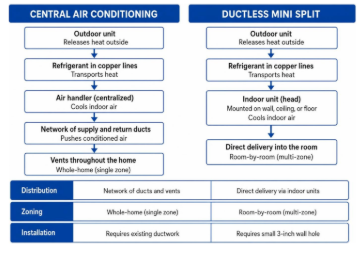
At their most fundamental level, both central air conditioning and ductless mini-split systems operate on the same principle: the refrigeration cycle. Neither system actually “creates” cold air. Instead, they use a refrigerant to absorb heat and humidity from your indoor air, transport that heat through copper lines, and release it outside. The primary difference lies in how that cooled air reaches your living spaces.
Central AC systems utilize a centralized air handler—often located in an attic, basement, or utility closet—to push conditioned air through a network of supply and return ducts. This “forced air” approach is designed to treat the entire building as a single zone. In contrast, ductless mini-split systems connect an outdoor compressor to one or more individual indoor units (often called “heads”) mounted directly on your walls, ceilings, or floors. Because there is no ductwork, the air is cooled exactly where it is needed.
Feature Central Air Conditioning Ductless Mini Split Distribution Network of ducts and vents Direct delivery via indoor units Zoning Whole-home (single zone) Room-by-room (multi-zone) Installation Requires existing ductwork Requires small 3-inch wall hole Compressor Usually on/off (single/two-stage) Variable-speed (inverter) Aesthetics Discreet, hidden in walls/ceilings Visible wall-mounted units Evaluating Ductwork Status When Choosing Home Cooling
Before selecting a system, you must assess the “arteries” of your home. If you have an existing central system, its efficiency is only as good as the ductwork itself. According to industry data, typical duct systems lose between 20% and 30% of their cooling energy through leaks, disconnected joints, or poor insulation. This is known as “thermal bypass.” If your ducts are aging or improperly sealed, you are essentially paying to cool your attic or crawlspace instead of your living room.
For homeowners in older properties, the cost of installing new ductwork can be prohibitive, often adding thousands to the total project price. In such cases, the ductless approach—which requires only a small, three-inch hole in the wall for the refrigerant lines—is far less invasive and avoids the structural disruption of tearing open ceilings or floors.
Inverter Technology and Variable-Speed Performance
One of the “secret weapons” of modern mini-split systems is inverter technology. Traditional central AC compressors typically operate in an “all or nothing” fashion; they run at full power until the thermostat is satisfied, then shut off completely. This constant cycling creates temperature swings and consumes significant energy during startup.
Mini-split systems use variable-speed compressors that modulate their output. Instead of shutting down, they “sip” just enough energy to maintain your desired temperature. By running at lower speeds for longer periods, they provide superior humidity control and consistent comfort, avoiding the “blast of cold” followed by a stagnant, humid period often associated with older central units.
Energy Efficiency, SEER2 Ratings, and Operating Costs
Efficiency is measured by the Seasonal Energy Efficiency Ratio 2 (SEER2). A higher SEER2 rating indicates a more efficient system. While high-end central AC units have made great strides, reaching ratings between 18 and 26, modern ductless mini-splits often achieve ratings of 30 to 42+.
This efficiency gap is largely attributed to the absence of duct losses. When you eliminate the 20% to 30% energy waste inherent in ductwork, you immediately gain a massive advantage in operational costs. Furthermore, because mini-splits allow for “zoning,” you can avoid cooling empty bedrooms or guest wings, focusing your energy budget only on the spaces you are currently using.
Key Factors in Choosing Home Cooling for Maximum Efficiency
When choosing home cooling, you should prioritize a professional load calculation, known as a “Manual J.” This calculation determines the exact cooling needs of your home based on square footage, insulation levels, window orientation, and local climate. An oversized system—whether central or ductless—will “short cycle,” turning on and off too frequently, which leads to poor dehumidification and premature equipment failure. Always work with a professional who evaluates your home’s specific thermal envelope rather than just guessing based on square footage.
Long-Term Operational Savings and Incentives
The long-term savings of a high-efficiency system often outweigh the initial installation price. Many homeowners qualify for federal tax credits through programs like the Inflation Reduction Act, which provides significant incentives for ENERGY STAR-certified heat pumps. Because most modern mini-splits are heat pumps, they can handle both heating and cooling, effectively replacing two aging systems with one highly efficient unit. When calculating your return on investment, be sure to account for these tax credits and potential local utility rebates, which can reduce your effective upfront cost by thousands of dollars.
Critical Factors When Choosing Home Cooling Systems
Aesthetics and comfort are subjective, but they are vital to your daily experience. Central AC is often preferred by homeowners who want an “invisible” system; the only visible components are small, discreet vents. If you value a clean, minimalist interior design, this is a major selling point.
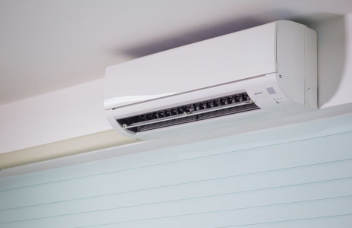
However, mini-splits have evolved. While the standard wall-mounted unit is the most common, manufacturers now offer ceiling cassettes, floor-mounted consoles, and “slim-duct” units that can be hidden in a closet or above a hallway, providing the benefits of ductless technology with a more refined look.
Zoning Control and Temperature Customization
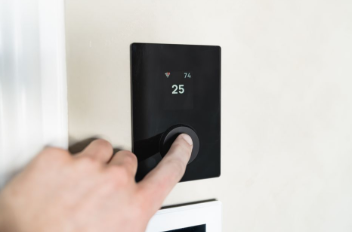
If your household suffers from “thermostat wars”—where one person is freezing while another is sweating—zoning is the solution. Central AC can be zoned using motorized dampers, but this is a complex, costly, and often finicky mechanical add-on. Mini-splits provide native zoning. Each indoor head has its own remote or wall-mounted thermostat, allowing you to set the master bedroom to a cool 68°F while keeping the home office at a comfortable 74°F.
Indoor Air Quality, Filtration, and Acoustic Performance
Central AC excels at whole-home air filtration. Because all air passes through a large central return, you can install high-MERV or HEPA filters to scrub the entire home’s air supply. Mini-splits filter air on a per-unit basis, which is excellent for localized allergen reduction but requires more frequent maintenance, as each unit’s filter must be cleaned individually.
In terms of noise, mini-splits are the clear winner. Indoor units operate at decibel levels as low as 19 to 26, which is quieter than a whisper. Central AC systems, while generally quiet, can produce a noticeable “whoosh” of air from vents and a low-frequency hum from the air handler, which some sensitive sleepers find distracting.
Installation Complexity, Maintenance, and System Lifespan
Installation disruption is a significant factor. A central AC replacement in a home with existing, well-maintained ducts is a straightforward process. However, if you are starting from scratch, the installation of ductwork is a major construction project that can take days or weeks. Mini-splits can typically be installed in a single day, as the process is limited to mounting the units and running small-diameter refrigerant lines.
Maintenance requirements differ as well. Central AC requires annual professional tune-ups and periodic filter changes. Mini-splits also require annual professional servicing to clean the blower wheels and coils, but they demand more frequent user-level maintenance—specifically, rinsing the mesh filters every two to four weeks during peak season. With proper care, both systems generally last 15 to 20 years, though premium mini-split models are known to exceed this lifespan due to their inverter-driven, low-stress operation.
Maintenance Task Central AC Ductless Mini Split Filter Cleaning Every 1-3 months Every 2-4 weeks Professional Tune-up Annually Annually Duct/Coil Cleaning Duct cleaning as needed Deep cleaning of blower wheels Best System Matches for Specific Home Layouts
- Historic Homes:Ductless is almost always the best choice to avoid cutting into original architectural features.
- Room Additions:A single-zone mini-split is the most cost-effective way to condition a sunroom, garage, or attic conversion.
- Open Floor Plans:Large, modern homes with existing ducts often find a high-efficiency central system to be the most cost-effective “whole-house” solution.
- Hybrid Configurations:Many homeowners choose to keep a central system for the main living areas while adding a mini-split to a “problem room” or home office that the central system cannot reach.
Frequently Asked Questions About Central AC and Ductless Mini Splits
Can ductless mini splits adequately heat a home during freezing winter weather?
Yes. Modern cold-climate heat pumps are designed to operate efficiently even when outdoor temperatures drop below freezing. They use a reversing valve to switch the flow of refrigerant, allowing them to extract heat from the outside air and bring it indoors. They are often significantly more efficient than traditional electric baseboard or furnace heating.
Is it possible to combine central AC and ductless units in a single home?
Absolutely. This “hybrid” approach is increasingly popular. You can maintain your central AC for the main house and install a single-zone mini-split in a new addition or a room that is consistently too hot or too cold. This allows you to solve specific comfort issues without the expense of replacing your entire central system.
How significantly does duct leakage impact real-world cooling performance?
Duct leakage is a silent efficiency killer. If your ducts are leaky, you are losing conditioned air into unconditioned spaces like attics, which forces your system to work longer and harder to reach the set temperature. This not only spikes your energy bills but also creates pressure imbalances in the home, which can pull dust, moisture, and pests from crawlspaces into your living areas.
Conclusion
Choosing between a central AC and a ductless mini-split is not about finding a “winner”; it is about finding the right tool for your specific home. If your home has well-sealed ductwork and you prefer a traditional, whole-house approach, a high-efficiency central unit is a fantastic investment. If you are dealing with an older home, an addition, or specific rooms that never seem to get comfortable, the zoning precision and efficiency of a ductless mini-split are hard to beat.
We recommend starting with a professional home comfort assessment. Have a technician evaluate the condition of your existing ducts and perform a load calculation to see which system will provide the best balance of comfort, efficiency, and long-term value for your household. By taking the time to compare these technologies, you ensure that your home remains a sanctuary regardless of what the thermometer reads outside.

