


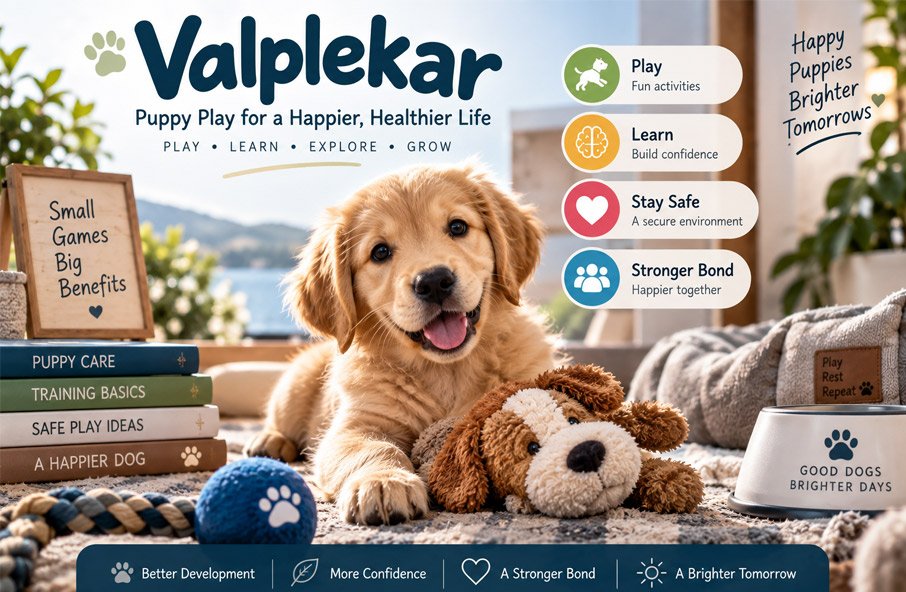
Valplekar is a Swedish term connected with puppies and play. In simple words, it means puppy play or puppy games.
People often search for Valplekar because different websites give different meanings. Some describe it as puppy training, a cultural idea, a surname, or even a place. However, the clearest meaning is connected with Swedish puppy play.
This article explains what Valplekar means, what puppy games can include, how play can support young dogs, and how owners can keep these activities safe.
What Is Valplekar?
Valplekar is best understood as a term for games and playful activities involving puppies.
It is not one particular game. A puppy can take part in Valplekar in many ways. It may chase a toy, search for a treat, carry an object, explore a room, play with its owner, or interact with another suitable dog.
The activity does not need special equipment or complicated rules.
Valplekar should also not automatically be described as a special training program, product, or puppy-development system. The available information supports a much simpler meaning: normal puppy play.
What Does Valplekar Mean in Swedish?
The meaning becomes clearer when we look at the Swedish words behind it.
Valp means puppy.
Lek means play or a game.
Lekar refers to games or forms of play.
Together, these words give Valplekar the simple meaning of puppy games or puppy play.
The word can look unusual to English-speaking readers. When written as “Valplekar” with a capital letter, it may even look like a company, brand, or person’s name.
This is one reason different meanings have appeared online. In a Swedish or puppy-related context, however, puppy play is the clearest meaning.
What Does Valplekar Look Like in Everyday Life?
Valplekar can be very simple.
A puppy may chase a suitable toy across a room. It may search for a hidden treat, carry a soft toy, follow its owner, or investigate a new object.
Other examples include gentle fetch, food puzzles, sniffing games, simple tug games, and safe exploration.
Play with another suitable dog can also be included when the interaction is safe and supervised.
Different puppies enjoy different activities. One puppy may enjoy chasing toys, while another may prefer sniffing or searching.
There is no need to make every activity difficult. Puppy play should remain enjoyable and suitable for the dog’s age, size, confidence, and development.
Why Puppy Play Is Important
Play is a normal part of a puppy’s early life.
Young dogs learn about their surroundings through movement, smell, touch, sound, and interaction.
For example, searching for a treat allows a puppy to use its nose and solve a simple problem. Playing with a toy can involve movement and coordination. Exploring a safe room can introduce new objects and surfaces.
Play can also give puppies mental stimulation. Different activities make them use their senses in different ways.
Interaction with an owner can also help a puppy become comfortable working and playing with people.
However, play is only one part of good puppy care. Puppies also need enough sleep, suitable food, basic training, safe social experiences, veterinary care, and a regular routine.
Owners should not try to keep a puppy busy every minute.
Structured and Unstructured Valplekar
Puppy play can be structured or unstructured.
Structured play has some direction from the owner.
For example, an owner may throw a toy for a short game of fetch or hide a treat for the puppy to find. A simple puzzle toy can also provide a clear activity.
Unstructured play gives the puppy more freedom.
The puppy may explore a safe room, choose between toys, carry objects, sniff around, or play without being told exactly what to do.
Both types can be useful.
Structured activities can support interaction and simple learning. Unstructured activities allow the puppy to explore naturally.
Owners do not need to control every moment. A puppy should also have opportunities to enjoy ordinary play without every activity becoming a lesson.
Valplekar and Puppy Training
Valplekar and puppy training can work together, but they are not the same thing.
Training normally has a clear goal.
For example, an owner may teach a puppy to respond to its name, come when called, sit, settle, or follow another simple cue.
Play is more flexible.
A puppy can chase a toy simply because it enjoys the activity. It does not always need to learn a specific behavior.
However, owners can sometimes include simple learning during play.
A puppy may hear its name before getting a toy. It may practise returning toward its owner during fetch. A searching game can help with attention and problem-solving.
This does not mean Valplekar is a formal Swedish training method.
There is no strong evidence showing that it is an official or branded training system with a named creator, fixed rules, certificates, or professional standards.
It is better understood as puppy play that can sometimes support learning.
Valplekar and Puppy Socialisation
Puppies can also learn through safe social experiences.
Valplekar may include play with people or suitable dogs. But good socialisation does not mean allowing a puppy to meet every dog it sees.
The quality of the experience matters more.
Before allowing puppies or dogs to play together, owners should consider their size, age, health, confidence, temperament, energy, and play style.
A very active puppy may be too much for a quiet or nervous dog.
Owners should watch the interaction instead of assuming the dogs will always manage it themselves.
Health also matters. A puppy’s vaccination status and local disease risks may affect where and when it should interact with unfamiliar dogs.
When there is any doubt about health or vaccination, advice from a veterinarian is the safer choice.
How to Tell If Puppy Play Is Going Well
Good play should allow both animals to take part willingly.
Dogs may chase each other, change direction, pause, and start playing again. They should also have opportunities to move away or take a break.
Owners should pay attention when one puppy repeatedly tries to leave.
Play may need to stop if a puppy:
- keeps trying to escape
- hides from the other dog
- looks frightened
- becomes very frustrated
- is repeatedly cornered
- becomes too excited
- cannot take a break
- loses interest in continuing
Rough play is not always dangerous, but owners should watch whether both dogs still appear comfortable.
One dog should not be forced back into play simply because the owner wants it to socialise.
Safe social play is about providing positive and manageable experiences, not meeting the largest possible number of dogs.
Indoor Valplekar Ideas
Indoor Valplekar can be simple and useful.
A puppy can search for hidden treats, play gentle fetch, carry a toy, use a food puzzle, or follow its owner around a safe room.
You can also let the puppy explore a new object or surface at its own pace.
Indoor play can be helpful when the weather is bad or when the puppy needs a calmer activity.
The play area should be safe. Avoid slippery floors, small objects, sharp items, loose wires, and anything the puppy may swallow.
Fast running in a small room may not be a good choice. Short and controlled activities are usually easier to manage.
Outdoor Valplekar Ideas
Outdoor Valplekar can give puppies new smells, sounds, surfaces, and experiences.
A puppy may sniff around, explore a safe area, walk over different surfaces, or calmly watch what is happening around it.
Short toy games can also work in a suitable place.
Outdoor play does not always need to involve running. Sniffing and exploring can also give a puppy useful mental activity.
Owners should consider the weather, temperature, traffic, ground conditions, other animals, and the puppy’s age.
Vaccination status and local disease risks are also important for young puppies. If you are unsure where your puppy can safely go, ask a veterinarian.
How to Keep Valplekar Safe
Safety should come before making a game exciting.
Before play starts, check the area for objects that may be dangerous. Remove small items, sharp objects, cables, unsafe products, and anything the puppy may chew or swallow.
Toys should also match the puppy’s size and chewing habits.
A damaged toy may break into small pieces, so it should be removed when it is no longer safe.
Supervision is especially useful when the puppy is using a new toy, exploring a new place, or playing with another dog.
Do not push a young puppy into hard physical activity. Puppies are still growing, and their needs can be very different from adult dogs.
If the puppy has pain, an injury, or another health concern, professional veterinary advice is more useful than general play tips.
Play, Exercise, and Rest
Play and exercise are connected, but they are not exactly the same.
Exercise mainly involves physical movement.
Play can include movement, but it can also involve sniffing, thinking, exploring, problem-solving, and social interaction.
For example, a puppy looking for a hidden treat may move slowly but still use its senses and attention.
Rest is just as important.
Puppies need sleep and quiet time after activity. A puppy does not need to become completely tired for a play session to be useful.
Good Valplekar should include a healthy balance of movement, mental activity, calm time, and rest.
Choosing the Right Games for Your Puppy
There is no single Valplekar game that suits every puppy.
Age, size, physical development, personality, confidence, energy, and past experiences can all affect what a puppy enjoys.
An active puppy may like short fetch games.
A curious puppy may enjoy searching and sniffing.
A nervous puppy may prefer calm exploration instead of fast or noisy games.
Watch how your puppy behaves during and after the activity.
If the puppy becomes frightened, very frustrated, too excited, or unable to settle, the game may need to be shorter or changed.
More activity is not always better.
The best game is one that matches the puppy in front of you.
Common Valplekar Mistakes
One common mistake is making play too long or too intense.
A puppy may look energetic at the start but become tired or overwhelmed later.
Another mistake is choosing the same games for every puppy. Different puppies have different needs and interests.
Unsafe toys can also create problems. Damaged toys, small parts, or unsuitable objects may become choking or swallowing risks.
Owners should also avoid rough play on slippery floors or in unsafe areas.
Forcing a puppy to play with other dogs is another problem. If the puppy wants to move away, it should be allowed to do so.
It is also unnecessary to turn every game into training.
Learning can happen during play, but puppies also need time to simply enjoy safe activities.
Is Valplekar a Formal Training Method?
There is no strong evidence that Valplekar is an official or standardized Swedish dog-training method.
A formal training system would normally have clear information about its creator, methods, rules, teaching materials, or professional standards.
That information has not been reliably established for Valplekar.
The word is better understood as being connected with puppy play.
Play can still support training. A puppy can practise attention, coming back to its owner, or following a simple cue during a game.
However, that does not make Valplekar a separate training system.
Other Meanings of Valplekar
Valplekar has appeared online with several different meanings.
These uses should not automatically be connected to each other.
Valplekar as a Surname
Valplekar can appear as a surname.
Some online sources connect the name with South Asia, especially western India.
The ending “-kar” is also found in Marathi and Konkani surnames and can sometimes have a connection with places or family origins.
However, the exact history of the Valplekar surname is not clearly confirmed.
There is not enough reliable information to state one exact village, family, caste, community, or ancestral origin.
The surname may have no connection at all with the Swedish puppy-play meaning.
Is Valplekar a Place?
Some websites have described Valplekar as a place or travel destination.
However, there is not enough strong evidence to confirm a well-known town, village, or tourist location under this name.
A real geographic claim should normally be supported by maps, government records, local authorities, postal information, or other reliable geographic sources.
A blog describing a place is not enough by itself.
For now, Valplekar should not be presented as a confirmed destination without better evidence.
Is Valplekar a Cultural Tradition?
Some online pages have also described Valplekar as an old cultural tradition.
These descriptions may mention farming, festivals, music, crafts, family customs, spirituality, marriage, or storytelling.
Such claims need strong historical or cultural evidence.
There is currently not enough reliable information to confirm Valplekar as one established cultural tradition with this history.
These claims should therefore be treated as unconfirmed.
Is Valplekar a Digital Platform?
Some pages may make Valplekar sound like a digital platform or online service.
There is no strong evidence confirming an official Valplekar software product.
No verified developer, company, app, pricing plan, subscription, technical documentation, or official feature list has been clearly established.
Because of this, supposed platform features should not be presented as facts unless an official source can confirm them.
Why Is Valplekar Appearing in Search Results?
Valplekar is an unusual word for many English-speaking readers.
When people see a word they do not know, they search for its meaning.
Websites then create articles about that search term.
As more pages appear, more people notice the word and search for it again.
This can also spread incorrect information.
One website may publish an unsupported meaning. Other websites may repeat it. After some time, the same claim can appear on many pages even if none of them has strong evidence.
This is why Valplekar now appears online with several different meanings.
Context is the best starting point. In Swedish and puppy-related content, puppy play is the clearest interpretation.
How to Find Reliable Information About Valplekar
Different claims need different types of sources.
For the Swedish meaning, dictionaries and reliable Swedish-language resources are the most useful.
For puppy play, behavior, health, exercise, and socialisation, use trusted veterinary or animal-care sources.
For surname claims, look for family records, historical documents, or reliable genealogy sources.
For location claims, check official maps, government records, and local geographic information.
For cultural claims, stronger evidence may include academic research, historical records, archives, or reliable community sources.
For a supposed digital platform, look for an official website, company information, developer details, technical documentation, pricing, or app listings.
Several blogs repeating the same information do not always count as separate proof.
Bottom Line
Valplekar is best understood as a Swedish term connected with puppy play or puppy games.
It can include simple activities such as searching, retrieving, exploring, playing with toys, interacting with owners, and suitable social play.
Valplekar is not confirmed as a formal training system.
Puppy play should be safe, age-appropriate, and suited to the individual dog. Puppies also need enough rest, sleep, care, and calm time.
Other meanings, including a surname, place, cultural tradition, or digital platform, should be kept separate unless stronger evidence supports them.
Frequently Asked Questions
What does Valplekar mean?
Valplekar is most clearly connected with Swedish words for puppies and play. In simple English, it means puppy play or puppy games.
Is Valplekar a Swedish word?
Yes. The term has a clear Swedish language connection. “Valp” means puppy, while “lek” and “lekar” relate to play and games.
What are some examples of Valplekar?
Examples include gentle fetch, treat searches, food puzzles, toy games, sniffing, exploring safe areas, and supervised play with suitable dogs.
Is Valplekar a puppy-training method?
No strong evidence shows that Valplekar is a formal or branded training method.
Puppy play can support simple learning, but Valplekar itself is better understood as puppy play.
Is Valplekar safe for puppies?
It can be safe when the game matches the puppy’s age, size, health, confidence, and development.
Use suitable toys, remove dangerous objects, supervise when needed, and give the puppy breaks.
How long should a puppy play?
There is no single play time that is right for every puppy.
Age, health, energy, and the type of activity all matter.
Stop or take a break if the puppy becomes tired, frustrated, frightened, too excited, or loses interest.
Is Valplekar also a surname?
Yes, Valplekar can appear in surname-related discussions.
Some sources connect it with South Asia, but its exact family and historical origin is not clearly confirmed.
Is Valplekar a place or digital platform?
There is not enough reliable evidence to confirm Valplekar as a recognized travel destination or established digital platform.
Those meanings should be treated carefully unless official or authoritative sources can verify them.
Explore More:

