


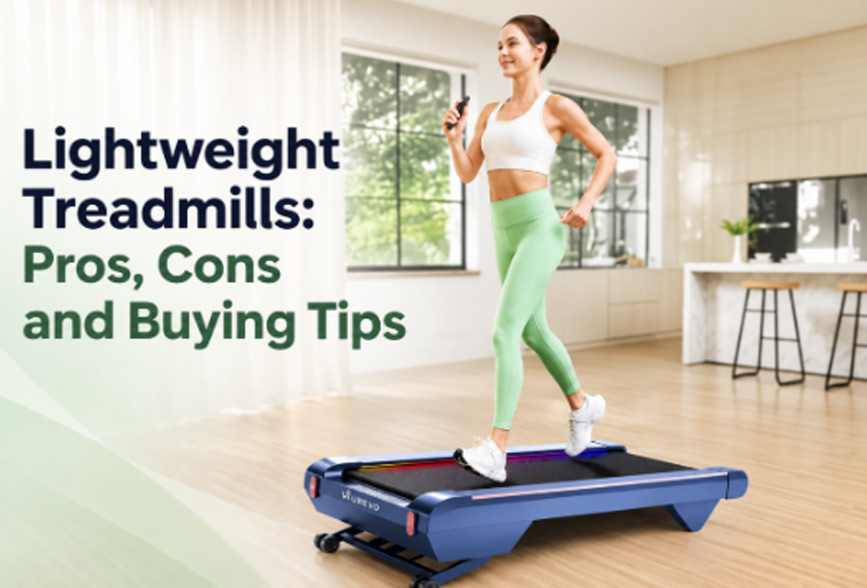
A lightweight treadmill is a treadmill designed to be easier to reposition than a conventional full-size model. It can be moved from room to room with minimal effort, which suits the growing demand for space-saving fitness equipment.
But is a lightweight treadmill right for you, or would a conventional full-size treadmill be the better option? This article breaks down the pros and cons to help you make an informed decision. It also shares practical buying tips. Read on to learn more.
Pros of Lightweight Treadmills
-
Easy to Move and Store
The most obvious advantage is portability. A full-size treadmill can be difficult to move without two or more people. A lightweight model is much easier to lift, tilt and roll to a new position. You can easily move a lightweight treadmill under a standing desk for walking during work calls and roll it in front of the TV for a more enjoyable workout.
-
Space-Saving Design
Lightweight treadmills are usually smaller in overall size, and many have a folding design. Once folded, the machine can slide under a bed or sofa, or stand against a wall. A full-size treadmill needs a permanent, dedicated space, which is hard to find in a small apartment or dormitory.
-
Quiet Operation
Compact treadmills designed for walking often operate more quietly than full-size running machines. Many lightweight treadmills run at around 35 dB, which is close to the sound of a quiet library. A full-size treadmill often reaches about 65 dB, similar to a normal conversation. This difference can matter when exercising early in the morning or during a Zoom meeting.
-
Simple Setup
A full-size treadmill may require several components to be assembled, including the console, handrails and upright frame. By comparison, many lightweight treadmills arrive largely assembled. Setup may involve little more than unpacking the machine, connecting the power cord and pairing a remote control or app.
-
Affordable Price
Lightweight treadmills generally cost less than full-size models. They use smaller motors and simpler frames, which reduces production costs. For people who want to build a walking habit without a large investment, this is a strong advantage.
Cons of Lightweight Treadmills
The same design choices that make these machines light and affordable also create limitations. Compared with a full-size treadmill, a lightweight model makes several trade-offs.
-
Limited Motor Power
Lightweight treadmills use smaller motors, usually rated for walking and brisk walking. Under heavy use, a small motor may overheat or wear out faster. A full-size treadmill is built to handle long sessions at high speed.
-
Lower Weight Capacity
Lightweight treadmills often support less weight than full-size treadmills. Still, some compact models offer surprisingly high weight limits, so this disadvantage does not apply equally to every product.
-
Smaller Running Surface
To reduce the overall footprint, manufacturers often shorten or narrow the belt. A compact belt may feel comfortable for walking but restrictive for jogging and running, particularly for taller users or people with a long stride. Smaller belts also leave less room for natural side-to-side movement.
-
Fewer Features
Lightweight treadmills may omit handrails, large displays, fans, speakers, preset programs and high incline levels. Some walking pads depend on a remote control or mobile app for operation. A simple interface can be an advantage if you only want to walk, but it may disappoint users seeking guided interval workouts or detailed performance data.
Who Should Buy a Lightweight Treadmill?
A lightweight treadmill suits people who mainly walk rather than jog or run, and who live in a space with limited room. It also works well for office use, for shared households, and for anyone who wants to stay active during the day without a large machine in the way.
It is less suitable for heavier users who may exceed the weight limit, for people who like fast running, and for those who need high-intensity training such as interval sessions or hill workouts. These users will be better served by a full-size treadmill with a stronger motor and a larger belt.
What to Look For When Buying a Lightweight Treadmill?
- Motor power. Choose motor power according to how often and how intensely you plan to use the treadmill. Walking requires less power than jogging or running.
- Weight capacity. Do not choose a model that just meets your body weight. Leave a safety margin of at least 20 to 30 percent so the motor and frame are not under constant stress.
- Running belt size. For walking, a belt around 40 inches long and 16 inches wide may be sufficient for many users. Light jogging generally requires a longer and wider surface, and jogging pace varies from person to person. Taller users should also allow extra room for their stride.
- Folding mechanism. Check whether the machine is easy to fold and unfold, and whether the locking system is secure. A loose lock can be a safety risk during storage.
- Portability. Compare the total weight of the machine, and check whether it has transport wheels. A lighter treadmill with good wheels is much easier to move.
- Noise level. Look at the decibel rating from the manufacturer, and read user reviews for real-world feedback. Sound levels often differ at higher speeds.
- Incline and speed range. Make sure the machine meets your training needs. If you plan to build fitness over time, a wider speed range and some incline will help.
- Warranty and after-sales service. A longer warranty shows the manufacturer’s confidence in the product. Pay particular attention to the coverage period for the motor and the frame, as these are the most important parts.
Which Lightweight Treadmills to Choose
If you are looking for a practical lightweight option, UREVO offers two smart treadmills worth considering.
UREVO CyberPad for Home Smart Treadmill
The UREVO CyberPad for Home Smart Treadmill is designed for compact home exercise. It measures 47.6 by 23.6 by 8.7 inches and has a 43.3-by-16.5-inch workout area. Its speed range is 0.6–4.0 mph, making it best suited to walking and brisk walking. The model weighs 70.6 pounds and supports up to 350 pounds. It also provides up to 14% incline, app connectivity and a brushless motor rated at 2.5 maximum HP.
UREVO CyberPad for Office Smart Treadmill
The UREVO CyberPad for Office Smart Treadmill is especially suitable for use with a standing desk. Its 6.3-inch-high profile, 42.9-by-22.8-inch body and open-front design help it fit into office environments. It has a 39.4-by-16.5-inch walking area, weighs 63.1 pounds and supports up to 400 pounds. The 0.6–4.0 mph speed range is appropriate for workday walking, while the automatic incline reaches 14%. It also achieves a 35 dB operating level.
| Specification | CyberPad for Home Smart Treadmill | CyberPad for Office Smart Treadmill |
| Product Dimensions | 47.6 × 23.6 × 8.7 in | 42.9 × 22.8 × 6.3 in |
| Walking Area | 43.3 × 16.5 in | 39.4 × 16.5 in |
| Product Weight | 70.6lbs/32kg | 63.1lbs/28.6kg |
| Maximum Load | 350lbs/159kg | 400lbs/181kg |
| Speed Range | 0.6–4.0 mph | 0.6–4.0 mph |
| Maximum Incline | 14% | 14% |
| Maximum Horsepower | 2.5 HP | 2.5 HP |
Conclusion
Lightweight treadmills offer clear advantages: they are easy to move and store, quiet, simple to set up and affordable. At the same time, they have limits in motor power, weight capacity, belt size and features. If your goal is regular walking or brisk walking in a limited space, a lightweight treadmill is a sensible option. By checking the key specifications, you can choose a model that fits your routine, your space and your budget.

