


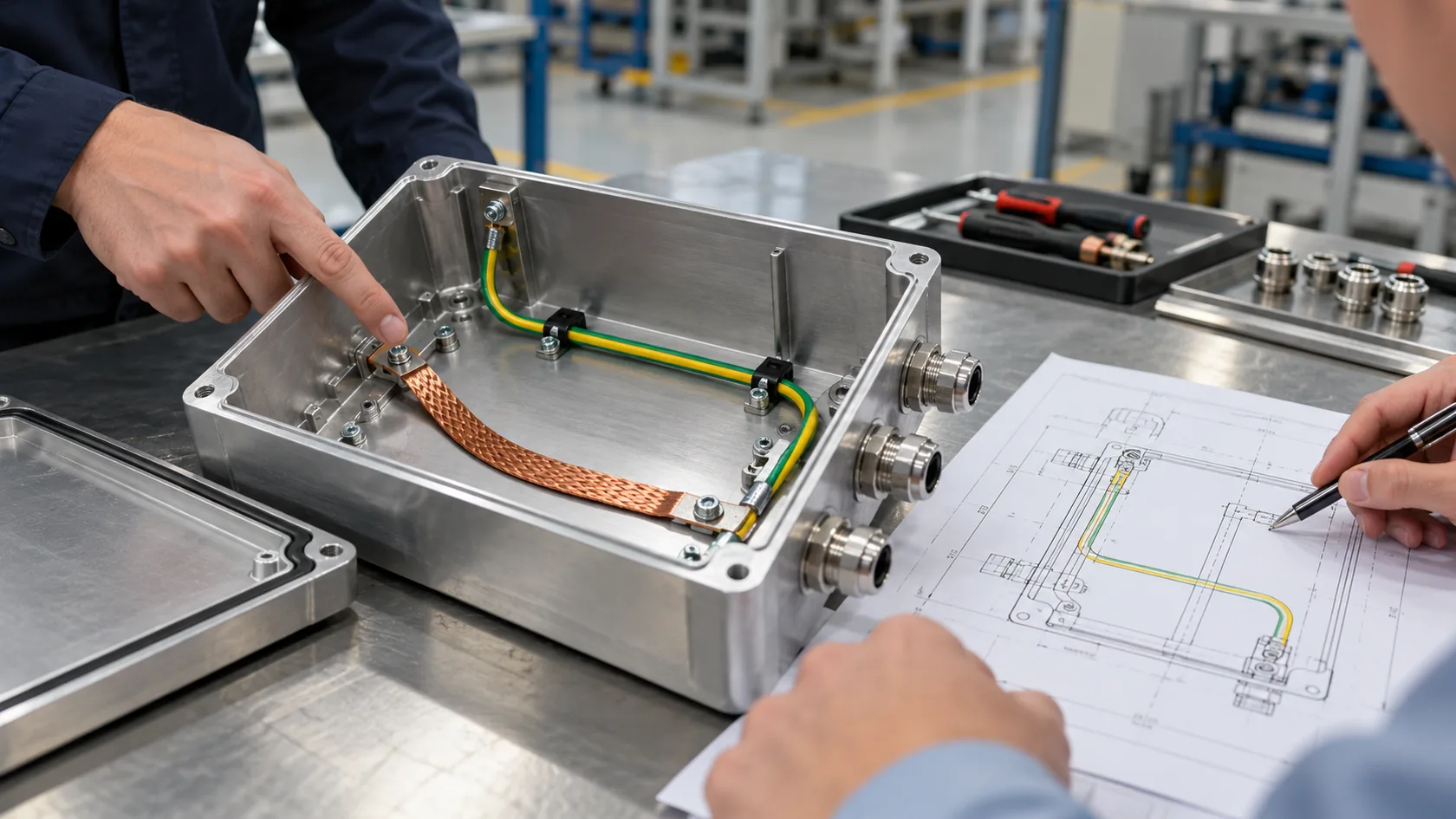
Outdoor electrical installations operate under conditions that indoor systems rarely have to contend with — sustained exposure to moisture, particulate matter, temperature swings, UV radiation, and physical impact. When electrical components fail in these environments, the consequences extend well beyond a tripped breaker. Downtime on a manufacturing line, a water treatment facility, or a communications installation can cost significantly more than the enclosure itself ever would have.
Despite this, enclosure selection is often treated as a secondary decision — something addressed late in the design process after major components have already been specified. This approach frequently leads to mismatches between the protection level chosen and the demands of the actual installation environment. The result is premature failure, costly replacements, and in some cases, safety incidents that could have been avoided with a more careful initial review.
The following sections address seven of the most consequential errors engineers make when selecting enclosures for outdoor electrical systems, and explain the reasoning behind why each one creates problems in practice.
Mistake 1: Treating IP Rating as an Absolute Rather Than a Baseline
An ip66 enclosure offers a defined and well-understood level of ingress protection — complete protection against dust and resistance to powerful water jets from any direction. This rating, defined under the International Electrotechnical Commission standard IEC 60529, tells you what a product survived under controlled test conditions. It does not tell you how it will perform across five years of a coastal industrial installation or a desert utility site.
The mistake is not in choosing this protection level — it is in treating that rating as the end of the evaluation rather than the beginning. Engineers who select an enclosure based solely on its IP classification often skip the harder questions about material compatibility, seal longevity, UV resistance, and how the product performs under sustained thermal cycling rather than a single controlled test.
Why Test Ratings Do Not Reflect Installation Reality
Laboratory testing captures performance at a specific moment under specific conditions. Outdoor installations introduce variables that accumulate over time — UV degradation of polymer seals, corrosion at cable entry points, gasket compression from repeated thermal expansion and contraction, and vibration from nearby machinery or wind. Each of these factors erodes the enclosure’s ability to maintain the protection it was rated for, and none of them appear in a standard IP rating.
Specifying an enclosure with the right rating but the wrong material for the environment is one of the most common causes of unexpected ingress failure. The rating told the engineer the enclosure could handle water jets. The environment delivered something the test was never designed to simulate.
Mistake 2: Underestimating the Role of Material Selection
Enclosures are available in a range of materials — mild steel, stainless steel, polycarbonate, GRP (glass-reinforced polyester), and various aluminium alloys. Each material carries a different set of trade-offs related to corrosion resistance, weight, impact tolerance, thermal performance, and long-term durability. Selecting the wrong material for a given environment often produces failures that the IP rating alone would never have predicted.
Matching Material to Environment, Not Just Application
A mild steel enclosure installed in a coastal or chemically active environment will begin corroding at surface scratches and fastener points regardless of its ingress protection rating. Polycarbonate enclosures offer excellent corrosion resistance but can become brittle under prolonged UV exposure if not UV-stabilised during manufacture. GRP enclosures handle chemical exposure and UV well but may not suit installations with significant physical impact risk.
The practical risk here is that material failure often develops slowly and invisibly — until it doesn’t. By the time corrosion has compromised a seal or a hairline crack has appeared in a polycarbonate housing, the internal components may have already been exposed to moisture or contaminants for some time.
Mistake 3: Ignoring Thermal Management as a Selection Criterion
Enclosures designed for outdoor use must manage not only ingress from outside but also heat generated from within. Electrical components — drives, relays, PLCs, power supplies — generate heat during operation. When that heat is contained in a sealed outdoor enclosure without adequate thermal management, internal temperatures can rise to levels that shorten component life or trigger protective shutdowns.
The Conflict Between Sealing and Ventilation
The higher the ingress protection rating, the more completely sealed the enclosure tends to be. This creates a direct tension between protection and heat dissipation. Engineers who focus entirely on the sealing performance of an enclosure sometimes neglect to assess whether the internal thermal environment will remain within acceptable limits for the equipment installed inside it.
Thermal management solutions — passive dissipation through the enclosure wall, internal fans with filtered vents, heat exchangers, or active cooling — each affect the enclosure’s ability to maintain its ingress protection. A solution that works well in one climate may be entirely inadequate in another. Outdoor enclosures in direct sunlight in warm climates absorb radiated heat in addition to internally generated heat, compounding the problem further.
Mistake 4: Overlooking Cable Entry and Gland Management
An enclosure body can be specified and installed correctly, and still fail to maintain its protection rating if cable entries are not managed with equal care. Glands, conduit entries, and knockout seals represent the most common points of ingress failure in outdoor electrical installations, and they are frequently addressed as an afterthought rather than as part of the enclosure design process.
Why Entry Points Carry Disproportionate Risk
Every cable entry is a potential breach point. The gland must form a reliable seal between the cable jacket and the enclosure wall, accounting for the cable’s outer diameter, the number of conductors, and the movement the cable may experience due to vibration or thermal cycling. Poorly specified glands, incorrect seating, or glands that have not been tightened to the manufacturer’s torque specification can all result in moisture ingress that the enclosure itself was perfectly designed to prevent.
Unused knockouts are another persistent issue. Engineers sometimes prepare enclosures for future cable additions by fitting temporary blanking plugs that are not rated to the same standard as the enclosure itself, or that are removed and not replaced during subsequent site visits.
Mistake 5: Failing to Account for the Full Mechanical Environment
Protection against dust and water receives the most attention during enclosure selection, but outdoor installations also expose enclosures to physical stress — mechanical impact, vandalism, wind load, vibration from adjacent equipment, and the stresses introduced by mounting on structures that flex or settle over time.
Structural Considerations That Affect Long-Term Seal Integrity
An enclosure mounted on a surface that flexes — a thin metal panel, a lightweight bracket, or a structure subject to wind-induced movement — may experience repeated micro-deformation of its mounting points. Over time, this can distort the enclosure body or door frame, preventing the door from sealing consistently against the gasket. The IP rating was tested on a rigid, stable installation. Real-world mounting conditions may be considerably more variable.
Similarly, enclosures in environments with sustained vibration — near compressors, generators, or heavy rotating machinery — are subject to gradual loosening of fasteners, connectors, and internal mounting hardware. None of this is reflected in an ingress protection test.
Mistake 6: Treating Gasket and Seal Condition as a One-Time Concern
The gasket is the primary barrier between the internal environment of an enclosure and the external environment. It is also one of the few components in an electrical enclosure that has a finite service life under outdoor conditions and requires periodic inspection. Engineers who treat the gasket as a permanently reliable element — rather than a wear component — often encounter ingress failures that were entirely predictable.
How Gaskets Degrade in Practice
Foam and neoprene gaskets compress over time, particularly in enclosures that are opened and closed regularly during maintenance. Each time the door is opened, the gasket partially recovers its shape. Over years of thermal cycling and compression, it loses elasticity and no longer forms a consistent seal when closed. UV exposure accelerates this process in enclosures with any amount of direct sunlight exposure.
The practical implication is that an enclosure which maintained its protection rating at installation may be performing below specification within a few years — without any visible external damage to indicate the problem. Maintenance schedules should account for gasket inspection and replacement at defined intervals, particularly in harsh environments.
Mistake 7: Specifying for the Expected Environment Rather Than the Possible One
Outdoor electrical installations are typically designed for the environment that is anticipated — the average rainfall, the typical ambient temperature, the expected dust levels. They are not always designed with adequate margin for conditions that occur less frequently but can be significantly more severe.
The Cost of Under-Specifying for Extreme Conditions
A site that experiences occasional flooding, unusually severe dust storms, or periodic chemical washdown from adjacent processes may expose an enclosure to conditions well beyond what its standard testing covered. Engineers who specify based on the typical case, without building in a margin for the atypical case, create installations that are reliable under normal conditions but vulnerable to the events that carry the greatest risk.
Building in additional protection — a higher-rated enclosure, a more corrosion-resistant material, an enclosure surround that provides additional physical protection — represents a modest cost at the specification stage. Retrofitting protection after a failure, or replacing failed equipment, consistently costs more than the margin would have.
Conclusion: Enclosure Selection Is an Engineering Decision, Not a Procurement Shortcut
The selection of an enclosure for an outdoor electrical system deserves the same rigour applied to the components it protects. Choosing an ip66 enclosure is a meaningful starting point, but it is not a complete answer. The material, the thermal management approach, the gland specification, the gasket maintenance plan, and the margin built in for environmental conditions beyond the typical all determine whether that protection level is actually maintained over the life of the installation.
Engineers who treat enclosure selection as a checklist item — confirm the IP rating, order the product, move on — are relying on the rating to do more work than it was designed to do. The result is often not immediate failure, but gradual degradation that becomes apparent at the worst possible time.
The decisions that matter most in outdoor electrical installations are not always the most visible ones. A gasket that has lost its compression, a gland that was never properly torqued, an enclosure material that was adequate for the expected environment but not the actual one — these are the details that determine whether a system operates reliably over years rather than months. Getting them right at the specification stage is consistently less expensive than correcting them afterward.

