


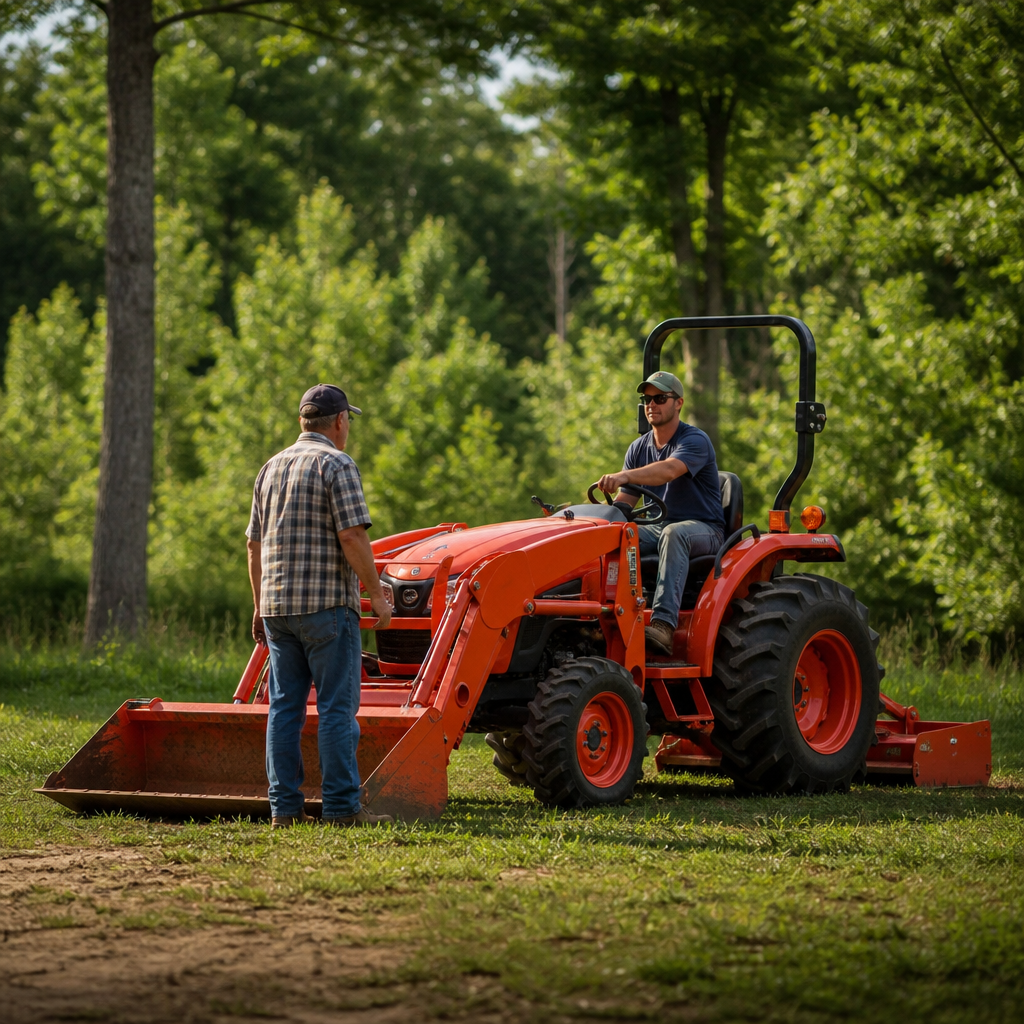
Most people buy a tractor twice. The first purchase is based on price and curb appeal, and it usually ends with a machine that strains on a hill, lifts less than the brochure implied, or sits too heavy for the lawn it was supposed to maintain. The second purchase is based on the work actually in front of them — acreage, slopes, implements, storage space — and it tends to last fifteen years. This guide is about getting to that second decision the first time, whether you own five acres outside the village or run a few hundred acres of hay ground.
Start with the implements, then pick the tractor
A tractor is a power source and a ballast weight. Everything useful hangs off the back or front of it. So list the jobs first, in order of frequency: mowing six acres of rough pasture every three weeks, moving round bales twice a day in winter, grading a quarter-mile gravel drive each spring, digging post holes occasionally. Each of those has a minimum PTO horsepower, a minimum hydraulic lift capacity, and a minimum weight requirement.
Rough rules of thumb that hold up in the field: a rotary cutter needs roughly 5 PTO horsepower per foot of cutting width in light grass and closer to 8 in heavy brush. A round bale weighing 1,200 pounds needs a loader rated well above that figure at full height, not at the pin — those numbers differ by a wide margin. A box blade only works if the tractor has enough rear weight to keep the front end planted when the blade loads up. If your implement list points at a 5-foot cutter and 1,000-pound loader lifts, you are shopping in the 25 to 35 horsepower compact range. If it points at 6-foot tools, heavy bale handling and a small square baler, you are in utility territory at 45 to 70 horsepower, and the price difference between those two categories is smaller than the frustration of being undersized.
Weight, wheelbase and the hills you actually own
Horsepower gets the attention; weight does the work. Two machines rated at 40 horsepower can differ by 1,500 pounds, and the heavier one will pull a disc, hold a slope and carry a loaded bucket far better. If your ground rolls, favor a longer wheelbase, a wider rear track and the option to add wheel weights or fluid-filled rear tires. Four-wheel drive is close to mandatory on anything that sees mud, loader work or grades. R4 industrial tires are the usual compromise for mixed use; turf tires only make sense if lawn care genuinely dominates, and agricultural bar tires only if traction in soft soil matters more than the sod.
Package deals: where they help and where they trap you
Bundled tractor-and-implement packages make sense because they are matched — the loader, cutter and box blade are sized to the machine, and the hitch and PTO specs line up without guesswork. The trap is accepting a bundle that includes a tool you will never use while leaving out the one you need weekly. Ask whether the package can be adjusted: swap a tiller for a rear blade, step the cutter up a size, add a pallet fork instead of a second bucket. A good package also tells you something about the dealer’s thinking. If the staff ask about your acreage, slopes and what you are cutting before quoting a configuration, you are in the right building.
Two specs worth confirming on paper before you sign anything: three-point hitch category (Cat 1 versus Cat 2 changes which implements fit) and whether the PTO runs at 540 or 540/1000 rpm. Also note the number of rear remote valves. Adding hydraulic remotes later is possible but rarely cheap, and a single remote limits you the moment you want a hydraulic top link or a dump trailer.
Clearing overgrown ground: the job that breaks undersized machines
Reclaiming a field that has gone to multiflora rose, saplings and briars is the single most common reason owners wish they had bought one size up. Brush work loads the driveline in surges, heats hydraulics, and punishes blades, gearboxes and slip clutches. Before taking on that kind of project, it is worth reading up on the technique and equipment involved in clearing overgrown land and managing dense vegetation, because sequence matters: walk the ground for stumps and wire, cut high on the first pass, then drop the deck on subsequent passes once you can see what you are driving over.
Parts: when genuine is the cheaper choice
Not every part needs to carry the manufacturer’s box. Shear bolts, hitch pins, hose ends and general hardware are commodity items. But there are categories where aftermarket substitution regularly costs more than it saves:
- Filters, especially hydraulic and transmission filters, where micron rating and bypass valve behavior are engineered to the machine.
- Injection and fuel system components on modern diesels, where tolerances are tight and emissions systems are sensitive to upstream problems.
- Cooling system parts, belts and seals that sit behind labor-intensive teardowns — a part that costs slightly less but lasts half as long is a bad trade when you pay to install it twice.
- Safety-related items: ROPS hardware, seat switches, PTO shields and driveline guards.
Keep a small shelf stock of what grounds you mid-season: engine oil and filters, a spare set of cutter blades and bolts, a few hydraulic hoses in the lengths you use, baler twine knotter parts if you make hay, and a tube of grease that matches your lubrication chart. In July, a two-day parts wait is a lost cutting window.
Where a dealer relationship earns its keep
The people who stay happiest with their equipment tend to buy from a place that can also service it. That means a parts counter that can pull your serial number and identify the right filter without a guessing game, technicians who have seen your model’s common failure points, and a shop willing to look at a mower deck as well as a 60-horsepower utility tractor. Across Kentucky, Tennessee and Indiana, owners weighing new and used machines, custom or pre-built Kubota tractor packages, and genuine Kubota parts often find it simpler to work with a single farm equipment dealer that handles the sale, the implement matching and the repair work — including lawn mower service at locations such as Owensboro — rather than splitting those jobs across three unrelated vendors. The practical benefit shows up years later, when a part number question gets answered in one phone call.
A seasonal service rhythm that prevents breakdowns
Spring
Change engine oil and filter, inspect the air filter rather than blowing it out aggressively, check coolant strength, grease every zerk on the loader and three-point, and inspect tires for sidewall cracking. Drain any water from the fuel filter bowl before first heavy use.
Hay season
Daily: check knotters and twine path, inspect pickup teeth, verify belt tension and tracking, and grease per the baler chart — balers want attention measured in hours, not weeks. Keep spare knives and shear bolts in the truck.
Late summer and fall
Sharpen or replace cutter blades, check gearbox oil level in rotary cutters and tillers, inspect driveline shields, and service hydraulic fluid and filters on schedule rather than by appearance — hydraulic oil looks fine long after it has stopped protecting.
Winter
Fuel stabilizer and a full tank to limit condensation, battery on a maintainer, loader cylinders retracted to protect the rods, and a written list of the repairs you postponed. Winter is when shop schedules open up, and when deferred work is cheapest to address.
Looking a few years ahead
Equipment is getting more instrumented, and maintenance decisions are increasingly being made from machine data rather than from a wall calendar. Research into predictive agriculture, including work on digital twin technology for farming systems, points toward a future where a tractor’s own sensor history flags a failing component before it strands you in a field. That technology will arrive gradually and unevenly, which makes the fundamentals more valuable, not less: buy enough weight and horsepower for the heaviest job you do regularly, match implements to the hitch and PTO you actually have, use the right filters, and keep a service record you can hand to a technician.
Do that, and the second tractor purchase never has to happen.

