


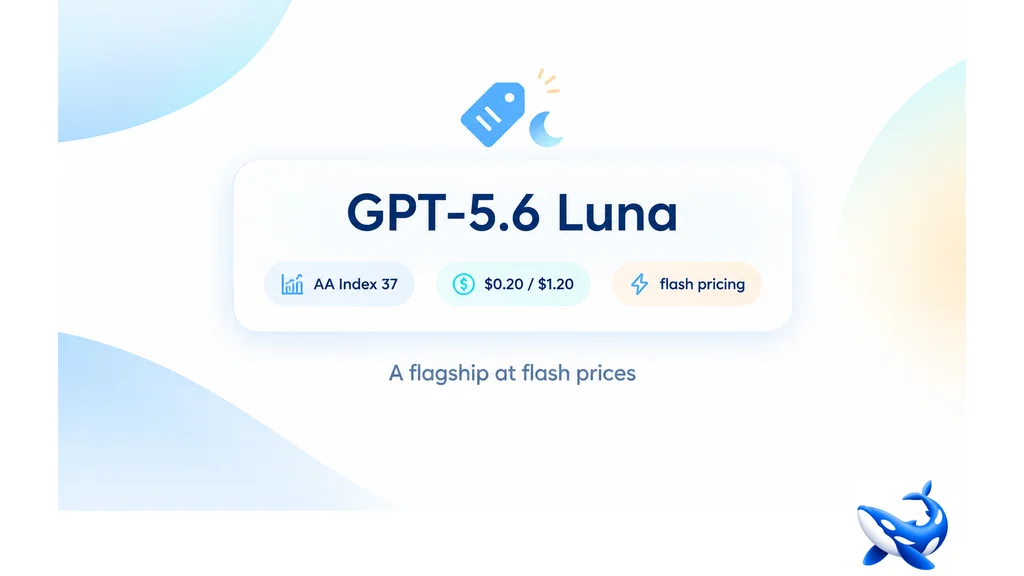
On OrcaRouter we host the GPT-5.6 Luna model — OpenAI’s 5.6 family entry point, shipped on July 9, 2026, and the most surprising card in the lineup: $0.20 per million input tokens and $1.20 per million output, a fifth of the price of its mid-tier sibling on a model with a 1.05M-token context window. Artificial Analysis scores it 37 at the max reasoning setting with a per-task cost of $0.18, and its weekly production traffic of 169.7 million tokens is the highest in the family. It is served at list price on the same key as every other OpenAI model, with the live telemetry on the linked page.
The arithmetic is worth saying out loud: the cheapest card in the family carries the most traffic. That combination is not an accident — it is the pricing strategy working exactly as designed.
The pricing trick that is not a trick
Most cheap models are cheap because they are small or because they are fast. Luna is cheap because OpenAI priced a full-context flagship at the bottom of its own price ladder. The proof is the 1.05M context window — a number usually reserved for the top of a lineup — and the measured output speed of 113.9 tokens per second on Artificial Analysis’s live page. This is not a stripped model; it is a flagship with a discount sticker.
The strategy makes sense from the vendor’s side: get the family’s name onto as many workloads as possible by making the entry card the default choice, then let usage find its way up the ladder. From the buyer’s side it means the cost question gets interesting — the same company sells a sibling at $2 / $12 for what looks like a small index premium.
The design shows in one more place: the family’s input prices step up in clean factors — $0.20, $2, $4 — while the context window stays flat at 1.05M across all three rungs. OpenAI chose to differentiate its own generation by price and reasoning tier rather than by context, which means the cheapest card is not the smallest one. A team that only needs the window gets the full 1.05M at the bottom of the ladder, and that single fact is what makes the entry card a genuine flagship rather than a teaser.
Where the family lines up
| model | context | input / output | AA index (config) | per-task cost | p50 TTFT |
| GPT-5.6 Luna | 1.05M | $0.20 / $1.20 | 37 (max) | $0.18 | 1.55 s |
| GPT-5.6 Terra | 1.05M | $2 / $12 | 42 (max) | $1.40 | 4.10 s |
| GPT-5.6 Sol | 1.05M | $4 / $20 | 47 (max) | $1.99 | 1.36 s |
Context windows and rate cards are what OpenAI lists; the index and per-task costs are Artificial Analysis’s live readings; the TTFT column is production telemetry from the linked page. The family is a ladder in everything except latency: Luna and Sol both answer fast (1.55 s and 1.36 s p50) while the mid-tier Terra sits at 4.10 s. The five-point index gap between Luna and Terra costs ten times the price — that is the trade a budget-limited team is actually making.
The per-task column is the part of the table that rewards a second glance: $0.18 for Luna against $1.40 for Terra and $1.99 for Sol. The standard task set lets each model read and write what it needs to finish the job, and Luna’s reading is the most efficient in the family — it completes the same assignment for a tenth of the mid-tier’s bill. That is the difference between a cheap rate card and a frugal model: the price is low *and* the model uses its tokens sparingly, and the two together are why the bottom rung carries the family’s traffic.
Why 169.7M tokens a week flows to the cheap card
Volume follows price when quality is good enough, and Luna’s numbers say the quality threshold is met. A measured 1.55-second first token makes it the fastest-answering model at the low end of any major lineup, and 113.9 tokens per second of output means high-volume batch work finishes in budget. Teams running classification, extraction, summarization and rewrite pipelines all discover the same thing: a full-context card at $0.20 / $1.20 removes the temptation to build two-tier architectures at all.
That is the deeper insight in the traffic number. 169.7 million tokens a week means teams are not using Luna as a fallback — they are using it as the primary endpoint, which is exactly what a cheap flagship is for. The production telemetry on the linked page is the evidence: one key, one endpoint, and the usage to prove the pricing worked.
There is a second reason volume lands on the cheap card that has nothing to do with price: migration cost. Teams already on the family’s key can add Luna as one line of configuration, run it beside their existing endpoint, and compare on their own workload before moving traffic. The measured figures on the linked page — the p50 first token, the weekly volume, the rate card — are the same kind of number the team would generate in that test, which makes the evaluation faster than it has any right to be.

Reading the traffic honestly
The seven-day window on the linked page shows 169.7 million tokens — more than every other OpenAI card we serve — at a p50 first token of 1.55 seconds. That is not a benchmark figure and not a vendor claim; it is the model’s own production record. The honest caveat that belongs next to it: the index score of 37 (max) is the lowest in its family, so Luna is not the right card for the highest-difficulty reasoning tiers. It is the right card for the enormous middle of the workload distribution where the model is good enough and the price is unbeatable.

The cost arithmetic at list price is worth keeping on hand: $0.20 / $1.20 per million tokens means a million-token batch job costs cents. Against the $4 / $20 flagship sibling, a volume workload that needs quality-over-budget reasoning will still justify the premium — but a workload that does not needs the premium justified back, every month.
The takeaway
GPT-5.6 Luna is a full-context flagship priced like a flash model: $0.20 / $1.20, a 1.05M window, a measured 1.55-second first token, and 169.7 million tokens of weekly traffic that make it the most-used card in its family. Its 37 (max) index score is honest but bottom-of-family, and its per-task cost of $0.18 on the standard task set is among the lowest in the industry. If the trade is a five-point index gap for a ten-times price drop, the market has already voted.
Start with Luna on the workload you currently run on anything more expensive. The endpoint is live at list price on the same key as your existing OpenAI models, and the linked page shows the telemetry to confirm it behaves before you commit the traffic.
Sourcing note: release date, context window and rate card are what OpenAI lists and have not been independently reproduced. The Intelligence Index score, output speed and per-task cost are from Artificial Analysis’ live model page, read 2026-10-08, and the 37 was measured at the max reasoning setting. The p50 time-to-first-token and seven-day token volume are OrcaRouter production telemetry from the linked model page. All checked 2026-10-08.

