


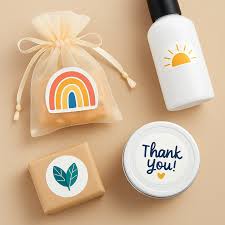
A logo that starts curling a week after launch is a small thing, but customers notice. For New York small brands selling at neighborhood markets, out of corner shops or through a storefront door that gets wiped down all the time, waterproof stickers can solve a lot of that, as long as the material, finish and adhesive match where the sticker is going to live.
This is a practical look at what separates a sticker that lasts from one that peels, plus a couple of New York rules worth checking before you print a single label.
Why Some Stickers Give Up After a Week
In many cases it comes down to three things: the face material, whether there’s a protective layer on top, and the adhesive.
Paper stickers are cheap and print beautifully. But paper can soak up water, and once it does, the ink may smear and the edges can lift or tear. That’s fine for a gift tag. It’s not fine for a bottle that goes through a sink every night.
Vinyl behaves differently. It doesn’t absorb water the way paper does, so a vinyl sticker with a laminate layer on top tends to handle splashes, scrubbing and handling a lot better. The laminate is the part people forget about, and it’s what protects the printed ink from scratches and scuffs.
Then there’s adhesive, and the wording can be confusing. Some printers describe an adhesive as permanent but removable without residue, meaning it’s built to hold firmly in normal use and come off cleanly later. That isn’t a guarantee for every case, though. How cleanly a sticker comes off can depend on the surface, how long it’s been on and what it’s been through.
No single adhesive suits every surface, either. If you sell products people keep and reuse, ask the printer which surfaces the adhesive is meant for, whether that’s glass, a particular plastic or both.
Labels on Home-Processed Food Have Their Own Rules
Food is where a sticker stops being only a branding choice. In New York, home bakers and jam makers who register under the state’s home processor exemption have specific labeling requirements, laid out in the home processing guidance from the state Department of Agriculture and Markets. The exemption covers a defined list of approved foods, such as certain baked goods and jams made from high-acid fruits, so it doesn’t describe every vendor at every market.
For registered home processors selling those approved products, the label has to show the product’s common name, an ingredient list in order of predominance by weight, the net quantity, the processor’s name and full address, and any major allergens. The guidance also says home processors should add a statement such as “Made in a Home Kitchen” in type at least 1/16 of an inch tall.
The same guidance says these items must be pre-packaged and labeled at home, and that packaging at an agricultural event like a farmers market isn’t permitted. Again, that’s a rule for home processors. Licensed food businesses, farms and other vendors may fall under different requirements, so check the category that fits your operation before you design a label.
Compliance and durability are separate questions. The state guidance covers what the label has to say, while the sticker material decides whether that text stays easy to read after a full day of handling. Small type tends to show wear early, so it makes sense to check legibility on the actual jar.
Clear Stickers on Glass and Storefront Windows
Clear stickers are printed on transparent vinyl, so only the design shows and the background disappears into the surface. On candle jars, glass bottles and shop doors, that can look a lot cleaner than a white rectangle.
Storefronts are a common use. A clear decal with your hours, logo or social handle can read well on a door without covering the whole pane the way a paper sign does.
Just don’t mix up decoration with required notices. NYC’s Department of Consumer and Worker Protection keeps a list of required signs and downloadable templates for certain business types, from pawnbrokers to tobacco retailers. If your business is on that list, the official sign may come with its own wording or size rules, so a custom window decal works alongside it, not instead of it.
Test a Few Before the Big Order
This step is easy to skip, and it’s often the cheapest one.
Whether you’re comparing printers or reordering from one you already use, such as Stickerbeat, it helps to put a few durable waterproof stickers on the actual product and live with them for a while before committing to thousands. Start with the printer’s application and care instructions, since a test that ignores them won’t tell you much.
Then put a handful through the kind of use your product sees day to day:
- A few rounds of hand washing with dish soap (bottles and tumblers)
- A dishwasher cycle, only if the printer rates that specific product as dishwasher safe
- A week of daily handling in a tote, on a commute or on a market table
- A glass jar wiped down with a damp cloth a few times
- A window decal checked after the glass gets cleaned
Look closely afterward. Corners lifting, ink scuffing, dirt collecting along the edge. Problems like these can show up within days if something is off.
Keep the limits in mind, though. A week of testing can catch an obvious mismatch, but it can’t prove how a sticker holds up over months or years. And results on one bottle won’t necessarily carry over to another, since glass, stainless steel and different plastics can each behave differently with the same adhesive.
Product ratings vary too. A printer’s regular stickers, roll labels and specialty products may come with different care guidance, so check the details for the exact item you’re ordering.
Getting the Design Right on Clear Vinyl
Clear vinyl has a quirk. Whatever sits behind the sticker shows through the design, so light colors can look washed out on a dark bottle or a busy background.
Printers handle this with a white underlay, a layer of white ink printed under the colored parts so they stay opaque. If your logo has pale tones, gradients or photos, ask about it at the proof stage.
Simple artwork tends to work better on clear stock. Bold text, a strong logo, one or two solid colors. Thin script fonts and tiny details can get lost against glass, and that goes double for anything a customer has to read, like an ingredient list.
Ask for a digital proof too, since many printers provide one before anything prints. Screens show color differently, so the proof is your best reference for the final result.
Application Habits That Help
A good sticker can still fail if it goes on wrong. A few habits make a difference:
- Clean the surface and let it dry fully before applying
- Press from the center outward to push out air bubbles
- Run a thumb firmly along the edges, since that’s where peeling often starts
- Measure the flat part of a curved bottle, not the full circumference
That last one catches people. A sticker that’s too wide for a narrow bottle can wrinkle at the sides, and no adhesive fixes a bad fit.
Before You Reorder
Keep a few stickers from each batch and write the date on the back. Six months later you’ll know which version held up and which one didn’t, and that tells you more than a spec sheet will.
Stickers are a small expense next to inventory and rent. But they’re the thing customers touch every time they pick up the product, so a little testing now can save a reprint later.

